
Some work ends with a paycheck. Some ends with clean dishes, a repaired chair, or an elderly parent settled safely for the night. Some days are spent applying for work and hearing nothing back. Christian teaching has something to say in each of those places.
The Bible treats useful labor as part of human life under God. It also confronts dishonest gain, stolen wages, and the temptation to make achievement our identity. A faithful approach to work has room for diligence, justice, ordinary service, and the limits of a human body.
GUIDED ARTICLE EXPERIENCE
What Does the Bible Teach About Work? Vocation, Integrity, and Serving Others
Read along as the narration moves through the article.
Browser narration · No stored audio or site tracking
CONTINUE GUIDED TOUR
Continue where you left off.
GUIDED TOUR COMPLETE
You have reached the end of this study.
Study record saved on this device.
GUIDED TOUR
What Does the Bible Teach About Work? Vocation, Integrity, and Serving Others
Narrator: Paranoid Prophet Recommended Voice Native device narration
Prepare to follow the article as it is narrated.
VOICE & TOUR OPTIONS
Voice & Listening
NARRATOR
Finding a narrator…
Checking the best narrator available on this device.
Restores the site recommendations available in this browser.
Our listening picks lead when available; other voices are ranked for narration. Known novelty voices are hidden. Browser-provided voices may use an online voice service.
Screen-awake support will be checked when narration starts.
Optional: improve your device voices
Listening works with the voices already available here. Your device may offer additional free voices through its own settings.
iPhone or iPad: Settings → Accessibility → Read & Speak (or Spoken Content) → Voices → English. Look for Premium or Enhanced choices, then return here.
If offered, preview Ava or Zoe for U.S. English, or Serena or Jamie for British English. An explicit Premium or Enhanced version can improve on its compact version.
Mac: System Settings → Accessibility → Read & Speak → System voice. Open the voice list to preview or download additional choices.
Windows: Settings → Accessibility → Narrator → Add natural voices. Browser availability varies; a Narrator voice may not appear on websites. Edge may also expose online Natural voices without a model download.
Android: Open Accessibility → Text-to-speech output (the location varies by device). In the preferred engine settings, look for voice data and English choices.
Download sizes vary; some enhanced voices exceed 100 MB. This website cannot install system voices, and an installed voice appears here only if your browser exposes it.
Apple voice guide · Windows voice guide · Android voice guide
CHOOSE A NARRATOR
Recommended on this device
Our listening picks: Aaron, Martha, then Daniel, when available here. Otherwise, automatic uses the highest-ranked suitable voice. Preview alternatives or save your own choice.
Preparing the guided article experience…
RESUME GUIDED TOUR?
Continue where you left off.
GUIDED TOUR COMPLETE
You have reached the end of this study.
Article Guide13 sections
The short answer: work is a place to serve God and your neighbor
Christians are called to do honest, useful work with care for the people affected by it. Paid employment matters, and so do caregiving, household responsibilities, and other forms of service. Authority brings responsibility for how others are treated. Rest matters too. Your dignity does not rise and fall with your salary, job title, health, or output.
Genesis places humanity in the garden with a task before the story of sin and its consequences. Ephesians connects honest labor with having something to share. These passages give work a purpose larger than personal advancement. Genesis 2:15; Ephesians 4:28.
Looking for a particular issue? Jump to Colossians and slavery, unemployment and disability, or integrity at work.
Faithful work this week: four questions
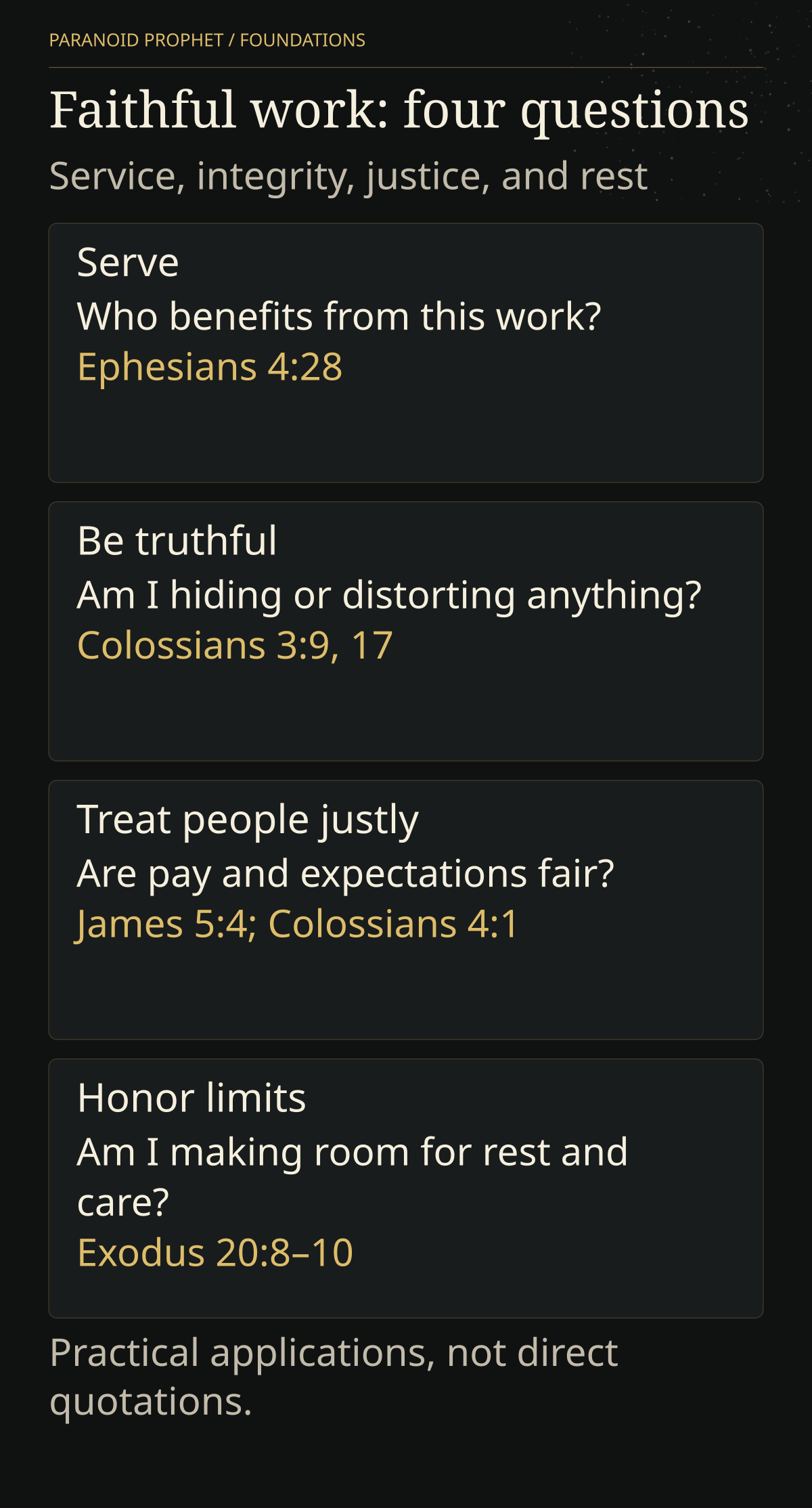
Faithful work: four questions
Service, integrity, justice, and rest
- Serve: Who benefits from this work? Consider the customer, patient, colleague, child, or neighbor on the receiving end. Ephesians 4:28.
- Be truthful: Am I hiding or distorting anything? Accurate records and honest explanations belong to Christian integrity. Colossians 3:9, 17.
- Treat people justly: Are pay and expectations fair? People with power must answer for how they use it. James 5:4; Colossians 4:1.
- Honor limits: Am I making room for rest and care? The Sabbath command includes relief for those under another person’s authority. Exodus 20:8–10.
Practical applications, not direct quotations.
PARANOID PROPHET / FOUNDATIONS
These questions are practical applications of the passages, not quotations or a complete formula for every workplace. Choose one concrete change: correct an invoice, finish a neglected repair, give a clear deadline, or ask someone to share an unsustainable care burden. Start where responsibility is actually yours.
Why work matters before anything goes wrong
In Genesis 2, tending the garden belongs to humanity’s life with God. Genesis 3 describes the frustration and painful toil that follow sin. That sequence matters. Useful activity is present before the curse; the curse makes human labor painful and resistant. Genesis 2:15; 3:17–19.
We experience both sides. There can be satisfaction in making a meal, solving a problem, or finishing a task well. There can also be exhaustion, pointless bureaucracy, unfair treatment, and work that never seems finished. Scripture gives us language for that mixture without pretending every job is fulfilling.
Human dignity comes earlier still, in the declaration that human beings bear God’s image. Someone who cannot work remains a person worthy of love, protection, and belonging. No performance review can grant or remove that standing. Genesis 1:26–27.
For Christians, service also grows out of grace. Ephesians 2:8–10 connects salvation received through faith with a life shaped by good works. Productivity cannot purchase God’s acceptance. If that distinction is unclear, begin with our guide to salvation by grace.
Vocation includes more than finding the perfect career
Vocation means calling. Christians often use the word for the responsibilities through which they serve God and other people. A career can be part of that calling, alongside family, church, friendship, and community life. Scripture does not give every believer a hidden job title they must discover before they can obey God.
Paul’s instructions to the Thessalonians include loving fellow believers, attending to their own affairs, and working with their hands. The picture is ordinary and grounded. Faithfulness can look like dependable work that receives little public attention. 1 Thessalonians 4:9–12.
When choosing a job, ask whether the work is morally sound, whether you can meet its responsibilities, what it will require of your household, and whom it will serve. Seek counsel. Learn what the actual role involves. An impressive title cannot make deceitful work good, and an unglamorous title does not make honest work insignificant.
Several options may be wise. Changing careers can be responsible, especially when circumstances or abilities change. For a fuller approach to decisions without demanding a private sign for every choice, see how to discern God’s will.
Work beyond a paycheck: caregiving and household life
Washing clothes, organizing appointments, helping someone eat, teaching a child, and maintaining a home meet real human needs. A lack of wages does not make those responsibilities imaginary. It is possible to overlook a great deal of labor simply because nobody sends an invoice for it.
Scripture takes responsibility for family care seriously. First Timothy 5 discusses care for widows and the obligations of relatives. That passage should make us attentive to people who need support and to the work of providing it. It should also prompt a church to notice who has no dependable family help. 1 Timothy 5:3–8.
Caregiving deserves more than a compliment about sacrifice. An exhausted caregiver may need respite, money, transportation, a meal, or someone to take over specific tasks. Calling the work meaningful does not make an impossible workload sustainable. Families can name the work, divide it more fairly, and ask their church or community for practical support.
The same principle applies to household work between adults. Discuss what each person is carrying, including planning and coordination. Look for an arrangement that fits real capacity and obligations rather than assuming one person can absorb everything. Receiving care is also part of human life. Dependency does not put someone outside the household of faith.

Read Colossians honestly: these verses address slavery
Colossians 3:17 speaks broadly about words and actions done in the name of Jesus. The following verses address relationships within ancient households. In 3:22–25, the audience includes enslaved people. In 4:1, the letter addresses masters. These are not simply ancient words for employees and managers. Slavery involved coercion and denied people the freedom that modern employment is supposed to protect. Colossians 3:17–4:1.
The passage instructs enslaved Christians about faithfulness within that setting. It also places masters under divine accountability and requires just and fair treatment. It does not lay out a program abolishing the institution. We should acknowledge that limitation plainly rather than rewriting the passage into a modern labor policy.
Christians have used slavery texts to defend oppression. That use must be rejected. Instructions addressed to people living under domination do not give an employer permission to threaten, exploit, or demand unquestioning obedience. Nor should a pastor tell an abused worker that staying silent is the measure of faith.
Ephesians 6:9 directly forbids masters from threatening and reminds them that God shows no favoritism. Philemon 15–16 appeals for Onesimus to be received as a beloved brother. These passages require careful reading alongside the Bible’s teaching about human dignity and love of neighbor. Ephesians 6:9; Philemon 15–16.
A responsible application today includes honest effort and accountability for those in power. It does not erase the difference between slavery and employment. Seeking safety, reporting wrongdoing through appropriate channels, or leaving an abusive job can be consistent with Christian faithfulness. Our guide to reading the Bible in context explains why the original audience matters.
Integrity when nobody is checking
Honesty often becomes concrete in small decisions: recording the hours actually worked, admitting a mistake before it becomes someone else’s problem, explaining what a product can really do, or giving a colleague credit. These habits protect people who depend on our words and work.
Imagine a repair technician discovers that a cheaper part will safely solve the customer’s problem. The shop earns more if the technician recommends a larger replacement. Christian integrity asks for a truthful explanation of the options. The customer’s lack of expertise creates a responsibility to be clear.
Diligence includes learning the job, asking questions, and completing agreed work as well as your capacity allows. It also includes admitting what you cannot safely do. Pretending competence can endanger others. Perfectionism can become its own form of self-protection when it prevents honest conversation or consumes time needed elsewhere.
A manager’s instruction does not excuse fraud or harm. When a request seems wrong, clarify what is being asked, check relevant policies, and seek qualified advice if the stakes are high. Keep appropriate factual records without taking information you are not entitled to retain. This is practical guidance, not individual legal advice.
Leadership is accountable for wages and working conditions
James 5:1–6 confronts wealthy people whose laborers have been deprived of their wages. The passage treats withheld pay as a serious moral wrong that God hears. Religious language cannot make that conduct respectable. James 5:1–6.
If you supervise people, consider how your decisions affect their lives. Pay what is owed on time. Communicate expectations clearly. Do not treat chronic understaffing as a personal failure of the workers carrying it. Give people a way to raise concerns without humiliation or retaliation. Christian leadership should be willing to hear uncomfortable facts.
Businesses face real constraints, and leaders sometimes have to make painful decisions. Honesty about those constraints matters. So do fair processes and attention to those bearing the cost. A profitable result by itself does not settle whether a decision was just.
Christian traditions have developed these themes in different ways. For example, the Catholic Catechism’s treatment of economic activity emphasizes service to persons, employers’ responsibilities, and just wages. That is one tradition’s developed account, not a claim that every Christian agrees on every economic policy. Catechism of the Catholic Church, paragraphs 2426–2434.
Unemployment, disability, and seasons of dependence
Losing a job can disrupt income, routine, confidence, and relationships at once. Disability or illness can change what a person is able to do. Retirement may bring relief alongside questions about purpose. None of these circumstances removes a person’s place in the church.
Second Thessalonians 3:6–15 addresses disorderly idleness and people who are unwilling to work. Unwillingness is different from inability. The passage is not permission to withhold food from someone who is ill, disabled, caring for another person, or unable to find employment. It also tells the community to continue doing good and to correct a fellow believer as family rather than an enemy. 2 Thessalonians 3:6–15.
The distinction matters in practice. First Thessalonians 5:14 calls for different responses to different needs: warning the idle, encouraging the disheartened, and helping the weak, with patience toward everyone. A church needs to know people well enough to offer appropriate help instead of making assumptions from an empty work schedule. 1 Thessalonians 5:14.
If you are seeking work, a manageable application plan, trusted feedback, and help from your community may be more useful than constant self-accusation. If paid work is beyond your capacity, you do not need to invent a productivity test to justify your existence. Receive help. Where you can serve, do so freely and realistically. Where you cannot, you still belong.
Healthy limits and the temptation to live for achievement
Work can become a source of identity so powerful that stopping feels like failure. Warning signs may include persistent dishonesty about your availability, treating every interruption as an enemy, or repeatedly neglecting essential care and relationships for optional gains. Circumstances differ, and a difficult season is not automatically evidence of idolatry.
The Sabbath command places limits on labor and extends rest to servants, foreigners, and animals within Israel’s household life. Christians disagree about how Sabbath observance applies under the new covenant. Those differences deserve care, but none makes unlimited extraction from other people a virtue. Exodus 20:8–11. See should Christians keep the Sabbath? for the fuller discussion.
A nurse on rotating shifts, a parent caring for a newborn, and a business owner in an emergency will have different possibilities. Seek realistic patterns of recovery and shared responsibility. If someone has little control over a punishing schedule, the response should include practical support and concern for working conditions.
Faithful work does not guarantee promotion, wealth, or protection from unfair treatment. Christian hope rests in Christ, beyond what a career can deliver. Ordinary service matters even when its results are hidden, unfinished, or quickly forgotten by others.
Common questions about Christians and work
Is church work more valuable than an ordinary job?
Church ministry has important responsibilities, but honest work outside a church can also serve real needs and honor God. The ethical character of the work and the way people are treated matter more than whether the employer is religious. A church workplace also needs accountability.
Can I leave a job without failing my calling?
Yes. A job change may be wise because of safety, family responsibilities, health, opportunity, or the nature of the work. Consider your commitments and practical consequences, seek counsel, and make an honest transition where possible. Christian faith does not bind you permanently to an employer.
Does working for God mean accepting every extra task?
No. Responsible service requires truthful commitments and attention to competing duties. You may need to explain your capacity, ask which task takes priority, or decline work you cannot safely complete. Other people benefit from clear limits as well as willing effort.
A next step worth taking
Think about the work already in front of you. Who depends on it? Where does honesty need attention? Who is carrying too much? Pick one faithful action you can take today, and one burden you need help carrying. Bring both to God in prayer.
Christian growth reaches into ordinary responsibilities. That slow formation of habits and desires is part of sanctification. The next place to practice may be a workshop, a kitchen, a hospital room, or an application form.
Scripture and source notes
Scripture references link to the New International Version for reading in context. Biblical teaching is summarized in the author’s own words; practical examples and the four-question guide are applications, not additional biblical commands. The Catholic Catechism is identified as a representative tradition-specific primary source. This article offers Christian reflection, not individualized employment, legal, or medical advice.