
The appointment is over, but the questions follow you home. A chair at the table is empty. Someone you trusted has done real harm. You keep doing the ordinary things because they need doing, even while the life you expected feels far away.
Christian faith has something to say in that place. Scripture gives us language for grief, reasons to trust Christ, and responsibilities toward people who hurt. It does not give us permission to explain every tragedy with a confident guess about what God must be doing.
GUIDED ARTICLE EXPERIENCE
Suffering and Christian Hope: Trusting God When Life Hurts
Read along as the narration moves through the article.
Browser narration · No stored audio or site tracking
CONTINUE GUIDED TOUR
Continue where you left off.
GUIDED TOUR COMPLETE
You have reached the end of this study.
Study record saved on this device.
GUIDED TOUR
Suffering and Christian Hope: Trusting God When Life Hurts
Narrator: Paranoid Prophet Recommended Voice Native device narration
Prepare to follow the article as it is narrated.
VOICE & TOUR OPTIONS
Voice & Listening
NARRATOR
Finding a narrator…
Checking the best narrator available on this device.
Restores the site recommendations available in this browser.
Our listening picks lead when available; other voices are ranked for narration. Known novelty voices are hidden. Browser-provided voices may use an online voice service.
Screen-awake support will be checked when narration starts.
Optional: improve your device voices
Listening works with the voices already available here. Your device may offer additional free voices through its own settings.
iPhone or iPad: Settings → Accessibility → Read & Speak (or Spoken Content) → Voices → English. Look for Premium or Enhanced choices, then return here.
If offered, preview Ava or Zoe for U.S. English, or Serena or Jamie for British English. An explicit Premium or Enhanced version can improve on its compact version.
Mac: System Settings → Accessibility → Read & Speak → System voice. Open the voice list to preview or download additional choices.
Windows: Settings → Accessibility → Narrator → Add natural voices. Browser availability varies; a Narrator voice may not appear on websites. Edge may also expose online Natural voices without a model download.
Android: Open Accessibility → Text-to-speech output (the location varies by device). In the preferred engine settings, look for voice data and English choices.
Download sizes vary; some enhanced voices exceed 100 MB. This website cannot install system voices, and an installed voice appears here only if your browser exposes it.
Apple voice guide · Windows voice guide · Android voice guide
CHOOSE A NARRATOR
Recommended on this device
Our listening picks: Aaron, Martha, then Daniel, when available here. Otherwise, automatic uses the highest-ranked suitable voice. Preview alternatives or save your own choice.
Preparing the guided article experience…
RESUME GUIDED TOUR?
Continue where you left off.
GUIDED TOUR COMPLETE
You have reached the end of this study.
Article Guide12 sections
What Does Christianity Say About Suffering?
Christian hope rests on the crucified and risen Jesus. It allows us to grieve honestly, seek help, oppose evil, and trust that suffering and death will not have the final word. Belonging to Christ does not promise an easy life or a recovery timetable.
If you need something practical first, go to What Can You Do When You Are Hurting?. If you are supporting someone else, go to How Can Christians Help Someone Who Is Suffering?. For a passage that is often used too quickly, see What Does Romans 8:28 Actually Promise?.
This guide focuses on living with suffering and caring for one another. It does not attempt a complete philosophical defense of God’s existence or settle every Christian disagreement about providence. It asks what Scripture gives us to hold, say, and do when pain is already here.
What Can You Do When You Are Hurting?
You do not have to solve the meaning of your suffering before taking the next helpful step. Start with the need in front of you.
- Tell one trustworthy person what is happening. Be specific if you can: you need company, help making an appointment, a meal, childcare, or someone to listen without giving advice.
- Seek appropriate care. Prayer and pastoral support can accompany medical care, counseling, practical assistance, and protection from harm. A spiritual explanation should never be used to delay urgently needed help.
- Use a short, honest prayer. You can say, “Lord, this hurts. I do not know what to do. Help me receive help today.” You do not need eloquence to begin.
- Choose a manageable portion of Scripture. Psalm 13, John 11:17–44, or Romans 8:18–27 may be enough for one sitting. Read the surrounding passage rather than demanding that one isolated sentence immediately change how you feel.
- Accept limits for today. Rest, food, an ordinary task, and a conversation may be the next faithful steps. Recovery and grief do not proceed on a schedule established by other people’s expectations.
If someone is abusing, threatening, or exploiting you, seek safety and appropriate outside assistance. Christian teaching about patience and forgiveness does not require giving a harmful person continued access to you. A church leader should not use your desire to obey God to obstruct protection or accountability.
These suggestions are practical applications, not a prescribed spiritual treatment. For ongoing distress that affects daily life, a qualified clinician can help alongside trustworthy pastoral care. Needing that support is not proof of spiritual failure.
Does Suffering Mean God Is Punishing You?
The Bible recognizes that actions can have painful consequences. It also refuses the claim that the person who suffers most must be the person who sinned most.
In John 9:1–7, the disciples ask whether a man’s blindness was caused by his sin or his parents’ sin. Jesus rejects their proposed explanation and turns toward the man’s need. We should be careful about making someone’s disability, illness, or loss into evidence for an accusation Jesus did not authorize.
In Luke 13:1–5, Jesus rejects the assumption that people killed by violence or a collapsing tower were worse sinners than others. He calls His hearers to repentance, but He does not permit them to rank the victims’ guilt by the severity of their deaths.
Job’s friends repeatedly try to fit his suffering into a moral explanation they believe they understand. The book ultimately rebukes their speech about God. Its ending should make us cautious about borrowing their certainty while imagining we are offering comfort. Read Job 42:7–9.
There are biblical accounts of judgment, and Hebrews 12:5–11 speaks about God’s fatherly discipline. Neither gives us a universal diagnostic method for explaining another person’s cancer, bereavement, depression, or financial crisis. We can examine our own conduct honestly without inventing hidden guilt to explain every hardship.
Our guide to sin explores the difference between genuine moral responsibility and shame imposed without warrant.
Is It Faithful to Grieve, Question, and Lament?
Yes. Biblical prayer includes complaint, tears, bewilderment, and requests for relief.
Psalm 13 begins with repeated questions about how long the psalmist must wait. It moves from distress toward trust and praise. That movement can teach us how to pray, but it should not become a rule that every hurting person must reach a cheerful conclusion before the conversation ends.
Psalm 88 ends without the resolution many readers expect. Its anguish is still addressed to God. Scripture preserves that prayer rather than editing it into a more comfortable testimony.
Lament brings suffering into the relationship with God. It can name loss, ask why, request rescue, and appeal to His character. It does not require pretending that every thought formed in distress is a complete or final description of reality. You can bring a question honestly without claiming that you already know its answer.
A person may cry and trust Christ in the same hour. Another may feel emotionally numb. Neither response, by itself, measures the depth of faith. Our prayer guide offers further help with confession, lament, and unanswered prayer.
Where Is Jesus in Human Suffering?
The Gospels show Jesus encountering grief directly. He does not remain a distant observer of wounded lives.
In John 11:17–44, Jesus meets Martha and Mary after Lazarus has died. He speaks of resurrection and life, and He weeps. His knowledge of what He is about to do does not make their sorrow beneath His attention. The passage gives Christian hope a deeply personal center: the one who raises the dead also meets people in their grief.
Hebrews 4:14–16 presents Jesus as our great high priest, able to sympathize with human weakness and yet without sin. The invitation is to approach God for mercy and grace. We do not need to make ourselves impressive before asking for help.
The cross also prevents us from treating innocence and suffering as incompatible. Jesus suffers unjustly. Christian proclamation holds that His death deals with sin and His resurrection defeats death’s claim to be the end of His story. For that fuller explanation, read What Is the Gospel?.
Christ’s suffering does not make every abusive situation something we should preserve. Matthew 10:23 includes permission to flee persecution. Faithfulness can involve endurance, escape, testimony, resistance to wrongdoing, or accepting protection, depending on the circumstances. No human authority has permission to demand harm as proof of your devotion.
What Does Romans 8:28 Actually Promise?
Romans 8:18–39 places hope alongside creation’s suffering, believers’ waiting, and the Spirit’s help in weakness. Verse 28 belongs inside that argument.
Paul addresses this promise to those who love God and are called according to His purpose. The promised good is connected in the following verse to being conformed to the Son. Paul looks toward God’s completed saving purpose. He does not promise that every loss will lead to a visible benefit, a better job, a healed body, or an explanation we can recognize this year.
Christians differ over how to explain God’s providence and human freedom. The passage does not authorize us to identify the hidden purpose of a particular tragedy. When someone has just received devastating news, telling them exactly why God allowed it can add a burden that the text never gave us authority to impose.
You can trust God’s purpose while calling cruelty evil. You can hope for redemption while asking that present suffering stop. The chapter itself gives room for weakness and waiting.
Does God Promise You Will Never Face More Than You Can Handle?
That familiar reassurance can make overwhelmed people feel they have failed a test they should have passed.
First Corinthians 10:12–14 addresses temptation and God’s faithfulness amid it. It should not be expanded into a promise that every bereavement, injury, or crisis will stay within our independent emotional capacity.
Paul describes an experience of severe affliction that exceeded his own ability to endure in 2 Corinthians 1:3–11. His account points toward reliance on God, the prayers of others, and comfort received and shared. It does not commend self-sufficiency.
A person who says, “I cannot carry this alone,” may be recognizing something true. The appropriate response is help, rather than an argument about whether a faithful Christian should need it.
What If You Pray and the Suffering Continues?
Scripture encourages prayer for help. It also records faithful people who do not receive the outcome they request.
In 2 Corinthians 12:7–10, Paul repeatedly asks for his thorn to be removed. He receives an assurance of sufficient grace rather than the removal he requested. The passage does not identify the thorn precisely enough for us to diagnose it with confidence, and it should not become an instruction to stop seeking treatment for our own conditions.
Christians differ about healing practices, spiritual gifts, and how particular promises apply now. We can pray for healing without promising it will occur on our timetable. We should never tell someone that a continuing illness proves they prayed incorrectly, failed to donate enough, or lacked sufficient faith.
Growth can occur during hardship, but we should not demand a lesson from someone whose wound is still open. Sanctification concerns God’s work throughout Christian life. It gives us no permission to judge a sufferer by how quickly they produce a story of personal improvement.
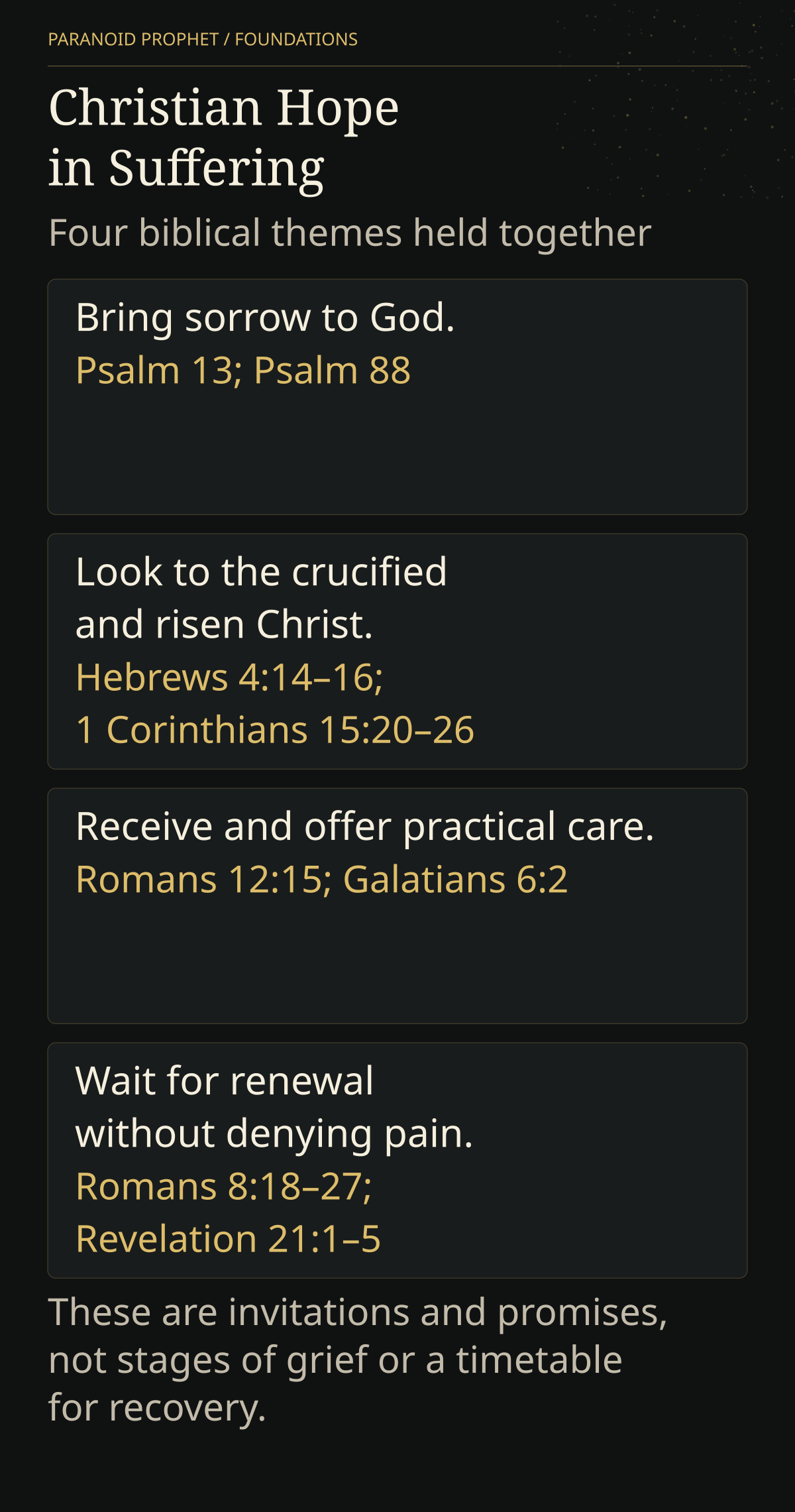
Christian Hope in Suffering (image text)
Four biblical themes held together
- Bring sorrow to God.
Psalm 13; Psalm 88 - Look to the crucified
and risen Christ.
Hebrews 4:14–16;
1 Corinthians 15:20–26 - Receive and offer practical care.
Romans 12:15; Galatians 6:2 - Wait for renewal
without denying pain.
Romans 8:18–27;
Revelation 21:1–5
These are invitations and promises, not stages of grief or a timetable for recovery.
PARANOID PROPHET / FOUNDATIONS
What Makes Christian Hope More Than Positive Thinking?
Christian hope makes a claim about what God has done in Christ and what He will complete. Its foundation is not the expectation that circumstances always improve soon.
First Corinthians 15:20–26 connects the resurrection of Christ with the future resurrection of those who belong to Him. Death is described as an enemy to be destroyed. Christian hope therefore has room to oppose death and mourn its damage, even while expecting its defeat.
Revelation 21:1–5 depicts God dwelling with His people and the end of death, mourning, crying, and pain. Christians debate details of the events surrounding that future, but the text’s picture of renewal is not a command to become indifferent to suffering now.
A promise that tears will be wiped away acknowledges that tears have been shed. Hope can sustain care for a sick neighbor, work for justice, and patient companionship with someone grieving. It should never become an excuse to look away.

How Can Christians Help Someone Who Is Suffering?
Often the most useful beginning is smaller than a speech. Listen. Ask what would help. Follow through on something concrete.
Romans 12:15 calls Christians to share others’ joy and sorrow. Galatians 6:2 calls believers to carry one another’s burdens. These responsibilities become visible through ordinary acts of care.
Instead of saying, “Let me know if you need anything,” you might offer a meal on a particular day, a ride to an appointment, or an hour of company. Ask permission before arranging help, sharing someone’s story, or making their situation public as a prayer request. Compassion respects privacy and agency.
Avoid explanations you cannot know: that the loss happened to teach a specific lesson, that a loved one’s death was necessary for someone else’s growth, or that recovery would come if faith were stronger. You can admit that you do not know why this happened and still stay present.
Keep checking in after the immediate attention fades. Remember that the person may want ordinary conversation as well as space for grief. Do not make every visit a test of whether they are improving.
A healthy church community should help people receive support without forcing them to disclose every detail publicly. When specialized care is needed, wise pastoral care can help someone reach it instead of competing with it.
Can You Grieve and Still Have Hope?
Paul’s encouragement in 1 Thessalonians 4:13–18 addresses believers worried about those who have died. His answer rests on Jesus’ death and resurrection. He distinguishes grief shaped by hope from grief without that hope; he does not prohibit grief.
You may understand a Christian promise intellectually and still feel the ache of an empty place. Familiar dates, ordinary objects, and unexpected moments can reopen sorrow. The continued presence of grief does not, by itself, prove that you have rejected the resurrection.
You do not have to know the reason for every wound before turning toward Christ. You can ask for relief, receive help, tell the truth about what hurts, and take the next responsible step. Christian hope gives us reason to do those things while waiting for a restoration we cannot yet see.
Scripture and Further Reading
The biblical teaching above is chiefly paraphrased, with passage links opening the NIV. Read the passages in context, including their original audiences and purposes. Practical care suggestions are pastoral applications rather than diagnoses or guarantees.
Continue with How Should Christians Pray?, Who Is the Holy Spirit?, or How to Read the Bible in Context. If hardship has become entangled with fears about belonging to Christ, Can a Christian Be Sure of Salvation? addresses that question separately.