


You can be grateful for your life and still ache over what is missing. A necessary bill goes unpaid. A prayer seems unanswered. Someone else reaches the milestone you hoped would be yours by now. Being told to feel satisfied can sound like being told to stop telling the truth.
Christian contentment makes room for that truth. It is the learned practice of trusting God’s care while living faithfully with what you have today. It loosens the grip of envy and fear without requiring you to abandon worthwhile goals, deny hardship, or remain in danger.
GUIDED ARTICLE EXPERIENCE
What Is Christian Contentment? Learning to Trust God Today
Read along as the narration moves through the article.
Browser narration · No stored audio or site tracking
CONTINUE GUIDED TOUR
Continue where you left off.
GUIDED TOUR COMPLETE
You have reached the end of this study.
Study record saved on this device.
GUIDED TOUR
What Is Christian Contentment? Learning to Trust God Today
Narrator: Paranoid Prophet Recommended Voice Native device narration
Prepare to follow the article as it is narrated.
VOICE & TOUR OPTIONS
Voice & Listening
NARRATOR
Finding a narrator…
Checking the best narrator available on this device.
Restores the site recommendations available in this browser.
Our listening picks lead when available; other voices are ranked for narration. Known novelty voices are hidden. Browser-provided voices may use an online voice service.
Screen-awake support will be checked when narration starts.
Optional: improve your device voices
Listening works with the voices already available here. Your device may offer additional free voices through its own settings.
iPhone or iPad: Settings → Accessibility → Read & Speak (or Spoken Content) → Voices → English. Look for Premium or Enhanced choices, then return here.
If offered, preview Ava or Zoe for U.S. English, or Serena or Jamie for British English. An explicit Premium or Enhanced version can improve on its compact version.
Mac: System Settings → Accessibility → Read & Speak → System voice. Open the voice list to preview or download additional choices.
Windows: Settings → Accessibility → Narrator → Add natural voices. Browser availability varies; a Narrator voice may not appear on websites. Edge may also expose online Natural voices without a model download.
Android: Open Accessibility → Text-to-speech output (the location varies by device). In the preferred engine settings, look for voice data and English choices.
Download sizes vary; some enhanced voices exceed 100 MB. This website cannot install system voices, and an installed voice appears here only if your browser exposes it.
Apple voice guide · Windows voice guide · Android voice guide
CHOOSE A NARRATOR
Recommended on this device
Our listening picks: Aaron, Martha, then Daniel, when available here. Otherwise, automatic uses the highest-ranked suitable voice. Preview alternatives or save your own choice.
Preparing the guided article experience…
RESUME GUIDED TOUR?
Continue where you left off.
GUIDED TOUR COMPLETE
You have reached the end of this study.
Article Guide8 sections
What contentment means
Christian contentment grows from belonging to God. It asks where we place our deepest confidence when circumstances remain uncertain. A person can enjoy good things, work for improvement, and admit disappointment while learning that their worth and hope do not depend on securing every desired outcome.
This is difficult because comparison makes ordinary life feel like a contest. A home becomes inadequate after seeing someone else’s renovation. Meaningful work starts to seem embarrassing beside a friend’s promotion. A quiet weekend feels empty when everyone else’s photographs suggest something remarkable is happening.
Sometimes the comparison uncovers a legitimate need. You may need better pay, companionship, rest, or a safer place to live. Sometimes it creates a demand that keeps moving. Each achievement briefly relieves the pressure before another person becomes the standard. Contentment helps us examine that difference honestly.
Ask two questions: What good am I actually seeking? What am I expecting that good to prove about me? Wanting reliable transportation is reasonable. Expecting a particular car to establish your importance places a burden on the purchase that it cannot carry.
You do not need to shame yourself for noticing a desire. Bring it into prayer, examine it patiently, and consider what faithfulness would look like if the answer takes longer than you hoped. Learning contentment often begins with that small pause between wanting something and letting the desire direct your decisions.
Philippians 4 in context
In Philippians 4:10–20, Paul thanks the Philippians for their material support. He has experienced both shortage and abundance. His ability to remain faithful through either condition comes from Christ’s strength. He also welcomes their help and praises their generosity.
That setting governs the meaning of Philippians 4:13. Paul is describing Christ’s enabling strength amid changing circumstances, including hunger and need. The verse does not guarantee victory in every competition, admission to a desired school, business success, or the fulfillment of any goal attached to religious confidence.
Using the verse as a guarantee of achievement can leave a disappointed Christian with a painful conclusion: perhaps Christ failed, or perhaps their faith was too weak. The passage gives us a more durable hope. Christ sustains his people through circumstances they would never have chosen, even when the hoped-for outcome does not arrive.
Notice also that Paul describes contentment as something learned. There is room for growth. A hard afternoon, a jealous thought, or a frightened response to bad news does not establish that you have no faith. It identifies a place where you need help, practice, and grace.
For example, after a rejection you might pray, “Lord, I wanted this opportunity. Help me face the disappointment without treating it as the final verdict on my life.” You can then ask for feedback, consider another opening, and let a trusted person know you are hurting. None of those actions contradicts dependence on Christ.
The chapter also prevents us from turning contentment into isolation. Paul’s gratitude for practical assistance shows that accepting help belongs within a faithful life. If a friend offers groceries during unemployment, receiving them is compatible with trusting God. A congregation should not quote contentment verses as a substitute for responding to a member’s actual need.
Paul’s assurance about God’s provision in verse 19 belongs within this relationship of generous partnership and dependence on God. It is not a financial formula promising that a donation will produce a larger payment. We should resist any appeal that uses it to pressure vulnerable people into giving money they need for basic responsibilities.
Money and enough
First Timothy 6:6–19 connects godliness with contentment, warns against destructive eagerness for wealth, and calls wealthy believers to generosity rather than pride. Money’s power to shape our trust receives close attention. Possessions are temporary, and wealth is uncertain.
The warning concerns the love of money. It does not teach that every purchase is sinful or that every financially comfortable person is unfaithful. The same passage directs those with resources toward good works and sharing. Having something available to give can become an opportunity for love. Our guide to biblical giving explores that responsibility further.
Contentment therefore includes decisions about both spending and keeping. We can chase status through visible purchases, but we can also seek absolute security through endless accumulation. Wisdom plans for needs and responsibilities. Fear can insist that no amount will ever be enough to permit generosity, rest, or trust.
Consider a purchase that is attracting your attention. Can you afford it without neglecting obligations? Will it serve a genuine purpose or bring appropriate enjoyment? Are you buying mainly to escape the feeling of being behind? Would waiting a week help you answer more clearly?
These questions are tools for discernment, not a universal spending rule. Families have different needs, resources, and seasons. A necessary expense for one household may be optional for another. Comparing budgets can become another form of comparison if we use our own circumstances to judge everyone else.
Material hardship deserves particular care here. Someone worried about food or housing does not primarily need a lecture about being satisfied with less. They need practical support and respectful attention. Contentment is something Christians learn together while taking real needs seriously.
God’s presence when circumstances stay uncertain
Hebrews 13:5–6 places contentment alongside freedom from the love of money and grounds it in God’s faithful presence. The foundation is personal: God does not abandon his people. The passage directs confidence toward his help rather than toward possessions.
That assurance does not promise a painless life. It gives Christians a reason to face a painful one without treating themselves as forgotten. You may still need to make difficult calls, explain a financial problem, or wait for news. God’s presence does not make those tasks imaginary or effortless.
A useful prayer can be specific: “God, I am afraid about next month. Help me see the next responsibility clearly, receive the help available, and remember that uncertainty does not mean you have left.” Honest language is often more useful than trying to sound composed.
Gratitude can accompany that prayer. Name one concrete gift without forcing it to cancel your concern: a person who answered the phone, enough food for today, a peaceful hour, or the ability to ask for help. Gratitude becomes healthier when it notices reality instead of arguing against grief. Our article on suffering and Christian hope considers that honest hope in more depth.
Change and safety
Contentment leaves room for action. You can pursue a better job, seek medical care, challenge unfair treatment, repair a relationship, or work toward a safer living situation. Trusting God does not require refusing the ordinary means of care and change available to you.
A helpful distinction concerns what is driving the action. Are you trying to meet a responsibility, protect someone, develop a gift, or address a real problem? Or has a particular outcome become the condition you place on your worth, your ability to love others, or your willingness to trust God?
Motives are often mixed. You do not have to achieve perfect inner clarity before taking a responsible step. Seek wise counsel, do what is necessary, and continue bringing your motives before God. Contentment can grow while you are filling out an application or attending an appointment. Read more about what the Bible teaches about work for a broader view of faithful effort.
No one should use this teaching to demand acceptance of abuse, coercion, threats, or exploitation. A person causing harm does not gain the right to control you by telling you to be grateful. Seeking safety, setting boundaries, and involving appropriate professional or emergency help can be faithful responses.
Likewise, contentment should never become an excuse for someone else’s indifference. If you have the ability and responsibility to help, telling a struggling person to trust God does not remove your own responsibility. Christian care needs hands, time, resources, and honest attention as well as encouraging words.

A practical example
Imagine Daniel, whose hours have been reduced at work. He opens his phone after checking the household bills and sees a friend’s vacation photographs. Within minutes, concern about rent has become resentment about his whole life.
His first step is to separate the actual problem from the comparison. The reduced income needs attention. His friend’s holiday did not create that problem, and the photographs reveal very little about the friend’s full circumstances. Daniel can acknowledge envy without pretending his financial concern is trivial.
Next, he describes the need plainly: “We have less income than expected, and I am afraid we will fall behind.” He reviews the bills with his spouse, identifies what is urgent, and asks his employer about available hours. If necessary, he contacts suitable assistance services and a trusted church leader about immediate support.
He also makes a modest change to the comparison habit. For the next few evenings, he leaves social media alone while reviewing finances. This is a practical boundary, not a claim that everyone who posts holiday pictures is doing something wrong.
Then Daniel brings both the need and the resentment to God. He asks for provision, wisdom, and freedom to wish his friend well. He thanks God for the people willing to help. He keeps looking for suitable work without interpreting every unanswered application as evidence that he has been abandoned.
A week later, the income problem may remain. Contentment’s progress might be visible in smaller ways: Daniel has asked for help, stopped blaming his friend, and taken the next responsible step. His circumstances are unresolved, but comparison no longer controls every response to them.
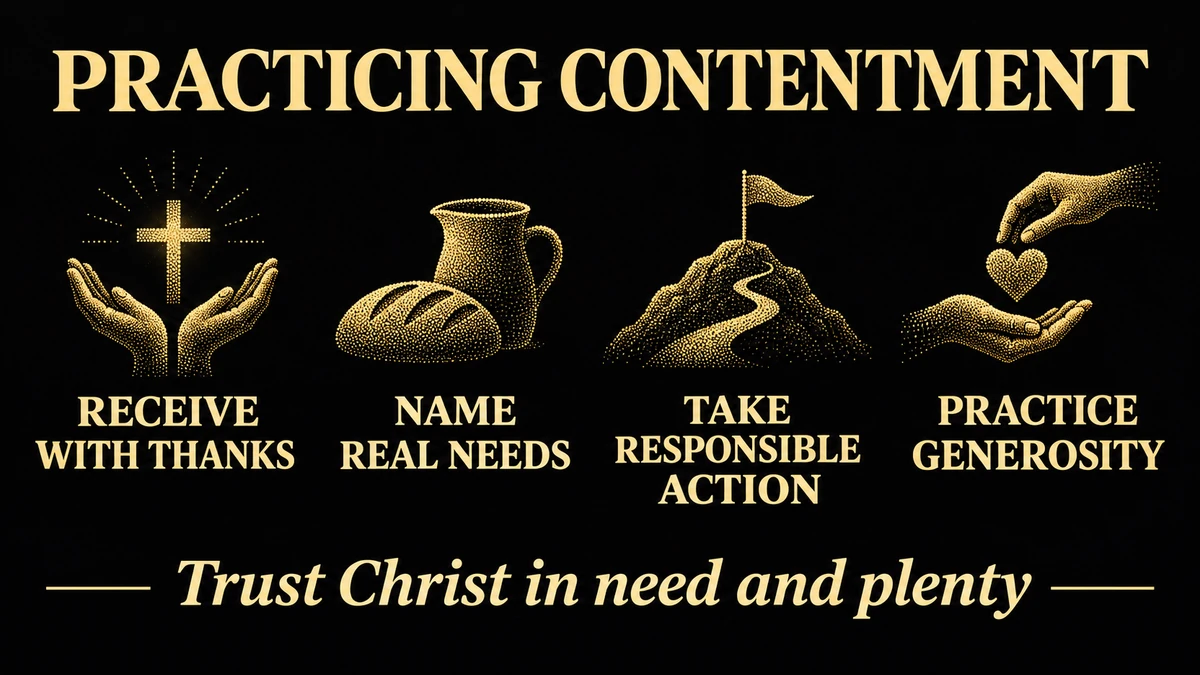
Practicing contentment: receive with thanks; name real needs; take responsible action; practice generosity. Trust Christ in need and plenty.
A small practice for this week
Receive with thanks. Name real needs. Take responsible action. Practice generosity. These four practices give a simple shape to the week. Choose one recurring source of dissatisfaction rather than trying to reform your entire life at once. Write down the actual need or desire in a sentence. Then describe what is within your responsibility today and what you cannot currently control.
Pray over both. Take one proportionate action, such as making a call, arranging a conversation, updating a budget, or resting after necessary work. Notice one gift already present. If comparison is repeatedly distorting your judgment, place a reasonable limit on the situation that feeds it.
At the end of the week, ask whether you became more honest, more willing to receive help, or less controlled by envy. These questions are more useful than demanding uninterrupted happiness. Contentment develops through repeated dependence, including the days when that dependence feels awkward and unfinished.
Questions
Can I be content and still want something to change?
Yes. A desire for healing, meaningful work, companionship, or improved circumstances can be legitimate. Contentment concerns how you trust God and respond today while pursuing those goods. It does not require pretending that every present circumstance is good.
Does Philippians 4:13 mean I can achieve anything?
In context, Paul describes strength to face both abundance and need. Applying the verse as a guarantee of any chosen achievement overlooks the surrounding passage. Christ’s sustaining strength remains relevant when a goal is disappointed as well as when it succeeds.
Is sadness evidence that I lack contentment?
Sadness alone does not establish that. Grief and disappointment deserve honesty and care. You can trust God while crying, seeking support, or wishing the situation were different. Persistent distress may also call for qualified support alongside pastoral care.
Must I stop being ambitious?
You can work diligently and develop your abilities. Examine whether your goals serve good responsibilities and whether you are willing to pursue them honestly. Ambition becomes destructive when success excuses harm or becomes the only basis on which you believe your life matters.
Where should I begin?
Read Philippians 4:10–20 as a whole. Name one pressure you are facing, ask Christ for strength to respond faithfully, and take one responsible next step. If you need help, ask someone trustworthy. Contentment is learned in real life, with real needs and real support.