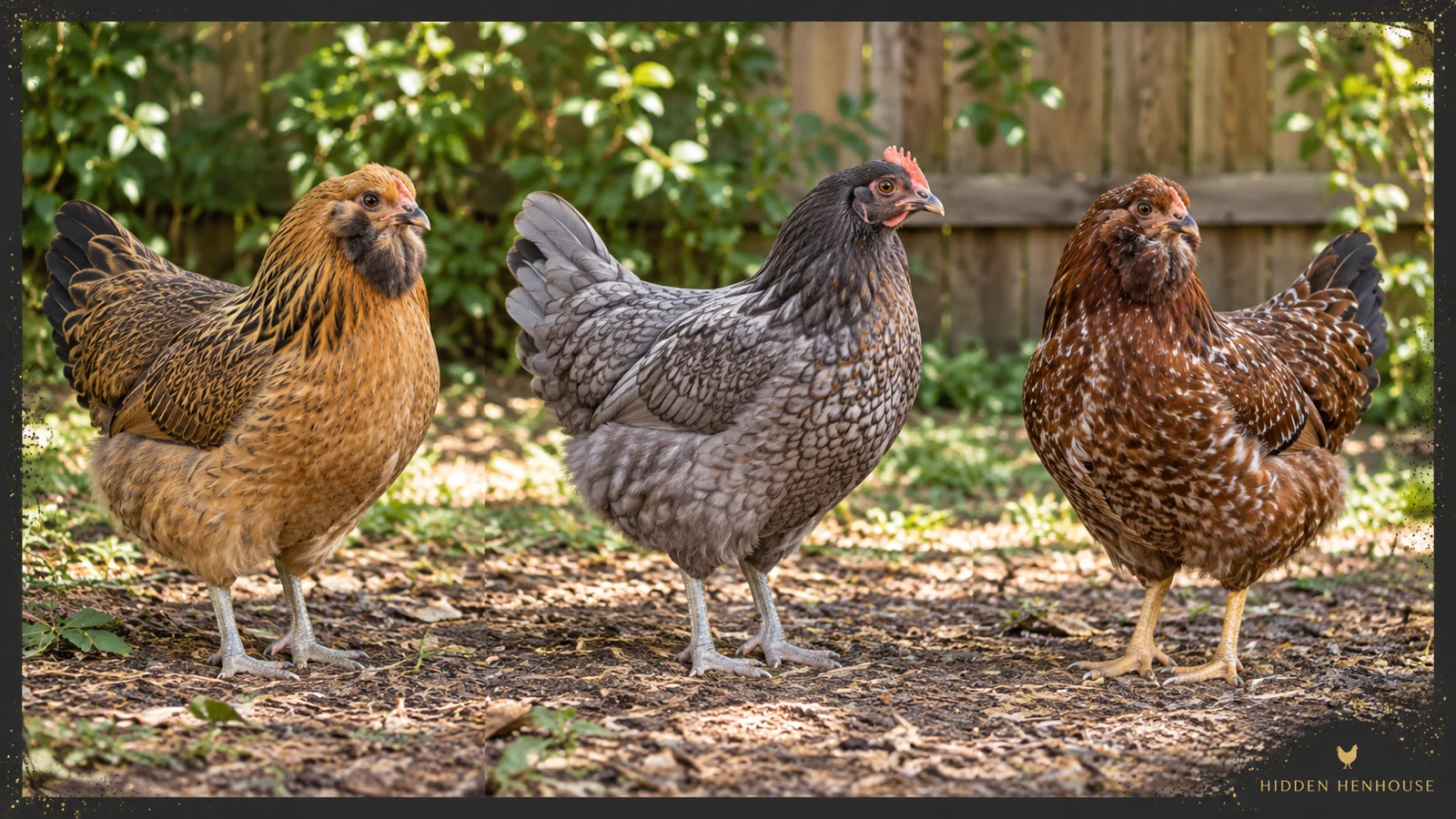

An Easter Egger is popular because of colorful eggs and variety.
The first thing to understand is that Easter Egger is not a standardized chicken breed.
The Ameraucana Breeders Club defines an Easter Egger as a chicken that possesses the blue-egg gene but does not fully meet the recognized Ameraucana or Araucana breed/approved-variety requirements.
That is why one Easter Egger can look and behave very differently from another.
Updated October 6, 2026. Breed and husbandry sources checked for this remaster.
GUIDED ARTICLE EXPERIENCE
Easter Egger Chicken: Egg Colors, Ameraucana Differences & What to Expect
Read along as the narration moves through the article.
Private device narration · No hosted audio or tracking
CONTINUE GUIDED TOUR
Continue where you left off.
GUIDED TOUR COMPLETE
You have reached the end of this study.
Study record saved on this device.
GUIDED TOUR
Easter Egger Chicken: Egg Colors, Ameraucana Differences & What to Expect
Narrator: Paranoid Prophet Recommended Voice Native device narration
Prepare to follow the article as it is narrated.
VOICE & TOUR OPTIONS
Voice & Listening
NARRATOR
Finding a narrator…
Checking the best narrator available on this device.
Restores the best curated narrator available on this device.
Narrator choices are curated for clear, long-form listening on this device.
Screen-awake support will be checked when narration starts.
CHOOSE A NARRATOR
Curated for this device
Choose a verified narrator for this browser, or use System Narrator. Automatic mode uses the best reliable route exposed by this device; your chosen narrator is preserved even if this device needs a temporary fallback.
Preparing the guided article experience…
RESUME GUIDED TOUR?
Continue where you left off.
GUIDED TOUR COMPLETE
You have reached the end of this study.
Article Guide14 sections
Easter Egger quick facts
| Trait | Practical answer |
|---|---|
| Identity | Nonstandard category, not an APA breed |
| Defining link | Possesses blue-egg genetics but does not fully meet a recognized breed/variety standard |
| Appearance | Highly variable |
| Egg color | Blue shell genetics may appear blue or, when combined with brown shell-pigment genetics, green-toned |
| Egg production | No responsible universal annual number |
| Adult size | Depends on ancestry |
| Temperament | Depends on ancestry and line |
| Comb / muffs | Not guaranteed |
| Climate | No universal category-wide profile |
| Best fit | Keepers comfortable buying a variable bird rather than a standardized breed |
Easter Egger vs Ameraucana vs Araucana
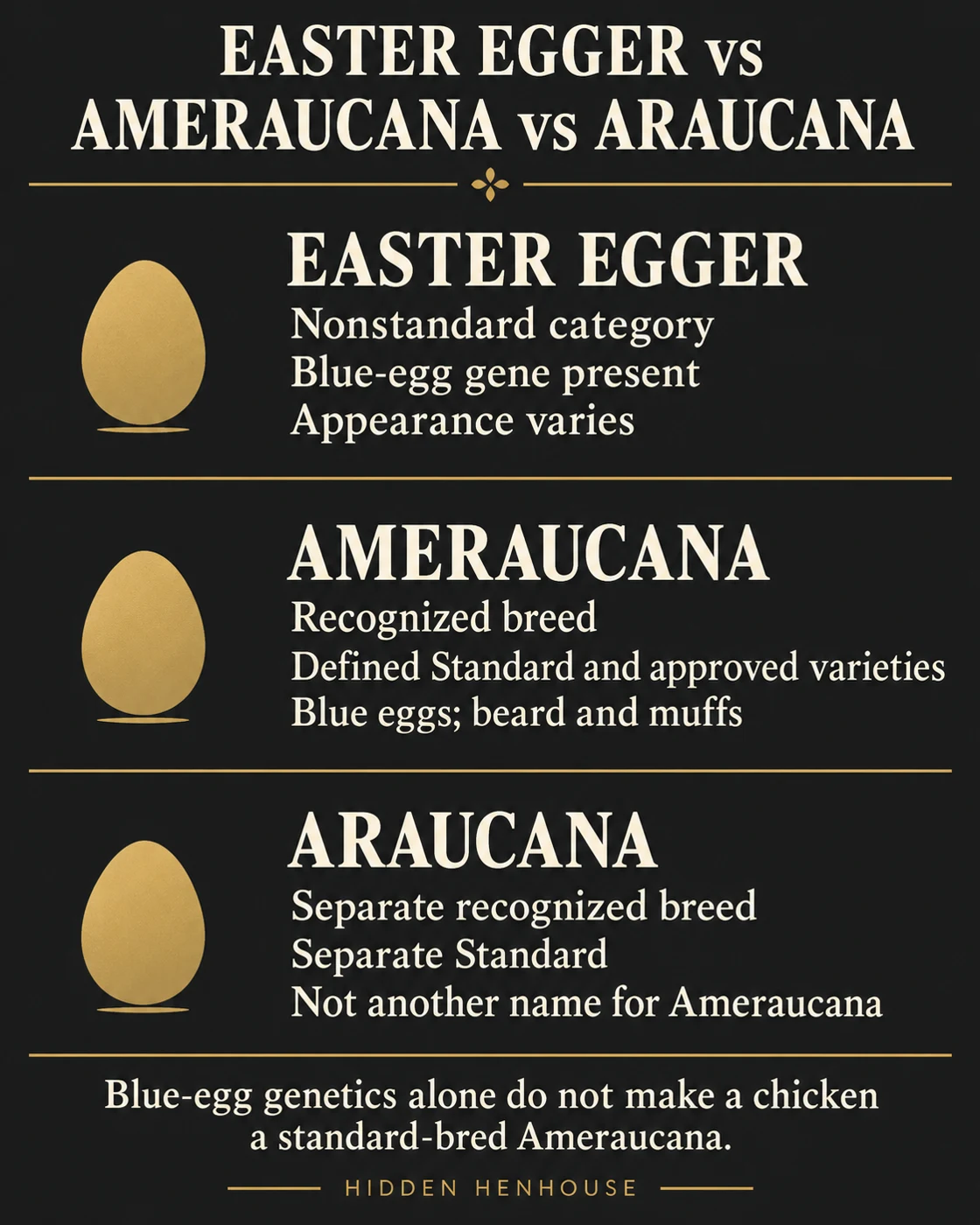
These names should not be used interchangeably.
Ameraucana
Ameraucana is a recognized breed with a written Standard, approved color varieties, blue eggs, pea comb, beard/muffs and other breed requirements.
Araucana
Araucana is a separate recognized breed with its own Standard and different defining traits.
Easter Egger
Easter Egger is the catch-all/nonstandard category for birds carrying blue-egg genetics that do not fully meet those recognized breed and variety standards.
Possessing a blue-egg gene alone does not make a chicken an Ameraucana.
That distinction protects buyers from paying standard-bred prices for birds that are not being bred to a recognized Standard.
Why Easter Eggers vary so much
A standardized breed narrows expected:
- body shape
- weight
- comb
- plumage
- skin/leg traits
- egg shell color
- breeding consistency
Easter Eggers do not have one official Standard doing that job.
So depending on ancestry, an Easter Egger may have:
- muffs or a clean face
- pea comb or another comb type
- many plumage colors
- different body sizes
- different activity levels
- different laying rates
That variability is not a defect if you want a colorful backyard flock.
It becomes a problem only when the bird is marketed as though all Easter Eggers share one predictable breed profile.
What egg colors can Easter Eggers lay?
The reason Easter Eggers exist as a category is the presence of blue-egg genetics.
Blue shell genetics can interact with brown shell-pigment genetics to produce green shades. The Ameraucana Breeders Club specifically notes that green eggs are blue shells with a brown tint or coating.
That is why Easter Egger flocks may produce eggs that appear:
- blue
- blue-green
- green
- olive or muted green in some genetic combinations
Do not assume every bird sold under the Easter Egger name has the same shell-color genetics.
The most useful buying question is:
What colors are the hens in this specific breeding line actually laying?
One hen also does not lay a rotating rainbow simply because she is an Easter Egger. Her genetics determine the shell color she produces.
How many eggs do Easter Eggers lay?
There is no single authoritative annual number for the category.
That is exactly what you would expect from a nonstandard population with mixed ancestry.
A category-wide annual egg total creates false precision.
A particular hatchery can report production for its own line. That number should stay attached to that line rather than becoming a universal Easter Egger fact.
If egg quantity matters, ask the supplier:
- what parent stock is used
- what annual output they observe
- how strongly the line is selected for production
Temperament cannot be standardized either
Promises that every Easter Egger is docile, playful, kid-friendly and non-aggressive go beyond what the category tells you.
The category is too genetically variable for those promises.
An individual Easter Egger may be calm and people-oriented.
Another line may be more active or wary.
Treat the actual supplier line and individual behavior as more useful information than a generic breed chart.
For families, supervision and poultry hygiene remain required regardless of the bird’s reputation.
Climate claims need the same caution
Not every Easter Egger has the same:
- comb
- body size
- feather density
- ancestry
So “highly adaptable in every climate” is not a responsible category-wide claim.
If a supplier’s birds consistently have small pea combs, that may change frostbite exposure compared with a large single-comb line. But do not assume every Easter Egger has a pea comb.
Use actual bird anatomy plus the site’s Winterizing guidance and University of Minnesota Extension’s heat-stress guidance.
Broodiness is line-dependent
There is no one broodiness profile for Easter Eggers.
Some hens may brood. Others may rarely show the behavior.
If natural hatching matters, ask the breeder whether broodiness is common in that line.
If a hen actually begins persistent nesting behavior, use the site’s Broody Hen Behavior guide instead of relying on a category stereotype.
Main drawbacks
An Easter Egger may be a poor fit if:
- you want a standardized show breed
- you want predictable adult appearance
- you need a precise annual egg-production expectation
- you want guaranteed blue rather than potentially variable blue/green-toned eggs
- you want known mature size before purchase
- you expect one temperament profile across suppliers
The variability that makes Easter Eggers fun is also their main limitation.
Who should choose Easter Eggers?
Consider them if you want:
- colorful-egg genetics
- visual variety
- a backyard flock where standard exhibition type is not the goal
- the fun of more variable birds
- willingness to ask the supplier about the actual line
Choose a standard-bred Ameraucana instead if recognized breed type, known physical traits and true breeding are important to you.
Use Best Chicken Breeds for Beginners to compare priorities and How Many Chickens Should You Start With? to plan a manageable flock.
What to ask before buying
- Are these Easter Eggers or standard-bred Ameraucanas?
- What parent stock created this line?
- What shell colors are the adult hens actually laying?
- What adult weights do you see?
- What comb types are common?
- What is the line’s observed egg production?
- What are adult birds like temperamentally?
- Does the seller breed toward any consistent physical type, or primarily for egg color?
Easter Egger FAQ
Is Easter Egger a breed?
No. It is a nonstandard category rather than an APA-recognized breed.
Is an Easter Egger the same as an Ameraucana?
No. Ameraucana is a standardized recognized breed. Easter Egger does not fully meet that breed/variety Standard.
Do Easter Eggers lay blue eggs?
They carry blue-egg genetics, but other shell-color genetics can alter the visible shade. Ask about the specific line.
Do Easter Eggers lay a different color every day?
No. An individual hen’s genetics determine her shell-color type. A mixed flock can create a colorful carton, but one hen is not a daily rainbow machine.
Are Easter Eggers friendly?
Some are. The category is too genetically variable for one universal temperament promise.
Are they cold hardy?
There is no one category-wide climate profile because comb, body type and ancestry vary.
The label should tell you less than the bird
Easter Eggers are a good reminder that chicken names can be marketing shorthand rather than standardized biology.
Good stewardship means knowing what the label does and does not tell you, then asking the breeder about the actual birds you are bringing home.