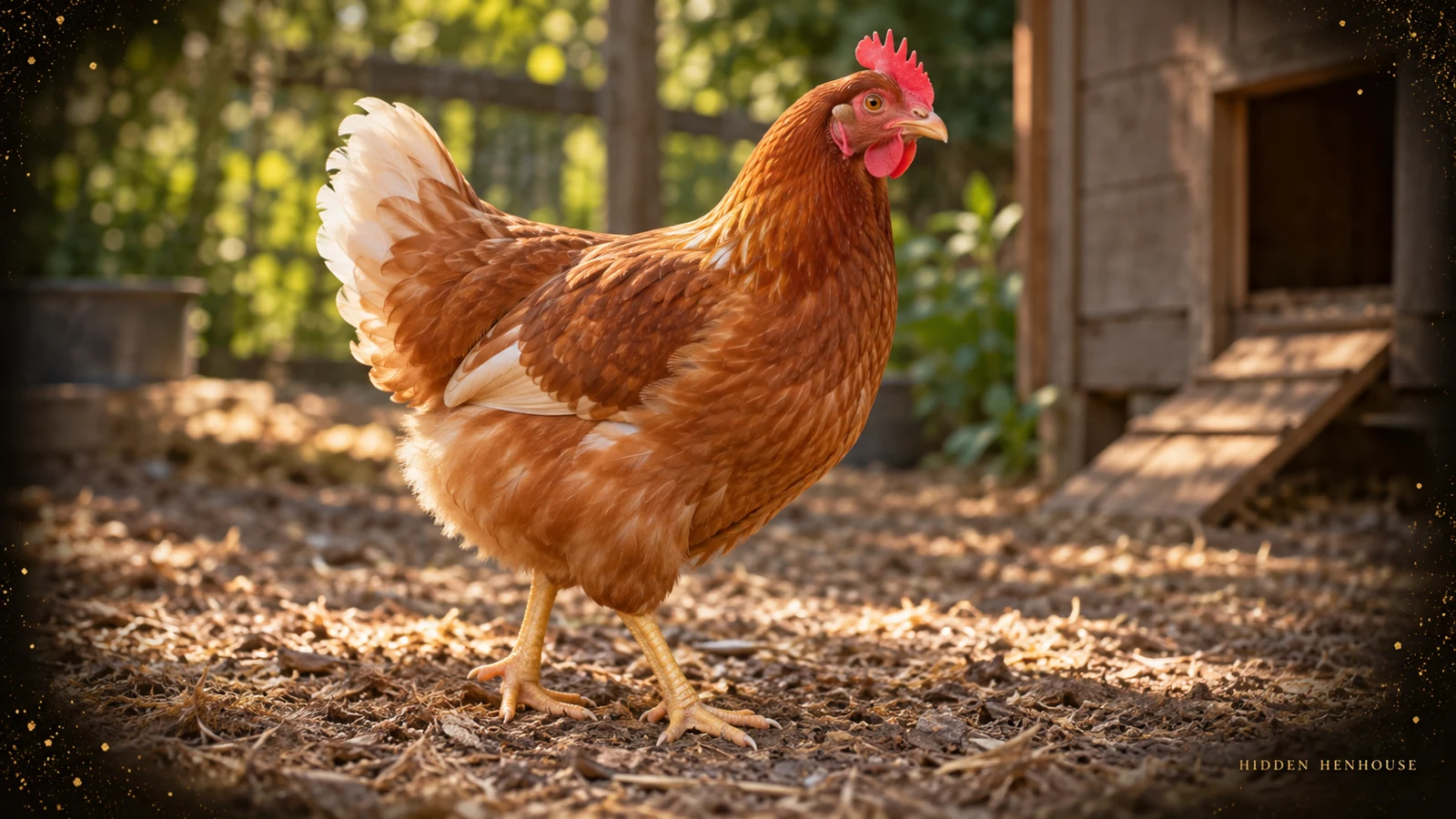

“Golden Comet” sounds like a breed name.
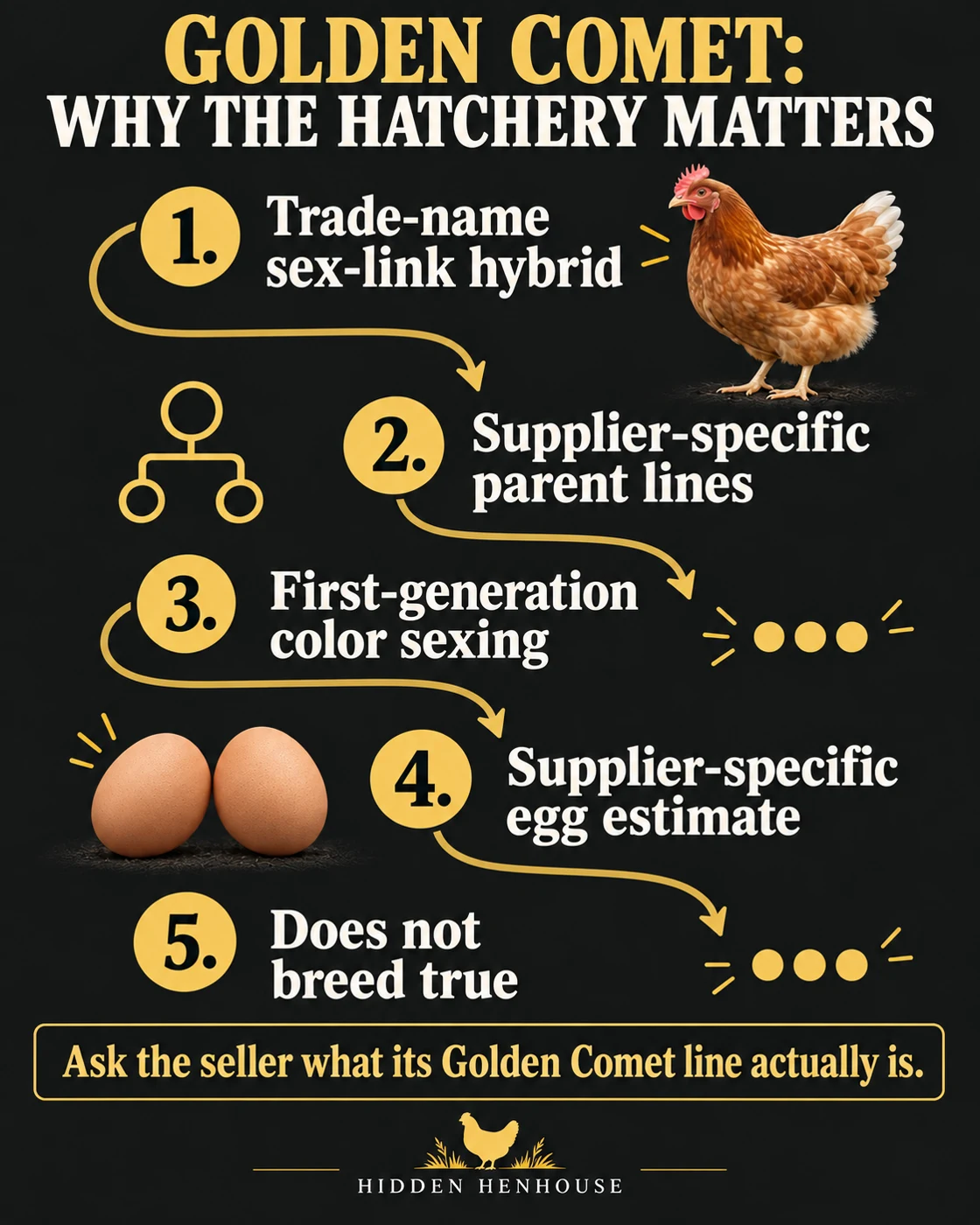
For a buyer, the more useful way to think about it is a production-oriented sex-link hybrid sold under a shared hatchery/trade name, not a standardized American Poultry Association breed.
That distinction explains why online Golden Comet guides disagree about parent breeds, adult size, temperament and exact production numbers.
The seller’s actual line matters.
Updated October 6, 2026. Breed and husbandry sources checked for this remaster.
GUIDED ARTICLE EXPERIENCE
Golden Comet Chicken: Sex-Link Hybrid, Egg Production & What to Know
Read along as the narration moves through the article.
Private device narration · No hosted audio or tracking
CONTINUE GUIDED TOUR
Continue where you left off.
GUIDED TOUR COMPLETE
You have reached the end of this study.
Study record saved on this device.
GUIDED TOUR
Golden Comet Chicken: Sex-Link Hybrid, Egg Production & What to Know
Narrator: Paranoid Prophet Recommended Voice Native device narration
Prepare to follow the article as it is narrated.
VOICE & TOUR OPTIONS
Voice & Listening
NARRATOR
Finding a narrator…
Checking the best narrator available on this device.
Restores the best curated narrator available on this device.
Narrator choices are curated for clear, long-form listening on this device.
Screen-awake support will be checked when narration starts.
CHOOSE A NARRATOR
Curated for this device
Choose a verified narrator for this browser, or use System Narrator. Automatic mode uses the best reliable route exposed by this device; your chosen narrator is preserved even if this device needs a temporary fallback.
Preparing the guided article experience…
RESUME GUIDED TOUR?
Continue where you left off.
GUIDED TOUR COMPLETE
You have reached the end of this study.
Article Guide14 sections
Golden Comet quick facts
| Trait | Practical answer |
|---|---|
| Identity | Nonstandardized production sex-link hybrid; seller line matters |
| APA breed? | No |
| Primary purpose | Brown-egg production |
| Parentage | Supplier-specific |
| Sexable at hatch | First-generation sex-link lines are designed for this |
| Egg color | Brown |
| Egg production | Supplier-specific; As checked on October 6, 2026, Cackle estimates 250-320/year for its line |
| Breeds true? | No |
| Temperament | Line-dependent; Cackle labels its current line active |
| Main caveat | The name does not define one universal standardized genetic package |
What “sex-link” actually means
Mississippi State University Extension explains that sex-link chickens are crossbred chickens whose color at hatch differs by sex.
That lets a hatchery distinguish many male and female chicks early.
The useful trait comes from the planned parent cross.
It is not the same as a standardized breed that reproduces its defining type generation after generation.
That means Golden Comets should not be described as:
- an APA breed
- a heritage breed
- an autosexing breed
- a line that breeds true when Golden Comet is crossed to Golden Comet
The parentage problem: ask the hatchery
A single parent formula copied from a breed chart can misidentify the bird you are buying.
That should not be a universal site fact.
Parentage depends on the supplier’s breeding program.
For example, Cackle Hatchery’s current Golden Comet line is described as a proprietary cross using a Cherry Egger male and a Rhode Island White female.
Other red sex-link programs can use different red male and white/silver female parent lines.
So when someone asks, “What breeds make a Golden Comet?” the responsible answer is:
Ask the hatchery that produced that specific line.
Current seller descriptions reinforce that point. Cackle’s 2026 page lists its line as a Cherry Egger male crossed with a Rhode Island White female, while Hoover’s current Golden Comet listing publishes a different set of line-level performance and temperament claims. Those seller pages are not independent evidence for a universal Golden Comet personality or output. They are evidence that the name should not be treated like a tightly standardized breed.
Egg production: strong potential, supplier-specific numbers
Golden Comets are sold for egg production.
Cackle currently estimates 250 to 320 brown eggs per year for its Golden Comet line and labels the figure an estimate.
That is useful information about Cackle’s line.
It should not be copied into a universal claim that every chicken sold as Golden Comet will lay 250 to 320 eggs.
Mississippi State Extension also notes that sex-link chickens can be extremely strong layers, which supports the overall production focus.
Actual output still depends on:
- parent lines
- age
- daylight
- nutrition
- health
- molt
- management
If egg volume is your top priority, Golden Comet-type hybrids are worth comparing. Ask the actual seller for observed performance.
First-generation sex-link does not mean true breeding
The planned first-generation cross produces the sex-linked chick-color advantage.
Breeding two Golden Comets together does not simply recreate the original parent cross.
The offspring can split into different combinations of traits and should not be expected to reproduce the same color-sexing pattern, appearance or production profile.
If you want repeatable Golden Comet-type chicks, you need the correct parent lines or new first-generation chicks from the breeding program.
Temperament: avoid the universal “friendly family hen” promise
Promises that Golden Comets are universally calm, friendly, non-aggressive and ideal for children go beyond a supplier-specific description.
That is stronger than the evidence.
Cackle currently labels its line active. Hoover’s current listing, by contrast, describes its Golden Comet as docile, calm and friendly.
Those are seller-specific descriptions, not a scientific breed consensus. Those descriptions differ in emphasis and are not necessarily mutually exclusive: a bird can be active and friendly. Neither seller’s wording establishes a universal Golden Comet temperament.
The safe way to write this hybrid is:
- ask the supplier about adult temperament
- inspect parent-stock goals where possible
- remember individuals vary
- never use a hybrid label as a child-safety guarantee
Climate: there is no Golden Comet Standard to anchor a universal answer
Because Golden Comet is not a standardized breed and supplier lines can differ, “all-climate performer” is too broad.
Use:
- the actual bird’s comb/body characteristics
- supplier guidance for that line
- normal heat and winter management
Every flock still needs shade, ventilation and water in heat, plus dry ventilated housing and unfrozen water in cold weather.
Do not let “hybrid” turn into “weather-proof.”
Health and longevity: do not invent a production-burnout rule
High egg production is nutritionally demanding.
That does not give this site permission to publish one Golden Comet lifespan or claim that every high-output hybrid follows the same decline timeline.
A fixed lifespan or a fixed number of productive years needs line-specific authoritative evidence; neither should be assumed from the trade name.
Use proper complete feed, free-choice calcium for appropriate laying hens, clean water and normal health monitoring. The Chicken Feeder Placement guide covers access, while Cheap Chicken Feed explains how to budget without diluting the ration.
Main drawbacks
A Golden Comet-type hybrid may be the wrong choice if:
- you want an APA-recognized breed
- you want to breed birds true to type
- you want one predictable parent formula across sellers
- you want exhibition stock
- you expect one universal temperament
- you are buying based on a production number copied from a different hatchery’s line
The hybrid’s strength is purposeful production.
Its tradeoff is that the trade name does not give you the genetic predictability of a standardized breed.
Who should choose Golden Comet-type layers?
They make sense if:
- brown egg production is a high priority
- early chick sex identification is valuable
- you do not need a pure breed
- you plan to buy replacement first-generation pullets/chicks rather than maintain the line yourself
- you are willing to evaluate the hatchery’s specific stock
Choose a standardized breed if long-term true breeding, exhibition or preservation is the goal.
Compare the options in Best Chicken Breeds for Beginners. Then use Cost of Raising Backyard Chickens and How Many Chickens Should You Start With? to plan a flock you can support.
What to ask the hatchery
- What exact parent lines create your Golden Comet?
- Is this a first-generation sex-link cross?
- How accurate is chick color sexing in your line?
- What annual production do you estimate, and what conditions is that estimate based on?
- What adult weights do you observe?
- How would you describe adult temperament?
- What age range do your pullets usually begin laying under your program?
- What does this line do in your local climate?
Golden Comet FAQ
Is Golden Comet a breed?
No. Treat it as a production-oriented sex-link hybrid/trade-name type rather than an APA-recognized standardized breed.
What breeds make a Golden Comet?
There is no single parent formula that should be assumed across every seller. Cackle’s current line, for example, uses a Cherry Egger male and Rhode Island White female. Ask your hatchery.
How many eggs do Golden Comets lay?
Use supplier-specific estimates. Cackle currently lists 250-320 eggs/year for its own line. That is not a universal guarantee.
Can Golden Comets breed true?
No. Crossing hybrid offspring does not recreate the original planned first-generation sex-link cross.
Are Golden Comets friendly?
Temperament is line- and individual-dependent. Cackle labels its current line active. Do not use the name as a guarantee of family-friendly behavior.
Are Golden Comets good for beginners?
They can be practical for an egg-focused beginner who understands that they are production hybrids and who buys from a supplier with clear line information.
Know what you are actually buying
The best thing about a Golden Comet-type layer is not the marketing name.
It is the intentional first-generation production cross behind the bird.
Good stewardship means asking what that cross actually is, what the seller has selected for, and whether that bird fits your long-term flock goals.