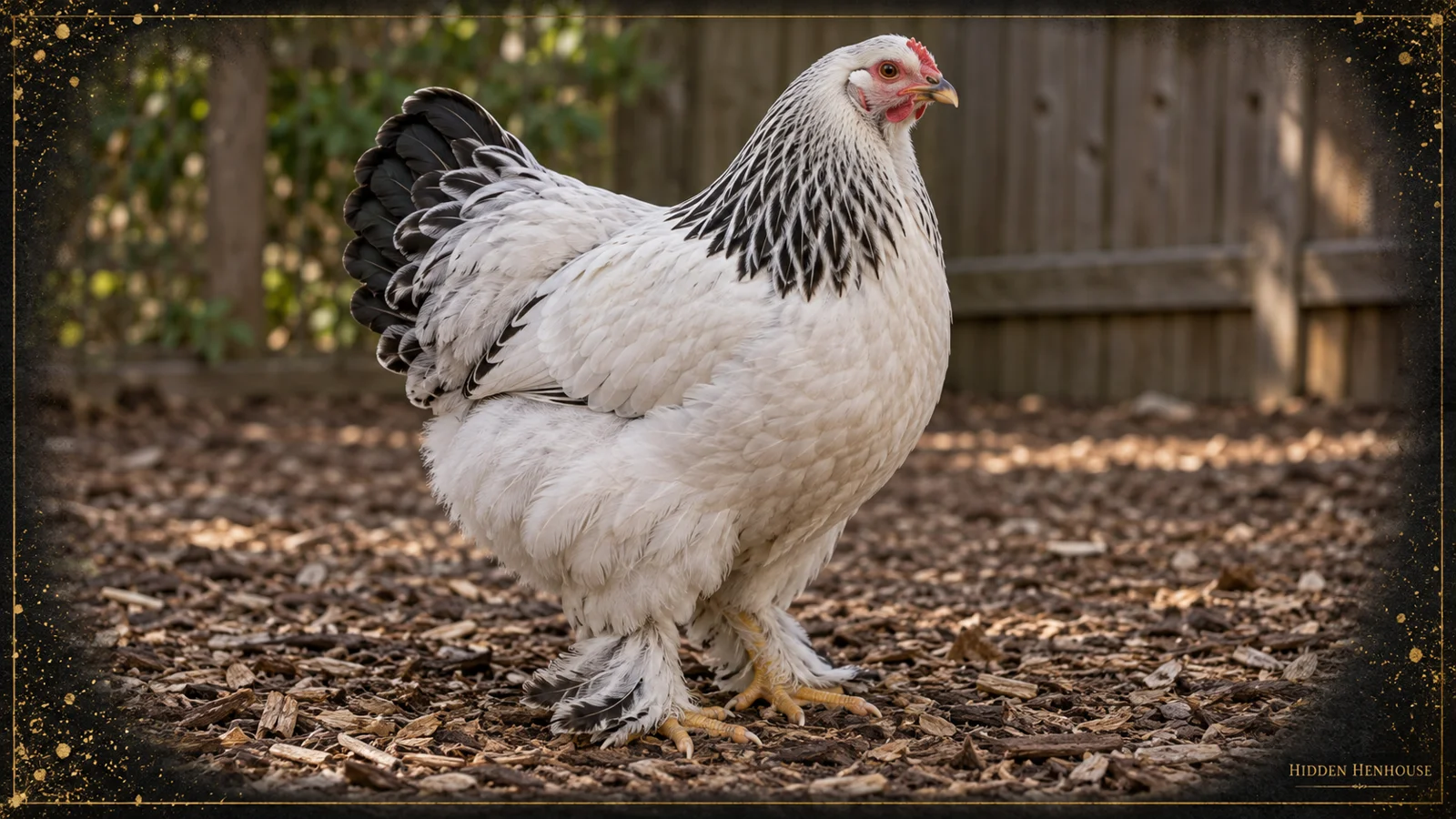

The Brahma is one of the largest recognized chicken breeds and one of the better-supported choices for cold climates. The Livestock Conservancy describes it as calm and docile, good in cold conditions, and a good layer of winter eggs.
That does not make a Brahma a perfect family pet or an all-purpose climate bird.
That cold-weather strength comes with a real climate caveat: Mississippi State University Extension says Brahmas are not ideal for warmer regions.
Updated October 6, 2026. Breed and husbandry sources checked for this remaster.
GUIDED ARTICLE EXPERIENCE
Brahma Chicken: Size, Temperament, Winter Eggs & Heat Tradeoffs
Read along as the narration moves through the article.
Private device narration · No hosted audio or tracking
CONTINUE GUIDED TOUR
Continue where you left off.
GUIDED TOUR COMPLETE
You have reached the end of this study.
Study record saved on this device.
GUIDED TOUR
Brahma Chicken: Size, Temperament, Winter Eggs & Heat Tradeoffs
Narrator: Paranoid Prophet Recommended Voice Native device narration
Prepare to follow the article as it is narrated.
VOICE & TOUR OPTIONS
Voice & Listening
NARRATOR
Finding a narrator…
Checking the best narrator available on this device.
Restores the best curated narrator available on this device.
Narrator choices are curated for clear, long-form listening on this device.
Screen-awake support will be checked when narration starts.
CHOOSE A NARRATOR
Curated for this device
Choose a verified narrator for this browser, or use System Narrator. Automatic mode uses the best reliable route exposed by this device; your chosen narrator is preserved even if this device needs a temporary fallback.
Preparing the guided article experience…
RESUME GUIDED TOUR?
Continue where you left off.
GUIDED TOUR COMPLETE
You have reached the end of this study.
Article Guide14 sections
Brahma quick facts
| Trait | Practical answer |
|---|---|
| Identity | Recognized breed |
| Origin | Developed in America from large Asian-origin fowl |
| APA varieties | Light, Dark, Buff |
| Purpose | Dual-purpose |
| Egg color | Brown |
| Egg size | Medium to large |
| Annual production | No universal figure used here |
| Adult size | About 10 lb hens and 12 lb males |
| Temperament | Calm, docile tendency |
| Climate | Strong cold suitability; not ideal for warmer climates |
| Maturity | Slow maturing |
| Distinctive trait | Feathered shanks and toes |
Why Brahmas are different from ordinary backyard layers
Size is not a marketing detail with Brahmas.
The Livestock Conservancy lists mature females around 10 pounds and males around 12 pounds. Historical birds could be even larger, but those are not the modern standard weights to plan around.
They also have:
- a pea comb
- feathered shanks and toes
- dense feathering
- a broad, substantial body
That physical package affects housing, feed use, weather fit and maturity.
Temperament: calm and docile, but still an individual animal
The Livestock Conservancy describes Brahmas as calm and docile.
The Conservancy’s broader heritage guidance also places Asiatic breeds such as Brahma among the calmer and quieter breed groups.
That supports the “gentle giant” reputation as a tendency.
It does not prove:
- every rooster will be gentle
- every hen enjoys handling
- the breed is child-safe
- Brahmas always keep peace in mixed flocks
For families, the breed can be a reasonable choice when its size and management needs fit the property. Children still need supervision and hygiene.
Egg production: winter reputation and realistic expectations
The Livestock Conservancy calls Brahmas good layers of winter eggs.
Mississippi State Extension also describes them as good egg layers for their size.
The Conservancy’s detailed profile also describes production up to 200 eggs a year. That is an upper-end breed-profile description, not a guaranteed annual result for every hen or line.
This guide therefore avoids one universal annual number.
Ask the breeder what their line actually produces, and remember that age, daylight, nutrition, molt and health affect every hen.
Cold-weather strength
Brahma cold suitability is one of the breed’s clearest documented strengths.
The Livestock Conservancy says they are good in cold climates.
Mississippi State Extension describes them as extremely hardy and says they stand cold very well.
That still does not remove the need for:
- dry housing
- ventilation
- unfrozen water
- clean litter
- complete feed
- observation for cold stress
The site’s Winterizing a Chicken Coop and Run guide owns those management details.
Heat is the real climate tradeoff
Mississippi State Extension specifically says Brahmas are not ideal for warmer climates.
That is more precise than calling them incapable of living in the South.
A warm-climate keeper should ask whether the property can reliably provide:
- deep shade
- strong airflow
- abundant cool water
- low crowding
- regular heat-stress monitoring
If the run bakes in afternoon sun, a giant, densely feathered breed may not be the responsible first choice.
Slow maturity is part of the package
Brahmas mature slowly.
That matters if you are comparing them with production-oriented layers or faster-growing utility birds.
Do not buy a Brahma expecting the timeline of a commercial hybrid.
Slow maturity also reinforces the broader point: this is a large traditional breed selected for a different balance of traits than a lightweight egg specialist.
Feathered legs and housing
Feathered shanks and toes are part of Brahma breed identity.
Do not turn that into the old myth that feathered feet are a built-in winter boot.
The practical management goal remains dry, clean footing.
Wet, muddy conditions are undesirable for any chicken and are especially inconvenient when feathers extend down the legs and toes.
Use the site’s Chicken Space Requirements and bedding guidance instead of inventing a special Brahma square-foot rule.
Main drawbacks
A Brahma may be a poor fit if:
- your property is consistently hot with weak shade
- you want a bird that matures quickly
- you want the highest egg output for the least body mass
- your housing is designed around smaller chickens
- you want a lightweight active forager
- you assume “docile” guarantees safe rooster behavior
Large size is both the breed’s attraction and its management cost.
Who should choose Brahmas?
Consider Brahmas if you want:
- a very large traditional chicken
- calm/docile temperament tendency
- strong cold suitability
- brown eggs with a winter-laying reputation
- feathered-leg breed character
- a slow-maturing dual-purpose bird
Choose something else if intense summer heat is your main environmental problem or maximum egg efficiency is your primary goal.
Compare those priorities in Best Chicken Breeds for Beginners, then use How Many Chickens Should You Start With? to plan flock size.
What to ask the breeder or hatchery
- Which variety is this: Light, Dark or Buff?
- What adult size does your line reach?
- What are the parent birds like temperamentally?
- What egg production do you actually observe?
- How old are your pullets typically when they mature under your conditions?
- How does the line perform in your local summer weather?
- Is leg/toe feathering consistent with breed type?
Brahma FAQ
Are Brahmas really giant chickens?
Yes. Current breed profiles place hens around 10 pounds and males around 12 pounds.
Are Brahmas friendly?
Calm and docile is a well-supported breed tendency. Individual birds, especially roosters, still vary.
Are Brahmas good egg layers?
They are described as good layers for their size and have a strong winter-egg reputation. This article does not promise one universal annual total.
Are Brahmas good in cold weather?
Yes. Cold suitability is one of their best-supported traits.
Are Brahmas good in hot climates?
Mississippi State Extension says they are not ideal for warmer climates. Hot-climate keepers need excellent shade, airflow and water management.
Do Brahmas mature late?
They are a slow-maturing breed. Avoid fixed week counts unless the supplier can document its own line.
Big birds need realistic planning
The Brahma is impressive because it is genuinely different, not because it is a magical “gentle giant.”
Good stewardship means planning for the size, slower maturity and climate tradeoff that comes with the calm temperament and cold-weather strengths.