
GUIDED ARTICLE EXPERIENCE
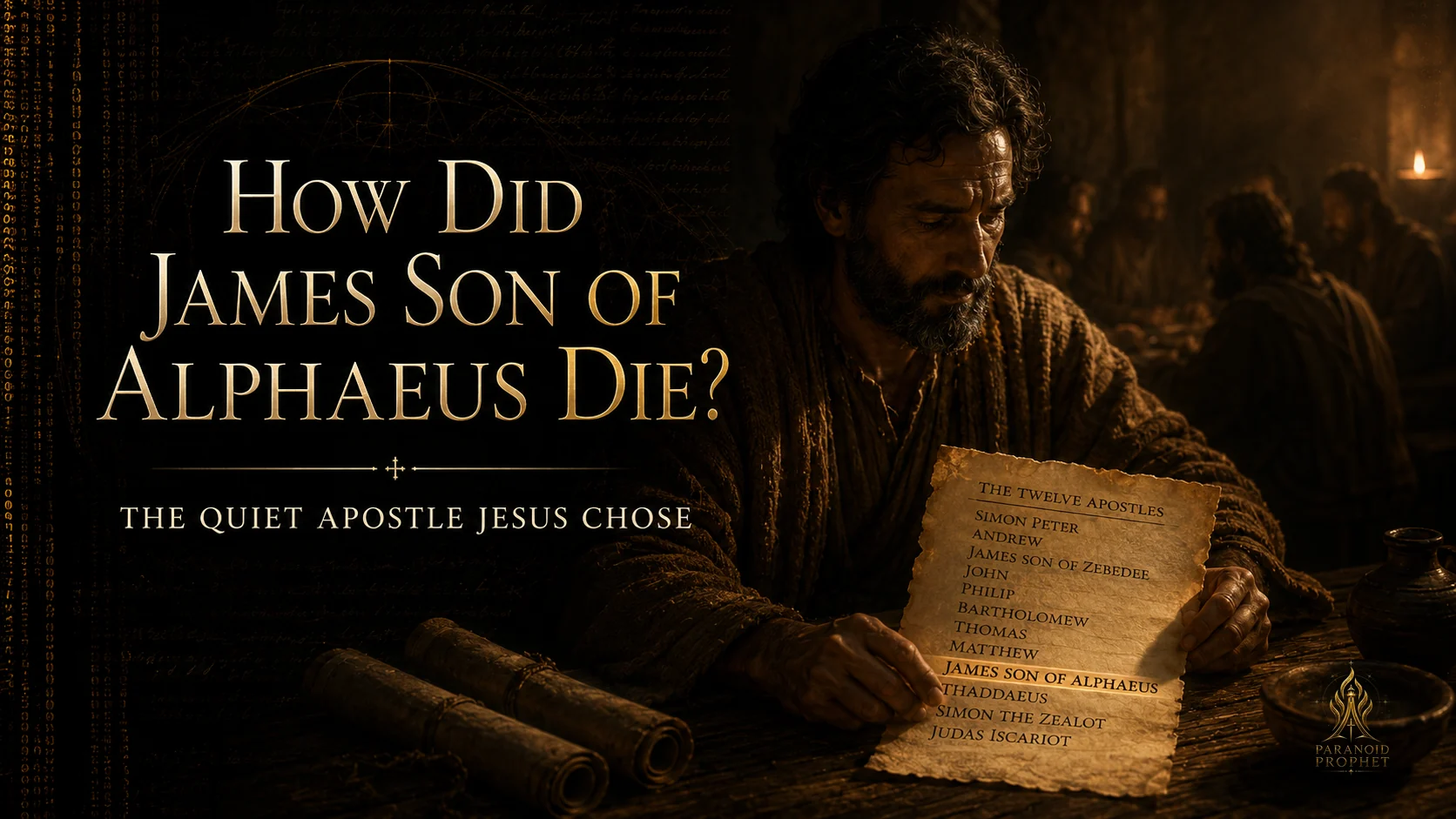
How Did James Son of Alphaeus Die?
Read along as the narration moves through the article.
Private device narration · No hosted audio or tracking
CONTINUE GUIDED TOUR
Continue where you left off.
GUIDED TOUR COMPLETE
You have reached the end of this study.
Study record saved on this device.
GUIDED TOUR
How Did James Son of Alphaeus Die?
Narrator: Paranoid Prophet Recommended Voice Native device narration
Prepare to follow the article as it is narrated.
VOICE & TOUR OPTIONS
Voice & Listening
NARRATOR
Finding a narrator…
Checking the best narrator available on this device.
Restores the best curated narrator available on this device.
Narrator choices are curated for clear, long-form listening on this device.
Screen-awake support will be checked when narration starts.
CHOOSE A NARRATOR
Curated for this device
Choose a verified narrator for this browser, or use System Narrator. Automatic mode uses the best reliable route exposed by this device; your chosen narrator is preserved even if this device needs a temporary fallback.
Preparing the guided article experience…
RESUME GUIDED TOUR?
Continue where you left off.
GUIDED TOUR COMPLETE
You have reached the end of this study.
How did James son of Alphaeus die? Scripture does not tell us. The Bible names James son of Alphaeus among the Twelve apostles, but it does not record his individual ministry, final mission field, or death scene. Later Christian tradition remembers him as a preacher of Christ and possible martyr, often by stoning, but those traditions are later and complicated by confusion with other men named James.
That means the strongest starting point is not his death. It is his identity. James son of Alphaeus was one of the Twelve men Jesus chose, named in the apostle lists, and remembered in the apostolic company after the resurrection and ascension of Christ.
James son of Alphaeus is one of the quiet apostles. Scripture gives him no recorded sermon, miracle, argument, question, failure, or dramatic death scene. But Scripture gives him something stronger than later legend: Jesus chose him. His obscurity is not evidence of insignificance. The Lord of glory placed him among the Twelve.
So this article should not begin by pretending we can reconstruct his final hour with certainty. It should begin where Scripture begins: with James son of Alphaeus named among the apostles of Jesus Christ. Before asking how he died, we need to ask who he was, which James we are talking about, and what his quiet place among the Twelve testifies about Jesus.
Bottom line: James son of Alphaeus was one of the Twelve apostles Jesus chose and sent. Scripture does not record his death. Later traditions remember him as a preacher and possible martyr, but the exact location and method of his death remain uncertain.
Source discipline: This article does not claim the Bible records the death of James son of Alphaeus. It does not treat him as the same person as James son of Zebedee or James the brother of Jesus. It handles the possible identification with James the Less cautiously. The strongest biblical claim is that James son of Alphaeus was one of the Twelve apostles Jesus chose and sent. The later martyrdom traditions are useful as Christian memory, but they are not equal to Scripture.
Article Guide15 sections
Evidence Map for James Son of Alphaeus
James son of Alphaeus needs a careful evidence map because his story is easily distorted. Some claims are directly biblical. Some are possible but debated. Some come from later tradition. Some belong to other men named James and should not be transferred to him without warning.
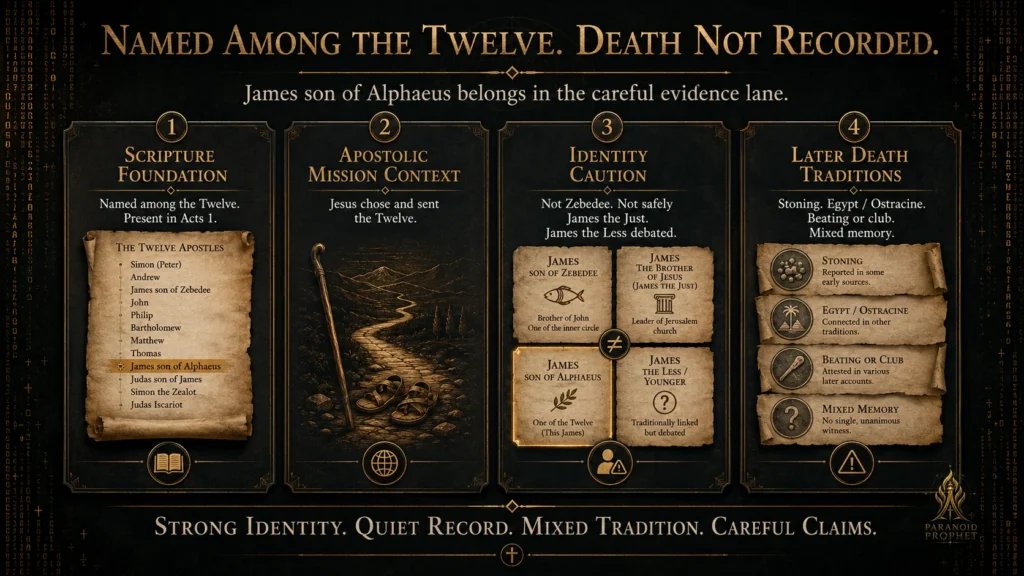
The silence around James should not be filled with imagination. It should be filled with source discipline. A careful article lets each source prove what it can prove, and no more.
| Claim | Evidence strength | Best use |
|---|---|---|
| James son of Alphaeus was one of the Twelve | Very strong | Biblical identity |
| Jesus authorized and sent the Twelve | Very strong | Apostolic mission context |
| James son of Alphaeus appears in Acts 1 after the ascension | Strong | Post-resurrection apostolic company |
| He has an individual Gospel scene | No biblical evidence | Avoid inventing biography |
| He is the same as James the Less | Possible / debated | Mention cautiously |
| He is the same as James the brother of Jesus | Unsafe to claim as fact | Avoid conflation |
| He may have been related to Matthew / Levi | Possible but uncertain | Mention carefully |
| Later tradition says he preached Christ | Later tradition | Useful as Christian memory |
| Later tradition says he was stoned or otherwise killed | Later / mixed | Supporting tradition, not foundation |
| Exact death method and location | Uncertain | Do not overclaim |
This map does not weaken the article. It strengthens it. A strong Christian case does not need every tradition to carry the same weight. Scripture gives certainty where God has spoken. Later tradition can be useful, but it must stay in its proper lane.
Which James Are We Talking About?
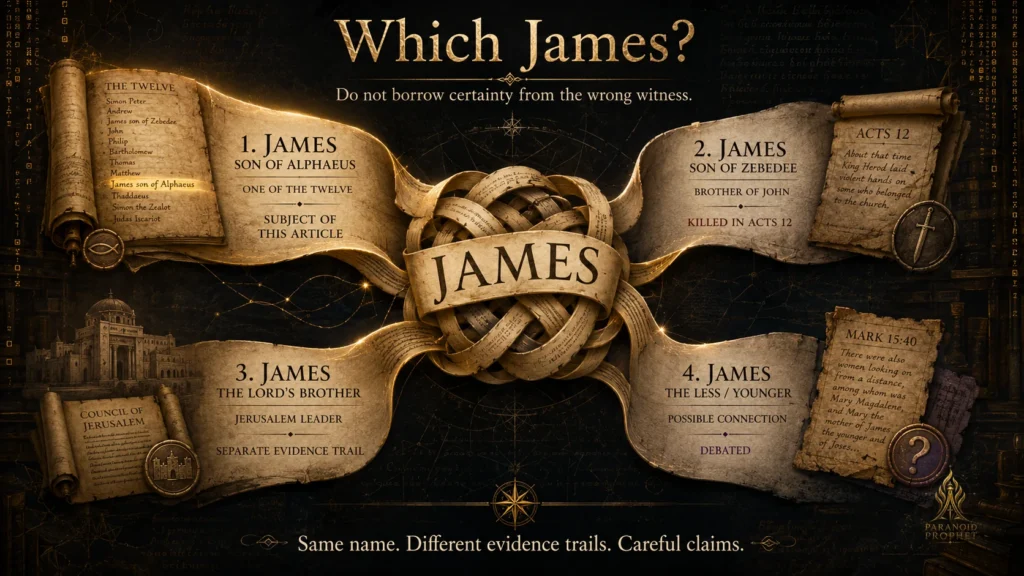
The first job of this article is not to dramatize James’s death. It is to identify him correctly. The New Testament includes several men named James, and later Christian tradition sometimes blends their stories together. If we do not separate them carefully, we may accidentally give James son of Alphaeus evidence that belongs to someone else.
That matters because not every James has the same evidence trail. James son of Zebedee has a clear biblical death in Acts 12. James the brother of Jesus becomes a major leader in the Jerusalem church and has a stronger historical death tradition. James son of Alphaeus is different. Scripture names him among the Twelve, but it does not spotlight his individual ministry or death.
So before asking how James son of Alphaeus died, we need to ask which James Scripture gives us.
| Figure | Who he is | Article decision |
|---|---|---|
| James son of Alphaeus | One of the Twelve apostles | Subject of this article |
| James son of Zebedee | Brother of John, prominent apostle, killed in Acts 12 | Not this James |
| James the brother of Jesus / James the Just | Jerusalem church leader | Do not identify him with son of Alphaeus as fact |
| James the Less / Younger | Mentioned in Mark 15:40 | Possible traditional connection, but debated |
James Son of Alphaeus Was One of the Twelve
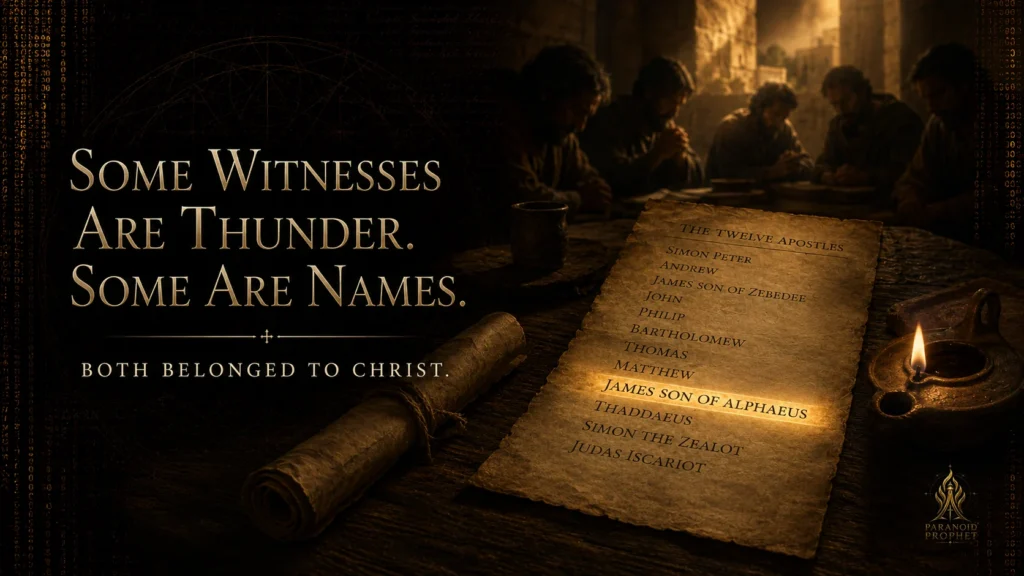
The clearest biblical fact about James son of Alphaeus is that he was one of the Twelve apostles. He appears in the apostle lists in Matthew 10:2–4, Mark 3:16–19, Luke 6:14–16, and Acts 1:13.
That repeated naming matters. James son of Alphaeus is not a later legend inserted into Christian memory. He belongs to the apostolic lists preserved in the New Testament. Scripture may not give him a spotlight, but it gives him a place among the Twelve.
This is the strongest foundation for the whole article. James son of Alphaeus was not merely a distant follower, anonymous disciple, or later church figure. He belonged to the circle Jesus chose. He was counted among the men publicly identified with the ministry, teaching, mission, and resurrection witness of Christ.
That does not mean we should invent details Scripture does not give. It means we should value what Scripture does give. Jesus chose him. Jesus placed him among the apostolic company. That is not a small thing.
Some apostles are remembered with thunder. Some are remembered with a name. Both belonged to Christ.
He Was Not James Son of Zebedee
James son of Alphaeus should not be confused with James son of Zebedee. James son of Zebedee was the brother of John, appeared more prominently in the Gospels, and belonged to the smaller circle that witnessed several key moments in Jesus’ ministry. He is also the James whose death is recorded in Acts 12:1–2, where Herod kills him with the sword.
That is not James son of Alphaeus. The apostle lists distinguish them. Matthew and Mark name James son of Zebedee and James son of Alphaeus as two different men.
This matters because the death of James son of Zebedee is strong biblical evidence. James son of Alphaeus does not have that kind of death record. A careful article should not borrow certainty from one James and hand it to another.
James son of Zebedee belongs in one evidence lane. James son of Alphaeus belongs in another. The first has a biblical martyrdom account. The second has a clear biblical apostolic identity and later mixed death traditions.
He Should Not Be Confused With James the Brother of Jesus
James son of Alphaeus should also not be casually identified with James the brother of Jesus, often called James the Just. James the brother of Jesus becomes a major figure in the early Jerusalem church. Paul refers to “James the Lord’s brother” in Galatians 1:18–19, and Acts presents James as an important leader in Jerusalem.
Some Christian traditions have identified James son of Alphaeus, James the Less, and James the brother of Jesus as the same person. That tradition has a history, and it can be discussed honestly. But this article should not treat it as settled fact.
The reason is simple: James the brother of Jesus has his own evidence trail. His leadership in Jerusalem, his relationship to Jesus, and his death traditions should not be transferred to James son of Alphaeus without warning. If those details are borrowed too quickly, the article becomes less trustworthy.
So this article will treat James son of Alphaeus as James son of Alphaeus. Where later traditions connect him with James the Less or James the Just, we will say so openly and cautiously. But we will not build the argument by collapsing several men into one.
Was James Son of Alphaeus the Same as James the Less?
Another common question is whether James son of Alphaeus was the same person as James the Less, or James the Younger. Mark 15:40 mentions “James the younger,” often rendered or discussed as James the Less. Christian tradition has often connected that figure with James son of Alphaeus.
That identification is possible, but it should be handled carefully. Mark 15:40 does not explicitly say, “James the younger is James son of Alphaeus.” The phrase may refer to age, height, prominence, or reputation. It may distinguish this James from the more visible James son of Zebedee. But the text itself does not settle every question.
The best wording is careful: James son of Alphaeus has often been identified with James the Less in Christian tradition, but the New Testament does not clearly prove that identification. Possible does not mean certain.
This distinction matters because later traditions about James the Less sometimes overlap with traditions about James the brother of Jesus. If we are not careful, the evidence becomes a knot of borrowed details. The better path is to identify the tradition, explain the uncertainty, and keep the article’s foundation on what Scripture clearly says.
Was James Son of Alphaeus Related to Matthew?
There is also a possible connection between James son of Alphaeus and Matthew. James is called the son of Alphaeus in the apostle lists. In Mark 2:14, Levi, traditionally identified with Matthew, is also called the son of Alphaeus.
That raises an interesting question: were James and Matthew brothers? It is possible, but Scripture does not say so. The Gospels clearly identify some brothers, such as Peter and Andrew or James and John. They do not clearly present Matthew and James son of Alphaeus as brothers.
Shared names do not automatically prove a shared identity or family relationship. Alphaeus may have been the same man, or it may have been another man with the same name. The safest claim is simple: James son of Alphaeus was one of the Twelve. Anything beyond that must be weighed carefully.
What Scripture Does and Does Not Say About James Son of Alphaeus
Once the identity issues are clear, the next step is to let Scripture speak. The New Testament gives us enough to identify James son of Alphaeus as one of the Twelve, but not enough to write a full biography. That is not a failure of Scripture. It is a warning against speculation.
Scripture does not tell us everything we might want to know. It tells us what God has preserved for the church. In James son of Alphaeus’s case, the preserved witness is quiet but meaningful: his name remains among the apostles of Jesus Christ.
Scripture Names Him, But Does Not Spotlight Him
James son of Alphaeus is named, but not spotlighted. He does not speak in a recorded scene. He is not shown asking Jesus a question. He is not singled out at the transfiguration. He is not given a personal rebuke or a personal miracle story. He stands in the record as one of the Twelve.
That might feel small at first, but it is not small. Jesus did not choose filler apostles. He chose witnesses. He chose men who would walk with Him, hear Him, watch His works, stumble in real time, and become part of the apostolic foundation of the church’s testimony.
The fact that James son of Alphaeus is quiet in the record does not mean he was absent from the story. His name in the apostle lists testifies that he belonged to the company Jesus called. His obscurity is not evidence of insignificance. Jesus chose him.
This is where the article must be careful and reverent. We should not treat James as unimportant because Scripture gives fewer details. But we also should not invent details to make him seem more important. The name Scripture gives is enough to begin: James son of Alphaeus, one of the Twelve.
Scripture Does Not Record His Death
The Bible does not record how James son of Alphaeus died. There is no verse that says he was stoned, beaten, crucified, clubbed, or killed in a particular city. There is no biblical death scene for him.
That silence matters. It means later death traditions should be examined, but not treated as Scripture. It also means this article should not use James son of Alphaeus as a first-tier martyrdom proof. His death evidence is not in the same category as Stephen in Acts 7 or James son of Zebedee in Acts 12.
But the silence about his death does not erase his witness. Scripture’s strongest testimony about James son of Alphaeus is not how he died. It is where Jesus placed him. He was one of the Twelve. That is the foundation.
The death traditions will matter later in the article, but they should remain secondary. The life of James son of Alphaeus testifies first because Christ chose him, not because later sources give us a clean execution scene.
Why That Silence Should Not Be Filled With Imagination
When Scripture is quiet, writers are often tempted to fill the silence with drama. That would be a mistake. James son of Alphaeus does not need an invented speech, invented missionary map, or invented death scene to matter. The authority of his story comes from Jesus, not from our imagination.
A faithful article should let the silence do its work. It should remind the reader that the kingdom of Christ was not carried only by apostles whose individual stories became famous. It was also carried by men whose names remain in the record even when their personal details are hidden from us.
Why James Son of Alphaeus Matters in the Story of Jesus
Once the identity confusion is cleared away, James’s place among the Twelve becomes the heart of the article. His story is not built on fame, but on Christ’s choice.
Scripture gives James son of Alphaeus no famous speech, no dramatic question, no individual miracle scene, and no recorded death. Yet it gives him something better than speculation: a place among the apostles Jesus chose. That is not a small detail.
The danger with a lesser-known apostle is that readers may treat silence as emptiness. But biblical silence is not the same thing as insignificance. Peter speaks often. John stands close to several major scenes. James son of Zebedee is remembered with his brother John and later killed by Herod. James son of Alphaeus is quieter. But Jesus still chose him.
That is the point to hold steady. James does not matter because later Christians made him famous. He matters because Jesus placed him among the apostolic witnesses. His life testifies to Christ not by personal celebrity, but by apostolic belonging.
Some apostles are remembered with thunder. Some are remembered with a name. Both belonged to Christ.
Jesus Chose Him
The most important thing about James son of Alphaeus is not what later tradition says about his death. It is what Scripture says about Christ’s choice. In Luke 6:12–16, Jesus spends the night in prayer to God. Then He calls His disciples and chooses twelve of them, whom He names apostles. Among them is James son of Alphaeus.
That detail matters. The Twelve were not chosen casually. Luke frames their appointment after a night of prayer. The apostolic circle was not a random crowd, a political committee, or a human strategy group. Jesus chose them under the will of the Father, for the mission of the kingdom.
James son of Alphaeus stands inside that choice. Scripture does not preserve his private emotions or personal background. It does not tell us what James said when Jesus called him into the apostolic company. But it tells us enough to know this: he was wanted by Christ for the apostolic mission.
Before James could be remembered by tradition, he was chosen by Jesus. The authority of his story does not come from a later martyrdom account. It comes from the Lord who called the Twelve and placed James among them.
That keeps the article Christ-centered. James son of Alphaeus is not important because we can make him dramatic. He is important because Jesus chose him. The focus belongs first on Christ’s authority, Christ’s wisdom, and Christ’s mission.
Jesus did not choose background filler for the apostolic foundation.
Jesus Sent the Twelve
James son of Alphaeus was not only named among the Twelve. He belonged to the group Jesus authorized and sent. In Matthew 10:1–8, Jesus calls the Twelve, gives them authority over unclean spirits and diseases, and sends them to proclaim that the kingdom of heaven is at hand.
This is where the article can speak positively without inventing details. Scripture does not isolate James son of Alphaeus and say, “He healed this person,” or “He preached in this village,” or “He cast out this demon.” We should not create a personal ministry record where Scripture does not give one.
But Scripture does place James inside the group mission of the Twelve. That means his achievement in the biblical record is not a preserved solo sermon. It is participation in the mission Jesus gave the apostles. He belonged to the men Jesus authorized to proclaim the kingdom.
In Mark 3:13–19, Jesus appoints the Twelve “so that they might be with him and he might send them out to preach.” That twofold purpose is important. Before they were sent, they were with Him. Apostolic witness did not begin with theory. It began with nearness to Jesus.
James son of Alphaeus was included in that apostolic pattern: with Jesus, then sent by Jesus. The quietness of his individual record does not erase the significance of that calling.
Scripture gives group mission, not individual biography. That is enough if we are willing to let the text define the argument.
James Was Named in the Apostolic Company After the Ascension
James son of Alphaeus also appears in Acts 1:13–14, after Jesus’ resurrection and ascension. The apostles return to Jerusalem and gather in the upper room. Among those named is James son of Alphaeus.
This is one of the most important details in his story. James is not only a pre-cross name in an apostle list. Acts remembers him on the resurrection side of the cross, gathered with the apostolic company after the risen Christ had ascended.
The wording should stay careful. Acts 1 does not give James son of Alphaeus an individual speech. It does not describe a private resurrection appearance to him by name. It does not tell us what he said in the upper room. But it does keep him present among the apostles after the resurrection and ascension of Jesus.
That matters for the larger witness theme. The apostles were about to become public proclaimers of the risen Christ. The book of Acts will show the message of Jesus moving outward from Jerusalem. James son of Alphaeus is named in the apostolic company at the doorway of that mission.
Acts 1 does not make James loud, but it does keep him present.
That presence matters. The quiet apostle belongs in the company that moved from fear, confusion, and waiting into Spirit-empowered witness. His name remains in the record not because he dominates the story, but because he belonged to the witnesses Jesus chose.
What Did James Son of Alphaeus Achieve?
If achievement means personal fame, Scripture gives us very little about James son of Alphaeus. But if achievement means being chosen by Christ, included among the Twelve, sent in the apostolic mission, and preserved in the company that bore witness after the resurrection, then James’s achievement is not small.
His achievement was not celebrity. It was witness.
Modern readers often measure importance by visibility. We assume the people who speak the most, appear the most, or leave the most records are the ones who mattered most. Scripture challenges that instinct. The kingdom of God is not built on celebrity. It is built by the Lord who calls, sends, strengthens, and preserves His servants.
James son of Alphaeus reminds us that a man can matter deeply in the story of Jesus even when most personal details are hidden. The question is not whether James became famous. The question is whether Christ chose him and included him in the apostolic witness. Scripture says yes.
He Belonged to the Authorized Witness Circle
The Twelve were not simply a group of interested listeners. They were the authorized witness circle around Jesus. They heard His teaching, watched His works, traveled under His authority, and were prepared for the mission that would follow His death and resurrection.
James son of Alphaeus belonged to that circle. This does not require us to invent a private biography. His name in the apostle lists is enough to show that he was not outside the witness. He was inside the circle Jesus appointed.
That matters for apologetics because Christianity did not begin as vague admiration for a distant religious symbol. It began with testimony about Jesus: His kingdom, His authority, His miracles, His death, His resurrection, and His lordship. The apostles were not myth-makers inventing a detached idea. They were witnesses to a real Lord who acted in history.
James son of Alphaeus does not need a preserved sermon to belong to the testimony. His name is preserved among the men Jesus chose to be with Him and to be sent by Him.
He Shared in the Mission of the Twelve
James also shared in the mission of the Twelve. Matthew 10 does not merely list names. It places those names in the context of Jesus giving authority and sending His apostles to proclaim the kingdom. James son of Alphaeus stands in that list.
That means we can say something positive without overclaiming. We should not say, “James healed this person,” where Scripture does not say so. We should not say, “James preached in this exact town,” where Scripture does not say so. But we can say he shared in the mission Jesus gave the Twelve, because Scripture names him among them.
That mission was not small. Jesus sent the Twelve to announce the nearness of the kingdom. Their message was not self-improvement, political revolution, or religious branding. It was the reign of God breaking into the world through Christ the King.
James’s role in that mission is quiet in the record, but real in the text. He was included among the sent ones. The later traditions about his preaching and death will need careful ranking, but the biblical foundation already gives us this: James was part of the apostolic mission of Jesus.
He Stood With the Apostolic Company After the Resurrection
James son of Alphaeus is also named in Acts 1, after the resurrection and ascension of Jesus. This does not give him a dramatic individual role, but it does place him among the gathered apostles at a crucial moment in redemptive history.
The cross had happened. The tomb had been found empty. The risen Christ had appeared to His followers. Jesus had ascended. The apostles were gathered in Jerusalem, waiting in prayer before the public explosion of witness at Pentecost. James son of Alphaeus is named among them.
That is a meaningful achievement. James remained with the apostolic company after the events that define the Christian faith. He is not presented as a man who abandoned the witness, vanished from the company, or returned to an old life. Acts keeps his name among those gathered after the ascension.
Again, we should not say more than Acts says. But we should not say less either. James son of Alphaeus stood with the apostolic company on the resurrection side of the story.
The Quiet Apostles Still Matter
James son of Alphaeus matters because the kingdom of Christ was not carried only by the famous. The Gospel record gives more detail about some apostles than others, but Jesus chose all Twelve. The quieter names are not disposable. They are part of the witness.
This is one of the most important theological lessons in the article. The Bible does not treat obscurity as uselessness. God does not need every servant to become a headline. Some names are preserved with long stories. Others are preserved with a single line. Both are known to Christ.
James son of Alphaeus is not a gap to be filled with fiction. He is a witness to the kind of kingdom Jesus builds. Christ does not measure significance the way the world does. The world asks who became visible. Christ asks who belongs to Him.
His obscurity should not embarrass the article. It should strengthen the theme. The resurrection witness was not carried only by famous voices. It was carried by the apostolic company Jesus chose, including men whose individual stories remain mostly hidden.
Some witnesses are thunder. Some are names in the record. All belong to the Lord who called them.
The Witness of Jesus Was Bigger Than Famous Names
The witness of Jesus was bigger than famous names. Peter mattered, but the witness was not Peter alone. John mattered, but the witness was not John alone. James son of Zebedee mattered, but the apostolic company was larger than the inner circle.
James son of Alphaeus reminds us that the testimony to Jesus was corporate before it became individually famous. The Twelve together testified to Christ’s authority, teaching, kingdom, death, resurrection, and commission. Some of their individual stories are preserved in detail. Others remain quiet. The truth they bore witness to is the same.
This helps the article avoid a shallow view of evidence. The case for Christ is not built only on dramatic death scenes. It is built on Scripture, apostolic witness, early proclamation, costly testimony, and the resurrection of Jesus. James son of Alphaeus belongs to that wider pattern, even if his personal biography remains mostly hidden.
The quiet apostle points to the loud truth: Jesus is risen, and He chose witnesses to carry His name.
James Points Beyond Himself
James son of Alphaeus should not become the center of the article. Jesus should. That is true for every apostle, but it is especially clear here. James gives us fewer personal details, which means the article has less temptation to build a personality cult around him. His significance points beyond himself.
He points to the Lord who chose him. He points to the kingdom mission Jesus gave the Twelve. He points to the apostolic company gathered after the resurrection and ascension. He points to a witness larger than one man’s fame.
That is why James son of Alphaeus is worth studying. Not because we know everything about him, but because the little Scripture gives us is enough to point us back to Christ.
Once James’s life is framed as witness, the later death traditions can be handled more carefully. They should not become the foundation of the article, but they do show how Christian memory remembered this quiet apostle as a preacher of Christ, and in some traditions, as a man who suffered for that testimony.
What Later Tradition Says About His Mission and Death
Once James son of Alphaeus is framed first as a witness chosen by Jesus, the later death traditions can be handled in their proper place. They should not become the foundation of the article, but they should not be ignored either.
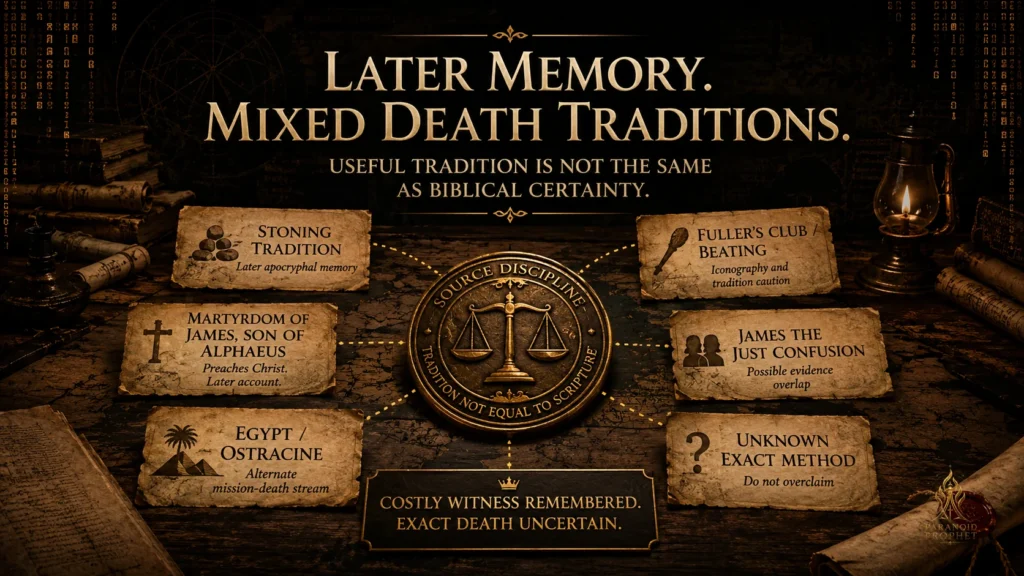
Scripture does not narrate the death of James son of Alphaeus. Later Christian tradition, however, often remembers him as a preacher of Christ and possible martyr. The most common traditions connect him with stoning, crucifixion, beating, or another violent death. The problem is not that there is no martyrdom memory. The problem is that the memory is later, varied, and often tangled with other men named James.
That does not make the traditions worthless. It means they need to be ranked honestly. Later Christian memory can preserve meaningful testimony about how the church remembered an apostle. But later tradition should not be treated as if it were the same kind of evidence as Scripture.
For James son of Alphaeus, the safest path is careful: later traditions often remember him as a costly witness to Christ, sometimes as a martyr, but they do not give us one certain death scene that can be stated with biblical confidence.
The Stoning Tradition
One of the clearest later traditions says James son of Alphaeus was stoned. In the tradition preserved under the title Martyrdom of James, Son of Alphaeus, James is remembered as teaching Christian doctrine centered on Jesus Christ. The summary of the text presents him teaching Christ’s pre-existence with God, His incarnation and birth, His death, and His resurrection.
That detail matters. In this later tradition, James is not killed for vague religion. He is opposed after proclaiming Jesus Christ. The conflict is tied to the message of who Jesus is and what God has done through Him.
The account then describes opposition rising against James. He is seized, brought before Claudius, accused by false witnesses, and condemned to be stoned. The tradition also says his body was buried beside the temple.
This is useful evidence, but only in the right lane. It is not a biblical death account. It is not a first-century court record. It is later apocryphal martyrdom tradition. It can show that Christian memory remembered James son of Alphaeus as a preacher of Christ and a martyr by stoning, but it should not be used to claim absolute certainty about his exact death.
The tradition matters most when it points back to Christ, not when it tempts us to overstate the evidence.
The Martyrdom of James Son of Alphaeus Tradition
The Martyrdom of James, Son of Alphaeus belongs to the world of Christian apocryphal acts and martyrdom traditions. These texts are not part of the New Testament. They often preserve later Christian storytelling, devotion, regional memory, theological emphasis, and sometimes echoes of older tradition.
That means the text should be neither dismissed carelessly nor treated as Scripture. A weak article would make one of two mistakes. It would throw away the tradition because it is later, or it would treat the tradition as if it were equal to Luke, Matthew, Mark, John, or Acts. A stronger article does neither.
The right use is careful: this tradition shows how some Christians remembered James son of Alphaeus. They remembered him as a man who proclaimed Christ and suffered for that proclamation. That is historically meaningful as tradition history, even if it does not settle every detail of his death.
It also fits the article’s larger theme. James son of Alphaeus is quiet in Scripture, but later memory does not remember him as empty. It remembers him as a witness. The stoning account may not give us first-tier certainty, but it does show a tradition of costly testimony attached to his name.
That is the proper apologetic use. Not “this later account proves everything,” but “this later account remembers James as preaching the same Christ proclaimed by the apostolic church.”
The Ostracine and Egypt Tradition
Another stream of later tradition connects James son of Alphaeus, often under the name James the Less or James the Lesser, with ministry beyond Judea and death in Egypt. Some versions place his martyrdom at Ostracine, a location associated with Lower Egypt, and remember him as crucified there while preaching the Gospel.
This tradition differs from the Jerusalem stoning tradition. One stream remembers stoning near Jerusalem. Another places him in an Egyptian setting and connects his death with crucifixion. Those differences do not make every tradition meaningless, but they do make the exact location and method uncertain.
Two later streams may remember costly witness, but they do not give one clean map. That is why the article should avoid saying James son of Alphaeus definitely died in Jerusalem or definitely died in Egypt. Both claims appear in later memory. Neither should be stated with the confidence we give to biblical events.
The better conclusion is careful: later traditions place James son of Alphaeus or James the Less in different mission settings and remember his death as violent. These traditions support a memory of costly witness, but they do not allow us to reconstruct one certain itinerary or execution scene.
The Beating or Clubbing Tradition Requires Caution
Some traditions and church art associate James the Less with a fuller’s club, a staff, or beating. This is where caution becomes especially important. The fuller’s club tradition is often tied to James the Less, and James the Less is often identified with James son of Alphaeus in Christian tradition. But that identification is not always clean, and the tradition can overlap with stories about James the brother of Jesus.
So the article should not say, “James son of Alphaeus was definitely beaten with a fuller’s club.” That would be too strong. It is safer to say that later tradition and iconography sometimes attach clubbing or beating imagery to James the Less, and because James the Less has often been identified with James son of Alphaeus, that imagery is sometimes connected to him.
The club may belong more clearly to later iconography than to secure history. It may preserve a memory of violent death, but it does not give the same kind of evidence as a biblical narrative or early historical source.
This does not weaken the article. It strengthens it. Readers can trust an article more when it refuses to turn uncertain tradition into false certainty.
The Problem of Confusion With James the Just
The greatest difficulty in the death tradition is confusion with James the Just, the brother of Jesus. Some later traditions appear to blend James son of Alphaeus with James the Just or James the Less. That blending affects the death stories.
This matters because James the brother of Jesus has his own death tradition, often connected with Jerusalem, the temple, stoning, and being struck. When a later tradition about James son of Alphaeus also speaks of stoning near Jerusalem and burial by the temple, the article must slow down.
Apocryphicity’s discussion of James the Less shows why this caution matters. Some tradition material can speak of “James, son of Alphaeus, called the Just,” language that signals a blending of James son of Alphaeus with James the Just rather than a clean, separate death report.
When a tradition calls James son of Alphaeus “the Just,” the article must slow down.
That kind of language may show that later Christians were connecting, combining, or confusing several James figures. It does not mean the tradition is worthless, but it does mean we should not treat it as a clean independent death record for James son of Alphaeus.
This is why the identity work in the first part of the article matters. If we collapse James son of Alphaeus, James the Less, and James the brother of Jesus into one person too quickly, the evidence becomes stronger than it really is. A careful article keeps the lines visible, even when later tradition blurs them.
The safest conclusion is that James son of Alphaeus was remembered in later tradition as a costly witness and possible martyr, but some of the most vivid details may be affected by confusion with other James traditions.
How Strong Is the Martyrdom Evidence?
The martyrdom evidence for James son of Alphaeus is not empty, but it is not first-tier. It is later, mixed, and complicated by identity confusion. It can support a tradition of costly witness. It should not be used as clean proof that James died by one certain method in one certain place.
This places James son of Alphaeus in a different category from figures whose death evidence is stronger. Stephen’s death is narrated in Acts. James son of Zebedee is killed by the sword in Acts 12. James the brother of Jesus has a stronger historical trail through Josephus and early Christian tradition. Peter and Paul have stronger early Roman martyrdom traditions. James son of Alphaeus does not have the same level of death evidence.
That honesty matters. The article does not need to make every apostle’s death equally certain. The stronger argument is that James son of Alphaeus belonged to the apostolic witness circle Jesus chose and sent, and that later Christian memory remembered him as a preacher of Christ whose testimony may have cost him his life.
That is enough for the right kind of article. James son of Alphaeus should not carry the whole martyrdom argument. But he does belong inside the wider pattern of apostolic witness.
What We Can Say Carefully
We can say that Scripture names James son of Alphaeus among the Twelve. We can say that Jesus chose and sent the Twelve. We can say that James is named in the apostolic company after the ascension. We can say that later tradition remembers him as a preacher of Christ. We can say that some later traditions remember him as a martyr, often by stoning, while other streams connect him with different locations or methods.
We can also say that the later martyrdom tradition is meaningful because it remembers James’s witness as centered on Jesus. In the stoning tradition, the message attributed to James is not vague spirituality. It is Christ: His divine pre-existence, His incarnation, His death, and His resurrection.
That matters for the article’s Jesus evidence lane. Even when the death details are uncertain, the remembered reason for opposition points back to Christ. James is remembered as a man associated with the proclamation of Jesus, not merely as a name attached to a dramatic death scene.
The best careful conclusion is this: James son of Alphaeus was a quiet apostolic witness in Scripture, later remembered in some Christian traditions as a preacher and possible martyr. The exact location and method of his death remain uncertain.
What We Should Not Claim
We should not claim that the Bible records his death. It does not. We should not claim that James son of Alphaeus was definitely stoned in Jerusalem, definitely crucified in Egypt, or definitely beaten with a fuller’s club. The traditions are too mixed for that.
We should not claim that he was certainly the same person as James the Less or James the brother of Jesus. Those identifications have been made in Christian tradition, but they are not safe enough to build the whole article on as settled fact.
We should also not claim that his death alone proves the resurrection. Martyrdom, by itself, proves sincerity more directly than truth. And in James son of Alphaeus’s case, the martyrdom evidence is not strong enough to carry that argument alone anyway.
The article’s stronger claim is more careful and more persuasive: James son of Alphaeus belonged to the apostolic company Jesus chose and sent. Later tradition remembered him as a preacher of Christ and possible martyr. His story contributes to the cumulative pattern of apostolic witness, but it should not be overstated.
What Each Source Actually Proves
The later traditions become clearer when each source is allowed to prove what it can prove and no more. That is especially important with James son of Alphaeus because the evidence is complicated by several men named James.
| Source or tradition | What it supports | What it does not prove |
|---|---|---|
| Scripture apostle lists | James son of Alphaeus was one of the Twelve | His death method or mission location |
| Acts 1 | James named among the post-ascension apostolic company | A personal speech, private resurrection appearance, or death scene |
| Martyrdom of James, Son of Alphaeus | Later memory of James preaching Christ and being stoned | First-tier historical certainty about his death |
| Stoning / temple burial tradition | Later martyrdom memory | That the account is not influenced by James the Just traditions |
| Ostracine / Egypt tradition | Alternate later mission and death stream | One secure location or itinerary |
| Fuller’s club / beating tradition | Later iconographic or traditional memory | A certain death method for James son of Alphaeus |
| Identity studies and tradition analysis | The tradition is tangled and often conflated | That James is historically irrelevant |
The evidence does not give us a clean execution file. It gives us a layered memory of witness. James son of Alphaeus should not carry the whole martyrdom argument. But when handled carefully, his story still belongs inside the wider pattern of men who bore witness to Jesus Christ, proclaimed His resurrection, and were remembered as willing to suffer for His name.
Why His Witness Still Matters for the Resurrection Case
James son of Alphaeus is not the strongest martyrdom case among the apostles. That should be said plainly. Scripture does not record his death, and later traditions are mixed. But James still matters because the resurrection case does not depend on one apostle’s death tradition. It rests on the broader apostolic witness to Jesus Christ.
James’s uncertain death should not become the center. Christ should. Jesus chose him as one of the Twelve, included him in the apostolic mission, and preserved his name among the gathered apostles after the resurrection and ascension. Later traditions remember him as a preacher of Christ and possible martyr, but his clearest testimony is still his place among the witnesses Jesus called and sent.
That is why James son of Alphaeus belongs in this series. Not because we can reconstruct every detail of his life or death, but because he stands inside the apostolic pattern: chosen by Jesus, sent in His mission, gathered with His witnesses, and later remembered as one who suffered for the name of Christ.
The quiet apostle points to the loud truth: Jesus is risen, and He chose witnesses to carry His name.
His Story Is Cumulative, Not Standalone Proof
James son of Alphaeus should not be used as a standalone proof of the resurrection. His martyrdom tradition is too late and mixed to carry that kind of weight, and martyrdom by itself does not automatically prove a belief true. People can die sincerely for false beliefs.
But apostolic suffering still matters. The earliest Christian witnesses were not merely defending an inherited religious idea. They were bearing witness to Jesus: His ministry, His authority, His death, His resurrection, and His lordship. Their willingness to suffer supports the sincerity of their testimony, especially when tied to the public proclamation that God raised Jesus from the dead.
James son of Alphaeus contributes to that cumulative picture. He does not carry the whole case. He does not need to. Scripture gives his apostolic identity. Acts places him in the post-ascension apostolic company. Later tradition remembers him as a preacher of Christ and possible martyr. Taken together, his story belongs to the wider pattern of costly witness.
The resurrection case does not rest on pretending every apostle’s death is equally certain. A stronger case tells the truth: some death traditions are strong, some are mixed, and some are late. James son of Alphaeus belongs in the mixed and cautious category. But he still belongs.
The Apostles Were Witnesses, Not Myth-Makers
The apostles were not myth-makers selling vague spirituality. They proclaimed Jesus Christ as Lord. They preached His kingdom, His cross, His resurrection, and His authority over every rival claim. That message was not safe. It challenged religious pride, sin, idolatry, and earthly powers.
James son of Alphaeus is quieter than Peter, John, or Paul, but his name still belongs to the apostolic company. Acts places him among the gathered apostles after Jesus’ ascension, before the public witness of the church explodes outward from Jerusalem. He stands near the doorway of Acts: not loud, not spotlighted, but present among the witnesses before the message goes public.
That matters because Christian faith is not built on anonymous myth floating outside history. It is tied to Jesus of Nazareth, His real disciples, His death under human authorities, His resurrection proclamation, and the apostolic witness that carried His name into the world.
James son of Alphaeus does not give us a dramatic speech in Acts. But Acts keeps his name among the men who stood on the resurrection side of the cross. His quietness does not remove him from the witness. It simply means his testimony is carried by his place in the apostolic company rather than by a preserved solo scene.

Quiet Faithfulness Still Points to Christ
James son of Alphaeus gives this article a different kind of strength. His story is not about fame. It is about faithful obscurity. Scripture gives him a name, a place, and a company. Jesus gives him significance.
That is a needed correction for modern readers. We often assume that if a person does not dominate the record, he must not matter. But Scripture does not measure importance by visibility. Some servants are preserved with long narratives. Others are preserved with a name. Both are known to Christ.
James son of Alphaeus reminds us that the resurrection witness was not carried only by famous voices. It was carried by the apostolic company Jesus chose, including men whose individual stories remain mostly hidden from us.
That should not frustrate us. It should humble us. The kingdom belongs to Christ, not to human celebrity. James points beyond himself to the Lord who chose him, sent him, and preserved his name among the witnesses of the crucified and risen King.
Common Objections About James Son of Alphaeus
Objection: “If We Know So Little, Why Write About Him?”
Because Jesus chose him. That is enough to make James son of Alphaeus worth studying. Scripture names him among the Twelve and places him in the apostolic company after Jesus’ ascension. The article is not built on what we wish we knew. It is built on what Scripture gives.
We know less about James son of Alphaeus than we know about Peter, John, James son of Zebedee, or James the brother of Jesus. But less detail does not mean no meaning. His life matters because he belonged to the witness circle Jesus called and sent.
Objection: “Was James Son of Alphaeus the Same as James the Less?”
Possibly, but the article should not treat that identification as certain. Christian tradition has often connected James son of Alphaeus with James the Less or James the Younger. Mark 15:40 mentions James the Younger, but it does not explicitly say he is James son of Alphaeus.
The safest approach is to acknowledge the traditional identification while keeping it in the caution lane. Possible does not mean proven. A careful article should not make the entire case depend on an identification the New Testament does not directly settle.
Objection: “Was James Son of Alphaeus the Same as James the Brother of Jesus?”
It is not safe to claim that as fact. James the brother of Jesus, often called James the Just, has his own evidence trail. He appears as a major figure in the Jerusalem church, and his death tradition is stronger than the tradition for James son of Alphaeus.
Some later traditions blend James son of Alphaeus, James the Less, and James the Just. That blending is exactly why caution matters. If we collapse them too quickly, we may accidentally give James son of Alphaeus evidence that belongs to another James.
Objection: “Does His Death Prove the Resurrection?”
No. James son of Alphaeus’s death does not prove the resurrection by itself. Scripture does not record his death, and later traditions are too mixed to use his martyrdom as a first-tier proof.
But his story still belongs in the cumulative case. He was one of the Twelve. He belonged to the group Jesus chose and sent. Acts names him after the resurrection and ascension. Later traditions remember him as a preacher of Christ and possible martyr. His life contributes to the wider pattern of apostolic witness, even if his death tradition remains uncertain.
Objection: “Are the Later Traditions Reliable?”
They are useful, but they must be ranked properly. Later traditions are not equal to Scripture. They can preserve Christian memory, regional tradition, theological emphasis, and sometimes historical echoes. But they can also develop, combine figures, or reshape details over time.
For James son of Alphaeus, the later traditions are meaningful because they remember him as a preacher of Christ and possible martyr. But they are not strong enough to settle one certain location or death method. The right use is careful: tradition history, not biblical certainty.
Final Answer: How Did James Son of Alphaeus Die?
So how did James son of Alphaeus die? Scripture does not tell us. The Bible names him among the Twelve and remembers him in the apostolic company after Jesus’ ascension, but it does not record his death.
Later traditions remember James son of Alphaeus as a preacher of Christ and possible martyr. Some traditions say he was stoned. Other traditions connect him with different locations or forms of violent death, including crucifixion or beating. Because these traditions are later and often tangled with James the Less or James the brother of Jesus, the exact location and method of his death remain uncertain.
The strongest answer is careful: James son of Alphaeus was one of the quiet apostles Jesus chose and sent. His death may have been remembered as martyrdom in later Christian tradition, but his clearest testimony is his place among the witnesses of the crucified and risen Lord.
The quiet apostle points to the loud truth: Jesus is risen, and He chose witnesses to carry His name.
Frequently Asked Questions About James Son of Alphaeus
How did James son of Alphaeus die?
Scripture does not record how James son of Alphaeus died. Later traditions remember him as a preacher and possible martyr, often by stoning, but the exact location and method of his death remain uncertain.
Does the Bible say James son of Alphaeus was martyred?
No. The Bible names James son of Alphaeus among the Twelve, but it does not describe his death or say that he was martyred.
Who was James son of Alphaeus?
James son of Alphaeus was one of the Twelve apostles of Jesus. Scripture names him in the apostle lists in Matthew, Mark, Luke, and Acts.
Was James son of Alphaeus one of the Twelve?
Yes. James son of Alphaeus is named among the Twelve apostles in the New Testament apostle lists.
Was James son of Alphaeus the same as James the Less?
Possibly, according to Christian tradition, but it is not certain. Mark 15:40 mentions James the Less or James the Younger, but it does not explicitly identify him as James son of Alphaeus.
Was James son of Alphaeus the brother of Jesus?
It is not safe to claim that as fact. James the brother of Jesus, also called James the Just, has his own evidence trail and should not be automatically identified with James son of Alphaeus.
Was James son of Alphaeus related to Matthew?
It is possible but uncertain. Mark 2:14 calls Levi, traditionally identified with Matthew, the son of Alphaeus. James is also called son of Alphaeus. But the Gospels do not clearly say Matthew and James were brothers.
What did James son of Alphaeus achieve?
Scripture does not record a personal sermon or miracle from James son of Alphaeus. His achievement in the biblical record is apostolic belonging: Jesus chose him, included him among the Twelve, and preserved his name among the apostolic company after the ascension.
Why does James son of Alphaeus matter if we know so little?
He matters because Jesus chose him. His quiet place in the record reminds us that the resurrection witness was carried not only by famous apostles, but also by faithful men whose individual stories are mostly hidden from us.
Does James son of Alphaeus’s death prove the resurrection?
No. His death tradition is too mixed to serve as standalone proof. But his apostolic identity, post-ascension presence, and later memory as a preacher and possible martyr contribute to the cumulative pattern of apostolic witness to Jesus Christ.
Read Next
- Martyrdom of Jesus’ Disciples: What Do We Actually Know?
- How Did Matthew Die? Evidence for Matthew’s Martyrdom Tradition
- How Did James the Brother of Jesus Die?
- How Did Paul Die? Evidence for Paul’s Martyrdom in Rome
- Peter’s Martyrdom: What Does the Evidence Say?
- Resurrection Evidence: The Case for Jesus Rising From the Dead
Sources and Further Reading
- Matthew 10:1–8 — Jesus calls, authorizes, and sends the Twelve.
- Matthew 10:2–4 — James son of Alphaeus named among the Twelve.
- Mark 3:13–19 — Jesus appoints the Twelve to be with Him and to be sent out to preach.
- Luke 6:12–16 — Jesus prays and chooses the Twelve.
- Acts 1:8 — Jesus commissions His witnesses to Jerusalem, Judea, Samaria, and the ends of the earth.
- Acts 1:13–14 — James son of Alphaeus named among the post-ascension apostolic company.
- Acts 12:1–2 — James son of Zebedee killed by Herod, distinguished from James son of Alphaeus.
- Mark 15:40 — James the Less / Younger reference, handled cautiously.
- Galatians 1:18–19 — James the Lord’s brother, distinguished from James son of Alphaeus.
- NASSCAL, Martyrdom of James, Son of Alphaeus — later tradition of James preaching Christ and being stoned.
- Apocryphicity, “Anchor Bible Report 17: James the Less” — identity confusion and later traditions around James son of Alphaeus, James the Less, and James the Just.
- Bible Gateway Encyclopedia of the Bible, “James” — identity discussion and caution around James son of Alphaeus and James the Younger/Less.
- Bible Gateway Encyclopedia of the Bible, “Alphaeus” — background on Alphaeus and related identity questions.
- Sean McDowell, “Did the Apostles Really Die as Martyrs for their Faith?” — careful framing of apostolic martyrdom as evidence of sincere conviction, not automatic proof by itself.
Source note: Later martyrdom traditions are included as tradition history and evidence of Christian memory. They are not treated as equal to Scripture or as first-tier proof of James son of Alphaeus’s exact death.
CONTINUE THE INVESTIGATION
Evidence standard continuation
Did the Apostles Die for the Resurrection? What We Can Honestly Say
Return from this individual witness tradition to the comparative source review that separates strong evidence, plausible tradition, and uncertainty.