
GUIDED ARTICLE EXPERIENCE
How Did Jude Thaddaeus Die? The Apostle Called Judas, Not Iscariot
Read along as the narration moves through the article.
Private device narration · No hosted audio or tracking
CONTINUE GUIDED TOUR
Continue where you left off.
GUIDED TOUR COMPLETE
You have reached the end of this study.
Study record saved on this device.
GUIDED TOUR
How Did Jude Thaddaeus Die? The Apostle Called Judas, Not Iscariot
Narrator: Paranoid Prophet Recommended Voice Native device narration
Prepare to follow the article as it is narrated.
VOICE & TOUR OPTIONS
Voice & Listening
NARRATOR
Finding a narrator…
Checking the best narrator available on this device.
Restores the best curated narrator available on this device.
Narrator choices are curated for clear, long-form listening on this device.
Screen-awake support will be checked when narration starts.
CHOOSE A NARRATOR
Curated for this device
Choose a verified narrator for this browser, or use System Narrator. Automatic mode uses the best reliable route exposed by this device; your chosen narrator is preserved even if this device needs a temporary fallback.
Preparing the guided article experience…
RESUME GUIDED TOUR?
Continue where you left off.
GUIDED TOUR COMPLETE
You have reached the end of this study.
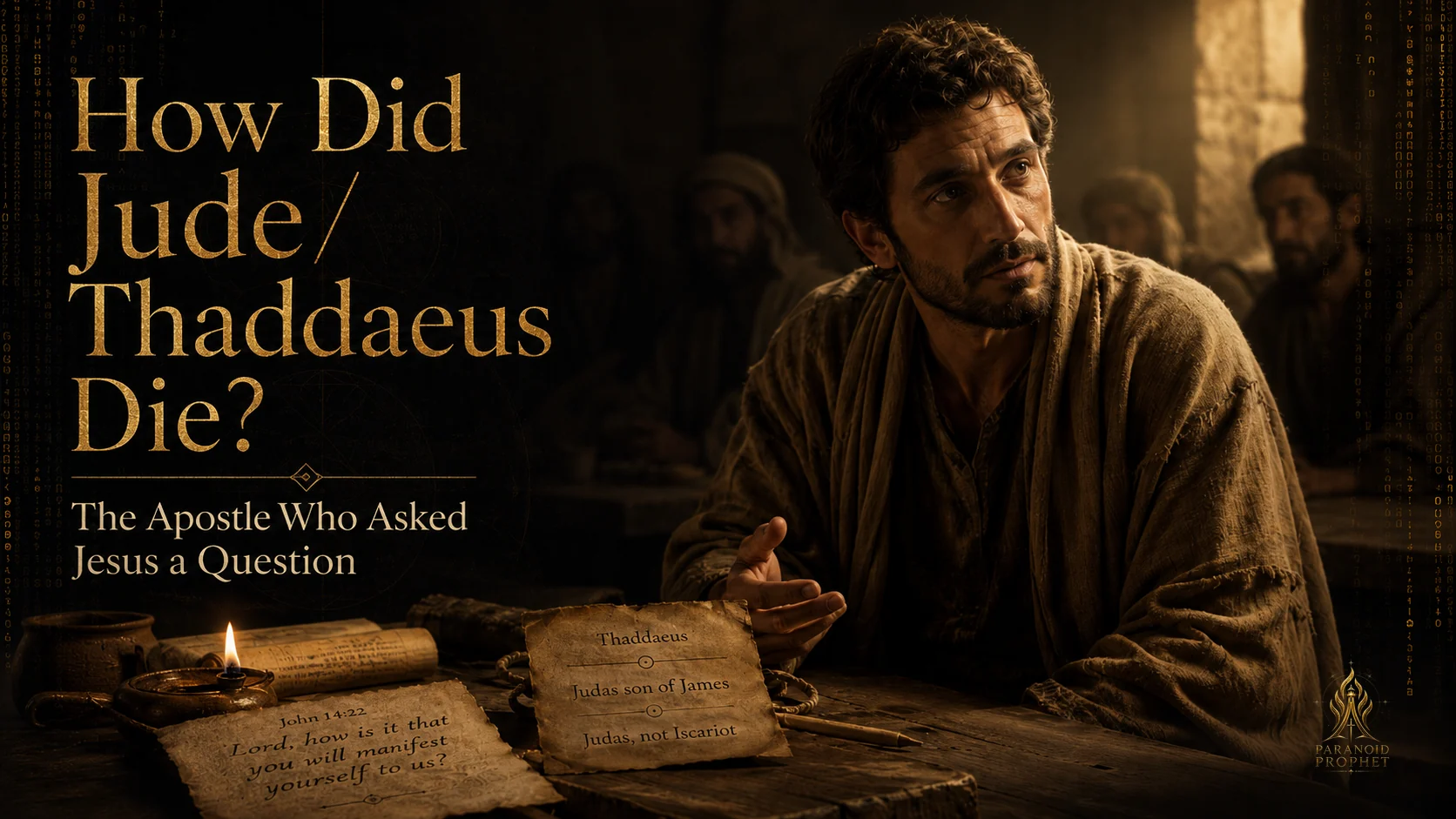
How did Jude/Thaddaeus die? Scripture does not tell us. The New Testament names him among the Twelve, distinguishes him from Judas Iscariot, and preserves one question he asked Jesus, but it does not record his final mission field, death scene, or exact method of martyrdom.
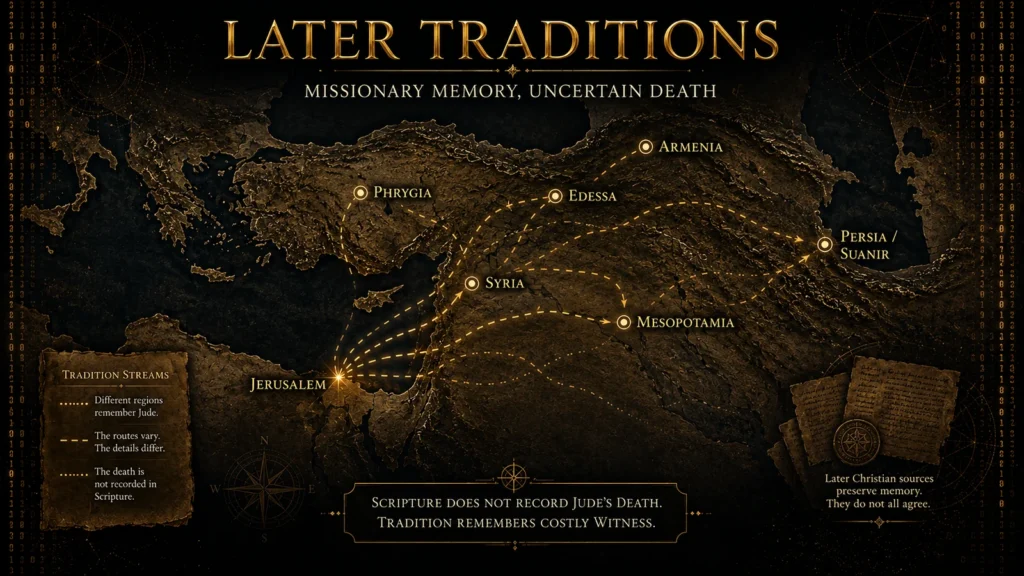
Later Christian tradition remembers Jude/Thaddaeus as a missionary and possible martyr, often linked with Simon the Zealot. Some traditions place his death in Persia. Other streams connect Thaddaeus traditions with Armenia, Edessa, Syria, Mesopotamia, or related eastern mission fields. The reported methods also vary, which means the tradition should be handled carefully rather than flattened into one certain death scene.
The strongest starting point is not his death. It is his identity. Jude/Thaddaeus was one of the Twelve apostles Jesus chose. He was not Judas Iscariot. He is commonly identified with “Judas, not Iscariot,” the disciple who asked Jesus why He would reveal Himself to the disciples and not to the world.
That question gives this article its center. Jude is remembered by later tradition for how he may have died, but Scripture remembers him for what he asked Jesus. His clearest testimony is not a certain death scene. It is his apostolic identity and his question that led Jesus to speak about love, obedience, and the presence of God with His people.
Bottom line: Jude/Thaddaeus was one of the Twelve apostles. He should not be confused with Judas Iscariot. Scripture does not record his death. Later traditions remember him as a missionary and possible martyr, often with Simon the Zealot, but the exact place and method remain uncertain.
Source discipline: This article does not claim the Bible records Jude/Thaddaeus’s death. It does not treat every Jude, Judas, Thaddaeus, Addai, or eastern tradition as automatically identical. It treats the common identification of Thaddaeus, Judas son of James, and “Judas, not Iscariot” as likely and traditional, while distinguishing biblical evidence from later martyrdom tradition.
Article Guide15 sections
Evidence Map for Jude/Thaddaeus
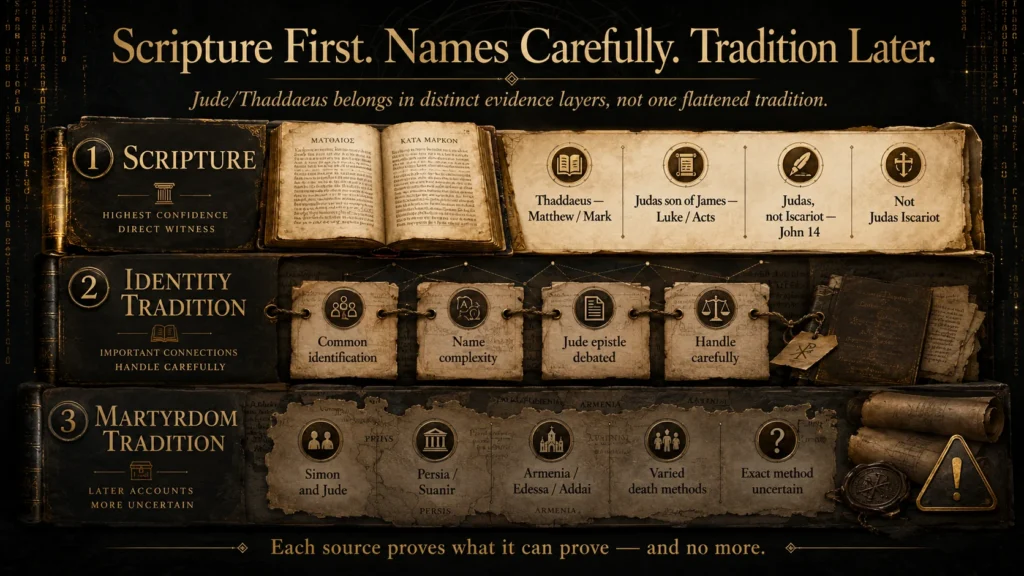
Jude/Thaddaeus needs a careful evidence map because his story is easy to confuse. His name appears in different forms. His identity is sometimes blurred with other figures. His later death traditions vary by region and source. A responsible article should let each source prove what it can prove, and no more.
The first layer is Scripture. The second layer is identity tradition. The third layer is martyrdom tradition. Those layers belong together, but they do not carry the same level of certainty.
| Claim | Evidence strength | Best use |
|---|---|---|
| Thaddaeus appears among the Twelve in Matthew and Mark | Very strong | Biblical identity |
| Judas son of James appears among the Twelve in Luke and Acts | Very strong | Naming and identity discussion |
| “Judas, not Iscariot” asks Jesus a question in John 14 | Strong | Biblical heart of the article |
| Jude/Thaddaeus is distinct from Judas Iscariot | Very strong | Avoid confusion with the betrayer |
| Thaddaeus, Judas son of James, and Judas not Iscariot are commonly identified as the same apostle | Likely / traditional | Explain carefully |
| Jude/Thaddaeus wrote the Epistle of Jude | Debated | Mention cautiously, not central |
| Jude/Thaddaeus died with Simon the Zealot | Later tradition | Tradition history |
| Exact place and method of death | Uncertain | Do not overclaim |
This map does not weaken the article. It strengthens it. Jude/Thaddaeus does not need an exaggerated death claim to matter. Scripture already gives him a place among the Twelve and a question before Christ. Later tradition can be meaningful, but it must stay in its proper lane.
Which Jude, Judas, or Thaddaeus Are We Talking About?
The first challenge in this article is not martyrdom. It is names. Jude/Thaddaeus appears in a cloud of similar names: Judas, Jude, Thaddaeus, Judas son of James, Judas not Iscariot, and later eastern Thaddaeus traditions. If those names are blurred too quickly, the article becomes less trustworthy.
That is why the identity work has to come before the death tradition. Before asking how Jude/Thaddaeus died, we need to ask which Jude, which Judas, and which Thaddaeus we mean.
| Name or title | Where it appears | How to handle it |
|---|---|---|
| Thaddaeus | Matthew and Mark apostle lists | One of the Twelve |
| Judas son of James | Luke and Acts apostle lists | Commonly identified with Thaddaeus |
| Judas, not Iscariot | John 14:22 | Distinguished from the betrayer |
| Jude, brother of James | Jude 1:1 | Possible author connection, debated |
| Thaddaeus / Addai traditions | Eastern Christian and apocryphal traditions | Handle cautiously |
The safest approach is to build the article on what Scripture clearly gives, then explain later identifications and traditions carefully. Jude/Thaddaeus should not disappear into confusion. He was not Judas Iscariot. He belonged to the Twelve. He asked a real question preserved in John’s Gospel.
He Was Not Judas Iscariot
The most important identity distinction is this: Jude/Thaddaeus was not Judas Iscariot. John makes that clear by calling him “Judas, not Iscariot” in John 14:22.
That phrase matters. John refuses to let this apostle disappear under the shadow of the betrayer. One Judas betrayed Jesus. Another Judas asked how Jesus would reveal Himself. The names may sound similar, but the men are not the same.
Many readers hear “Judas” and immediately think of betrayal. But Jude/Thaddaeus belongs in a different lane. He is not remembered in Scripture as the traitor. He is remembered as one of the Twelve and as the disciple whose question drew out Jesus’ teaching about love, obedience, and divine presence.
That is why this article will not let Judas Iscariot define him. Jude/Thaddaeus should be understood in relation to Christ’s calling, not the betrayer’s shadow.
Thaddaeus in Matthew and Mark
Matthew and Mark list Thaddaeus among the Twelve apostles. In Matthew 10:2–4, Thaddaeus appears in the apostolic list after James son of Alphaeus and before Simon the Zealot. In Mark 3:16–19, he appears again among the Twelve Jesus appointed.
That gives the article a firm biblical anchor. Thaddaeus is not merely a later saint from church legend. He appears in the New Testament apostle lists. Whatever later traditions say about his mission or death, the starting point is that he belonged to the Twelve.
Mark also places the naming of the Twelve inside Jesus’ appointment of apostles “so that they might be with him and he might send them out to preach.” Thaddaeus belonged to that apostolic pattern: with Jesus, then sent by Jesus.
Scripture does not give Thaddaeus a long biography in Matthew or Mark. It gives him a name and a place. That is still significant. No apostle named by Christ is filler in the story of His kingdom.
Judas Son of James in Luke and Acts
Luke and Acts use a different name. In Luke 6:12–16, the apostle list names “Judas the son of James.” In Acts 1:13, after the ascension of Jesus, the same naming pattern appears again.
Many Christian traditions identify this Judas son of James with Thaddaeus in Matthew and Mark. That is a reasonable and common harmonization because the lists are naming the Twelve and the names appear in corresponding places. Still, the article should acknowledge the naming complexity instead of pretending it does not exist.
The phrase itself has also been handled differently in Bible tradition. Many modern translations render it “Judas son of James,” while some older traditions have understood it as “Judas brother of James.” Either way, the key point for this article remains the same: Luke and Acts name a Judas among the apostles who is not Judas Iscariot.
Acts 1 adds an important witness detail. This apostle is named in the post-ascension apostolic company. He is not only a pre-cross name in a list. He is remembered among the apostles after Jesus’ resurrection and ascension, gathered before the public mission of the church moves outward.
That matters because the article’s foundation is not a late death tradition. It is apostolic identity. Jude/Thaddaeus belonged to the witness circle Jesus chose and sent.
Judas, Not Iscariot, in John 14
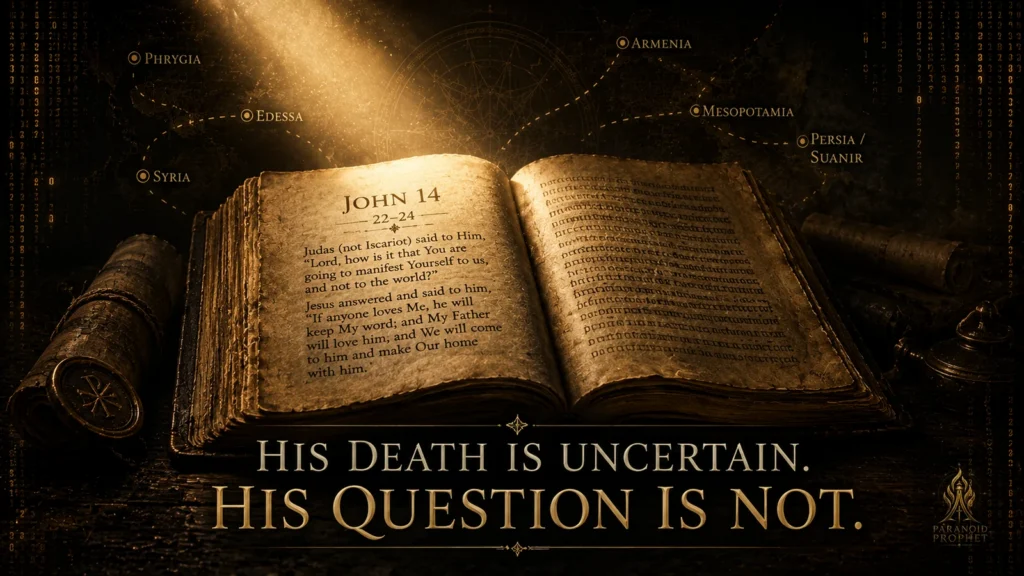
The most personal New Testament moment attached to Jude/Thaddaeus comes in John 14:22–24. There, “Judas, not Iscariot,” asks Jesus, “Lord, how is it that you will manifest yourself to us, and not to the world?”
This question is not a distraction from the article. It is the heart of the article. If the reader only asks how Jude/Thaddaeus died, he may miss the deeper biblical gift. Jude’s one recorded question leads directly into Jesus’ teaching about love for Christ, obedience to His word, the Father’s love, and God making His home with His people.
That means Jude/Thaddaeus is not merely a confusing name in an apostle list. Scripture gives him one recorded question before Jesus. That question opens a window into Christ’s promise of divine nearness.
The order matters. First, identify Jude/Thaddaeus carefully. Then listen to the question he asked Jesus. Only after that should the article weigh the later traditions about his mission and death.
Did Jude/Thaddaeus Write the Book of Jude?
Another common question is whether Jude/Thaddaeus wrote the Epistle of Jude. Some Christian traditions identify Jude the apostle with the author of the letter. Other interpreters distinguish them.
The letter itself opens with the words, “Jude, a servant of Jesus Christ and brother of James” in Jude 1:1. That description has been understood in different ways. Some connect this Jude to the apostle. Others connect him to Jude, the brother of Jesus, because the Gospels mention Jesus’ brothers, including James and Judas.
This article does not need to settle that debate to answer its main question. The article is about Jude/Thaddaeus the apostle: the one named among the Twelve, distinguished from Judas Iscariot, and connected with the question in John 14.
The Epistle of Jude can be mentioned as an identity question, but it should not take over the article. The stronger path is to stay focused: Scripture gives Jude/Thaddaeus an apostolic place and one recorded question to Jesus. Later tradition gives varied memories of mission and martyrdom. Those lanes need to remain clear.
Once the name confusion is cleared away, Jude/Thaddaeus becomes more than a difficult apostle to label. Scripture gives him one recorded question to Jesus, and that question opens one of the richest promises Christ ever gave about love, obedience, and the presence of God.
Jude’s Question to Jesus in John 14
The most important biblical moment attached to Jude/Thaddaeus is not his death. It is his question. In John 14:22–24, “Judas, not Iscariot” asks Jesus why He will manifest Himself to the disciples and not to the world.
That question gives this article its biblical heart. Jude is remembered by later tradition for how he may have died, but Scripture remembers him for what he asked Jesus. His question did not produce a side note. It drew out one of Christ’s most intimate promises about love, obedience, and the presence of God with His people.
This is where Jude/Thaddaeus becomes more than a difficult name in the apostle lists. He is not Judas Iscariot. He is not merely a later martyrdom tradition. He is the disciple whose question opened a window into how Jesus reveals Himself to those who love Him.
Before we weigh how Jude may have died, we should listen to what Jesus said when Jude asked.
“Lord, How Is It That You Will Manifest Yourself to Us?”
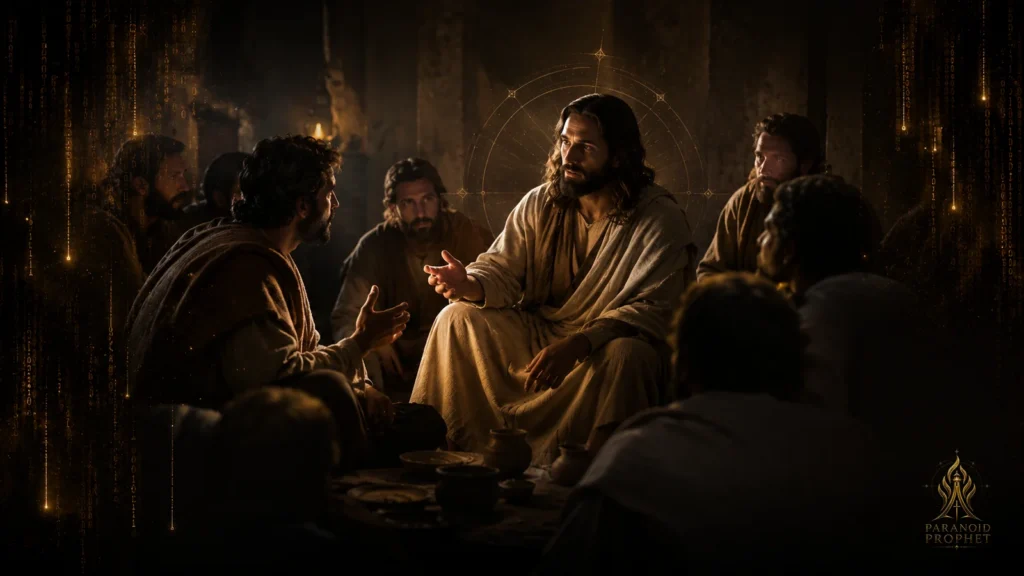
Jude’s question comes in the upper-room teaching of Jesus. Christ has been speaking to His disciples about His departure, the coming Helper, love, obedience, and the way He will reveal Himself to those who belong to Him. Then Judas, not Iscariot, asks, “Lord, how is it that you will manifest yourself to us, and not to the world?”
This is not the voice of betrayal. It is the voice of a disciple trying to understand the hiddenness and nearness of Christ. Jude hears Jesus speaking about manifestation, but he does not yet understand how Jesus will reveal Himself to His own people without revealing Himself to the world in the same way.
The question is honest. It is also useful. Jude asks something many readers still wonder about: Why does Jesus make Himself known to His people in a way the world does not recognize? Why does faith see what unbelief misses? Why is Christ’s presence real even when it is not displayed as a public spectacle on the world’s terms?
Jude’s question gives Jesus room to answer on His own terms. Christ does not explain His manifestation as political display, public conquest, or worldly fame. He answers by describing the life of those who love Him and keep His word.
One Judas betrayed Jesus. Another Judas asked how Jesus would reveal Himself. John makes sure we know the difference.
Jesus Answers With Love, Obedience, and the Presence of God
Jesus answers Jude with a promise deeper than public spectacle. He says that if anyone loves Him, that person will keep His word. The Father will love him. Then Jesus says, “we will come to him and make our home with him.”
Jude asked about manifestation. Jesus answered with indwelling.
That answer is theologically rich. Jesus does not say that He will be known through curiosity, fame, or force. He speaks of love for Him, obedience to His word, the Father’s love, and the presence of God with the believer. The revelation Jude asks about is not merely outward display. It is covenant nearness. It is the Father and Son making their home with those who love Christ.
Jesus also grounds His words in the Father. He says that the word the disciples hear is not merely His own private message, but the word of the Father who sent Him. That matters for Christology. Jesus does not speak as a detached religious teacher guessing about God. He speaks as the Son sent by the Father, revealing the Father’s will and promising divine presence to His people.
This is why Jude’s question matters. It leads Jesus to clarify that true revelation is not only about who sees a sign. It is about who loves the Son, keeps His word, and receives the presence of the Father and Son. Christ reveals Himself to His people in a way the world cannot control, manufacture, or reduce to spectacle.
Jude asked once, but the answer has served the church across the centuries.
Jude’s Question Reveals More About Jesus Than About Jude
Jude/Thaddaeus matters here not because his question makes him the center, but because his question draws our eyes to Christ. The article should not turn Jude into the hero. Jesus is the revelation. Jesus is the Lord who speaks. Jesus is the Son who promises the nearness of God.
His answer reveals that Jesus is not merely leaving His disciples with memories. He promises presence. He is not merely handing them instructions and disappearing from the story. He teaches that love for Him is joined to obedience, that the Father loves those who love the Son, and that the Father and Son will make their home with them.
That is a massive claim. Jesus places Himself at the center of love, obedience, revelation, and divine fellowship. The question Jude asks allows Jesus to speak in a way that is deeply personal and deeply theological at the same time.
This is the strongest biblical connection between Jude/Thaddaeus and Jesus. Tradition may remember Jude as a missionary and martyr, and that may matter. But John gives us something stronger and earlier: a disciple asking Jesus a question, and Jesus answering with a promise of the Father and Son making their home with His people.
His death tradition may be uncertain, but his question to Jesus is not.
What Did Jude/Thaddaeus Achieve?
If achievement means fame, Scripture gives Jude/Thaddaeus very little. But if achievement means being chosen by Jesus, named among the Twelve, preserved in the apostolic company after the ascension, and remembered for a question that drew out one of Christ’s most intimate promises, then his achievement is not small.
His achievement was not celebrity. It was witness — and one honest question that led Jesus to speak about the presence of God with His people.
Modern readers often measure importance by visibility. We assume the people who speak the most, appear the most, or leave the longest record are the ones who mattered most. Scripture challenges that instinct. The kingdom of Christ is not built on celebrity. It is built by the Lord who calls, sends, strengthens, and preserves His servants.
Jude/Thaddaeus reminds us that a man can matter deeply in the story of Jesus even when his personal biography is short. The question is not whether Jude became famous. The question is whether Christ chose him, included him among the Twelve, and preserved his witness in Scripture. The New Testament says yes.
He Was Chosen by Jesus
Before later tradition remembered Jude/Thaddaeus as a missionary or martyr, Jesus chose him as an apostle. Matthew and Mark name Thaddaeus among the Twelve. Luke and Acts name Judas son of James in the apostolic company. John remembers “Judas, not Iscariot” asking Jesus a question. The naming details require care, but the apostolic identity remains central.
That matters because Jude/Thaddaeus was not a later symbol invented to fill out a devotional tradition. He belonged to the circle of men Jesus chose and sent. He was attached to the ministry of Christ before any later tradition attached a death story to his name.
This keeps the article grounded. The strongest foundation is not Persia, Armenia, an axe, a club, or any later martyrdom scene. The strongest foundation is that Jesus chose him. The death traditions will need careful ranking, but Jude’s apostolic identity is already enough to make him worth studying.
No apostle named by Christ is filler in the story of His kingdom.
He Asked a Question That Served the Church
Jude’s question served the church because Jesus’ answer was preserved for all disciples. He asked once, but the answer did not end with him. Every believer who reads John 14 receives the benefit of the question.
Jude asked how Jesus would reveal Himself to His disciples and not to the world. Jesus answered by teaching that love for Him is shown by keeping His word, that the Father loves those who love the Son, and that the Father and Son will make their home with them.
That answer has comforted, corrected, and strengthened Christians across generations. It teaches that Christ’s presence is not shallow emotion or religious imagination. It is tied to love, obedience, the Father’s love, and the promise of divine fellowship.
So Jude’s achievement is not that he became famous. It is that his question became a doorway for Jesus’ teaching. The apostle speaks once in the Gospel record, and Christ’s answer still nourishes the church.
That is not a small legacy.
He Belonged to the Witness Circle
Jude/Thaddaeus also belonged to the witness circle Jesus chose and sent. The Twelve were not simply interested listeners. They were appointed to be with Jesus and to be sent out. They heard His teaching, saw His works, lived under His authority, and became part of the apostolic witness that carried His name after the resurrection.
Acts remembers Judas son of James in the post-ascension apostolic company. That does not give us a private speech, individual resurrection appearance, or personal mission diary. It does not need to. It places him among the gathered apostles after Jesus had risen and ascended.
That is meaningful. Jude/Thaddaeus stands in the apostolic company on the resurrection side of the story. His testimony is not preserved as a long solo sermon, but his name remains among the witnesses Jesus chose.
This matters for the larger Jesus evidence lane. Christianity did not begin as vague admiration for a distant religious symbol. It began with testimony about Jesus: His kingdom, His authority, His death, His resurrection, and His lordship. Jude/Thaddaeus belongs to that witness pattern, even when his individual biography remains brief.
Why Jude/Thaddaeus Matters Before We Discuss His Death
If we rush straight to Persia, Armenia, axes, clubs, relics, or martyrdom scenes, we miss the clearest biblical testimony. Jude/Thaddaeus first matters because Jesus chose him, John distinguishes him from the betrayer, and Scripture preserves his question to Christ.
His death tradition may be meaningful. But his connection to Jesus is stronger than the later details of his death. Scripture gives us a disciple in the upper room asking how Jesus will reveal Himself. Jesus answers by pointing to love, obedience, the Father’s love, and the presence of God with His people.
That is the center of the article. Jude/Thaddaeus should not be reduced to a disputed martyrdom method. He should be remembered first as an apostle of Jesus Christ, a man distinct from Judas Iscariot, and a witness whose question drew out one of the richest promises in John’s Gospel.
What Later Tradition Says About Jude/Thaddaeus’s Mission and Death
Once Jude/Thaddaeus’s biblical witness is clear, the later traditions can be weighed in their proper place. They should not become the foundation of the article, but they should not be ignored either. Scripture does not record how Jude/Thaddaeus died. Later Christian tradition, however, often remembers him as a missionary and possible martyr whose witness to Christ became costly.
The traditions vary by region and source. Some connect Jude/Thaddaeus with Simon the Zealot. Some place his ministry and death in Persia. Other streams connect Thaddaeus traditions with Armenia, Edessa, Syria, Mesopotamia, Phrygia, or surrounding eastern mission fields. The death methods also vary: axe, club, spear, sword, arrows, or another violent end.
That variation matters. It does not make every tradition worthless. It means the evidence must be ranked honestly. Later tradition can preserve meaningful Christian memory, but it should not be treated as equal to Scripture or forced into one certain death scene.
The traditions agree more clearly that Jude/Thaddaeus was remembered as a costly missionary witness than they agree on exactly where or how he died.
The Simon and Jude Tradition
The best-known later tradition links Jude/Thaddaeus with Simon the Zealot. The two are often commemorated together, remembered together, and placed together in eastern mission fields. This connection explains why many readers hear that Jude died alongside Simon.
In this tradition, Jude is not remembered as an isolated devotional figure. He is remembered as an apostolic missionary, joined with another apostle, bearing witness to Christ beyond the land of Israel. That is meaningful as tradition history. It shows how Christian memory understood Jude/Thaddaeus not merely as a difficult name in a list, but as a sent witness.
But the article must stay careful. Scripture does not say Jude died with Simon. The New Testament lists Simon and Jude near each other, but it does not narrate a shared mission or shared martyrdom. The Simon-and-Jude pairing belongs to later tradition, not to a biblical death account.
That does not make the tradition useless. It simply means we should use it in the right lane. The tradition can show how the church remembered Jude and Simon as missionary companions and martyrs. It cannot, by itself, prove every detail of their route, trial, or death.
Tradition can be honored without being exaggerated.
The Persia and Suanir Tradition
Persia is one of the most common traditional answers to where Jude/Thaddaeus died. Vatican News summarizes the tradition associated with Fortunatus of Poitiers, who states that Simon and Jude Thaddaeus were buried in Suanir, a city in Persia, where they suffered martyrdom.
This gives the article a real tradition to discuss. It is more useful than a vague claim that “Jude died somewhere in the East.” It names a region, links Jude with Simon, and remembers martyrdom as the outcome of their mission.
Still, common tradition is not the same thing as biblical certainty. Persia may be the most familiar traditional answer, but the New Testament does not place Jude’s final mission field there. The careful wording is that later tradition often places Jude/Thaddaeus’s martyrdom in Persia, especially in connection with Simon the Zealot, while Scripture does not record that death.
The Persia tradition is meaningful because it remembers Jude as a witness beyond the familiar Gospel geography. It presents the apostle as one who carried the name of Christ into hostile territory. But the claim must remain a tradition, not a certainty equal to Acts.
The safest answer is this: later tradition often links Jude/Thaddaeus with Simon the Zealot and remembers them as martyrs in Persia, but Scripture does not record the event.
The Passion of Simon and Jude
Another major tradition appears in the apocryphal Passion of Simon and Jude. NASSCAL classifies this work as an apocryphal act. That category matters. This is not Scripture. It is later Christian tradition history.
In this tradition, Simon and Jude travel, preach, confront false worship, and eventually reach Suanir. Priests demand that they sacrifice to the gods of the sun and moon. Simon and Jude refuse. The story includes visions, demons emerging from idols, lightning striking a temple, and the apostles being killed by angry priests.
Those features show why the text must be handled carefully. It is not a simple execution record. It is a later passion narrative with theological, polemical, and legendary elements. The miracles, dramatic idol scenes, and temple-collapse imagery are part of the story-world of apocryphal apostolic literature.
The value of the Passion of Simon and Jude is not that it gives a clean courtroom transcript of Jude’s final hour. Its value is that it preserves a tradition in which Jude’s witness to Christ is public, confrontational, and costly.
That is useful for the article’s larger argument. Jude/Thaddaeus is not remembered merely as a name or as a private saint of later devotion. In this tradition, he is remembered as a missionary witness whose loyalty to Christ clashes with idolatry. The exact historical details remain uncertain, but the memory of costly witness is clear.
This is how the tradition should be used: not as proof that every detail happened exactly as told, but as evidence that Christian memory connected Jude/Thaddaeus with proclamation, opposition, and martyrdom.
The Armenian and Thaddaeus Tradition
Another stream of tradition connects Thaddaeus with Armenia and other eastern regions. These traditions are important, but they require caution because the name Thaddaeus can appear in several related streams, including Edessa, Addai, and Armenian missionary memory.
The Martyrdom of Thaddaeus preserves a later tradition in which Thaddaeus is appointed to Armenia by lot, stops in Edessa, preaches and heals, and eventually faces royal opposition under King Sanatruk. The account includes dramatic miracle material, mass conversions, imprisonment scenes, and appearances of Jesus that encourage Thaddaeus and his followers.
This tradition should not be flattened into the same category as the apostle lists or John 14. It is not a biblical account. It is also not a modern biography. It belongs to later Christian memory, shaped by regional tradition, devotion, and apocryphal storytelling.
Still, it is useful when handled properly. It shows that Thaddaeus was remembered in eastern Christian tradition as a missionary figure and sufferer for the faith. It also helps explain why some readers find traditions placing Jude/Thaddaeus in Armenia or related eastern mission fields rather than Persia alone.
The article should not choose Armenia against Persia as if one late tradition easily cancels the other. It should say the truth carefully: different later traditions place Jude/Thaddaeus, or Thaddaeus-like figures, in different eastern mission fields. Those traditions support a memory of missionary witness, but they do not give one certain itinerary.
The Fragmentary Martyrdom of Judas Thaddaeus
The Martyrdom of Judas Thaddaeus is useful for source discipline because its title directly uses the combined name Judas Thaddaeus. It also shows how later Christian tradition could connect Judas Thaddaeus with places such as Syria, Mesopotamia, Phrygia, Edessa, Artaz, and Jerusalem.
But this source is also a warning against overconfidence. NASSCAL describes the text as preserved in a single fragmentary manuscript that yields very little readable text. What can be deciphered includes the title, a broad missionary context, and only brief damaged references connected with accusations and death.
A fragmentary tradition can be useful without being decisive. It may show that Christian communities remembered Judas Thaddaeus as a missionary witness, but it cannot bear the full weight of certainty about his final hour.
This is especially important because Jude/Thaddaeus traditions overlap with other eastern Christian story-worlds. Edessa traditions, Addai traditions, Armenian traditions, and Judas Thaddaeus traditions can touch the same broad region of Christian memory while not always giving the same clean historical profile.
The responsible conclusion is not, “Ignore the tradition.” The responsible conclusion is, “Use the tradition for what it can show.” It can show that Jude/Thaddaeus was remembered as a missionary figure in eastern Christian memory. It cannot prove every detail of his death beyond dispute.
That distinction is the difference between source discipline and wishful apologetics.
Why the Death Method Varies
Readers will find different answers for how Jude/Thaddaeus died. Some say he was killed with an axe. Others say a club, spear, sword, arrows, stones, or another weapon. Some traditions link him with Simon the Zealot in Persia. Others connect Thaddaeus traditions with Armenia, Edessa, Syria, Mesopotamia, Phrygia, or nearby eastern regions.
The variation exists because the sources vary. Different regions preserved different traditions. Different devotional and iconographic streams attached different symbols to the apostle. Later passion narratives developed with theological and legendary features. Popular saint traditions sometimes compress those details into one simple answer.
That does not mean Jude was not remembered as a martyr. It means the article should not state one method as certain. A club, axe, spear, sword, arrow, or stone may appear in later tradition, but none of those can be given the same confidence as a death recorded in Scripture.
The better conclusion is careful: Jude/Thaddaeus was remembered in later tradition as a missionary and possible martyr, often linked with Simon the Zealot, but the exact method and location of his death remain uncertain.
How Strong Is the Martyrdom Evidence for Jude/Thaddaeus?
The martyrdom evidence for Jude/Thaddaeus is meaningful, but it is not first-tier. It is stronger as tradition history than as courtroom-style proof. Scripture does not record his death. Later sources remember him as a missionary and martyr, often with Simon, but the place and method vary.
That means Jude/Thaddaeus should not be used as a standalone martyrdom proof for the resurrection. His death tradition is too late and varied to carry that kind of weight. But his traditions still matter when placed in the larger pattern of apostolic witness.
The strongest foundation remains Scripture: Jude/Thaddaeus belonged to the Twelve, was distinct from Judas Iscariot, and is remembered in John 14 for a question to Jesus. Later tradition then remembers him as a missionary witness whose proclamation of Christ may have cost him his life.
That is a strong enough claim. It does not need inflation.
| Source or tradition | What it supports | What it does not prove |
|---|---|---|
| Scripture | Jude/Thaddaeus was one of the Twelve; Judas not Iscariot asked Jesus a question | His death method or final mission field |
| Persia / Suanir tradition | Later memory of Simon and Jude as martyrs in Persia | Biblical-level certainty about location |
| Passion of Simon and Jude | Later tradition of joint witness, conflict with idolatry, and martyrdom | A clean historical transcript of their deaths |
| Armenian / Thaddaeus tradition | Eastern memory of Thaddaeus as missionary and martyr | Simple identity certainty across every Thaddaeus stream |
| Martyrdom of Judas Thaddaeus | Fragmentary missionary memory connected with Judas Thaddaeus and eastern regions | Complete certainty about exact death scene |
| Popular iconography | Axe, club, spear, sword, arrows, or other martyrdom imagery | A secure death method |
This table is not designed to weaken Jude’s witness. It is designed to keep the article honest. Christian evidence is stronger when it does not exaggerate. Jude/Thaddaeus’s martyrdom tradition is meaningful, but it must be carried carefully.
The martyrdom traditions for Jude/Thaddaeus are not clean enough to carry the whole apologetic argument. The final step is to ask what we can say carefully, what we should not claim, and how Jude’s witness still contributes to the larger case for Jesus.
What We Can Say Carefully About Jude/Thaddaeus
After sorting the biblical evidence and later traditions, the careful answer becomes clearer. Jude/Thaddaeus was one of the Twelve apostles. He was not Judas Iscariot. The New Testament remembers him through more than one name pattern, and John preserves one question he asked Jesus in the upper-room teaching.
We can say confidently that Scripture places him inside the apostolic circle. Matthew and Mark name Thaddaeus among the Twelve. Luke and Acts name Judas son of James among the apostles. John distinguishes “Judas, not Iscariot,” and records his question to Jesus about how Christ would manifest Himself to the disciples and not to the world.
We can also say that Jesus answered Jude’s question with one of the most intimate promises in John’s Gospel. Christ spoke of love for Him, obedience to His word, the Father’s love, and the Father and Son making their home with the believer. That is the article’s strongest biblical center.
Scripture does not record Jude/Thaddaeus’s death. No New Testament passage gives his final mission field, trial, execution, burial place, or death method. Later tradition remembers him as a missionary and possible martyr, often linked with Simon the Zealot, but those traditions vary by source and region.
The careful conclusion is this: Jude/Thaddaeus was a real apostolic witness in Scripture, distinct from Judas Iscariot, remembered for a question to Jesus, and later remembered by Christian tradition as a costly witness to Christ. The exact place and method of his death remain uncertain.
What We Should Not Claim
A strong Christian case does not need fragile certainty. Jude/Thaddaeus is worth studying without pretending the evidence says more than it does.
- We should not claim that the Bible records his death. It does not.
- We should not claim that he definitely died in Persia, Armenia, Beirut, Edessa, Syria, Mesopotamia, or any one final location.
- We should not claim that he was definitely killed by an axe, club, spear, sword, arrows, stones, or any one weapon.
- We should not claim that he definitely died with Simon the Zealot as a matter of biblical fact.
- We should not claim that Jude/Thaddaeus definitely wrote the Epistle of Jude.
- We should not claim that his martyrdom tradition, by itself, proves the resurrection.
The stronger claim is more careful and more persuasive: Jude/Thaddaeus belonged to the apostolic company Jesus chose and sent. His question to Jesus is preserved in Scripture. Later Christian memory remembered him as a missionary and possible martyr. His story contributes to the wider pattern of apostolic witness, but it should not be overstated.
Why Jude/Thaddaeus Still Matters for the Jesus Evidence Case
Jude/Thaddaeus matters because his story keeps the evidence in the right order: Scripture first, historical and tradition evidence second, apologetic synthesis last.
His death tradition may be mixed, but his connection to Jesus is clear. Jesus chose him as one of the Twelve. John distinguishes him from Judas Iscariot. Scripture preserves his question to Christ. Jesus answered that question with a promise of the Father and Son making their home with those who love Him and keep His word.
That means Jude/Thaddaeus should not be reduced to a disputed martyrdom method. If the article ends only with an axe, club, spear, sword, or map location, it misses the better biblical treasure. Jude asked how Jesus would reveal Himself. Jesus answered with love, obedience, the Father’s love, and the presence of God with His people.
That is not a small contribution. Jude asked once, and the answer has served the church across the centuries.
His Story Is Cumulative, Not Standalone Proof
Jude/Thaddaeus should not carry the whole resurrection argument. He does not need to. The broader resurrection case rests on Scripture, Jesus’ death by crucifixion, early resurrection proclamation, apostolic witness, appearance claims, and the serious but debated evidence surrounding the empty tomb.
Paul’s summary in 1 Corinthians 15:3–8 gives the larger apostolic proclamation: Christ died, was buried, was raised, and appeared. Jude/Thaddaeus should be placed within that wider apostolic witness pattern, not forced to bear more evidential weight than his own record can carry.
Later martyrdom traditions can support the remembered cost and sincerity of the apostolic mission, but they do not prove the resurrection by themselves. In Jude’s case, the traditions are meaningful but varied. They are useful for tradition history, not as a clean execution record.
The uncertain death tradition does not silence the certain biblical witness.
His Question Points Beyond Martyrdom
Jude’s question points beyond martyrdom because it points directly to Christ. He asks about the manifestation of Jesus. Jesus answers by revealing how He and the Father will be present with those who love Him.
This is why Jude’s article should not become a list of possible death methods. The death traditions matter, but they are not the heart. The heart is Jesus Christ revealing Himself on His own terms, not by worldly spectacle, but by covenant presence with His people.
Jude/Thaddaeus points beyond his confusing names to the Lord who knew exactly whom He had chosen. His name may require careful sorting. His death may require cautious wording. But his question to Jesus remains clear.
The article should not end with uncertainty. It should end with Christ.
Common Objections About Jude/Thaddaeus
Objection: “Was Jude/Thaddaeus Judas Iscariot?”
No. Jude/Thaddaeus was not Judas Iscariot. John 14:22 explicitly calls him “Judas, not Iscariot.” That distinction matters because the name Judas immediately makes many readers think of betrayal. Scripture itself prevents that confusion.
One Judas betrayed Jesus. Another Judas asked how Jesus would reveal Himself. Jude/Thaddaeus should not be remembered under the shadow of the betrayer. He belongs to the apostolic witness of Jesus Christ.
Objection: “Was Jude the Same as Thaddaeus?”
Jude, Judas son of James, and Thaddaeus are commonly identified as the same apostle in Christian tradition. Matthew and Mark name Thaddaeus among the Twelve, while Luke and Acts name Judas son of James in the apostolic lists.
That common identification is reasonable, but it should be explained rather than assumed. The naming issue is real, and careful handling makes the article more trustworthy. The main point remains: this apostle was one of the Twelve and was not Judas Iscariot.
Objection: “Was Judas Son of James the Son or Brother of James?”
Many modern translations render the phrase as “Judas son of James.” Some older or traditional readings have understood it as “Judas brother of James.” The Greek wording has been discussed in different Bible traditions.
This article does not need to build too much on that phrase. Whether the relationship is understood as son or brother in a given tradition, the important point is that Luke and Acts name a Judas among the apostles who is not Judas Iscariot and who is commonly identified with Thaddaeus.
Objection: “Did Jude/Thaddaeus Write the Book of Jude?”
That question is debated. Jude 1:1 identifies the author as “Jude, a servant of Jesus Christ and brother of James.” Some traditions connect this Jude with the apostle Jude/Thaddaeus. Others connect him with Jude, the brother of Jesus, or distinguish him from the apostle.
This article does not depend on settling that debate. The focus here is Jude/Thaddaeus the apostle: the one connected with the Twelve, distinguished from Judas Iscariot, and remembered in John 14 for his question to Jesus.
Objection: “Did Jude/Thaddaeus Die With Simon the Zealot?”
Later tradition often says Jude/Thaddaeus died with Simon the Zealot, especially in traditions associated with Persia. Vatican News summarizes the Fortunatus/Suanir tradition, which remembers Simon and Jude as buried in Persia after suffering martyrdom. The apocryphal Passion of Simon and Jude preserves another later tradition of joint witness and martyrdom.
But Scripture does not record this event. The proper wording is careful: later tradition often links Jude/Thaddaeus with Simon the Zealot in mission and martyrdom, but the New Testament does not give us a shared death account.
Objection: “How Did Jude/Thaddaeus Die?”
Scripture does not say. Later tradition remembers him as a missionary and possible martyr. Some traditions place him with Simon in Persia. Others connect Thaddaeus traditions with Armenia, Syria, Edessa, Mesopotamia, Phrygia, or nearby eastern regions. The methods vary as well, including axe, club, spear, sword, arrows, stones, or another violent death.
The careful answer is that Jude/Thaddaeus was remembered as a costly witness to Christ, but the exact place and method of his death remain uncertain.
Objection: “Are the Later Traditions Reliable?”
They are useful, but they must be ranked properly. Later traditions are not equal to Scripture. They can preserve Christian memory, regional tradition, theological emphasis, and sometimes historical echoes. But they can also develop, combine figures, reshape details, or add legendary features over time.
For Jude/Thaddaeus, the traditions are meaningful because they remember him as a missionary witness and possible martyr. But they are not strong enough to settle one certain location or death method. The right use is careful: tradition history, not biblical certainty.
Objection: “Does Jude/Thaddaeus’s Death Prove the Resurrection?”
No, not by itself. His death tradition is too late and varied to function as standalone proof. Martyrdom also proves sincerity more directly than truth. People can die sincerely for beliefs that are false.
But Jude’s story still belongs in the cumulative case. He was one of the Twelve, distinct from Judas Iscariot, and remembered in Scripture for a question to Jesus. Later tradition remembers him as a missionary and possible martyr. Together, that places him inside the wider pattern of apostolic witness to Christ.
Final Answer: How Did Jude/Thaddaeus Die?
So how did Jude/Thaddaeus die? Scripture does not record his death. The Bible names him among the Twelve, distinguishes him from Judas Iscariot, and preserves one question he asked Jesus, but it does not tell us his final mission field or death method.
Later tradition remembers Jude/Thaddaeus as a missionary and possible martyr, often linked with Simon the Zealot. Some traditions place his martyrdom in Persia. Other streams connect Thaddaeus traditions with Armenia, Syria, Edessa, Mesopotamia, Phrygia, or related eastern regions. The reported methods vary, so we should not claim certainty about the exact weapon, location, or final scene.
The strongest answer is careful: Jude/Thaddaeus was one of the Twelve, not Judas Iscariot, remembered in John 14 for a question to Jesus, and later remembered by Christian tradition as a costly witness to Christ.
Jude asked how Jesus would reveal Himself. Jesus answered with the promise that the Father and Son would make their home with those who love Him. That is the clear truth beneath the uncertain death tradition.
Frequently Asked Questions About Jude/Thaddaeus
How did Jude/Thaddaeus die?
Scripture does not record how Jude/Thaddaeus died. Later traditions remember him as a missionary and possible martyr, often with Simon the Zealot, but the exact place and method vary by source.
Was Jude/Thaddaeus Judas Iscariot?
No. John 14:22 calls him “Judas, not Iscariot.” Jude/Thaddaeus should not be confused with the betrayer.
Why is Jude called Thaddaeus?
Matthew and Mark list Thaddaeus among the Twelve, while Luke and Acts list Judas son of James. Many Christian traditions identify these as the same apostle, though the naming issue should be explained carefully.
What did Jude ask Jesus?
In John 14:22, Judas, not Iscariot, asked why Jesus would manifest Himself to the disciples and not to the world.
How did Jesus answer Jude?
Jesus answered that those who love Him keep His word, are loved by the Father, and that the Father and Son will come and make their home with them.
Did Jude/Thaddaeus die with Simon the Zealot?
Later tradition often links Jude/Thaddaeus with Simon the Zealot in mission and martyrdom, especially in traditions connected with Persia. Scripture does not record their shared death.
Was Jude/Thaddaeus martyred in Persia?
Persia is one common later tradition, especially in the Simon-and-Jude/Suanir stream. But it is later tradition, not biblical certainty.
What weapon killed Jude/Thaddaeus?
Later traditions vary. Some mention an axe, club, spear, sword, arrows, stones, or another violent death. No single method can be stated with certainty from Scripture.
Did Jude/Thaddaeus write the Book of Jude?
That is debated. Jude 1:1 identifies the author as “a servant of Jesus Christ and brother of James.” Some traditions connect him with the apostle Jude/Thaddaeus, but this article does not depend on settling that identity.
Does Jude/Thaddaeus’s death prove the resurrection?
No, not by itself. His death tradition is too varied to serve as standalone proof. But his apostolic identity, his question to Jesus, and later memory as a possible martyr contribute to the wider pattern of apostolic witness to Christ.
Read Next
- Martyrdom of Jesus’ Disciples: What Do We Actually Know?
- How Did James Son of Alphaeus Die?
- How Did Matthew Die? Evidence for Matthew’s Martyrdom Tradition
- How Did James the Brother of Jesus Die?
- Resurrection Evidence: The Case for Jesus Rising From the Dead
- Is Jesus the Son of God? Evidence from History, Prophecy, Resurrection, and Scripture
Sources and Further Reading
- Matthew 10:2–4 — Thaddaeus named among the Twelve.
- Mark 3:13–19 — Jesus appoints the Twelve, including Thaddaeus.
- Luke 6:12–16 — Judas son of James named among the Twelve.
- Acts 1:13 — Judas son of James named among the post-ascension apostolic company.
- John 14:22–24 — Judas, not Iscariot, asks Jesus a question; Jesus answers with love, obedience, and divine presence.
- Jude 1:1 — debated identity of the author of Jude.
- Britannica, “Saint Jude” — overview of Jude/Thaddaeus identity and later tradition.
- Vatican News, “Sts. Simon and Jude (Taddeo), Apostles” — later tradition linking Simon and Jude with Suanir in Persia and martyrdom.
- NASSCAL, Passion of Simon and Jude — later apocryphal tradition of joint witness and martyrdom.
- NASSCAL, Martyrdom of Thaddaeus — later eastern tradition connected with Thaddaeus.
- NASSCAL, Martyrdom of Judas Thaddaeus — fragmentary later tradition connected with Judas Thaddaeus.
- Sean McDowell, “Did the Apostles Really Die as Martyrs for their Faith?” — useful caution that martyrdom most directly supports sincerity, not automatic proof of truth by itself.
Source note: Later martyrdom traditions are included as tradition history and evidence of Christian memory. They are not treated as equal to Scripture or as first-tier proof of Jude/Thaddaeus’s exact death.

CONTINUE THE INVESTIGATION
Evidence standard continuation
Did the Apostles Die for the Resurrection? What We Can Honestly Say
Return from this individual witness tradition to the comparative source review that separates strong evidence, plausible tradition, and uncertainty.