
GUIDED ARTICLE EXPERIENCE
How Did Matthew Die? Evidence for Matthew’s Martyrdom Tradition
Read along as the narration moves through the article.
Private device narration · No hosted audio or tracking
CONTINUE GUIDED TOUR
Continue where you left off.
GUIDED TOUR COMPLETE
You have reached the end of this study.
Study record saved on this device.
GUIDED TOUR
How Did Matthew Die? Evidence for Matthew’s Martyrdom Tradition
Narrator: Paranoid Prophet Recommended Voice Native device narration
Prepare to follow the article as it is narrated.
VOICE & TOUR OPTIONS
Voice & Listening
NARRATOR
Finding a narrator…
Checking the best narrator available on this device.
Restores the best curated narrator available on this device.
Narrator choices are curated for clear, long-form listening on this device.
Screen-awake support will be checked when narration starts.
CHOOSE A NARRATOR
Curated for this device
Choose a verified narrator for this browser, or use System Narrator. Automatic mode uses the best reliable route exposed by this device; your chosen narrator is preserved even if this device needs a temporary fallback.
Preparing the guided article experience…
RESUME GUIDED TOUR?
Continue where you left off.
GUIDED TOUR COMPLETE
You have reached the end of this study.
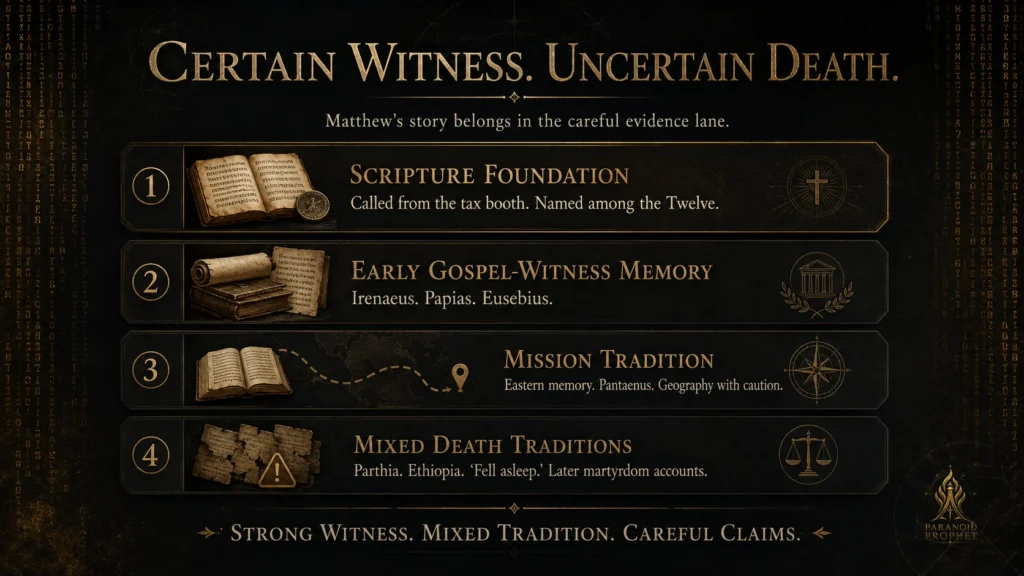
Scripture does not record Matthew’s death, and later Christian traditions vary. Some traditions remember Matthew as a martyr. Others preserve different locations, softer death language, or conflicting details about how his life ended.
That means Matthew belongs in a more cautious evidence lane than Stephen, James, Peter, or Paul. His story is still worth studying, but the strength of the case does not come from pretending we have a clean execution scene. It comes from Scripture-grounded transformation, early Gospel-witness memory, missionary tradition, and later martyrdom accounts ranked honestly.
The uncertainty around Matthew’s final moments does not erase the strength of his witness. Scripture presents him as a tax collector called by Jesus, named among the Twelve, and drawn out of an old life into public allegiance to Christ. Later Christian memory remembers him as connected to Gospel proclamation, missionary witness, and, in many traditions, costly death for the faith.
So the strongest answer is not, “Matthew definitely died this exact way in this exact place.” The stronger answer is more careful: Matthew’s death is not clearly recorded, but he was remembered by the church as an apostolic witness whose life was redirected by Jesus Christ. His story belongs in the wider study of the martyrdom of Jesus’ disciples, but it must be weighed in its own lane.
Matthew should not be used as a first-tier martyrdom proof. His death tradition does not carry the same evidential weight as Paul’s Roman martyrdom, Peter’s early Roman tradition, Stephen’s biblical death, or James the brother of Jesus in Josephus. But Matthew still strengthens the wider pattern of costly apostolic witness. The tax collector did not remain at the booth. He followed Christ.
Bottom line: The Bible does not tell us how Matthew died. The strongest evidence about Matthew is his calling by Jesus and his place among the Twelve. Early church tradition remembers him as connected to Gospel proclamation. Later traditions often remember him as a missionary and martyr, but the exact location and method of his death remain uncertain.
Source discipline: This article does not claim the Bible records Matthew’s death. It does not claim all traditions agree on where or how Matthew died. It does not treat later martyrdom stories as equal to Scripture. The stronger claim is that Scripture gives Matthew’s transformation and apostolic identity, early church tradition remembers him as a Gospel-bearing witness, and later Christian memory often remembers his mission as costly, sometimes unto death.
Article Guide16 sections
Evidence Map for Matthew’s Death and Witness
Matthew’s story is not one simple claim. It includes biblical evidence, early church memory, missionary tradition, ambiguous death language, and later martyrdom accounts. A careful case should not flatten those categories. Each source needs to be allowed to prove what it can prove, and no more.
| Claim | Evidence strength | Source lane | Best use |
|---|---|---|---|
| Matthew was called by Jesus from the tax booth | Very strong | Scripture | Foundation for transformation |
| Matthew was named among the Twelve | Very strong | Scripture | Apostolic identity |
| The Bible records Matthew’s death | No | Scripture does not narrate it | Avoid overclaiming |
| Matthew was remembered as connected to Gospel witness | Strong early tradition | Irenaeus, Papias, Eusebius | Early church memory |
| Matthew’s witness was remembered as moving outward | Moderate | Eusebius and mission tradition | Missionary-memory support |
| Matthew was remembered in some traditions as a martyr | Mixed / tradition-dependent | Later Christian tradition | Supporting evidence, not foundation |
| Matthew’s exact location and method of death | Weak or uncertain | Conflicting later accounts | Do not build the case on it |
| Softer death language rules out martyrdom | Not proven | Ambiguous tradition | Caution only |
This evidence map makes Matthew’s article stronger, not weaker. It prevents the reader from thinking the case depends on one fragile legend. Matthew’s death tradition is mixed, but his transformation is not. His apostolic identity is not. His place in Christian memory as a Gospel-bearing witness is not empty. The final death scene is the difficult part, not the whole story.
What Scripture Does and Does Not Say About Matthew’s Death
The Bible does not tell us how Matthew died. There is no verse that says Matthew was stabbed, burned, beheaded, stoned, or killed in a particular country. There is no biblical death scene for Matthew. Any claim that gives Matthew a certain biblical death method goes beyond Scripture.
That silence matters. Scripture is the final authority for who Jesus is and for the gospel Matthew followed. But Scripture does not answer every later biographical question about every apostle. The absence of a biblical death scene does not make Matthew’s later traditions worthless. It means they must be weighed carefully and ranked below Scripture.
What Scripture does give is still powerful. It gives Matthew’s calling. It gives his apostolic identity. It gives the kind of Lord who called him. Before the church remembered Matthew’s death, Scripture remembered his surrender.
Jesus Called Matthew From the Tax Booth
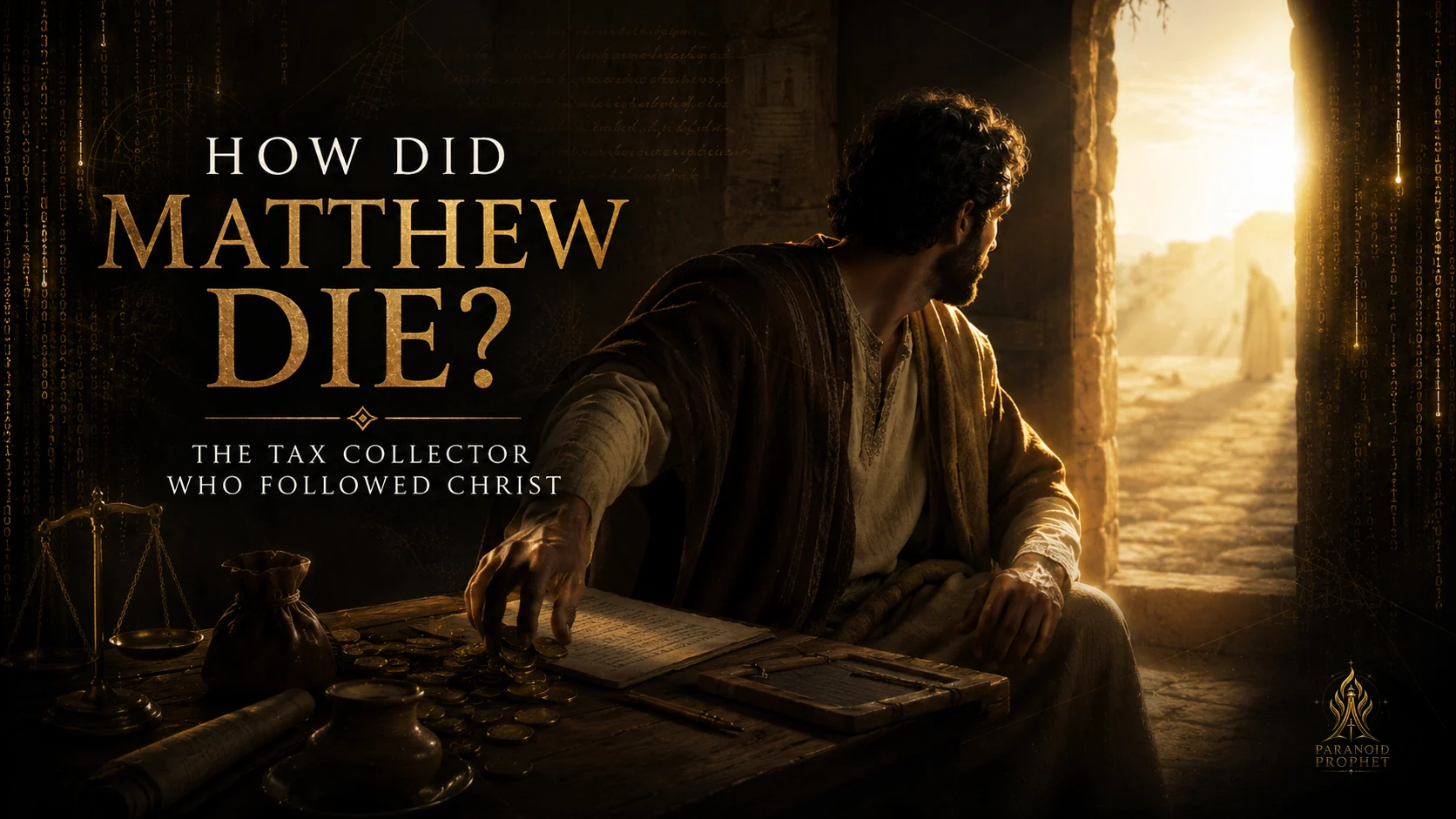
The clearest biblical starting point is Matthew 9:9–13. Jesus sees a man called Matthew sitting at the tax booth and says, “Follow me.” Matthew rises and follows Him.
The scene is brief, but it carries enormous weight. Matthew is not introduced as a religious hero. He is introduced at the tax booth. In the world of first-century Judea, tax collectors were often despised as collaborators, compromisers, and men attached to money under foreign rule. The Gospel bearing Matthew’s name does not hide that label. It puts the tax booth in the story because the grace of Christ is not embarrassed by the past He redeems.
Jesus does not wait for Matthew to clean up his own reputation. He calls him where he is. Matthew does not negotiate in the text. He rises and follows. That movement is the heart of the story: the tax collector leaves the booth because Jesus has summoned him.
The passage continues with Jesus reclining at table with tax collectors and sinners. When the Pharisees question why Jesus eats with such people, Jesus answers that those who are well have no need of a physician, but those who are sick. He says He came not to call the righteous, but sinners.
That context matters for Matthew. His story is not only about leaving a job. It is about mercy. Matthew’s calling displays the kind of Savior Jesus is. Christ does not merely recruit impressive men. He calls sinners, transforms them, and makes them witnesses.
This is why Matthew’s story should not begin with a speculative death scene. It should begin with Jesus. The strongest part of Matthew’s story is not that later tradition argues over where he died. The strongest part is that Scripture shows Christ calling him out of the old life and into discipleship.
Matthew Was Named Among the Twelve
Matthew is also named among the Twelve. In Matthew 10:2–4, the list of apostles includes “Matthew the tax collector.” That detail is striking. The text does not merely call him Matthew. It preserves the old label inside the apostolic list.
That is not a throwaway description. It is a testimony of grace. The man once known by the tax booth is now named among the apostles of Jesus Christ. The old identity is not erased as if it never existed. It is placed under the mercy and authority of Christ.
This matters for the larger martyrdom and witness question. Matthew was not a distant admirer of Jesus. He was counted among the Twelve. He belonged to the public apostolic circle connected to Jesus’ ministry, teaching, and resurrection proclamation. Even if the details of Matthew’s final death remain difficult to reconstruct, Scripture anchors him as an apostolic witness.
The case, then, does not begin with a late death legend. It begins with a named apostle whose life was redirected by Christ.
Matthew, Levi, and the Tax Collector Call Tradition
There is also a related question readers may notice. Matthew’s Gospel names the tax collector as Matthew. Mark and Luke give parallel call scenes involving a tax collector named Levi. In Mark 2:13–17, Jesus calls Levi the son of Alphaeus from the tax booth. In Luke 5:27–32, Levi leaves everything, rises, and follows Jesus.
Christian tradition has often identified Levi with Matthew. That identification is reasonable within the broader Gospel tradition, but this article does not need to solve every detail of the name question in order to make its main point. Matthew’s Gospel presents Matthew as the tax collector called by Jesus, and Matthew is named among the Twelve.
The central point remains clear: Jesus called a despised tax collector into discipleship and witness. Whether a reader focuses on Matthew’s name in Matthew’s Gospel or the parallel Levi call scenes in Mark and Luke, the theological pattern is the same. Christ calls the unlikely, receives sinners, and turns servants of the old order into witnesses of His kingdom.
This keeps the article from drifting into a side debate. Matthew was a tax collector. Jesus called him. Matthew followed. Matthew was named among the Twelve. That is enough to establish the biblical foundation before the article moves into early church tradition.
Why the Tax Collector Detail Matters
The tax collector detail matters because it shows what kind of transformation the gospel produced. Matthew did not start as an obvious candidate for holy witness. He was associated with a profession many Jews viewed with suspicion or disgust. He likely had access to money, records, and Roman-connected structures of power. His old life had a booth, a ledger, and a reputation.
Then Jesus called him away from it.
This does not prove Matthew’s martyrdom. It proves something more basic and more certain: Matthew’s life was interrupted by Christ. We may not be able to reconstruct his final hour with confidence, but Scripture confidently presents Matthew as a man whose direction changed when Jesus spoke.
That is why Matthew still matters in the larger case for Christ. The apostles were not merely spreading an idea that left their lives untouched. The message of Jesus remade people. Matthew’s own story begins with a visible break from the old life. The man at the tax booth became a follower of the King.
This is the best way to prepare for the later martyrdom traditions. If we start with disputed death details, the article feels fragile. If we start with Scripture, Matthew becomes clear. He was called by Jesus, named among the Twelve, and remembered by the church as part of the apostolic witness.
Matthew’s witness does not begin with late martyrdom stories. It begins with Jesus calling a tax collector to follow Him. From there, early Christian tradition remembers Matthew not as a man who returned to the booth, but as a Gospel-bearing witness. That tradition is where the next layer of evidence begins.
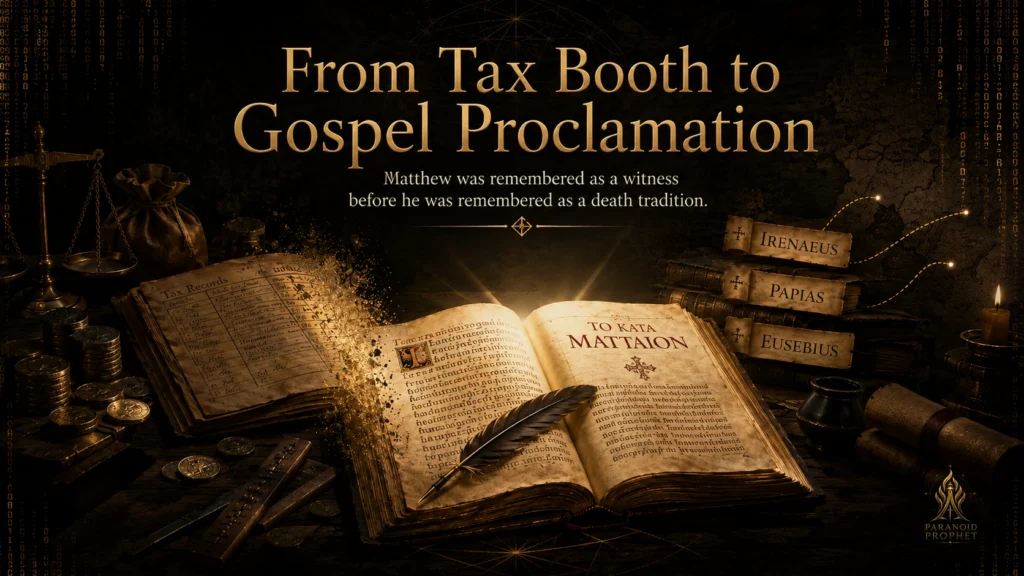
Matthew the Witness: From Tax Booth to Gospel Proclamation
Matthew’s death tradition is mixed, but his witness tradition is not empty. After Scripture shows Matthew called from the tax booth and named among the Twelve, early Christian sources remember him as connected to the written proclamation of Jesus Christ.
If we only ask, “Can we reconstruct Matthew’s final death scene?” the evidence becomes thin quickly. But if we ask the better historical question — “How did the early church remember Matthew’s witness?” — the trail becomes more meaningful.
Matthew was not remembered merely as a name in an apostolic list. Early Christian memory associated him with Gospel proclamation, especially among the Hebrews. That does not settle the question of his death, but it does show that Matthew was remembered as a servant of the message of Jesus.
The larger case is not only about death. It is about witness. The apostles and early Christian leaders proclaimed Christ crucified and risen, often under pressure, loss, opposition, exile, or death. Matthew’s exact ending remains difficult to reconstruct, but the remembered direction of his life points away from the tax booth and toward Gospel witness.
Irenaeus and Matthew’s Gospel Among the Hebrews
One of the most important early witnesses is Irenaeus. Writing in the second century, Irenaeus says that Matthew issued a written Gospel among the Hebrews in their own dialect while Peter and Paul were preaching in Rome and laying the foundation of the church.
This is not a death notice. Irenaeus does not tell us where Matthew died, describe a martyrdom scene, or give a method of execution. His value is different. He preserves early Christian memory that Matthew was connected with written Gospel witness among a Jewish or Hebrew-speaking audience.
That is still significant. The man Scripture introduces at the tax booth is remembered in early Christian tradition as a witness who served the spread of Jesus’ message. Matthew’s remembered role was not merely private belief. It was proclamation.
Irenaeus should therefore be used in the right lane. He strengthens Matthew’s Gospel-witness tradition. He does not prove Matthew’s martyrdom. Asking Irenaeus to prove Matthew’s death would be overclaiming. Letting Irenaeus show that Matthew was remembered as a Gospel-bearing witness is strong and fair.
Papias and the Hebrew Oracles Tradition
Another important early tradition comes from Papias, preserved by Eusebius. Papias says that Matthew composed or arranged the “oracles” in the Hebrew language, and that each interpreted them as he was able.
This statement has been discussed for centuries. What exactly did Papias mean by “oracles”? Was he referring to sayings of Jesus, a written collection, a Hebrew or Aramaic form of Matthew, or something related to the Gospel known to the church? How does this relate to the canonical Gospel of Matthew as we have it? Those are real questions, and a careful article should not pretend the debate does not exist.
But we should not miss the point that matters here. Papias preserves early memory connecting Matthew with the organized transmission of Jesus tradition. Even if scholars debate the exact meaning of the statement, Matthew is not being remembered as an irrelevant background figure. He is remembered in connection with the words, teaching, and witness of Christ.
This helps the article because Matthew’s strength is not only in later death traditions. Matthew’s strength is also in the early memory that his life became tied to the Gospel itself. The tax collector becomes associated with testimony about the King.
Papias is not giving a martyrdom report. His value is that he contributes to the larger portrait: Matthew was remembered early as a figure connected to the preservation and proclamation of Jesus’ message.
Eusebius and Matthew Going to Other Peoples
Eusebius also preserves a tradition that bridges Matthew’s Gospel witness to later mission memory. He says Matthew first preached to the Hebrews and, when he was about to go to other peoples, committed his Gospel to writing in his native tongue. According to that tradition, Matthew’s writing supplied the lack of his presence to those he was leaving behind.
In other words, the tradition remembers Matthew’s written witness as a way of continuing to serve the people he was leaving, even as his mission moved outward. Matthew is not pictured as stationary, silent, or withdrawn. He is remembered as a witness whose ministry moved beyond his first audience.
Eusebius does not give us Matthew’s death scene in this passage. But he does preserve a tradition in which Matthew’s Gospel witness is connected to mission beyond the first circle of Hebrew proclamation.
That matters for the larger case. Matthew’s life was remembered as serving the spread of Christ’s message. Even before we reach later martyrdom traditions, the source trail already points to public witness. The man called from the tax booth was remembered as one who carried the Gospel outward.
Why Matthew’s Gospel-Witness Tradition Matters
These early sources strengthen a part of Matthew’s story that is often overlooked. The question is not only whether Matthew died violently. The question is whether Matthew was remembered as a public witness to Jesus Christ. Irenaeus, Papias, and Eusebius all help answer that question.
They show that early Christian memory attached Matthew to Gospel proclamation. They do not give us a modern biography. They do not settle every authorship debate. They do not prove the final death tradition. But they do show that Matthew was remembered as a servant of the message.
For a Jesus evidence article, that matters because Gospel proclamation was not merely religious advice. It was testimony about Jesus’ identity, kingdom, death, resurrection, and authority.
Matthew Was Remembered as a Public Witness
Matthew’s story begins with a public call. Jesus sees him at the tax booth and calls him to follow. Early church memory then remembers Matthew in connection with public proclamation. That movement matters: from tax booth, to apostolic circle, to Gospel witness.
Matthew should not be reduced to an uncertain death tradition. He is more than a disputed ending. He is a witness whose life was redirected by Christ and whose name became attached to the written proclamation of Jesus.
If Matthew had returned to the old life, abandoned the apostolic witness, or disappeared from Christian memory as a man who turned away from Christ, the story would look different. Instead, the church remembered him as connected to the Gospel.
That does not remove every historical question. But it does give the article a stronger foundation than later martyrdom accounts alone. Matthew’s witness is older and stronger than the most detailed stories about his death.
Matthew Was Not Remembered First as a Corpse in a Legend
This order matters. If the article jumps straight from Matthew’s calling to late death traditions, the case feels fragile. But if the article first shows Matthew as a Gospel-bearing witness in early Christian memory, then the later death traditions are placed in a better context.
Matthew was not remembered first as a corpse in a legend. He was remembered as a witness. The death traditions come later in the source trail, and some of them conflict. But they attach to a man already remembered as belonging to the apostolic proclamation of Christ.
That order keeps the article from building on the weakest evidence first. It establishes that Matthew’s life after the tax booth was remembered as Gospel service. Then the article can ask how later traditions remembered the cost of that service.
Did Matthew Become a Missionary Beyond Judea?
After Scripture gives us Matthew’s calling and early Christian tradition remembers him as a Gospel-bearing witness, the next question is whether Matthew’s witness was remembered as moving beyond his first audience. The answer is yes, but with caution.
Matthew’s later mission traditions are not as firm as the biblical record of his calling or the early tradition connecting him with Gospel proclamation. Still, they matter. They show that Christian memory did not imagine Matthew as a man who rose from the tax booth and then disappeared into silence. He was remembered as part of the apostolic spread of Christ’s message.
Mission memory is not the same thing as a death record. A tradition about Matthew’s Gospel reaching distant regions does not prove Matthew personally died there. But it does strengthen the wider portrait: Matthew was remembered as a witness whose connection to the Gospel reached beyond the first circle of Jewish proclamation.
The Pantaenus Tradition and Matthew’s Gospel in the East
One important tradition comes through Eusebius’s account of Pantaenus. Pantaenus was associated with the Christian school in Alexandria and was remembered as a teacher and evangelist. Eusebius says he traveled as far as India and found the Gospel according to Matthew already among people there who knew Christ. The report also says Bartholomew had preached to them and left Matthew’s writing behind.
This is valuable evidence, but only in the right lane. The Pantaenus tradition does not say Matthew died in India. It does not even require Matthew himself to have traveled there. In the report, Bartholomew is the one associated with leaving Matthew’s Gospel behind.
So why does it matter for Matthew? Because it shows Matthew’s Gospel remembered in an eastern mission context. The written witness associated with Matthew was not remembered as locked inside one local community. It was remembered as serving the spread of Christ’s message beyond its first audience.
For a Jesus evidence article, that matters because the apostolic mission was not merely the spread of ethics or religious memory. It was the public proclamation that Jesus is the crucified and risen Lord.
Why the “India” Tradition Requires Caution
The “India” tradition also requires caution. Ancient writers did not always use geographic labels with modern precision. “India” in ancient and early Christian sources could sometimes function broadly for distant eastern regions. Later readers should be careful not to turn that into a precise modern map without further evidence.
It is one thing to say Matthew’s Gospel was remembered in an eastern mission tradition. It is another thing to say Matthew definitely preached in modern India and died there. The first claim has a source trail. The second claim goes beyond what this evidence can safely prove.
The best wording is careful: Matthew’s Gospel was connected in early Christian memory with eastern mission, and later traditions place Matthew himself in various regions. That supports missionary memory. It does not give one secure itinerary or death location.
Was Matthew Martyred?
So was Matthew martyred? Many later Christian traditions remember Matthew as a martyr, but the evidence is mixed and the details vary. Scripture does not narrate his death. The earliest and strongest traditions are more useful for Matthew’s calling and Gospel witness than for his final moments.
That does not mean the martyrdom tradition should be dismissed. It means it should be ranked properly. Matthew’s death is not a first-tier martyrdom case like Stephen in Acts, James the son of Zebedee in Acts, or the stronger Roman traditions surrounding Peter and Paul. Matthew belongs in a more cautious lane: a transformed apostolic witness with later and varied martyrdom traditions.
A strong article can be honest and still useful. The goal is not to pretend every apostle’s death is equally certain. The goal is to gather the evidence, rank it honestly, and ask what it contributes to the larger story of costly witness to Jesus Christ.
Later Tradition Says Yes, But Not With One Clear Account
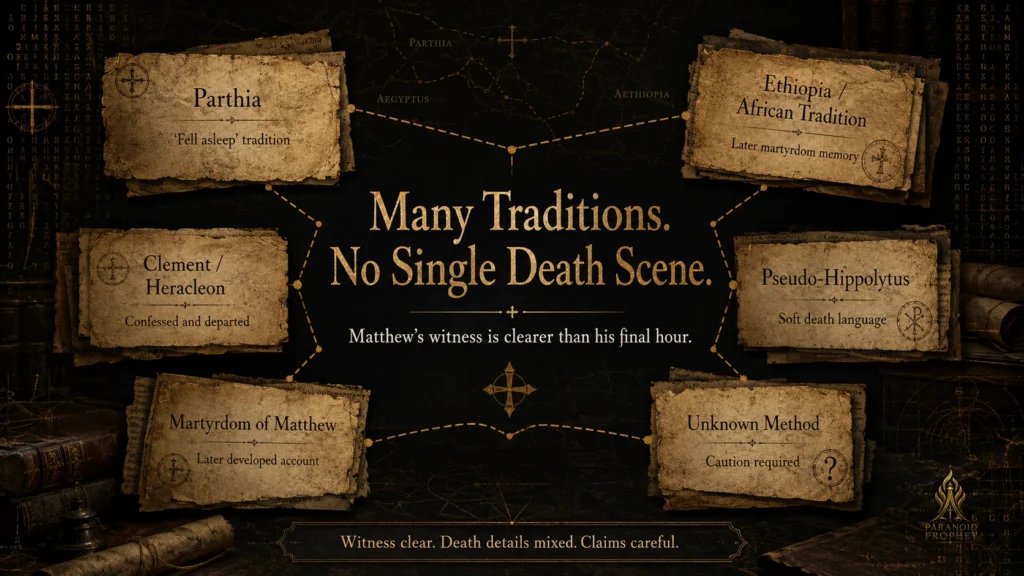
Later traditions often remember Matthew as killed for his witness. Some streams associate him with regions called Ethiopia. Others connect him with Parthia or eastern settings. Some traditions describe violent death by sword, beheading, fire, or other means. The problem is not that there is no martyrdom memory. The problem is that the memory does not come to us in one early, simple, consistent report.
That means we should not write as if the church preserved one clear execution file for Matthew. It did not. But we also should not write as if Matthew’s later martyrdom traditions are meaningless. They show that many Christians remembered Matthew’s witness as costly, and in some streams, costly unto death.
The responsible conclusion is not, “Matthew was certainly martyred in this exact place by this exact method.” The responsible conclusion is: Matthew was widely remembered in later Christian tradition as a missionary witness, often as a martyr, but the exact location and method remain uncertain.
Heracleon and Clement Complicate Certainty, Not Witness
One of the most important caution sources comes from Clement of Alexandria, who quotes Heracleon in a discussion about confession, witness, and martyrdom. Heracleon includes Matthew among those who confessed and “departed.” This has often been read as evidence that Matthew did not die in a dramatic martyrdom scene.
That reading should be considered, but it should not be overstated. Heracleon is not writing a full biography of Matthew. Clement is not giving a clean death notice. The passage is part of a theological discussion about confessing Christ before men, confession by life, and witness before authorities.
So this source complicates certainty, not witness. It warns us not to claim too much about Matthew’s death. It does not erase Matthew’s apostolic identity. It does not undo his Gospel-witness tradition. It does not prove Matthew could not have been killed for his witness.
Used carefully, Heracleon and Clement help the article. They keep the evidence honest without requiring us to dismiss every later martyrdom tradition as worthless.
Pseudo-Hippolytus and the “Fell Asleep” Tradition
Another important source is the apostolic list known as Pseudo-Hippolytus. In that list, Matthew is said to have written the Gospel in the Hebrew tongue, published it at Jerusalem, and “fell asleep” at Hierees, a town of Parthia.
This tradition is important because it gives a location and uses soft death language. On its own, it does not sound like a violent execution report. It sounds more like a death notice. That is why it belongs in the caution lane.
But caution should not become overstatement in the other direction. “Fell asleep” does not automatically mean Matthew died peacefully in bed. Christian sources often use sleep language for death because Christian hope is shaped by resurrection. The phrase can soften the language of death without telling us the exact circumstances.
The strongest point from Pseudo-Hippolytus is not that Matthew certainly died naturally. The strongest point is that one later list tradition remembered Matthew’s death differently from the more explicit martyrdom stories. That limits certainty. It does not close the case.
Why “Fell Asleep” Does Not Automatically Rule Out Martyrdom
The language of “sleep” is important enough to handle carefully. In Scripture, sleep language can describe death from the perspective of resurrection hope. The clearest example is Stephen. Acts describes Stephen being dragged out of the city and stoned, and then says that after he prayed, “he fell asleep.” Stephen’s death was violent, yet the language of sleep is still used.
That means the phrase “fell asleep” cannot by itself prove Matthew died non-violently. Christian death language is often theological before it is forensic. It speaks from the hope that those who die in Christ are not lost.
Still, the context of Pseudo-Hippolytus matters. The same list uses explicit violent terms for other apostles. Peter is crucified. Andrew is crucified. James is killed by the sword. Thomas is pierced. Paul is beheaded. Matthew, by contrast, is said to have “fallen asleep.”
That contrast means Matthew’s entry is not strong evidence for violent martyrdom. But because sleep language can be used for martyrdom, it is also not decisive evidence against it. The best category is ambiguity. Pseudo-Hippolytus complicates certainty. It does not negate Matthew’s witness or prove that later martyrdom traditions are impossible.
The Later Martyrdom of Matthew Tradition
There are also later apocryphal traditions that describe Matthew’s death more explicitly. The Martyrdom of Matthew stream preserves a developed story in which a ruler orders Matthew to be beheaded and his body cast out. In that tradition, Matthew’s death is plainly presented as martyrdom.
This tradition should not be ignored, but it should be used carefully. It is later, story-shaped, and not in the same evidential category as Scripture or early Gospel-witness traditions. It can help trace how Christian memory came to remember Matthew’s death as martyrdom. It should not be treated as the foundation of the historical case.
A weak article would either dismiss the later martyrdom tradition entirely or treat it as if it were a first-century report. A stronger article does neither. It says: later tradition remembers Matthew as killed for his witness, but the tradition is later and cannot settle every historical question.
Even so, the later martyrdom stream contributes something to the wider portrait. It shows that Christian memory did not only remember Matthew as an authorial figure or distant apostle. It also remembered him as a witness whose allegiance to Christ provoked opposition and, in some traditions, death.
Why Matthew’s Location and Method Remain Uncertain
When the evidence is gathered, Matthew’s exact location and method of death remain uncertain. Scripture does not narrate the event. Early Gospel-witness sources do not give a death scene. Mission traditions connect Matthew’s Gospel with distant regions, but not necessarily Matthew’s own death. Some sources use softer death language. Later stories describe martyrdom, but they vary and develop over time.
That is why the safest answer to “How did Matthew die?” is careful: Matthew’s death is not clearly recorded in Scripture, and later traditions differ. Some later traditions remember him as a martyr, often in eastern or African settings, but the exact place and method cannot be stated with confidence.
This does not make Matthew useless for the larger case for Christ. It simply means we should not make Matthew carry the strongest martyrdom claim. Matthew strengthens the wider picture in a different way. He gives us a transformed tax collector, a named apostle, a Gospel-bearing witness in early Christian memory, and a later tradition of costly mission that sometimes ends in martyrdom.
Matthew’s evidence is layered. It is not empty, and it is not simple. The stronger the article keeps those categories clear, the more trustworthy the case becomes.
What Each Source Actually Proves
The Matthew tradition becomes clearer when each source is allowed to prove what it can prove and no more. That is especially important in a case where later memory preserves more than one death tradition.
| Source | What it supports | What it does not prove |
|---|---|---|
| Eusebius / Pantaenus | Matthew’s Gospel remembered in eastern mission context | Matthew personally died in India |
| “India” tradition | Missionary memory connected with the east | Modern geographic certainty |
| Clement quoting Heracleon | Matthew remembered among those who confessed and “departed” | Exact death method or certainty of peaceful death |
| Pseudo-Hippolytus | A Parthia death tradition with soft death language | That Matthew certainly was not martyred |
| Martyrdom of Matthew | A developed martyrdom tradition, including beheading | Early first-tier historical certainty |
| Conflicting later traditions | Matthew remembered as a costly missionary witness | One secure location or method |
The result is not a clean execution scene. It is a layered tradition. Matthew is remembered in Scripture as the tax collector called by Jesus, in early church memory as a Gospel-bearing witness, in mission tradition as connected to the spread of the Gospel beyond its first audience, and in later streams as a martyr. The exact location and method remain uncertain. But the witness remains.
Why Matthew’s Witness Still Matters for the Case for Christ
Matthew’s death is not the strongest apostolic martyrdom case. That should be said clearly. His final moments are not recorded in Scripture, and later traditions do not give one simple, early, unified account. But Matthew still matters because the case is not built on one death tradition alone.
Matthew matters because Scripture gives us his transformation. Jesus called him from the tax booth. Matthew rose and followed. Matthew was named among the Twelve. Early Christian memory connects him with Gospel proclamation. Mission traditions connect the witness associated with Matthew to the spread of Christ’s message beyond its first audience. Later traditions often remember that witness as costly, sometimes ending in martyrdom.
That is a layered case, not an empty one.
Matthew’s uncertain final hour should not erase the visible arc of his life: called by Christ, named among the Twelve, remembered with the Gospel, and carried forward in traditions of mission and cost. We should not pretend to know more than we know. But we also should not treat uncertainty about the death scene as if Matthew’s witness disappears.
Matthew Does Not Carry the Whole Martyrdom Case
Matthew should not be made to carry the whole martyrdom argument. The stronger evidence for apostolic martyrdom is found elsewhere: Stephen is killed in Acts, James the son of Zebedee is killed by the sword in Acts, James the brother of Jesus is reported by Josephus, and Peter and Paul have stronger early Roman traditions.
Matthew belongs in a different lane. His evidence is meaningful, but it is not first-tier death evidence. He is a transformed apostolic witness with early Gospel-witness memory and later mixed martyrdom traditions. That is still worth including, but only if the article keeps the categories clear.
This strengthens the credibility of the larger case. A serious argument for Jesus does not need every apostle’s death to be equally certain. It needs honesty. It needs Scripture first. It needs historical sources weighed in order. It needs the courage to say when a tradition is strong, when it is mixed, and when it should be used carefully.
Matthew Strengthens the Pattern of Costly Witness
Matthew strengthens the pattern of costly witness. The apostles did not build a movement around comfort, silence, wealth, or safety. They proclaimed Jesus Christ as Lord. They preached a crucified and risen Messiah. They carried the message into public life, into opposition, and into places where allegiance to Christ could cost them dearly.
For a Jesus evidence article, that matters because apostolic mission was not merely the spread of ethics or religious memory. It was the public proclamation that Jesus is the crucified and risen Lord. Matthew’s remembered witness belongs to that larger movement.
Matthew’s death tradition may not be clean enough to prove one exact execution scene, but his witness still fits the broader pattern: Christ calls, Christ transforms, and Christ sends witnesses into the world.
The Tax Collector Did Not Return to the Booth
The most powerful part of Matthew’s story may be the simplest: the tax collector did not return to the booth. Scripture presents him as a man interrupted by Jesus. He rose and followed. The early church did not remember him as a man who abandoned Christ and went back to his old life. It remembered him in connection with the Gospel.
That does not answer every question about his death. But it does answer something deeper about his life. Matthew’s allegiance changed. His identity changed. His story became tied to Jesus Christ.
That is why Matthew belongs in this series. Not because his martyrdom tradition is the strongest, but because his witness belongs to the larger apostolic pattern of lives redirected by the risen Lord.
Does Matthew’s Uncertain Death Weaken the Resurrection Case?
No. Matthew’s uncertain death does not weaken the resurrection case, because the resurrection case does not depend on proving every apostle’s death with equal certainty. Matthew is a supporting witness in the larger pattern, not the foundation of the entire argument.
The careful martyrdom argument is not, “Every apostle certainly died in a documented execution, therefore Christianity is true.” That would be too simplistic. The stronger argument is that the earliest witnesses to Jesus proclaimed His resurrection publicly, endured suffering and opposition, and in several cases were killed for their testimony. Their willingness to suffer supports the sincerity of their belief that Jesus had risen.
Martyrdom by itself does not automatically prove a belief is true. People from many religions and causes have died sincerely. But the apostolic claim is different from generic religious zeal. The apostles were not merely dying for an inherited idea. They proclaimed events they believed they had encountered: Jesus crucified, buried, risen, and appearing to His followers.
Matthew’s role is therefore cumulative. His life does not prove the resurrection by itself. His death tradition does not settle the case by itself. But Matthew’s transformation, apostolic identity, Gospel-witness memory, mission tradition, and later martyrdom memory all contribute to the wider picture of costly witness.
Martyrdom Shows Sincerity, Not Automatic Proof
A careful Christian argument should say this plainly: martyrdom shows sincerity, not automatic proof. A person can be sincerely wrong. But when the earliest Christian witnesses suffer for the claim that Jesus rose from the dead, their suffering matters because they were proclaiming something public, historical, and personally consequential.
The apostles were not preaching that Jesus was merely inspiring. They were not saying He was only a moral teacher. They proclaimed that God raised Him from the dead and made Him Lord. That claim created conflict because it challenged sin, religious pride, imperial power, and every rival claim to ultimate authority.
Matthew’s evidence belongs inside that larger witness. He should not be inflated beyond the sources. He should not be erased because the sources are mixed. He should be placed where he belongs: a real apostolic witness whose life was remembered as bound to the Gospel of Christ.
The Stronger Resurrection Case Does Not Depend on Matthew Alone
The stronger resurrection case rests on a broader foundation: the early proclamation of Jesus’ resurrection, the transformation of the disciples, the testimony preserved in the New Testament, the early creed in 1 Corinthians 15:3–8, the rise of worship around Jesus, and the willingness of early witnesses to suffer for the message.
Matthew is one piece of that larger mosaic. He is not the whole picture. His story should point readers toward the broader resurrection evidence, not replace it.
This is why Matthew’s article can be both honest and persuasive. It does not need to force certainty where the evidence is mixed. It can show that Matthew’s exact death remains unclear while still showing that his life and remembered witness point toward the same Christ proclaimed by the apostolic church.
Common Objections About Matthew’s Death
Objection: “If We Do Not Know How Matthew Died, Why Include Him?”
Matthew should be included because he belongs to the apostolic witness pattern. The point is not that every apostle has equally strong death evidence. The point is that Matthew was called by Jesus, named among the Twelve, remembered in connection with Gospel proclamation, and later associated with mission and costly witness.
Matthew is not included because his death tradition is the strongest. He is included because his witness belongs to the larger story of the men Christ called and sent.
Objection: “Does ‘Fell Asleep’ Mean Matthew Was Not Martyred?”
Not necessarily. One tradition says Matthew “fell asleep” in Parthia, and that softer language does make the death tradition less certain. But Christian sources often use sleep language for death because of resurrection hope. Stephen was violently stoned, yet Acts 7:54–60 still describes him as having “fallen asleep.”
So “fell asleep” should be treated as ambiguous. It may suggest a softer death notice in that particular source, especially because the same list uses explicit violent language for other apostles. But it does not automatically prove Matthew died peacefully or rule out later martyrdom traditions.
Objection: “Are Later Martyrdom Traditions Just Legends?”
Some later martyrdom traditions are clearly story-shaped and should not be treated as first-tier history. But “later” does not automatically mean “worthless.” Later traditions can preserve memory, regional claims, devotional expansion, theological interpretation, and sometimes historical echoes.
The right approach is not to flatten all traditions into certainty or dismiss all of them as fiction. The right approach is to rank them. Scripture stands first. Early tradition comes next. Later apocryphal martyrdom stories belong lower in the evidence chain. Matthew’s later martyrdom traditions matter, but they cannot carry the historical foundation alone.
Objection: “Does Matthew’s Death Prove the Resurrection?”
No. Matthew’s death does not prove the resurrection by itself. His death tradition is too mixed to carry that kind of weight, and martyrdom is not automatic proof of truth anyway.
But Matthew still contributes to the cumulative case. His life was changed by Jesus. His name is preserved among the Twelve. Early Christian memory ties him to Gospel proclamation. Later traditions remember his witness as missionary and costly. That pattern supports the broader claim that the message of Jesus was not spread by comfortable men protecting an easy lie.
The resurrection case is bigger than Matthew. But Matthew still belongs inside it.
Final Answer: How Did Matthew Die?
So how did Matthew die? Scripture does not tell us. The Bible records Matthew’s calling from the tax booth and names him among the Twelve, but it does not narrate his death. Early Christian tradition strongly remembers Matthew as connected to Gospel proclamation. Later mission traditions connect his Gospel with eastern regions. Some sources use softer death language, while later martyrdom traditions remember him as killed for his witness.
The safest conclusion is that Matthew’s exact location and method of death remain uncertain. He may have been martyred, as many later traditions claim, but the evidence does not allow us to state one location or method with the same confidence we can use for stronger martyrdom cases.
But Matthew’s uncertain death should not become the center. Christ should. Jesus called a tax collector, made him an apostle, and the church remembered him as a witness of the Gospel. Matthew’s death tradition may be layered, but his life points to the Lord who called him.
The tax collector did not stay at the booth. He followed Jesus.

Seal the Witness File: Matthew Knowledge Check
Frequently Asked Questions About Matthew’s Death
How did Matthew die?
Scripture does not record how Matthew died. Later Christian traditions vary. Some remember him as a martyr, but the exact location and method of death are uncertain.
Does the Bible say Matthew was martyred?
No. The Bible records Matthew’s calling and names him among the Twelve, but it does not describe his death or say that he was martyred.
Was Matthew the apostle killed in Ethiopia?
Some later traditions connect Matthew with Ethiopia or African/eastern regions, but the evidence is not secure enough to state with confidence that Matthew died in Ethiopia.
Did Matthew die in Parthia?
Pseudo-Hippolytus preserves a tradition that Matthew “fell asleep” at Hierees, a town of Parthia. That tradition gives a location, but it does not settle whether Matthew died naturally or as a martyr.
Was Matthew beheaded?
A later Martyrdom of Matthew tradition describes Matthew being beheaded. That tradition is useful for tracing later martyrdom memory, but it should not be treated as first-tier historical evidence.
Does “fell asleep” mean Matthew died peacefully?
Not necessarily. Christian sources can use sleep language for death because of resurrection hope. Stephen was violently stoned and still described with sleep language. In Matthew’s case, “fell asleep” is ambiguous and should not be used as automatic proof either for or against martyrdom.
Was Matthew the same as Levi?
Christian tradition has often identified Levi with Matthew because Mark and Luke describe Levi being called from the tax booth while Matthew’s Gospel names the tax collector as Matthew. The central point remains clear: Jesus called a tax collector into discipleship.
Was Matthew the same as Matthias?
No. Matthew was one of the Twelve during Jesus’ ministry. Matthias was chosen in Acts 1 to replace Judas Iscariot after Judas’s betrayal and death.
Does Matthew’s uncertain death weaken the case for Christ?
No. Matthew is a supporting part of the cumulative witness pattern, not the foundation of the whole resurrection case. His uncertain death does not erase his transformation, apostolic identity, or Gospel-witness memory.
What is the strongest evidence about Matthew?
The strongest evidence is Scripture’s testimony that Jesus called Matthew from the tax booth and that Matthew was named among the Twelve. Early church tradition also connects Matthew with Gospel witness. His death tradition is later and mixed.
Read Next
- Martyrdom of Jesus’ Disciples: What Do We Actually Know?
- How Did Paul Die? Evidence for Paul’s Martyrdom in Rome
- Peter’s Martyrdom: What Does the Evidence Say?
- How Did James the Brother of Jesus Die?
- Resurrection Evidence: The Case for Jesus Rising From the Dead
Sources and Further Reading
- Matthew 9:9–13 — Matthew’s calling from the tax booth.
- Matthew 10:2–4 — Matthew named among the Twelve.
- Mark 2:13–17 — Levi called from the tax booth.
- Luke 5:27–32 — Levi leaves everything and follows Jesus.
- Acts 7:54–60 — Stephen’s martyrdom and the biblical use of “fell asleep” after a violent death.
- 1 Corinthians 15:3–8 — Paul’s early summary of Christ’s death, burial, resurrection, and appearances.
- Irenaeus, Against Heresies 3.1.1 — Matthew and written Gospel tradition among the Hebrews.
- Eusebius, Church History 3.39 — Papias and the tradition of Matthew’s “oracles.”
- Eusebius on Pantaenus — Matthew’s Gospel remembered in eastern mission context.
- Clement of Alexandria, Stromata 4 — Heracleon, confession, and Matthew among those who “departed.”
- Pseudo-Hippolytus, apostolic list — Matthew “fell asleep” in Parthia.
- Martyrdom of Matthew, NASSCAL summary — later martyrdom tradition, including beheading.
- Sean McDowell, “Do the Deaths of the Apostles Prove Anything?” — careful framing of martyrdom as evidence of apostolic sincerity.
Source note: Later martyrdom traditions are included as tradition history and evidence of later Christian memory. They are not treated as equal to Scripture or as first-tier proof of Matthew’s exact death.
CONTINUE THE INVESTIGATION
Evidence standard continuation
Did the Apostles Die for the Resurrection? What We Can Honestly Say
Return from this individual witness tradition to the comparative source review that separates strong evidence, plausible tradition, and uncertainty.