
GUIDED ARTICLE EXPERIENCE
How Did Simon the Zealot Die? The Apostle Whose Zeal Belonged to Christ
Read along as the narration moves through the article.
Private device narration · No hosted audio or tracking
CONTINUE GUIDED TOUR
Continue where you left off.
GUIDED TOUR COMPLETE
You have reached the end of this study.
Study record saved on this device.
GUIDED TOUR
How Did Simon the Zealot Die? The Apostle Whose Zeal Belonged to Christ
Narrator: Paranoid Prophet Recommended Voice Native device narration
Prepare to follow the article as it is narrated.
VOICE & TOUR OPTIONS
Voice & Listening
NARRATOR
Finding a narrator…
Checking the best narrator available on this device.
Restores the best curated narrator available on this device.
Narrator choices are curated for clear, long-form listening on this device.
Screen-awake support will be checked when narration starts.
CHOOSE A NARRATOR
Curated for this device
Choose a verified narrator for this browser, or use System Narrator. Automatic mode uses the best reliable route exposed by this device; your chosen narrator is preserved even if this device needs a temporary fallback.
Preparing the guided article experience…
RESUME GUIDED TOUR?
Continue where you left off.
GUIDED TOUR COMPLETE
You have reached the end of this study.
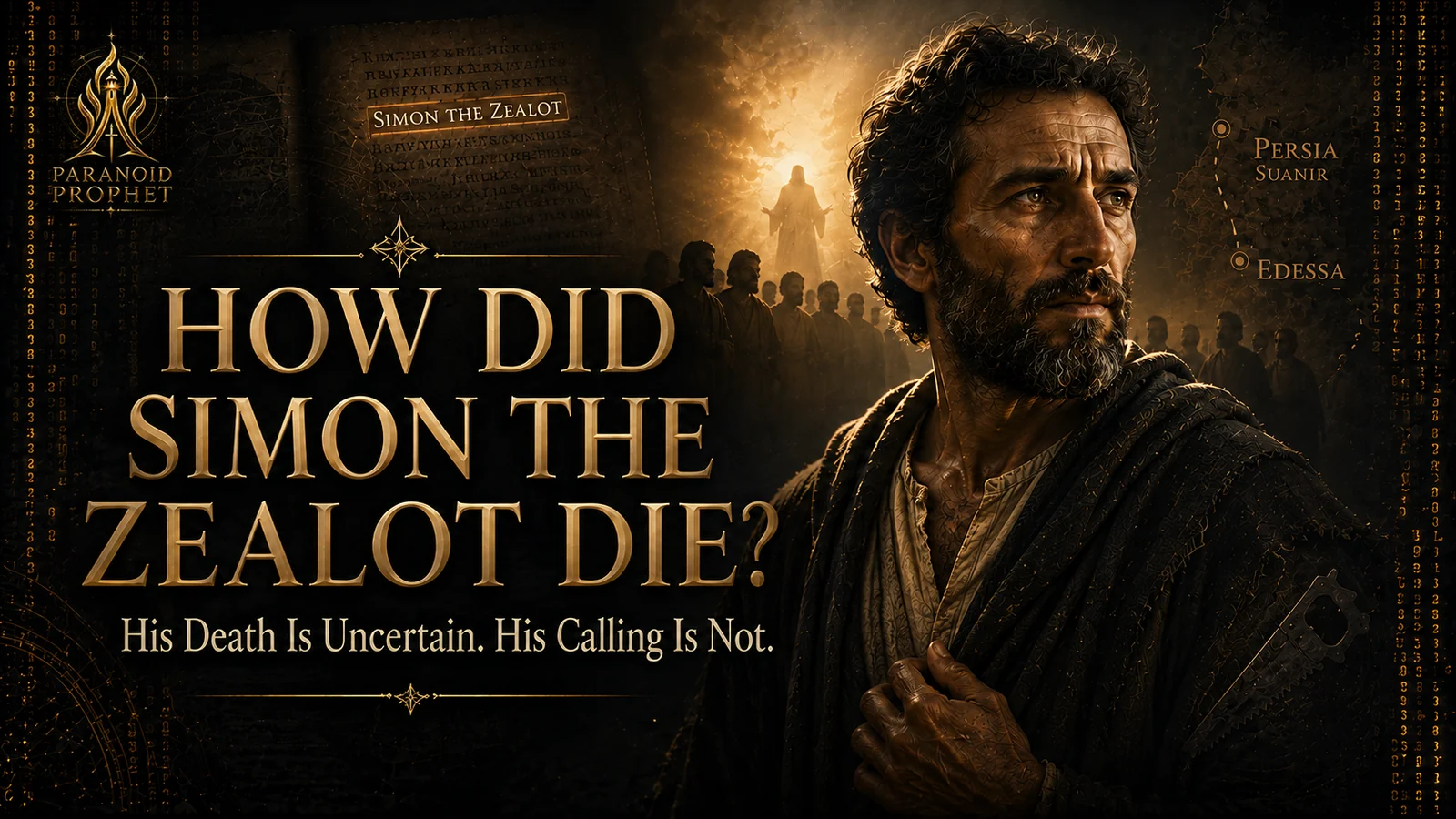
How did Simon the Zealot die? Scripture does not tell us. The New Testament names him among the Twelve apostles and remembers him in the post-ascension apostolic company, but it does not record his final mission field, death scene, or exact method of martyrdom.
Later church tradition often remembers Simon as a missionary and possible martyr, frequently linked with Jude/Thaddaeus and Persia. Some traditions say he was killed with a saw. Other traditions give different locations or even a peaceful death. Because the sources conflict, the exact place and method of Simon’s death cannot be stated with certainty.
The strongest starting point is not the saw. It is the call of Christ. Simon the Zealot was one of the Twelve apostles Jesus chose. His title points to zeal, but Scripture does not give us enough detail to write a full political biography. The article must begin where the Bible begins: Simon belonged to the men Jesus called, appointed, and sent.
That matters because Simon is easy to reduce to speculation. Readers may ask whether he was a revolutionary, whether he hated Rome, whether he clashed with Matthew the tax collector, or whether he was sawed in half in Persia. Those questions deserve careful answers, but they should not become the foundation. Simon’s clearest testimony is that Jesus chose him and placed him among the apostolic witnesses.
Bottom line: Simon the Zealot was one of the Twelve apostles Jesus chose. Scripture does not record his death. Later traditions remember him as a missionary and possible martyr, often linked with Jude/Thaddaeus and Persia, but the exact location and method of his death vary by source.
Source discipline: This article does not claim the Bible records Simon’s death. It does not claim he was certainly sawed in half, certainly died in Persia, or certainly belonged to the later organized Zealot party. It begins with Scripture, then weighs later church tradition as tradition history.
Article Guide15 sections
Evidence Map for Simon the Zealot
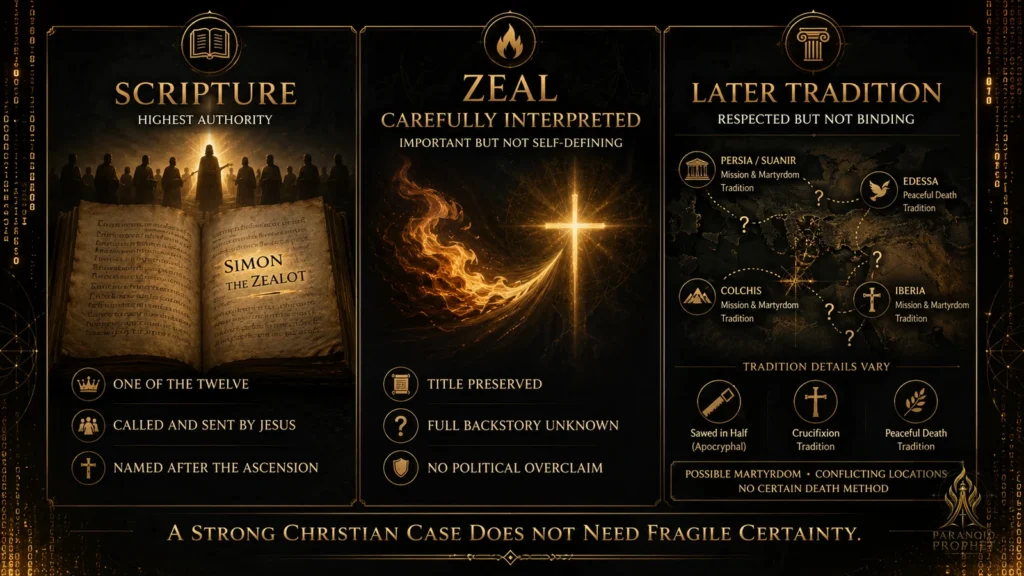
Simon the Zealot needs a careful evidence map because his story is short in Scripture and crowded with later tradition. Scripture gives his apostolic identity. His title raises questions about zeal. Later tradition remembers mission and possible martyrdom, but those traditions do not agree on every detail.
The first layer is Scripture. The second layer is careful interpretation of his name. The third layer is later martyrdom tradition. Those layers belong together, but they do not carry the same level of certainty.
| Claim | Evidence strength | Best use |
|---|---|---|
| Simon was one of the Twelve apostles | Very strong | Biblical identity |
| Simon belonged to the Twelve Jesus called and appointed | Very strong | Relationship to Jesus |
| Simon shared in the mission and authority of the Twelve | Strong | What he accomplished |
| Simon appears in the post-ascension apostolic company | Strong | Resurrection-side witness |
| Simon was called “the Zealot” | Very strong | Naming and theological theme |
| Simon definitely belonged to the organized Zealot political party | Uncertain | Mention cautiously |
| Simon died with Jude/Thaddaeus in Persia | Later tradition | Tradition history |
| Simon was sawed in half | Later apocryphal tradition | Do not overclaim |
| Simon died peacefully at Edessa | Conflicting later tradition | Shows uncertainty |
| Exact death location and method | Uncertain | Final-answer caution |
This map does not weaken Simon’s witness. It strengthens the article. A strong Christian case does not need fragile certainty. Simon does not need an exaggerated death claim to matter. Scripture already gives him a place among the Twelve, and that is where the article should begin.
Who Was Simon the Zealot?
Simon the Zealot was one of the Twelve apostles of Jesus Christ. He is not one of the most visible apostles in the Gospel narratives. Scripture records no personal speech from him, no individual miracle scene, and no private question like the one preserved from Jude/Thaddaeus in John 14.
But silence about personal episodes is not the same thing as insignificance. Scripture gives Simon something stronger than later speculation: a place among the men Jesus chose.
That is the starting point. Simon is not merely a later saint from church tradition. He is named in the New Testament apostle lists. His death traditions may be late and varied, but his apostolic identity is biblical.
Simon Was One of the Twelve
Matthew names Simon the Zealot among the Twelve in Matthew 10:2–4. Mark includes him in the list of the Twelve Jesus appointed in Mark 3:16–19. Luke names him in Luke 6:14–16, and Acts names him again in Acts 1:13.
That repeated listing matters. Simon’s first and greatest significance is not a death tradition. It is that Jesus chose him. He belonged to the apostolic company before any later tradition attached Persia, Edessa, a saw, or another death scene to his name.
Matthew 10 also places Simon within the mission and authority of the Twelve. Before naming the apostles, Matthew says Jesus called His twelve disciples and gave them authority over unclean spirits and every disease and affliction. Simon is named inside that group.
That means Simon’s ministry is not preserved as a solo biography, but Scripture places him inside the apostolic mission. He belonged to the company Jesus empowered and sent.
Simon the Zealot Was Not Simon Peter
Simon the Zealot should not be confused with Simon Peter. There were two Simons among the Twelve. Simon Peter is the more visible apostle in the Gospels, often speaking, failing, being corrected, and later being restored by Christ. Simon the Zealot is a different apostle.
The apostle lists make the distinction clear. Matthew names “Simon, who is called Peter” first, then later names “Simon the Zealot.” Mark, Luke, and Acts also distinguish Simon Peter from Simon the Zealot.
That matters for reader clarity. Simon the Zealot is not Peter under another title. He is a separate member of the Twelve, named in Scripture but given no long personal narrative.
His quieter profile should not make us treat him as less real or less important. Jesus knew whom He called. No apostle named by Christ is filler in the story of His kingdom.
Why Is He Called “the Zealot”?
Simon’s title is one of the most interesting things Scripture preserves about him. Luke and Acts call him “Simon the Zealot.” Matthew and Mark use a related form often rendered “Cananaean” or understood in connection with zeal. This does not mean Simon was from Cana or from Canaan. The term is connected to zeal.
That title invites questions, but it also requires restraint. Scripture calls Simon “the Zealot,” but it does not give us his full backstory. It does not record his former politics, his personal testimony, or a speech explaining what the title meant in his life.
So the article should avoid turning Simon into a political caricature. His title may point to personal religious zeal, a distinguishing label, or some connection with zealot currents in Jewish life. But the New Testament does not give enough detail to write a full political biography.
What Scripture makes clear is simpler and stronger: Jesus called Simon into His own kingdom and apostolic mission. Whatever zeal marked Simon’s name, Christ became his Lord.
His title points to zeal. His calling points to Christ.
Was Simon Part of the Zealot Political Movement?
Possibly, but not certainly. The New Testament gives the title “Zealot,” not a detailed political biography. Some readers assume Simon must have belonged to an organized anti-Roman revolutionary movement. That may be possible in a broad sense, but it should not be stated as certain.
The danger is reading too much later history back into one title. Simon may have been known for intense religious zeal. He may have carried a label connected with Jewish zeal for God and Israel. He may have had associations that made the title meaningful to the first readers. But Scripture does not tell us enough to claim he was definitely a member of a later organized Zealot party.
This caution does not make the title meaningless. It keeps the article honest. The title still gives the article a powerful theological theme: Jesus called a man marked by zeal and placed him under the authority of His own kingdom.
Christ did not build His kingdom by baptizing human faction. He called men out of lesser loyalties and placed them under His lordship.
Scripture does not give Simon a recorded sermon, private question, or individual miracle scene. But it gives him something stronger than speculation: a place among the men Jesus chose. To understand what Simon accomplished, we need to begin with his relationship to Christ.
What Did Simon the Zealot Accomplish?
Scripture gives Simon the Zealot no recorded sermon, no personal question, no individual miracle scene, and no private mission diary. But it gives him something stronger than speculation: a place among the men Jesus chose.
That matters because modern readers often measure importance by visibility. We assume the people who speak the most, appear the most, or leave the longest record must be the ones who mattered most. Scripture does not work that way. The kingdom of Christ is not built on celebrity. It is built by the Lord who calls, forms, sends, and preserves His servants.
Simon’s achievement was not celebrity. It was apostolic witness. He belonged to the Twelve. He shared in the mission Jesus gave them. He remained in the gathered apostolic company after the ascension. His individual biography is brief, but his biblical placement is not meaningless.
The saw tradition may be memorable, but Simon’s biblical calling is stronger. Before later tradition remembered how Simon may have died, Scripture remembered that Jesus called him.
He Was Chosen by Jesus
Simon’s relationship to Jesus begins with Christ’s choice. He was not self-appointed. He did not invent his own apostolic authority. He belonged to the Twelve because Jesus called and appointed the Twelve, and Simon was named in that company.
That gives Simon a stronger foundation than any later tradition can give him. He was not merely a name preserved in church legend. He was not only a figure attached to later stories about Persia, Edessa, or martyrdom by saw. He appears in Scripture as one of the men Jesus chose.
This is where the article must keep the evidence in order. Simon’s death traditions are interesting, but they are not the foundation. His title is intriguing, but it is not the foundation. His later missionary memory is meaningful, but it is not the foundation. The foundation is the call of Christ.
Simon’s strongest evidence is not the saw. It is the call of Christ.
He Shared in the Mission and Authority of the Twelve
Matthew does more than list Simon’s name. Before naming the apostles, Matthew 10:1–4 says Jesus called His twelve disciples and gave them authority over unclean spirits and every disease and affliction. Simon is named inside that group.
That means Simon’s ministry is not preserved as a solo biography, but Scripture places him inside the apostolic mission. He belonged to the company Jesus empowered and sent. He shared in the authority Jesus gave the Twelve, not because he was impressive in himself, but because Christ gave authority to the men He called.
Matthew 10 also shows that the Twelve were sent with a kingdom message. Jesus instructed them to proclaim that the kingdom of heaven was at hand. That matters for Simon especially. If his title marked him as a man of zeal, then his mission under Jesus was not to promote his own cause, faction, or national dream. He was sent under Christ’s authority with Christ’s message.
Simon’s accomplishment, then, was not that he became famous. It was that he was included in the commissioned witness of the Twelve. He went from being a man known by zeal to a man named among those Jesus sent.
That is not a small legacy.
He Remained in the Post-Ascension Apostolic Company
Acts adds an important witness detail. In Acts 1:13, Simon the Zealot is named among the apostles gathered after Jesus’ ascension. That does not give us a private speech from Simon, but it places him on the resurrection side of the story.
Acts does not record Simon preaching a solo sermon. It does not give us an individual resurrection appearance or a personal mission diary. It does not need to. It remembers him among the gathered apostles after Jesus had risen and ascended.
That matters for the larger Jesus evidence lane. Christianity did not begin as vague admiration for a distant religious symbol. It began with testimony about Jesus: His kingdom, His authority, His death, His resurrection, and His lordship. Simon belonged to the apostolic company that carried that witness forward.
His name remains in the witness circle. His individual biography is quiet, but his place in the apostolic testimony is not erased.
Simon’s Relationship to Jesus
Simon’s relationship to Jesus was defined by calling, nearness, mission, and lordship. Scripture does not give us a dramatic personal exchange between Simon and Jesus. It does not record Simon asking a question like Jude/Thaddaeus. It does not record Simon being restored like Peter. But it does show that Simon belonged to the men Jesus gathered around Himself.
That is enough to establish a real relationship. Simon was not a distant admirer. He was not merely a later symbol of zeal. He was one of the Twelve apostles of Jesus Christ.
His relationship to Jesus should not be measured by how many individual scenes are preserved. It should be measured by Christ’s choice, Christ’s authority, and Christ’s mission.
He Was With Jesus Before He Was Sent by Jesus
Mark gives one of the clearest pictures of apostolic relationship. In Mark 3:13–19, Jesus goes up on the mountain, calls those He desires, and appoints the Twelve. Mark says He appointed them “so that they might be with him” and so that He might send them out to preach.
That order matters. Simon’s apostleship began with nearness before mission. He belonged to the men Jesus gathered to Himself before sending them out in His name.
This keeps Simon’s story from becoming a cold list of names and traditions. Before he is remembered by later sources as a missionary or martyr, Scripture remembers him as one of the men Jesus appointed to be with Him. Simon’s mission flowed from relationship with Christ.
The Twelve were not merely religious messengers with borrowed slogans. They were men brought near to Jesus, taught by Jesus, corrected by Jesus, sent by Jesus, and made witnesses to Jesus. Simon’s individual words are not preserved, but his apostolic nearness is.
He was with Jesus before he was sent by Jesus.
He Lived Under the Authority of Jesus
Simon’s title points to zeal, but his apostleship points to a greater Lord. Whatever the title meant in full, Simon’s ultimate identity became tied to Jesus. He was not merely “the Zealot.” He was Simon the apostle of Christ.
That is an important distinction. Human zeal can be loud, intense, and deeply committed while still being misdirected. Zeal can be ruled by anger, fear, pride, faction, or earthly loyalties. But when Jesus calls a man, He does not merely use that man’s intensity. He claims the whole man.
Simon’s title may raise questions about his background, but his calling tells us where his loyalty had to go. The zeal attached to Simon’s name had to come under the authority of Christ. His Lord was not a political dream, a tribal cause, or a human faction. His Lord was Jesus.
This is why Simon matters theologically. The article cannot prove every detail of his former life. It does not need to. Scripture gives us the better truth: a man marked by zeal was called into the kingdom and mission of Christ.
What Simon’s Zeal Teaches Us About Jesus’ Kingdom
The title “Zealot” gives Simon’s article its unique theological center. We should not overbuild a political biography from one title, but we should not ignore the title either. Scripture chose to preserve it. Simon was remembered in the apostolic lists with a name that carried the scent of zeal.
That raises a deeper question: what happens when zeal meets the kingdom of Christ?
The answer is not that Jesus erases zeal. The answer is that Jesus rules it. Christ does not need passionless servants. But zeal must be purified, redirected, and placed under His lordship.
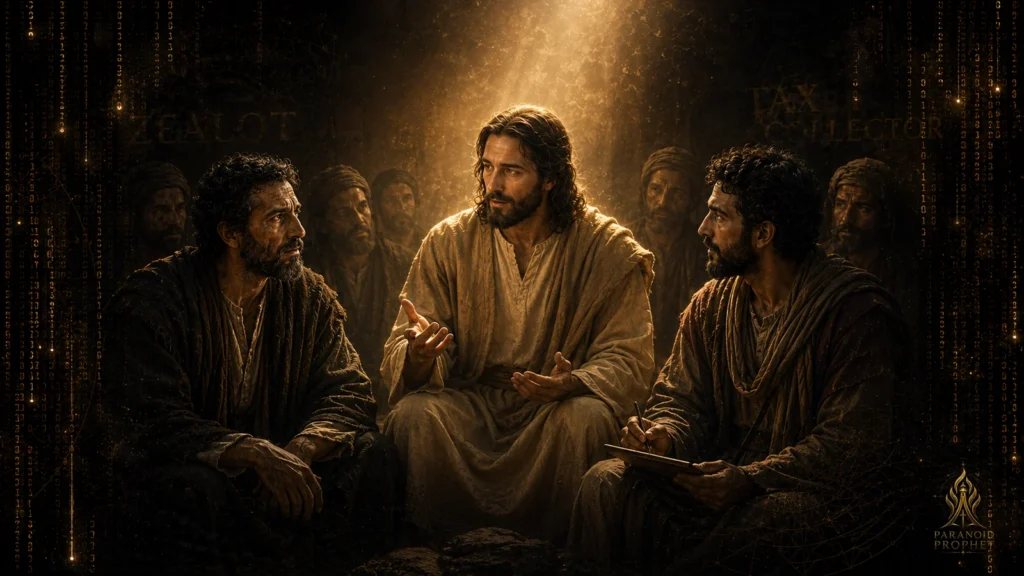
Zeal Without Christ Can Become Faction
Zeal is not holy merely because it is intense. A man can be passionate and still be wrong. He can be committed and still be ruled by pride. He can love a cause and still miss the kingdom of God.
This is why Simon’s title should make us careful. If his title pointed to religious intensity, national longing, or zealot currents in his world, that zeal still had to bow before Jesus. Scripture does not let us turn Simon into a confirmed revolutionary. It lets us see something better: a man known by zeal brought under the authority of Christ.
Without Christ, zeal can become faction. Under Christ, zeal becomes witness.
Simon’s story warns against confusing intensity with faithfulness. The question is not whether a man is passionate. The question is whether his passion belongs to the King.
Jesus Gathered Unlikely Men Under One Lord
Matthew’s apostle list gives a quiet but powerful contrast. In Matthew 10:2–4, Matthew the tax collector and Simon the Zealot stand in the same apostolic company.
We should not invent a private feud between Matthew and Simon. Scripture does not tell us that they hated each other, argued over politics, or carried personal hostility into the group. But the contrast is hard to miss. A tax collector and a man marked by zeal stood under the same Lord, inside the same mission, among the same Twelve.
That is not accidental background detail. It shows the power of Christ’s kingdom to gather men who would never have been united by ordinary loyalties. Jesus did not gather the Twelve around human faction. He gathered them around Himself.
Matthew’s old label and Simon’s old label could not rule the apostolic company. Christ ruled it. The tax collector and the Zealot were not made one by politics, temperament, or shared social interest. They were made one by the call of Jesus.
This is part of the quiet force of the apostle lists. They are not merely names. They are witnesses to the authority of Christ, who gathers unlikely men and makes them servants of one kingdom.
Christ Redirects Zeal Toward the Kingdom of God
If Simon’s zeal once leaned toward lesser loyalties, Christ placed that zeal under a greater kingdom. If his title simply marked personal fervor, Christ still became the Lord of that fervor. Either way, Simon’s story points beyond human intensity to divine authority.
Jesus does not need to borrow the methods of earthly factions to build His church. He calls men to Himself, gives them His word, places them under His authority, and sends them in His name.
Simon’s title points to zeal. His calling points to Christ. His later traditions may remember costly mission and martyrdom, but his biblical witness begins with something clearer: Jesus chose him, included him among the Twelve, and placed him in the apostolic company after the resurrection and ascension.
Once Simon’s biblical identity and relationship to Jesus are clear, the later traditions about his mission and death can be weighed in their proper place. They may preserve a memory of costly witness, but they are not the foundation. The foundation is that Simon belonged to Christ.
What Later Tradition Says About Simon the Zealot’s Mission and Death
With Simon’s biblical foundation in place, the later traditions can be weighed without making them carry more certainty than they can bear. Scripture gives Simon an apostolic place, not a death scene. Later tradition fills in that silence with mission and martyrdom accounts, but the accounts do not speak with one voice.
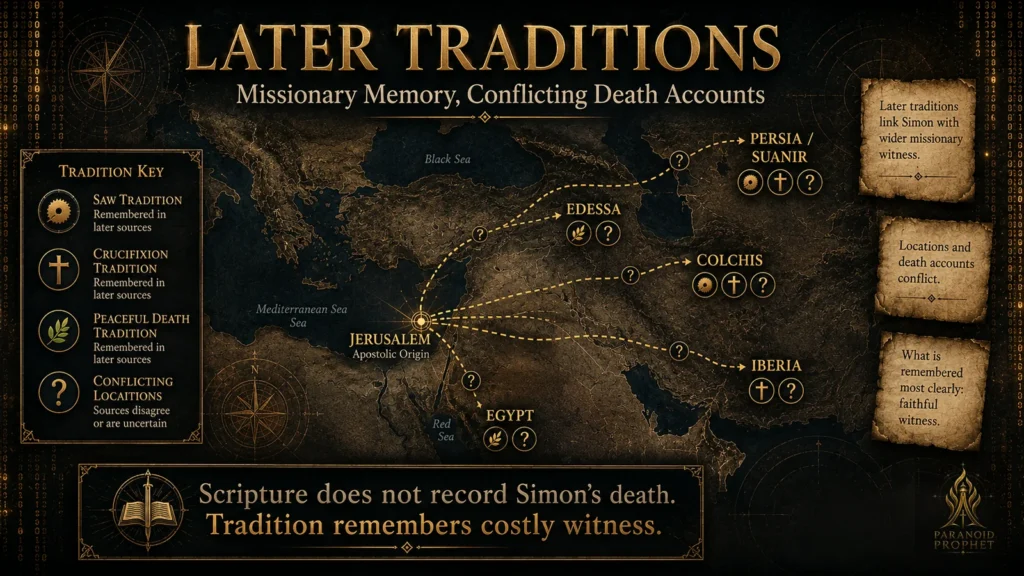
Some traditions place Simon with Jude/Thaddaeus in Persia. Some say he was killed with a saw. Other traditions point toward Edessa, Colchis, Iberia, or a different martyrdom scene altogether. One stream even remembers a peaceful death. That conflict does not make every tradition worthless, but it does warn us not to state one method or location as certain.
The traditions remember Simon as a costly witness more clearly than they agree on his final hour. That distinction matters. Tradition can be honored without being inflated.
The Simon and Jude Tradition
The best-known tradition links Simon the Zealot with Jude/Thaddaeus. The two apostles are often commemorated together, remembered together, and placed together in eastern mission fields. This pairing also makes sense of why many readers hear that Simon died alongside Jude.
The Simon-and-Jude tradition is useful because it shows how later Christian memory remembered Simon not as an isolated name, but as a missionary witness joined with another apostle. In that memory, Simon’s zeal was not private intensity. It became public witness to Christ.
But the article must stay careful. The New Testament does not narrate a shared mission or shared martyrdom for Simon and Jude. Scripture names them among the Twelve, but it does not record their final travels or deaths. The Simon-and-Jude pairing belongs to later tradition, not to a biblical death account.
That does not make the tradition useless. It simply means it belongs in the right lane. It can show how the church remembered Simon and Jude as missionary witnesses. It cannot, by itself, prove every detail of their route, trial, or execution.
The Persia and Suanir Tradition
Persia is one of the most common traditional answers to where Simon the Zealot died. Vatican News summarizes the tradition associated with Fortunatus of Poitiers, who states that Simon and Jude Thaddaeus were buried in Suanir, a city in Persia, where they suffered martyrdom.
This gives the article a real tradition to discuss. It is more useful than saying vaguely that Simon died “somewhere in the East.” It names Simon and Jude together, names Suanir, places the tradition in Persia, and remembers martyrdom as the outcome of their mission.
Still, common tradition is not the same thing as biblical certainty. Persia may be the most familiar traditional answer, but the New Testament does not place Simon’s final mission field there. The careful wording is that later tradition often places Simon’s martyrdom in Persia, especially in connection with Jude/Thaddaeus, while Scripture does not record that death.
The Persia tradition is meaningful because it remembers Simon as a witness beyond the familiar Gospel geography. It presents him as an apostle whose loyalty to Christ became costly. But the claim must remain a tradition, not a certainty equal to Acts.
The safest answer is this: later tradition often links Simon the Zealot with Jude/Thaddaeus and remembers them as martyrs in Persia, but Scripture does not record the event.
The Passion of Simon and Jude
One of the major sources behind the Simon-and-Jude martyrdom tradition is the apocryphal Passion of Simon and Jude. NASSCAL classifies this work as an apocryphal act. That category matters. This is not Scripture. It is later Christian tradition history.
In this tradition, Simon and Jude travel, preach, confront false worship, and eventually reach Suanir. Priests demand that they sacrifice to the gods of the sun and moon. Simon and Jude refuse. The story includes visions, demons emerging from idols, dramatic judgment imagery, and the apostles being killed by angry priests.
Those features show why the text must be handled carefully. It is not a simple execution record. It is a later passion narrative with theological, polemical, and legendary elements. The idol scenes, demonic confrontation, temple-collapse imagery, and dramatic judgment belong to the story-world of apocryphal apostolic literature.
The value of the Passion of Simon and Jude is not that it gives a clean courtroom transcript of Simon’s final hour. Its value is that it preserves a later tradition in which Simon’s witness to Christ is public, confrontational, and costly.
That is useful for the article’s larger argument. Simon is not remembered merely as a quiet name in a list. In this tradition, he is remembered as a missionary witness whose loyalty to Christ clashes with idolatry. The exact historical details remain uncertain, but the memory of costly witness is clear.
This is how the tradition should be used: not as proof that every detail happened exactly as told, but as evidence that Christian memory connected Simon the Zealot with proclamation, opposition, and martyrdom.
The Saw Tradition
The most memorable version of Simon’s death says he was killed with a saw. This is why Christian art often depicts Simon with a saw as one of his symbols. The image is striking, and it has shaped the way many people remember him.
But memorable does not mean certain. Scripture never says Simon was sawed in half. The saw tradition belongs to later tradition, especially the apocryphal Simon-and-Jude stream. It should be mentioned because readers will encounter it, but it should not be stated as a biblical fact.
This is an important place for source discipline. If the article says, “Simon was sawed in half,” it overstates the case. If it says, “Some later traditions say Simon was killed with a saw,” it tells the truth more carefully.
The saw tradition may be the most famous answer to how Simon died, but it is not the only tradition. It is one stream of later Christian memory, not a settled death report from the New Testament.
Conflicting Traditions: Edessa, Colchis, Iberia, and Crucifixion
The reason we cannot treat the saw tradition as certain is that other traditions conflict with it. Britannica summarizes the common tradition that Simon preached in Egypt, joined Jude in Persia, and was martyred with a saw, but it also notes a conflicting report associated with Basil the Great that Simon died peacefully at Edessa.
New Advent’s Catholic Encyclopedia also shows the tradition is not simple. It discusses Suanir, Persia, Colchis, Iberia, and uncertainty about Simon’s burial place. That kind of variation matters. It means Simon’s later memory was geographically widespread, but not historically clean enough to give one final location with confidence.
There is also a separate apocryphal stream in the Martyrdom of Simon the Canaanite. In that tradition, Simon is accused, delivered to Trajan, confesses faith in Jesus, and is handed over for crucifixion. This is not the same death scene as the saw tradition.
These conflicts do not erase Simon’s later memory as a missionary witness. They do, however, prevent us from naming one final scene with certainty. Persia, Edessa, Colchis, Iberia, a saw, crucifixion, and peaceful death cannot all be the same historical claim. The article should let that conflict strengthen its honesty.
Simon’s later traditions are strong enough to matter, but not clean enough to control the article.
Why the Traditions Conflict
The traditions conflict because later Christian memory often traveled through devotion, geography, symbol, and story. Different regions preserved different memories. Different communities emphasized different mission fields. Apocryphal acts often shaped apostolic stories with theological drama, miracles, confrontations with idols, and martyrdom scenes.
Iconography can also compress a tradition into a symbol. Once Simon becomes associated with a saw, the symbol can become more familiar than the source behind it. A visual tradition may preserve a memory of martyrdom, but it does not automatically prove the exact weapon.
Simon’s traditions also overlap with Jude/Thaddaeus traditions. When two apostles are commemorated together and remembered together, their mission fields and death stories can become intertwined. That pairing may preserve meaningful church memory, but it also makes source ranking necessary.
None of this means the traditions should be dismissed. It means they should be used honestly. Tradition often preserves memory through devotion, but devotion is not the same as a first-century death report.
The article should let tradition speak, but not let tradition shout over Scripture.
How Strong Is the Martyrdom Evidence for Simon the Zealot?
The martyrdom evidence for Simon the Zealot is meaningful, but it is not first-tier. It is stronger as tradition history than as courtroom-style proof. Scripture does not record his death. Later sources remember him as a missionary and possible martyr, often with Jude/Thaddaeus, but the place and method vary.
That means Simon should not be used as a standalone martyrdom proof for the resurrection. His death tradition is too late and conflicted to carry that kind of weight. But his traditions still matter when placed in the larger pattern of apostolic witness.
The strongest foundation remains Scripture: Simon belonged to the Twelve, was called “the Zealot,” and is remembered in Acts among the gathered apostles after the ascension. Later tradition then remembers him as a missionary witness whose proclamation of Christ may have cost him his life.
That is a strong enough claim. It does not need inflation.
| Source or tradition | What it supports | What it does not prove |
|---|---|---|
| Scripture | Simon was one of the Twelve and appears in the post-ascension apostolic company | His death method or final mission field |
| Vatican / Fortunatus tradition | Later memory of Simon and Jude as martyrs at Suanir in Persia | Biblical-level certainty about location |
| New Advent / Catholic Encyclopedia | Conflicting traditions involving Persia, Colchis, Iberia, and unknown burial | One certain final location |
| Passion of Simon and Jude | Later apocryphal tradition of joint witness, conflict with idolatry, and martyrdom | A clean historical transcript of their deaths |
| Britannica summary | Saw tradition and the conflicting peaceful-Edessa tradition | One certain death method |
| Martyrdom of Simon the Canaanite | A separate apocryphal crucifixion tradition under Trajan | Harmony among the traditions |
| Popular iconography | Saw imagery attached to Simon | A secure death method |
This table is not designed to weaken Simon’s witness. It is designed to keep the article honest. Christian evidence is stronger when it does not exaggerate. Simon’s martyrdom tradition is meaningful, but it must be carried carefully.
The martyrdom traditions for Simon the Zealot are not clean enough to carry the whole apologetic argument. The final step is to state what we can say carefully, what we should not claim, and how Simon’s witness still contributes to the larger case for Jesus.
What We Can Say Carefully About Simon the Zealot
After sorting the biblical evidence and later traditions, the careful answer becomes clear. Simon the Zealot was one of the Twelve apostles. He was a man marked by zeal, yet placed under the authority of Christ. Scripture names him in the apostolic company, remembers him after the ascension, and gives him a place among the witnesses Jesus chose.
We can say confidently that Simon belonged to the Twelve. Matthew, Mark, Luke, and Acts all name him in apostolic-list contexts. Matthew shows the Twelve receiving authority from Jesus. Mark shows the Twelve appointed to be with Jesus and to be sent by Jesus. Acts names Simon among the gathered apostles after the ascension.
We can also say that Simon’s title matters. He is remembered as “the Zealot.” That title gives the article a theological theme, but it does not give us permission to invent a full political biography. Simon may have been known for religious zeal, a distinguishing label, or some connection with zealot currents in Jewish life. Scripture does not tell us enough to claim more.
Scripture does not record Simon’s death. No New Testament passage gives his final mission field, trial, execution, burial place, or death method. Later tradition remembers him as a missionary and possible martyr, often linked with Jude/Thaddaeus, but those traditions vary by source and region.
The careful conclusion is this: Simon the Zealot was a real apostolic witness in Scripture, a man Jesus chose and placed among the Twelve. Later Christian tradition remembers him as a costly missionary witness, often as a martyr. But the exact place and method of his death remain uncertain.
What We Should Not Claim
A strong Christian case does not need fragile certainty. Simon the Zealot is worth studying without pretending the evidence says more than it does.
- We should not claim that the Bible records Simon’s death. It does not.
- We should not claim that Simon definitely died in Persia, Edessa, Colchis, Iberia, Egypt, or any one final location.
- We should not claim that Simon was definitely killed with a saw, cross, sword, spear, club, axe, or any one weapon.
- We should not claim that Simon definitely died with Jude/Thaddaeus as a matter of biblical fact.
- We should not claim that Simon definitely belonged to a formal anti-Roman Zealot movement as later history describes it.
- We should not claim that Matthew the tax collector and Simon the Zealot personally hated each other. Scripture does not say that.
- We should not claim that Simon’s martyrdom tradition, by itself, proves the resurrection.
The stronger claim is more careful and more persuasive: Simon belonged to the apostolic company Jesus chose and sent. His title points to zeal. His apostleship points to Christ. Later tradition remembers him as a missionary and possible martyr, but the details of his death should not be overstated.
Why Simon the Zealot Still Matters for the Jesus Evidence Case
Simon the Zealot matters because his story keeps the evidence in the right order: Scripture first, historical and tradition evidence second, apologetic synthesis last.
He does not matter because we can prove the exact weapon that killed him. He matters because Jesus chose him. Scripture names him among the Twelve, places him within the apostolic mission, and remembers him in the gathered apostolic company after the ascension.
Simon’s death tradition may be mixed, but his connection to Jesus is clear. He belonged to the men Jesus called, appointed, and sent. His title may raise questions about zeal, but his calling gives the answer: zeal must belong to Christ.
That means Simon should not be reduced to a disputed martyrdom method. If the article ends only with a saw, Persia, Edessa, or a map of uncertain mission fields, it misses the better biblical treasure. Simon’s strongest witness is not a weapon. It is the Lord who called him.
His Story Is Cumulative, Not Standalone Proof
Simon the Zealot should not carry the whole resurrection argument. He does not need to. The broader resurrection case rests on Scripture, Jesus’ death by crucifixion, early resurrection proclamation, apostolic witness, appearance claims, and the serious but debated evidence surrounding the empty tomb.
Paul’s summary in 1 Corinthians 15:3–8 gives the larger apostolic proclamation: Christ died, was buried, was raised, and appeared. Simon should be placed within that wider apostolic witness pattern, not forced to bear more evidential weight than his own record can carry.
Later martyrdom traditions can support the remembered cost and sincerity of the apostolic mission, but they do not prove the resurrection by themselves. In Simon’s case, the traditions are meaningful but conflicted. They are useful for tradition history, not as a clean execution record.
The uncertain death tradition does not silence the certain biblical witness.
His Zeal Points Beyond Politics to Christ
Simon’s title points to zeal, but his apostleship points to Christ. Whatever Simon’s title meant in full, Jesus did not leave Simon’s zeal untouched. He placed Simon under a higher authority, a greater loyalty, and a kingdom not built by human faction.
This is why Simon’s story matters spiritually. Zeal is not holy merely because it is intense. Passion can be ruled by pride. Loyalty can be chained to fear. A cause can become an idol. Simon’s title raises the question of zeal, but Jesus’ call gives the answer.
Christ does not merely collect strong personalities and use them as they are. He calls sinners to Himself, places them under His lordship, and sends them with His message. Simon’s zeal had to become Christ’s servant, not Christ’s replacement.
The article should not end with a saw. It should end with the Savior who called him.
Common Objections About Simon the Zealot
Objection: “Was Simon the Zealot One of the Twelve Apostles?”
Yes. Simon the Zealot is named among the Twelve apostles in the New Testament apostle lists. Matthew, Mark, Luke, and Acts all include him in the apostolic company.
That is the strongest foundation for this article. Simon’s death traditions are later and conflicted, but his place among the Twelve is biblical.
Objection: “Was Simon the Zealot the Same as Simon Peter?”
No. Simon the Zealot was not Simon Peter. The apostle lists distinguish Simon Peter from Simon the Zealot. Peter is the more visible apostle in the Gospels, while Simon the Zealot is another member of the Twelve.
This distinction matters because the name Simon appears more than once in the New Testament. Simon the Zealot should not be confused with Peter or with other men named Simon.
Objection: “What Does ‘Zealot’ Mean?”
The title “Zealot” is connected with zeal. Luke and Acts call him Simon the Zealot, while Matthew and Mark use a related form sometimes rendered “Cananaean” or “Canaanite” in older traditions. The title should not be taken to mean that Simon was from Cana or Canaan.
The safest explanation is that Simon was known by a title connected to zeal. That title matters, but Scripture does not explain his full backstory.
Objection: “Was Simon Definitely Part of the Zealot Political Movement?”
Not certainly. Simon’s title may suggest religious zeal, a distinguishing label, or some connection with zealot currents in Jewish life. But the New Testament does not give enough information to claim he was definitely a member of a formal anti-Roman Zealot movement.
This is where the article must avoid speculation. We can use Simon’s title to discuss zeal submitted to Christ. We should not turn him into a detailed political biography the Bible does not give.
Objection: “Did Simon the Zealot Die With Jude/Thaddaeus?”
Later tradition often says Simon died with Jude/Thaddaeus, especially in traditions connected with Persia. One common tradition remembers Simon and Jude as buried in Suanir, a city in Persia, where they suffered martyrdom.
But Scripture does not record this event. The proper wording is careful: later tradition often links Simon and Jude in mission and martyrdom, but the New Testament does not give us a shared death account.
Objection: “Was Simon the Zealot Sawed in Half?”
Some later traditions say Simon was killed with a saw, and this explains why Christian art often depicts him with a saw. But Scripture never says Simon was sawed in half.
The careful answer is that the saw tradition is a later tradition, not a biblical fact. It may preserve a memory of martyrdom, but it should not be stated as certain.
Objection: “Did Simon the Zealot Die Peacefully?”
One later tradition says Simon died peacefully at Edessa. That tradition conflicts with the more familiar martyrdom traditions, including the saw tradition and the Persia tradition.
This conflict is one reason the article should not name one final scene with certainty. The best answer is that Simon’s death is remembered in different ways by later sources, and Scripture does not settle the question.
Objection: “Why Do Sources Disagree About Simon’s Death?”
Sources disagree because later apostolic traditions developed through regional memory, devotion, apocryphal storytelling, and iconography. Simon was also often paired with Jude/Thaddaeus, which means their mission and martyrdom traditions sometimes overlap.
That does not mean every tradition should be dismissed. It means the traditions must be ranked. They are useful for understanding Christian memory, but they are not equal to Scripture.
Objection: “Does Simon’s Death Prove the Resurrection?”
No, not by itself. Simon’s death tradition is too late and conflicted to function as standalone proof. Martyrdom also proves sincerity more directly than truth. People can die sincerely for beliefs that are false.
But Simon’s story still belongs in the cumulative case. He was one of the Twelve, remembered after the ascension, and later remembered by tradition as a missionary and possible martyr. Together, that places him inside the wider pattern of apostolic witness to Christ.
Final Answer: How Did Simon the Zealot Die?
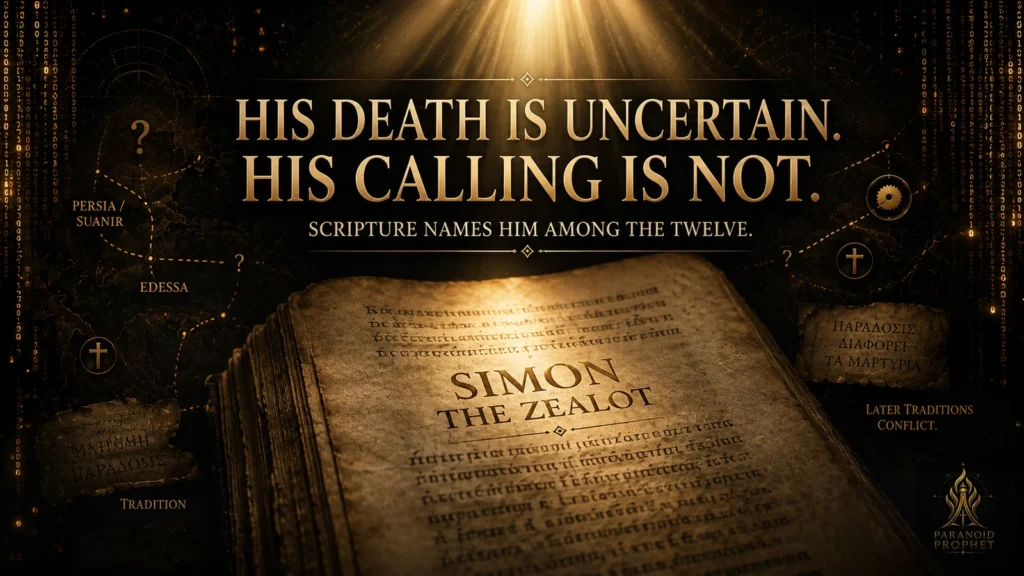
So how did Simon the Zealot die? Scripture does not record his death. The Bible names him among the Twelve apostles and remembers him in the post-ascension apostolic company, but it does not tell us his final mission field or death method.
Later tradition often remembers Simon as a missionary and possible martyr, frequently linked with Jude/Thaddaeus. The most common tradition places Simon and Jude in Persia, and some later traditions say Simon was killed with a saw. Other traditions point elsewhere or even say he died peacefully. Because the traditions conflict, the exact location and method of Simon’s death remain uncertain.
The strongest answer is careful: Simon the Zealot was one of the Twelve apostles Jesus chose, a man marked by zeal whose loyalty was placed under Christ. His death tradition may be uncertain, but his calling is not.
His title points to zeal. His apostleship points to the Lord who gathered unlikely men, placed them under His authority, and sent them in His name.

Frequently Asked Questions About Simon the Zealot
How did Simon the Zealot die?
Scripture does not record how Simon the Zealot died. Later traditions remember him as a missionary and possible martyr, often with Jude/Thaddaeus, but the exact place and method vary by source.
Was Simon the Zealot martyred?
Many later traditions remember Simon as a martyr, especially in connection with Jude/Thaddaeus and Persia. But the New Testament does not record his martyrdom, and later sources disagree on the details.
Was Simon the Zealot sawed in half?
Some later traditions say Simon was killed with a saw. This is why he is often depicted with a saw in Christian art. But Scripture does not say he was sawed in half, so the claim should be treated as later tradition rather than certainty.
Did Simon the Zealot die in Persia?
Persia is one common later tradition, especially in the Simon-and-Jude/Suanir stream. But Persia is not named in Scripture as Simon’s final mission field or death location.
Did Simon the Zealot die with Jude?
Later tradition often links Simon the Zealot with Jude/Thaddaeus in mission and martyrdom. Scripture does not record their shared death, so the claim should be worded as tradition, not biblical fact.
Was Simon the Zealot one of the Twelve?
Yes. Simon the Zealot is named among the Twelve apostles in the New Testament apostle lists. Acts also names him among the apostolic company after Jesus’ ascension.
What does “Zealot” mean?
The title is connected with zeal. It may indicate religious zeal, a distinguishing label, or some connection with zealot currents in Jewish life. The Bible does not give Simon’s full backstory.
Was Simon the Zealot part of the Zealot political party?
Possibly, but not certainly. The New Testament gives the title “Zealot,” not a detailed political biography. It is better to say Simon was known by a title connected with zeal, while avoiding claims Scripture does not make.
Was Simon the Zealot the same as Simon Peter?
No. Simon Peter and Simon the Zealot are different apostles. The apostle lists distinguish Simon Peter from Simon the Zealot.
Does Simon’s death prove the resurrection?
No, not by itself. Simon’s death tradition is too conflicted to serve as standalone proof. But his apostolic identity, post-ascension presence in Acts, and later memory as a possible martyr contribute to the wider pattern of apostolic witness to Christ.
Read Next
- How Did Jude Thaddaeus Die? The Apostle Called Judas, Not Iscariot
- Martyrdom of Jesus’ Disciples: What Do We Actually Know?
- How Did James Son of Alphaeus Die?
- How Did Matthew Die? Evidence for Matthew’s Martyrdom Tradition
- How Did James the Brother of Jesus Die?
- Resurrection Evidence: The Case for Jesus Rising From the Dead
- Is Jesus the Son of God? Evidence from History, Prophecy, Resurrection, and Scripture
Sources and Further Reading
- Matthew 10:1–4 — Jesus gives the Twelve authority and Simon is named among them.
- Mark 3:13–19 — Jesus appoints the Twelve to be with Him and to be sent out.
- Luke 6:14–16 — Simon is named as Simon the Zealot among the Twelve.
- Acts 1:13 — Simon the Zealot is named in the post-ascension apostolic company.
- 1 Corinthians 15:3–8 — Paul summarizes the early apostolic proclamation of Christ’s death, burial, resurrection, and appearances.
- Britannica, “Saint Simon the Apostle” — overview of Simon the Zealot, naming issues, saw tradition, and peaceful Edessa tradition.
- Vatican News, “Sts. Simon and Jude (Taddeo), Apostles” — later tradition linking Simon and Jude with Suanir in Persia and martyrdom.
- NASSCAL, Passion of Simon and Jude — later apocryphal tradition of joint witness and martyrdom.
- NASSCAL, Martyrdom of Simon the Canaanite — separate apocryphal tradition in which Simon is handed over for crucifixion.
- New Advent / Catholic Encyclopedia, “St. Simon the Apostle” — overview of conflicting later traditions involving Persia, Colchis, Iberia, and uncertain burial.
- Sean McDowell, “Did the Apostles Really Die as Martyrs for their Faith?” — useful caution that martyrdom most directly supports sincerity, not automatic proof of truth by itself.
Source note: Later martyrdom traditions are included as tradition history and evidence of Christian memory. They are not treated as equal to Scripture or as first-tier proof of Simon the Zealot’s exact death.
CONTINUE THE INVESTIGATION
Evidence standard continuation
Did the Apostles Die for the Resurrection? What We Can Honestly Say
Return from this individual witness tradition to the comparative source review that separates strong evidence, plausible tradition, and uncertainty.