
GUIDED ARTICLE EXPERIENCE
How Did Matthias Die? The Apostle Chosen to Replace Judas
Read along as the narration moves through the article.
Private device narration · No hosted audio or tracking
CONTINUE GUIDED TOUR
Continue where you left off.
GUIDED TOUR COMPLETE
You have reached the end of this study.
Study record saved on this device.
GUIDED TOUR
How Did Matthias Die? The Apostle Chosen to Replace Judas
Narrator: Paranoid Prophet Recommended Voice Native device narration
Prepare to follow the article as it is narrated.
VOICE & TOUR OPTIONS
Voice & Listening
NARRATOR
Finding a narrator…
Checking the best narrator available on this device.
Restores the best curated narrator available on this device.
Narrator choices are curated for clear, long-form listening on this device.
Screen-awake support will be checked when narration starts.
CHOOSE A NARRATOR
Curated for this device
Choose a verified narrator for this browser, or use System Narrator. Automatic mode uses the best reliable route exposed by this device; your chosen narrator is preserved even if this device needs a temporary fallback.
Preparing the guided article experience…
RESUME GUIDED TOUR?
Continue where you left off.
GUIDED TOUR COMPLETE
You have reached the end of this study.
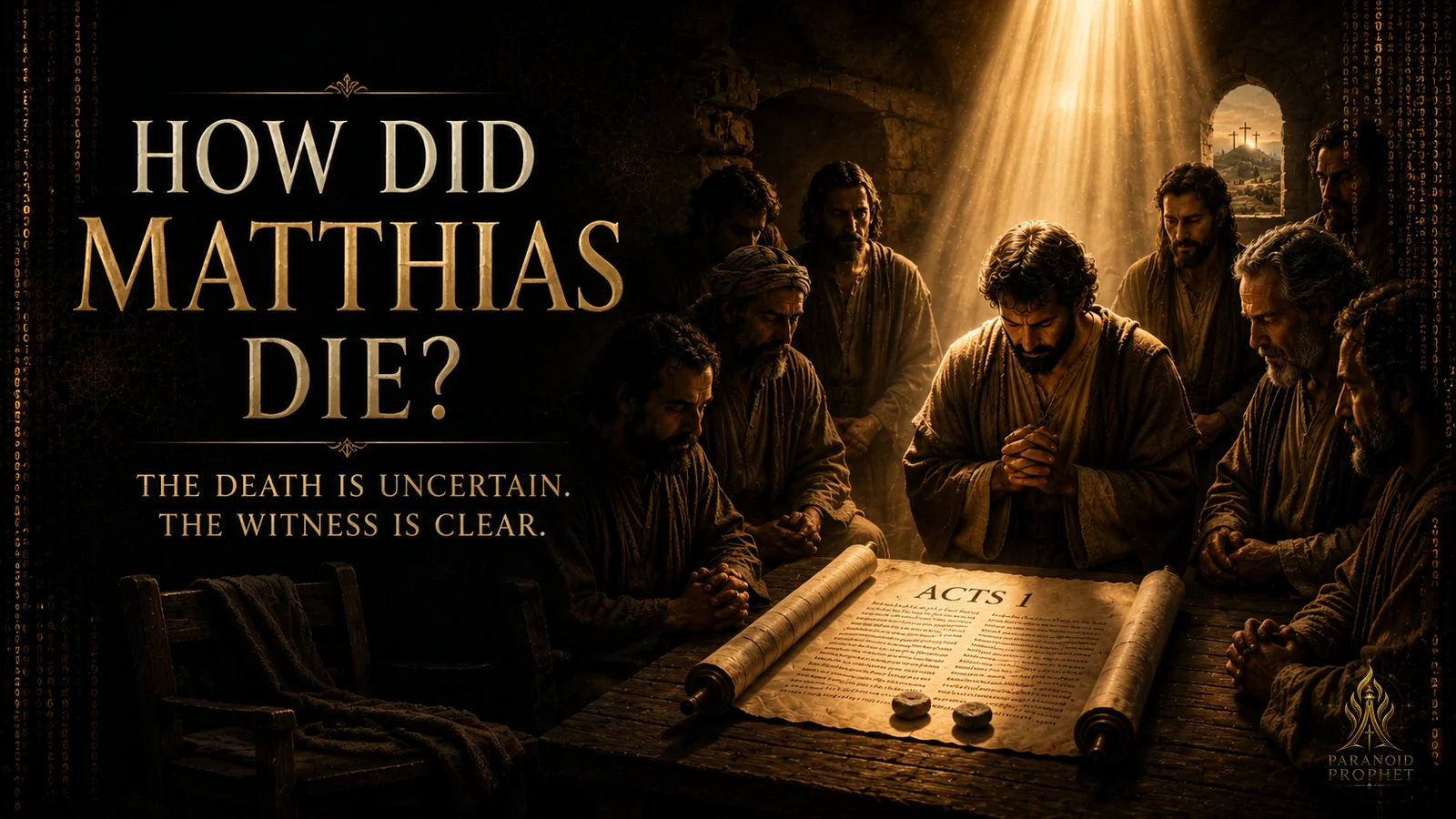
How did Matthias die? Scripture does not tell us. Acts records that Matthias was chosen to replace Judas Iscariot and become a witness to the resurrection, but it does not record his final mission field, death scene, or exact method of death.
Later traditions give different answers. Some say Matthias was stoned or beheaded. Others connect him with crucifixion, violent death in an eastern mission field, or, in some later summaries, a natural death. Those traditions are worth discussing because readers often ask how the apostles died. But they should not carry the center of the case.
The center of Matthias’s story is not how he died. It is why he was chosen.
Acts presents Matthias at a crucial moment. Judas has betrayed Jesus and abandoned his apostolic place. The circle of the Twelve has been wounded. Peter stands among the believers, appeals to Scripture, and says that another man must take Judas’s office. The replacement could not be a stranger to Jesus’ ministry. He had to be someone who had accompanied Jesus’ followers through the public ministry of Christ and could stand as a witness to the resurrection.
That is where Matthias enters the record. He is not introduced as a celebrity, a preacher with a preserved sermon, or a man with a dramatic personal scene in the Gospels. He is introduced as a qualified witness. Matthias had been present before he was prominent.
Bottom line: Matthias was chosen to replace Judas and was numbered with the eleven apostles. Scripture does not record his death. Later traditions give different endings, including stoning, beheading, crucifixion, violent death in an eastern mission field, or, in some later summaries, a natural death.
Source discipline: This article does not claim that the Bible records Matthias’s death. It does not treat later martyrdom traditions as equal to Acts. It begins with Scripture, then weighs later tradition as later tradition.
Article Guide16 sections
Evidence Map for Matthias
Matthias needs a careful evidence map because his biblical role is clear, but his death traditions are not. Acts gives his identity and purpose. Later sources give conflicting memories of his mission and death. Those layers belong in the same article, but they do not carry the same weight.
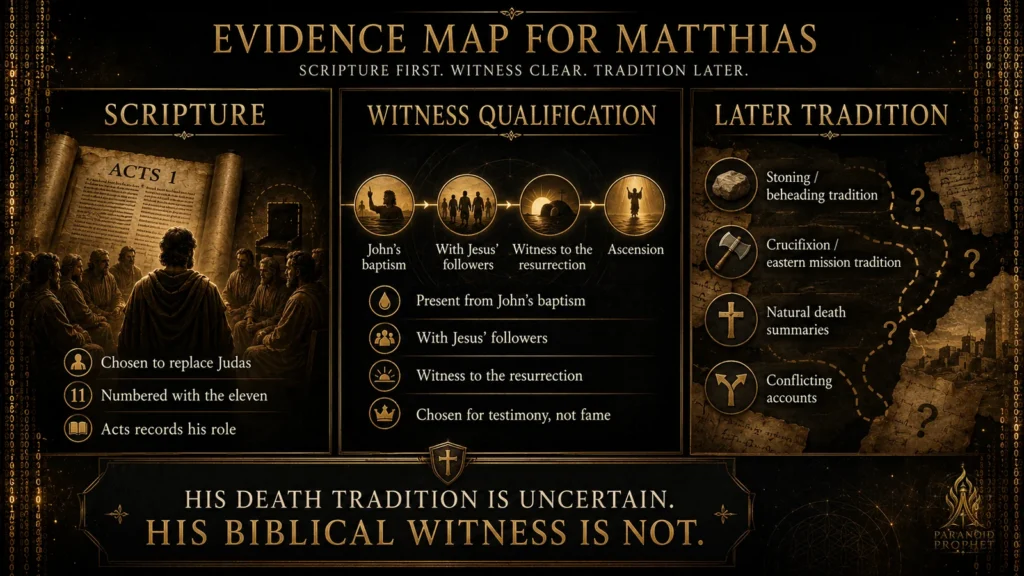
The first layer is Scripture. The second layer is careful interpretation of Matthias’s relationship to Jesus and the apostles. The third layer is later tradition about his mission and death. The article is strongest when those layers stay in order.
| Claim | Evidence strength | Best use |
|---|---|---|
| Matthias was chosen to replace Judas | Very strong | Biblical identity |
| Matthias accompanied Jesus’ followers from John’s baptism to the ascension | Very strong | Relationship to Jesus |
| Matthias was chosen to become a witness to the resurrection | Very strong | Article center |
| Matthias was numbered with the eleven apostles | Very strong | Apostolic status |
| Matthias is not mentioned again in the New Testament | Strong | Source discipline |
| Matthias was one of the seventy or seventy-two disciples | Later tradition | Mention carefully |
| Later tradition says Matthias was stoned and beheaded | Later tradition | Tradition history |
| Later tradition says Matthias was crucified or violently killed | Later tradition | Shows tradition conflict |
| Matthias died naturally or in old age | Later/conflicting tradition | Mention cautiously |
| Exact death location and method | Uncertain | Final-answer caution |
This map does not weaken Matthias’s witness. It keeps the evidence honest. His death tradition is uncertain, but his biblical role is not.
Matthias matters because Acts places him inside the restored apostolic witness after Judas. The question of his death is important, but the deeper question is why he was chosen in the first place.
Who Was Matthias?
Matthias was the disciple chosen to replace Judas Iscariot after Judas’s betrayal and death. He enters the New Testament record at a moment of rupture. The Twelve have been wounded by betrayal, and the apostolic witness needs to be restored.
That means Matthias’s story begins with both grief and hope. Judas had turned aside from his ministry and apostleship. The wound was real. But the mission of Christ did not collapse. The witness to the resurrection continued.
Judas’s betrayal did not get the final word.
Matthias is not one of the most visible figures in the New Testament. Scripture gives no preserved sermon, miracle, or private conversation from him. Yet Acts tells us what matters most for this article: Matthias was qualified to stand with the apostles as a witness to the risen Christ.
That is the heart of his biblical identity. Matthias was not chosen because he was famous. He was chosen because he could witness.
The Apostle Chosen After Judas
The story of Matthias is found in Acts 1:12–26. After Jesus ascends, the believers gather in Jerusalem. Peter speaks about Judas, appeals to Scripture, and says another must take his office.
This is not presented as a casual administrative move. Acts frames it with prayer, Scripture, and the need for resurrection witness. The apostolic circle had been broken by Judas’s betrayal, but the witness of the Twelve was not abandoned.
Two men are put forward: Joseph called Barsabbas, who was also called Justus, and Matthias. The believers pray, asking the Lord who knows every heart to show which of the two He has chosen. Then they cast lots, and Matthias is numbered with the eleven apostles.
That final statement matters. Acts does not present Matthias as a footnote, a mascot, or a failed attempt to replace Judas. It says he was numbered with the eleven apostles.
The apostolic witness did not collapse after Judas. It was restored.
Matthias Was Not a Stranger to Jesus
One of the most important details in Acts 1 is easy to miss. Peter says the replacement for Judas had to be someone who had accompanied the disciples during the whole period of Jesus’ public ministry, beginning from the baptism of John until the day Jesus was taken up.
That means Matthias was not a random man chosen to fill an empty seat. He had been there. He had walked close enough to the apostolic circle to meet the qualifications Peter gives. He had witnessed enough of Jesus’ ministry to stand with the apostles as a resurrection witness.
This gives Matthias a deeper relationship to Jesus than many readers assume. He was not prominent in the Gospel story, but he was not disconnected from it. Acts presents him as someone who had accompanied the movement of Jesus from the beginning of the public ministry to the ascension.
Matthias’s relationship to Jesus was one of long, quiet nearness before public appointment. He had been present before he was prominent.
Matthias and Joseph Barsabbas
Joseph Barsabbas, also called Justus, should not be treated as a failed disciple. Acts does not say he was morally inferior, spiritually unworthy, or rejected because of hidden sin. He was put forward alongside Matthias, which likely means he met the same basic qualifications.
Joseph’s presence in the story strengthens the seriousness of the selection. The early believers were not grabbing the nearest available name. They put forward men who had been with them, prayed, and entrusted the decision to God.
Matthias should not be inflated by tearing Joseph down. Scripture gives Matthias honor without dishonoring Joseph.
Was Matthias Really an Apostle?
Yes. Acts 1:26 says Matthias was numbered with the eleven apostles. That is the clearest biblical answer.
Some readers later ask whether Paul should have replaced Judas instead of Matthias. That objection deserves a careful answer later in the article, but it should not be allowed to erase what Acts actually says. Paul’s apostleship is real and powerful. Matthias’s place in Acts is also real.
Acts does not present Matthias as a mistake. It presents him as the man numbered with the eleven after prayer, Scripture, and the casting of lots. His later death tradition may be uncertain, but his apostolic status in Acts is not treated as uncertain.
So the article begins here: Matthias was chosen after Judas, qualified as a resurrection witness, and numbered with the eleven. The next question is why he was chosen, and Acts gives the answer: he had been with the witnesses from the beginning and was appointed to testify to the resurrection.
Why Was Matthias Chosen?
Acts does not leave Matthias’s selection unexplained. He was chosen because the apostolic witness needed a qualified voice: someone who had been with Jesus’ followers from the beginning and could testify to the resurrection.
Judas had abandoned his place, but the witness to the risen Christ did not end with Judas’s betrayal. Matthias was brought forward because the mission required testimony, not symbolism alone.
He Had Been With the Witnesses From the Beginning
Peter’s requirement reaches back through the public ministry of Jesus. The replacement for Judas had to be someone who had accompanied the disciples from the baptism of John until the ascension. Matthias was not inserted into the apostolic circle as an outsider. He had been there.
The text does not tell us he was famous. It tells us he was qualified. Matthias had walked close enough to the apostolic company to stand as a witness to Jesus’ ministry and resurrection.
That gives his story a different kind of weight. Some disciples are visible early. Others remain in the background until the Lord brings them forward. Matthias had been present before he was prominent. His hidden faithfulness mattered before his public appointment.
He Could Testify to the Resurrection
The explicit purpose of Matthias’s selection was resurrection witness. Peter says one of the qualified men must become, with the apostles, a witness to Jesus’ resurrection.
That single requirement gives Matthias’s article its heart. He was not chosen for an empty title. He was not chosen as a ceremonial replacement with no testimony. He was chosen because the restored apostolic circle needed a man who could bear witness to the risen Christ.
Christianity did not begin as vague admiration for a dead teacher. The apostolic proclamation centered on Jesus crucified and risen. Matthias was brought into the witness that Jesus was not merely remembered after death, but publicly proclaimed as crucified, risen, and Lord.
This matters for the larger Jesus evidence case. Matthias’s later death traditions are uncertain, but his biblical purpose is clear. Acts presents him as a qualified resurrection witness. That is stronger than any disputed tradition about how he died.
The Apostolic Circle Was Restored After Betrayal
Matthias also matters because his selection answers Judas’s betrayal. Judas broke fellowship by betrayal. Matthias entered by witness.
The betrayal was real, but it was not final. Judas’s fall left a wound in the apostolic circle, yet Acts does not present the witness of the Twelve as destroyed. The believers pray. Scripture is applied. Matthias is numbered with the eleven.
That makes Matthias a fitting figure near the close of the martyr cluster. The story of the apostles does not end with betrayal. It continues with restored witness to the risen Christ.
Matthias’s Relationship to Jesus
Matthias’s relationship to Jesus was one of long, quiet nearness before public appointment. Scripture does not give us his private conversations with Christ. It does not record a personal question, a healing scene, or a rebuke addressed to him by name. But Acts gives us something essential: Matthias had accompanied the disciples through the public ministry of Jesus.
That means Matthias was not disconnected from Christ’s earthly ministry. He was not a stranger brought in after the resurrection to fill a vacancy. He had been near enough, long enough, and faithfully enough to stand as a witness.
This is why Matthias’s article should not be built on speculation. We do not need to invent scenes the Bible does not give. The text already gives us a strong foundation: Matthias was qualified by long association with Jesus’ ministry and chosen for resurrection testimony.
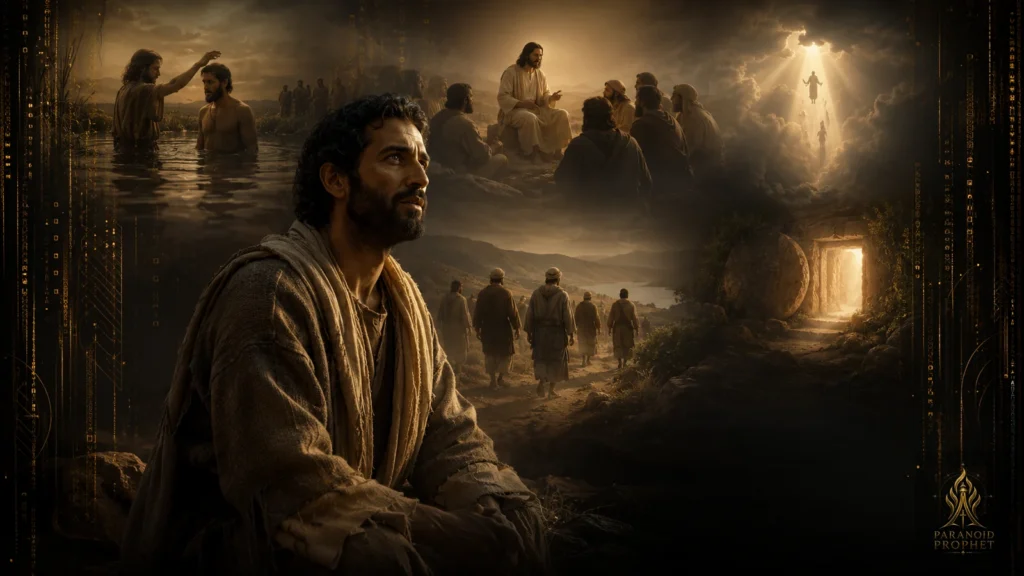
He Was Near the Ministry Before He Was Named
Matthias is not named during the Gospel narratives, but Acts shows that he had been near the ministry before he was publicly named. His hiddenness should not be mistaken for distance.
Peter speaks often. John leans close. Thomas asks. Philip questions. James and John are corrected. Matthias remains unnamed until Acts 1, but that does not mean he was absent from the story of Jesus’ ministry.
He Was Chosen for Witness, Not Fame
Matthias was not chosen because he had the largest public profile. He was chosen because he met the witness requirement. He had been with the disciples through Jesus’ ministry, and he could stand with the apostles as a witness to the resurrection.
This corrects a shallow way of measuring significance. The Bible does not always spotlight every faithful person before the moment he is needed. Matthias’s story shows that the Lord may prepare a witness in quietness long before that witness is publicly recognized.
His significance was not built on visibility, but on faithful nearness to Christ and readiness to testify.
He Belonged to the Restored Apostolic Company
Acts says Matthias was numbered with the eleven apostles. That statement should be allowed to stand with its full weight. Matthias’s place in Acts should not be treated as an embarrassment to explain away.
Paul’s later apostleship is real, powerful, and essential to the New Testament. But Paul’s apostleship does not erase what Acts says about Matthias. The text presents Matthias as the man numbered with the eleven after prayer, appeal to Scripture, and the casting of lots.
That means Matthias stands at the point where betrayal is answered by witness, prayer, and restoration.
Life as an Early Christian Witness
Acts does not give Matthias a personal diary after his selection. It does not say, “Matthias preached here,” or “Matthias was threatened there,” or “Matthias suffered in this exact scene.” Those limits matter. Acts gives Matthias’s apostolic setting, not a private biography.
But Acts does show the apostolic environment into which Matthias was added. He was numbered with the eleven before the life of the early Christian community is described in fuller detail. That community was shaped by teaching, fellowship, prayer, public witness, and pressure from authorities.
So Matthias should be understood inside that early apostolic environment: resurrection proclamation, shared life, prayer, teaching, public testimony, and the cost of speaking in Jesus’ name.
A Community Devoted to Teaching, Prayer, and Fellowship
Acts 2 describes the early believers devoting themselves to the apostles’ teaching, fellowship, the breaking of bread, and the prayers. The picture is not vague private spirituality. It is a gathered life shaped by truth, worship, generosity, and community.
This is the world Matthias entered as a restored apostolic witness. The early Christian community was formed around the apostles’ teaching because the apostles were witnesses to Jesus. Their message was not self-help, civic improvement, or moral symbolism. Their message was Christ crucified and risen.
The resurrection claim did not remain an idea floating above ordinary life. It created a visible community. Matthias is not individually named in Acts 2’s community summary, so we should not turn that chapter into a private Matthias biography. But his appointment immediately before this scene places him inside the apostolic company connected to this early witness.
A Witness That Faced Public Pressure
Acts also shows that the apostolic witness quickly faced public pressure. In Acts 4, the authorities command Peter and John not to speak or teach at all in the name of Jesus. Peter and John answer that they cannot stop speaking about what they have seen and heard.
That response captures the heart of apostolic witness. To be a resurrection witness was not merely to hold a private belief. It was to speak publicly about the risen Christ in a world that could command silence.
Acts later says the apostles gave testimony to the resurrection of the Lord Jesus with great power. That is the kind of witness Matthias had been chosen to join. The replacement for Judas was not chosen for a quiet title without a message. He was chosen for resurrection testimony.
Again, Acts does not single out Matthias in this scene. That distinction matters. But Acts does show the pressure surrounding the apostolic witness into which Matthias had been numbered.
A Mission That Could Bring Suffering
Acts 5 intensifies the pattern. The apostles are beaten, ordered not to speak in the name of Jesus, and released. Instead of treating suffering as proof that the message had failed, they leave rejoicing that they were counted worthy to suffer dishonor for the name.
Then they continue teaching and preaching that the Christ is Jesus. The pressure does not silence the witness. The beating does not erase the resurrection proclamation.
This matters for Matthias’s article because he had been added to the apostolic company before this early pattern of witness and pressure unfolds. We should not claim the text names Matthias as personally beaten in Acts 5. It does not. But we can say that Acts shows the kind of public risk attached to the apostolic witness Matthias joined.
Later Roman evidence also shows why Christian identity could become costly. In his letter to Trajan, Pliny says accused Christians could be released if they denied Christ, worshiped the gods, and cursed Christ; he also reports that Christians gathered before dawn and sang a hymn to Christ as to a god. This does not prove Matthias’s death, but it supports the broader world of costly Christian witness.
Early Christian witness was not merely an inward preference. It was public allegiance to Jesus as the risen Christ. That allegiance could bring warning, threat, shame, and suffering.
What Did Matthias Accomplish?
Matthias accomplished more than many readers notice. He does not leave us a preserved sermon or receive a long personal biography in Acts. But accomplishment in Scripture is not measured only by visibility.
Matthias was chosen to become a resurrection witness, numbered with the eleven, and placed inside the restored apostolic company after Judas’s betrayal.
He Became a Witness to the Resurrection
This is Matthias’s central accomplishment. Acts tells us why the replacement had to be chosen: he had to become a witness to Jesus’ resurrection.
That means Matthias stands inside the public claim that changed history. Jesus was not merely remembered as a teacher. He was proclaimed as the crucified and risen Lord. Matthias was chosen to share in that witness.
He Helped Restore the Twelve
Matthias also helped restore the apostolic circle after Judas. That does not mean the mission depended on Matthias’s personal greatness. It means the Lord preserved the structure of witness after betrayal.
The Twelve were not a random number in the Gospel story. They represented Jesus’ chosen apostolic foundation. Judas’s betrayal wounded that circle, but Acts shows that the witness continued. Matthias was numbered with the eleven, and the apostolic testimony moved forward.
He Stood Inside the Spirit-Empowered Apostolic Company
After Matthias is numbered with the eleven, Acts moves directly into the outpouring of the Holy Spirit at Pentecost. Matthias is not individually singled out in Acts 2, but he has just been placed inside the apostolic company before that Spirit-empowered witness begins to spread publicly.
Matthias’s later silence in the narrative should not make us ignore his place in that moment. He stands at the threshold between restoration after Judas and Spirit-empowered witness after Pentecost.
He Shows the Value of Quiet Faithfulness
Matthias may be one of the clearest reminders that faithfulness can be real before it is famous. He had been present through the ministry of Jesus, qualified as a witness, and available when the apostolic circle needed restoration.
That gives his story quiet force. He was not introduced by ambition. He was recognized because he had been with the witnesses and could testify to the risen Christ.
God sees long obedience before men see public assignment.
Once Matthias’s biblical role is clear, the later death traditions can be weighed without asking them to carry the whole case.
What Later Tradition Says About Matthias’s Mission and Death
Once Matthias’s biblical role is established, the later traditions about his death can be weighed without asking them to carry the whole article. Scripture does not record how Matthias died. Acts gives his calling, qualification, and apostolic placement, but it does not give his final mission field, trial, execution, burial, or death method.
Later tradition fills that silence with several different accounts. Some traditions say Matthias was stoned and then beheaded. Others send him eastward and remember him as crucified or violently killed. Another tradition places his death at Sebastopolis. Some later summaries also mention a natural-death or old-age tradition, though that should be handled cautiously because the better-attested tradition discussions focus on conflicting mission and martyrdom accounts.
Those traditions should not be ignored. Readers ask how the apostles died, and Matthias belongs in that discussion. But the traditions do not agree clearly enough to name one final scene with certainty.
The traditions remember Matthias as a witness more clearly than they agree on his final hour. The article should let Acts carry certainty and let later tradition carry possibility.
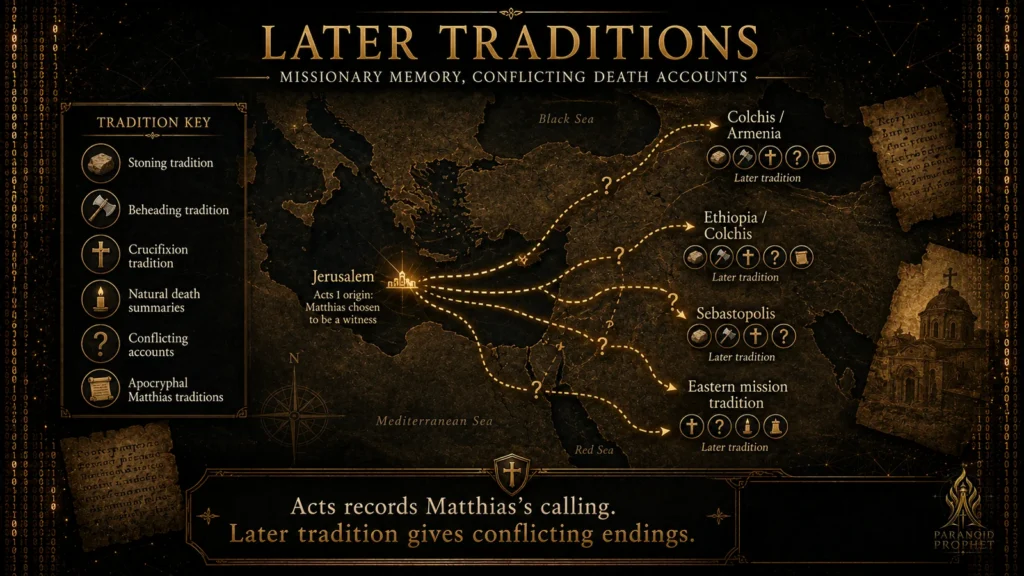
The Stoning and Beheading Tradition
One of the most familiar traditions says Matthias was stoned in Jerusalem and then beheaded. This tradition is often repeated in summaries of his death and helps explain why Matthias is sometimes associated in Christian art with an axe, halberd, or similar instrument of execution.
This tradition deserves mention because it gives readers one of the common answers they will find when searching for how Matthias died. But it must be stated carefully. Acts does not say Matthias was stoned. Acts does not say he was beheaded. The New Testament does not record his death at all.
The proper wording is not, “Matthias was stoned and beheaded.” The more honest wording is, “One later tradition says Matthias was stoned and then beheaded.” That small difference keeps the article from overstating the evidence.
The stoning-and-beheading tradition may preserve a memory of martyrdom, but it cannot carry biblical-level certainty. It is one tradition among several, not the settled testimony of Scripture.
The Crucifixion and Eastern Mission Traditions
Another stream of tradition sends Matthias eastward. Britannica summarizes Matthias as traditionally connected with Colchis and Armenia. New Advent’s Catholic Encyclopedia also reports a tradition from Nicephorus that Matthias preached in Judea and then in Ethiopia, understood there as Colchis, and was crucified.
This matters because Matthias’s later tradition was not limited to one simple Jerusalem death scene. Some sources remember him as a missionary beyond Judea. Some connect him with eastern regions. Some remember crucifixion or another violent death instead of stoning and beheading.
That does not mean every eastern mission detail should be accepted as historical fact. It means later Christian memory associated Matthias with missionary witness beyond the first Jerusalem setting. That memory is meaningful, but it is not precise enough to settle the death question.
The eastern mission traditions strengthen one broad point: Matthias was remembered as a witness. They do not give us one certain map, one certain method, or one certain final hour.
The Sebastopolis and Temple of the Sun Tradition
New Advent also preserves another tradition connected with Sebastopolis and burial near the Temple of the Sun. This tradition is useful because it shows how geographically varied Matthias’s later traditions became.
If one tradition places Matthias in Jerusalem, another in Colchis, and another near Sebastopolis, then the article should not pretend the tradition is simple. The location evidence is scattered. The death-method evidence is scattered. Acts gives Matthias’s apostolic role. Later tradition gives possible memories of mission and death, but not one unified report.
The Apocryphal Matthias Traditions
Several later apocryphal traditions also attach dramatic stories to Matthias. These accounts are useful for understanding how later Christians imagined him as a missionary sufferer, but they should not be treated as reliable death records.
One important example is the Acts of Andrew and Matthias. In this story-world, Matthias is connected to the “City of the Cannibals,” and the narrative belongs to a later apocryphal tradition rather than the first-century apostolic record.
Another example is the Martyrdom of Matthias. This tradition begins by recalling Matthias’s selection from Acts, then moves into a dramatic missionary story involving accusation, imprisonment, and miraculous survival under torture.
These accounts should not be mocked, but they should be ranked properly. They are not Scripture. They are not early courtroom transcripts. They belong to the wider world of apocryphal apostolic literature, where missionary journeys, miracles, persecution, idols, demons, and dramatic rescues often expand around apostolic names.
The apocryphal Matthias traditions are useful for showing how later Christians imagined Matthias as a missionary sufferer. They are not strong evidence for the exact facts of his death.
Why the Traditions Conflict
The traditions conflict partly because the New Testament says very little about Matthias after Acts 1. Once Acts tells us he was numbered with the eleven apostles, it does not give a later Matthias biography. That silence left room for different regions, churches, and stories to attach Matthias to different mission fields and death scenes.
Tradition can preserve memory, but it can also multiply details. Local churches may preserve a missionary association. Later writers may expand a name into a full story. Iconography may compress a tradition into a symbol. Apocryphal acts may shape apostolic memory with dramatic scenes meant to teach, warn, encourage, or glorify Christ through the sufferings of His witnesses.
This is why Matthias’s article must keep Acts 1 at the center. Acts gives the strongest evidence: Matthias was chosen after Judas, qualified by long association with Jesus’ ministry, and appointed as a witness to the resurrection. Later tradition gives possible mission and death memories, but those memories conflict.
The death evidence for Matthias is meaningful as tradition history, but not strong enough to name one final scene with certainty.
How Strong Is the Death Tradition for Matthias?
The death tradition for Matthias is weaker than his biblical role. That does not mean the tradition is useless. It means the article should not ask the tradition to carry more than it can carry.
Acts gives Matthias’s identity, qualification, and purpose. He was chosen to replace Judas, numbered with the eleven, and appointed to join the witness to the resurrection. Later sources remember mission and possible martyrdom, but they disagree over location and method.
So the strongest careful claim is this: Matthias was remembered by later Christians as a missionary witness, and many traditions remember him as a martyr, but Scripture does not record his death and the later accounts conflict.
| Source or tradition | What it supports | What it does not prove |
|---|---|---|
| Acts 1 | Matthias was chosen, qualified, and numbered with the eleven apostles | His death method or final mission field |
| New Advent / Catholic Encyclopedia | Conflicting later traditions involving Sebastopolis, Ethiopia/Colchis, stoning, beheading, and crucifixion | One certain final account |
| Britannica | Later tradition connecting Matthias with Colchis and Armenia | Exact death method |
| Stoning and beheading tradition | Later memory of martyrdom | Biblical certainty |
| Crucifixion and eastern mission tradition | Later memory of missionary witness and violent death | Harmony with other traditions |
| Natural-death summaries | A later or conflicting report sometimes mentioned in summaries | A secure historical conclusion |
| NASSCAL apocryphal traditions | Later story-world around Matthias as missionary sufferer | A reliable death record |
| Pliny / Trajan context | Broader Roman context for costly Christian identity | Matthias’s personal martyrdom |
This table is not meant to dismiss Matthias. It is meant to protect the article from overclaiming. Christian evidence is stronger when it does not force weak sources to sound stronger than they are.
Matthias’s death traditions are worth naming, but they are not clean enough to carry the whole case. The final step is to state what we can say, what we should not claim, and why Matthias still matters as the witness chosen after Judas to testify to the risen Christ.
What We Can Say With Confidence
A strong Christian article does not need to make weak evidence sound stronger than it is. The case for Matthias is already meaningful without pretending we know details Scripture does not give.
- We can say Matthias was chosen to replace Judas. Acts records his selection after Judas’s betrayal and death.
- We can say Matthias was qualified as a witness. Peter’s requirement was that Judas’s replacement had accompanied the disciples during Jesus’ public ministry and could testify to the resurrection.
- We can say Matthias was numbered with the eleven apostles. Acts presents him as part of the restored apostolic circle.
- We can say his death is not recorded in Scripture. The Bible gives his appointment, not his final scene.
- We can say later tradition remembers him as a missionary witness. Those traditions are meaningful, but they conflict.
- We can say many traditions remember him as a martyr. But we should not claim one method with certainty.
That balance is not weakness. It is honesty. Scripture gives us the center. Tradition gives possible later memory. The article is strongest when those layers stay in order.
What We Should Not Claim
Matthias is often surrounded by confident claims that go beyond the evidence. Those claims may sound impressive, but they can weaken the article if they are stated too strongly.
- Do not claim the Bible says Matthias was martyred. It does not.
- Do not claim Matthias was definitely stoned and beheaded. That is one later tradition, not a biblical record.
- Do not claim Matthias was definitely crucified. Crucifixion appears in some later tradition streams, but not in Acts.
- Do not claim the apocryphal Matthias stories are reliable biographies. They are later story-worlds, not first-century historical reports.
- Do not claim Matthias proves the resurrection by his death alone. His biblical role supports the early resurrection witness, but his death tradition is too uncertain to carry that kind of proof.
- Do not treat Paul’s apostleship as a reason to erase Matthias. Paul’s apostleship is real, but Acts still says Matthias was numbered with the eleven.
A strong Christian case does not need fake certainty. It needs faithful confidence where Scripture is clear and disciplined humility where later tradition is mixed.
Common Objections About Matthias
Was Matthias a mistake because Paul became an apostle later?
No. Acts does not present Matthias as a mistake. The believers pray, appeal to Scripture, cast lots, and Matthias is numbered with the eleven apostles. Paul’s later apostleship is essential to the New Testament, but it does not erase Matthias’s place in Acts.
Paul was uniquely called by the risen Christ as an apostle to the Gentiles. Matthias was chosen to restore the apostolic circle after Judas and to join the witness to the resurrection. Those roles are not identical, and they do not have to cancel each other out.
Does Matthias matter if the Bible says so little about him?
Yes. Matthias matters because Acts tells us why he was chosen. He had been with the witnesses from the beginning and could testify to the resurrection. His importance is not measured by how many scenes he receives, but by the role Scripture gives him.
Some servants of Christ are loud in the record. Others are quiet. Matthias reminds us that faithfulness can be real before it is famous.
Do conflicting death traditions mean the whole Matthias story is unreliable?
No. The uncertainty concerns Matthias’s later death traditions, not the biblical record of his selection. Acts gives the strongest claim: Matthias was chosen to replace Judas and become a witness to the resurrection. Later tradition is weaker and more varied.
Conflicting death traditions should make us careful, not cynical. They show that later Christian memory preserved Matthias’s name and missionary witness, but did not preserve one clear death account with the same strength as Scripture.
Can Matthias still support the case for Jesus’ resurrection?
Yes, but carefully. Matthias supports the resurrection case because Acts says he was chosen to become a witness to the resurrection. His death tradition should not be used as the main proof, because the details are uncertain.
The stronger argument is this: the early Christian movement cared deeply about qualified witnesses to Jesus’ resurrection. Matthias was selected on that basis. That tells us what the apostolic mission centered on: not vague inspiration, but testimony to the risen Christ.
Why Matthias Still Matters
Matthias matters because his story stands at the meeting point of betrayal and restoration. Judas abandoned his place. The apostolic circle was wounded. But the witness to Jesus did not die with betrayal.
The believers gathered. Scripture was applied. Prayer was offered. Matthias was chosen. The witness continued.
That is the deeper point of Matthias’s life. His death traditions are uncertain, but his biblical role is not. He was chosen after Judas to testify to the risen Christ.
Matthias also reminds modern readers that hidden faithfulness matters. Before he was publicly chosen, he had been present. Before he was named, he had followed near the ministry. Before he became prominent, he had already been prepared.
God sees witnesses before the world notices them.
And above Matthias stands the greater truth: Jesus Christ is risen. The apostolic witness did not continue because the disciples were building a brand, protecting a myth, or salvaging a failed movement. It continued because Christ had conquered death, and His witnesses were sent to proclaim Him.
Matthias’s name may be quiet, but the message he was chosen to witness is not quiet. Jesus is the crucified Savior, the risen Lord, and the King whose mission continued even after betrayal.
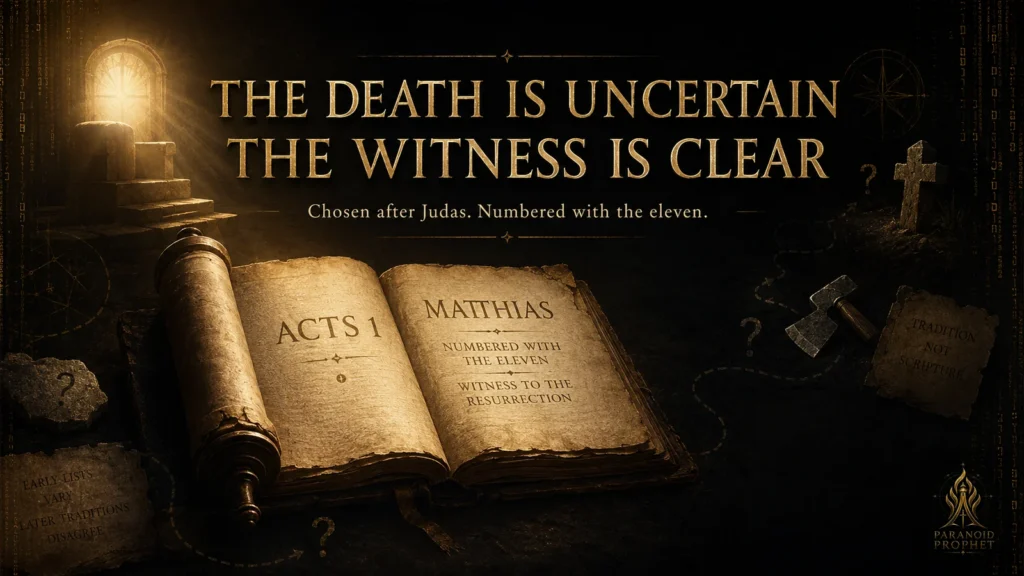
Final Answer: How Did Matthias Die?
Scripture does not tell us how Matthias died. Later traditions say he may have been stoned and beheaded, crucified, violently killed in an eastern mission field, buried near Sebastopolis, or, in some later summaries, died naturally. Those accounts conflict, so the exact method of his death remains uncertain.
What Scripture does tell us is more important: Matthias was chosen to replace Judas, numbered with the eleven apostles, and appointed to become a witness to the resurrection of Jesus Christ.
The death tradition is uncertain. The witness is clear.
Judas’s betrayal did not get the final word. The risen Christ did.
FAQ About Matthias the Apostle
How did Matthias the apostle die?
The Bible does not record how Matthias died. Later traditions say he may have been stoned, beheaded, crucified, violently killed in an eastern mission field, or possibly died naturally, but the accounts conflict.
Was Matthias martyred?
Many later traditions remember Matthias as a martyr, but Scripture does not record his martyrdom. It is reasonable to mention martyrdom as tradition, but not as biblical certainty.
Was Matthias stoned and beheaded?
One later tradition says Matthias was stoned in Jerusalem and then beheaded. That tradition is commonly repeated, but Acts does not record it.
Was Matthias crucified?
Some later traditions connect Matthias with crucifixion, especially in eastern mission settings. Other traditions give different endings, so crucifixion should be mentioned as one tradition, not as settled fact.
Why was Matthias chosen to replace Judas?
According to Acts 1, Judas’s replacement had to be someone who had accompanied the disciples during Jesus’ public ministry and could become a witness to the resurrection. Matthias met that qualification and was numbered with the eleven apostles.
Was Matthias really one of the Twelve apostles?
Yes. Acts 1:26 says Matthias was numbered with the eleven apostles. Paul’s later apostleship does not erase Matthias’s place in Acts.
Is Matthias mentioned after Acts 1?
Matthias is not given a later individual biography in the New Testament after Acts 1. That silence is one reason later traditions about his mission and death conflict.
Related Articles
- How Did Peter Die? The Martyrdom of the Apostle Peter
- How Did Paul Die? The Apostle, Rome, and the Cost of Witness
- How Did Matthew Die? The Apostle, the Tax Collector, and Later Martyrdom Tradition
- How Did James the Brother of Jesus Die?
Sources and Further Reading
- Acts 1:12–26 — Matthias Chosen to Replace Judas
- Acts 2:42–47 — The Early Christian Community
- Acts 4:18–20 — Commanded Not to Speak in Jesus’ Name
- Acts 5:40–42 — Apostolic Suffering and Continued Witness
- Catholic Encyclopedia — St. Matthias
- Britannica — Saint Matthias
- Pliny and Trajan on the Christians
- NASSCAL — Acts of Andrew and Matthias
- NASSCAL — Martyrdom of Matthias

CONTINUE THE INVESTIGATION
Evidence standard continuation
Did the Apostles Die for the Resurrection? What We Can Honestly Say
Return from this individual witness tradition to the comparative source review that separates strong evidence, plausible tradition, and uncertainty.