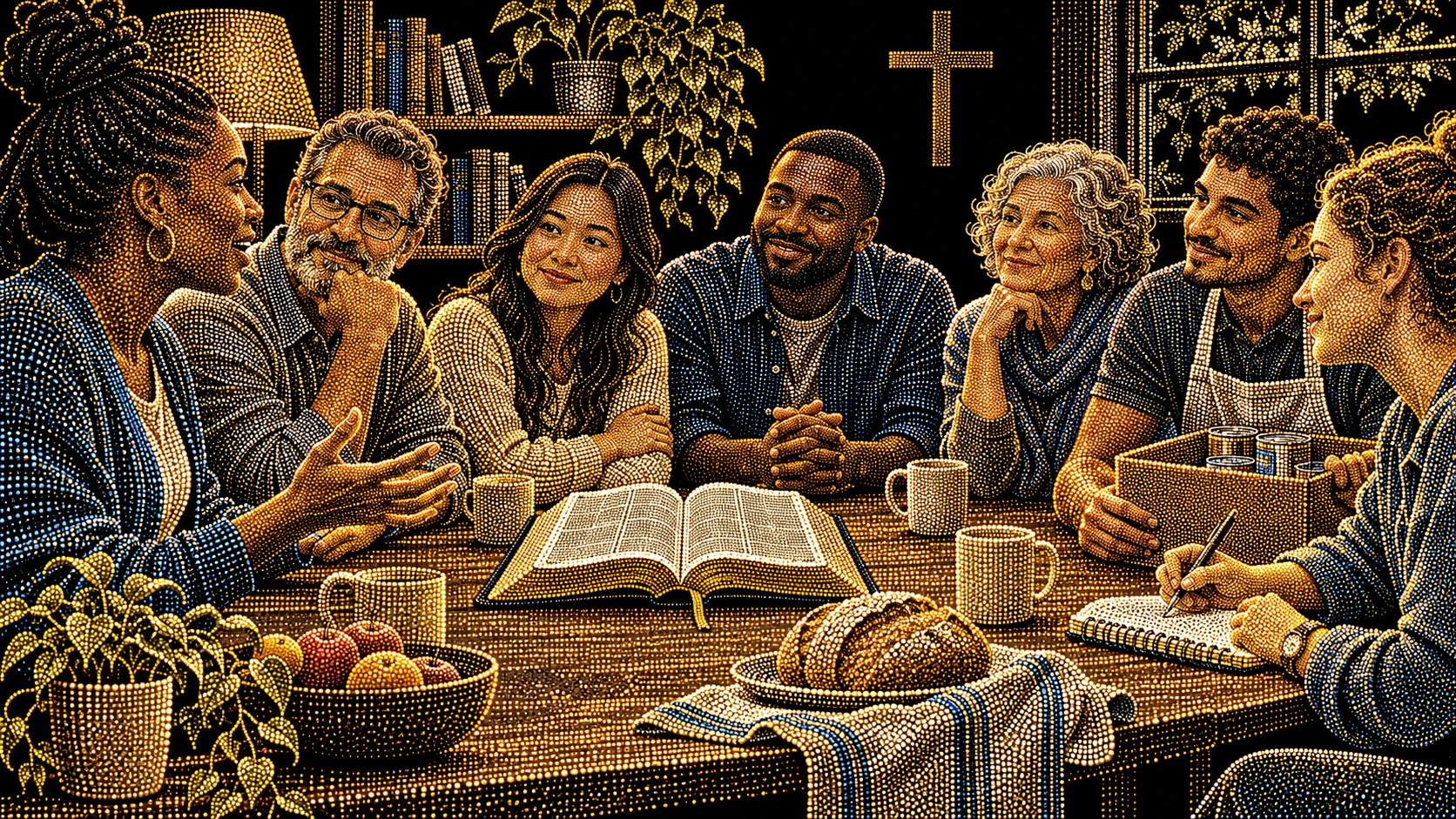

One church has a pastor and deacons. Another has several elders. A third belongs to a diocese led by a bishop. Even familiar titles can describe different responsibilities, leaving newcomers unsure who teaches, who makes decisions, and where ordinary members fit.
A church is led under Jesus Christ through people entrusted with teaching, pastoral care, oversight, and service. The New Testament closely connects elders, overseers, and shepherding, while also identifying deacons and the ministry of the whole congregation. Understanding these roles helps us distinguish biblical responsibilities from later titles and particular arrangements of church government.
GUIDED ARTICLE EXPERIENCE
How Is a Church Led? Elders, Pastors, Deacons, and Accountable Service
Read along as the narration moves through the article.
Browser narration · No stored audio or site tracking
CONTINUE GUIDED TOUR
Continue where you left off.
GUIDED TOUR COMPLETE
You have reached the end of this study.
Study record saved on this device.
GUIDED TOUR
How Is a Church Led? Elders, Pastors, Deacons, and Accountable Service
Narrator: Paranoid Prophet Recommended Voice Native device narration
Prepare to follow the article as it is narrated.
VOICE & TOUR OPTIONS
Voice & Listening
NARRATOR
Finding a narrator…
Checking the best narrator available on this device.
Restores the site recommendations available in this browser.
Our listening picks lead when available; other voices are ranked for narration. Known novelty voices are hidden. Browser-provided voices may use an online voice service.
Screen-awake support will be checked when narration starts.
Optional: improve your device voices
Listening works with the voices already available here. Your device may offer additional free voices through its own settings.
iPhone or iPad: Settings → Accessibility → Read & Speak (or Spoken Content) → Voices → English. Look for Premium or Enhanced choices, then return here.
If offered, preview Ava or Zoe for U.S. English, or Serena or Jamie for British English. An explicit Premium or Enhanced version can improve on its compact version.
Mac: System Settings → Accessibility → Read & Speak → System voice. Open the voice list to preview or download additional choices.
Windows: Settings → Accessibility → Narrator → Add natural voices. Browser availability varies; a Narrator voice may not appear on websites. Edge may also expose online Natural voices without a model download.
Android: Open Accessibility → Text-to-speech output (the location varies by device). In the preferred engine settings, look for voice data and English choices.
Download sizes vary; some enhanced voices exceed 100 MB. This website cannot install system voices, and an installed voice appears here only if your browser exposes it.
Apple voice guide · Windows voice guide · Android voice guide
CHOOSE A NARRATOR
Recommended on this device
Our listening picks: Aaron, Martha, then Daniel, when available here. Otherwise, automatic uses the highest-ranked suitable voice. Preview alternatives or save your own choice.
Preparing the guided article experience…
RESUME GUIDED TOUR?
Continue where you left off.
GUIDED TOUR COMPLETE
You have reached the end of this study.
Article Guide10 sections
Christ’s Authority Gives Leadership Its Purpose
In Mark 10:35–45, James and John seek places of honor beside Jesus. He answers by describing greatness through service and grounding that calling in His own mission to give His life for others. Their ambition becomes an occasion to redefine how His followers exercise responsibility. Our guide to Christian humility develops that posture of service.
Church leadership therefore has a purpose beyond preserving an organization. Leaders help people hear Christ’s teaching, worship God, grow in faith, and serve their neighbors. Decisions about money, meetings, and ministries should support those ends.
First Peter 5:1–4 addresses elders as people caring for God’s flock. Peter identifies Christ as the chief Shepherd. Leaders exercise genuine responsibility while remaining answerable to someone greater than themselves.
This also gives leadership limits. A ministry title cannot make a person’s preferences equivalent to God’s commands. Authority is entrusted for the good of people who belong to Christ. Our introduction to what the church is explains that community’s identity; the question here is how its responsibilities are organized.
Elders, Overseers, and Pastors: Related Biblical Language
Three words often cause confusion. Elder, from the Greek presbyteros, names a recognized leader in these church contexts. Overseer, from episkopos, emphasizes oversight and is sometimes translated bishop. Pastor means shepherd, expressing the work of feeding, guiding, and caring for a flock.
Acts 20:17–38 brings the terms together. Paul summons the elders of the Ephesian church. Addressing the same people, he says the Holy Spirit has made them overseers and charges them to shepherd God’s church. The passage describes related aspects of their responsibility rather than three successive promotions.
Titus 1:5–9 similarly moves from appointing elders to describing the qualifications of an overseer. First Peter 5 calls elders to shepherd and exercise oversight. These connections explain why many Protestant churches use elder, overseer, and pastor for one office.
Later Christian usage often distinguishes a bishop from presbyters or priests. Ignatius’s letter to the Trallians, chapters 2–3, already describes a bishop, presbyters, and deacons distinctly. Christians disagree over how that structure relates to apostolic practice. The overlap in particular New Testament passages should be acknowledged without pretending that a word study alone resolves every question about subsequent church order.
What Pastoral Oversight Actually Involves
Paul’s farewell in Acts 20 presents pastoral work through his own conduct: public teaching, instruction in homes, warnings offered with tears, and concern for the weak. Oversight involves sustained attention to people’s lives as well as speaking during worship.
Titus 1 connects an elder’s fidelity to the received message with the ability to encourage sound teaching and answer opposition. The task includes helping people understand why a teaching is sound. It requires more than repeating an approved vocabulary.
Prayer and personal care also belong here. James 5:13–16 describes the sick calling the church’s elders to pray. A pastoral ministry must have ways to notice people whose needs are easy to miss, including those unable to attend regularly.
First Timothy 5:17–18 gives particular attention to elders who labor in preaching and teaching, supporting the legitimacy of material provision for that work. Paid and unpaid responsibilities can differ without making salaried ministry a higher degree of Christian worth.
Different traditions assign the administration of baptism and Communion to particular ministers. A church should explain those responsibilities clearly. The biblical emphasis remains recognizable across arrangements: faithful instruction, prayerful care, responsible direction, and an example others can follow.
Character Comes Before Appointment
First Timothy 3:1–13 describes oversight as good work and then concentrates on the kind of person entrusted with it. Self-control, hospitality, gentleness, integrity, and freedom from greed receive more attention than charisma or organizational success. Ability to teach also matters.
These qualities are tested in ordinary relationships. The household passages connect care for a family with care for the church. They do not license coercion at home as preparation for authority elsewhere. Churches differ over how marriage, remarriage, and children’s faith affect eligibility; those questions require careful interpretation rather than assumptions based on a title.
A new convert is not to be rushed into oversight. For deacons, the instruction includes testing before service. Desire to lead deserves discernment, preparation, and recognition by others. A confident claim of calling does not complete that process.
Acts 14:21–23 describes Paul and Barnabas appointing elders with prayer and fasting. Churches apply such patterns through different combinations of congregational election, examination, ordination, and authorization by existing ministers or wider councils. The shared question is whether the person is genuinely prepared for the entrusted work.
Credentials can assist that assessment. They cannot replace the character the biblical passages require.
Deacons and the Ministry of Practical Service
Philippians 1:1–2 addresses the believers in Philippi together with overseers and deacons. First Timothy 3 gives deacons their own qualifications. These passages provide clearer evidence for a recognized ministry than the assumption that every biblical use of the word servant names an office.
The Greek diakonos can refer broadly to a servant or minister. Context matters. Its use for a church role does not mean that only deacons serve, or that practical service requires little spiritual maturity.
Acts 6:1–7 is traditionally connected with the diaconate. Greek-speaking widows were being neglected in the daily distribution. The community selected seven qualified men, and the apostles prayed and laid hands on them, allowing the neglected need and the apostles’ ministry of prayer and the word to receive attention.
Luke does not explicitly call the seven deacons. The account is an important pattern of delegated service, but identifying it as the formal institution of the later office goes beyond its wording.
In many Protestant churches, deacons organize assistance, practical care, and resources. In Catholic, Orthodox, and Anglican settings, deacons are ordained ministers with liturgical responsibilities as well as service. The Catholic Catechism’s account of the diaconate illustrates that broader role. Exact duties should be learned from the congregation’s own arrangements.

Leaders Equip a Congregation That Also Ministers
Ephesians 4:1–16 places ministers within Christ’s gifts to His people. Their work serves the equipping of believers, the building of the body, and growth toward maturity. The passage ends with the whole body contributing to its growth in love.
A congregation therefore should not measure leadership only by how many tasks the pastor personally completes. Good leadership develops other people: helping someone learn to explain Scripture, organize hospitality, visit those who are isolated, or serve a neighbor wisely.
Shared ministry still needs coordination. A gift for teaching does not automatically authorize someone to determine the church’s doctrine. Skill with finances does not independently confer pastoral office. Churches recognize gifts while clarifying who has authority for particular decisions. Our explanation of spiritual gifts explores how different abilities serve the whole church.
Members also have responsibilities toward those who lead. First Thessalonians 5:12–15 connects appreciation for those who labor among believers with a broader call to patience, encouragement, and care. Respect can take practical forms: prayer, constructive participation, realistic expectations, and support for necessary rest.
The result should be a community increasingly able to serve together. Constant dependence on one indispensable personality leaves both the congregation and that person carrying an unhealthy burden.
Why Churches Use Different Forms of Government
Episcopal government places oversight in bishops, commonly responsible for a diocese or region. Catholic, Orthodox, Anglican, and some Protestant churches have episcopal structures, though their understandings of succession, ordination, councils, and wider authority differ considerably. Catholic teaching understands bishops, priests, and deacons within sacramental Holy Orders and apostolic continuity. Episcopal government need not exclude substantial lay participation: the Episcopal Church describes leadership shared among laypeople, deacons, priests, and bishops.
Presbyterian government locates governing responsibility in councils of elders rather than a single diocesan bishop. Congregational councils connect with wider councils, often called presbyteries, synods, or assemblies. The Presbyterian Church (U.S.A.) explains its representative structure through ruling elders and ministers, also called teaching elders. Their shared responsibility extends beyond the local congregation.
Congregational government places final earthly authority for the local church’s affairs within that congregation under Christ. Pastors and elders can provide substantial leadership while members retain specified decisions, such as receiving leaders or adopting major commitments. The Baptist Faith and Message, Article VI, describes an autonomous congregation operating through congregational processes under Christ’s lordship. Such churches may cooperate in associations without giving those associations ordinary control over local decisions.
These are broad families, and some churches combine features. Presbyterians also have congregational votes; episcopal churches also have councils; congregational churches also appoint leaders. The significant question is where authority rests for a particular matter and how decisions are reviewed.
Christians defend their arrangements through Scripture and differing understandings of apostolic continuity. No organizational label, by itself, establishes that a congregation practices wisdom or faithful service.
Where Christians Disagree About Women in Ministry
Women’s ministry is clearly present in the New Testament. Romans 16:1–7 commends Phoebe and names Prisca among Paul’s fellow workers. The disagreement concerns how such ministries relate to particular teaching and governing offices.
Many complementarian Protestants reserve the elder or pastor office for qualified men, appealing especially to 1 Timothy 2:11–15 and the qualifications in chapter 3. The Danvers Statement represents this view while affirming women’s dignity and ministry. Complementarians differ over the range of teaching responsibilities and whether women may serve as deacons.
Egalitarian Protestants affirm qualified women and men in pastoral leadership. They interpret restrictions in relation to their setting and read them alongside women’s participation in ministry elsewhere. CBE International’s statement presents a biblical case for this position.
Catholic and Orthodox accounts of male priesthood also involve sacramental theology and tradition; they should not simply be treated as versions of Protestant complementarianism. The Catholic Catechism explains its own position.
Interpretation of deacons involves further questions. Romans 16 calls Phoebe a diakonos, translated servant or deacon. First Timothy 3:11 can be understood as referring to deacons’ wives or women deacons. These differences deserve explicit explanation. Ask your congregation how it interprets these passages and defines each office.
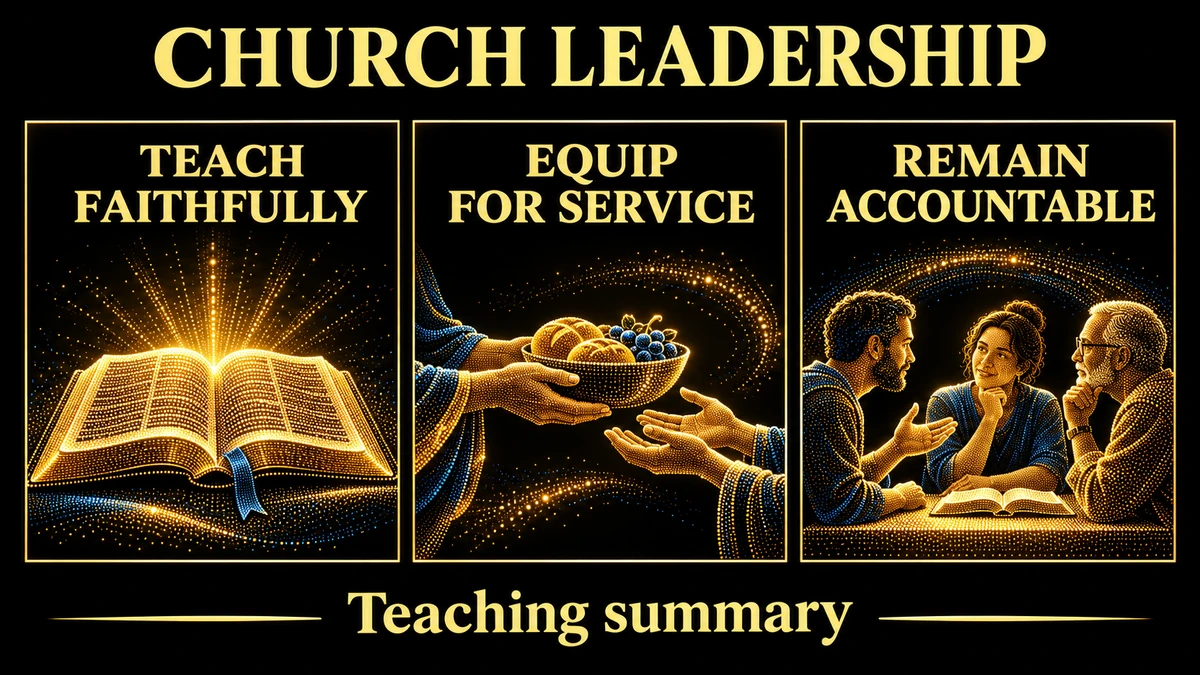
Church Leadership: teach faithfully; equip for service; remain accountable. Teaching summary, not a quotation of Scripture or a diagram of one required system of government.
Make Shared Responsibility Understandable
A church’s constitution, bylaws, or denominational rules should make its responsibilities understandable. Members need to know who appoints leaders, who directs teaching and worship, who approves spending, and which decisions require congregational or wider approval. Titles alone rarely answer those questions.
Consider an illustrative situation, not a reported case: a congregation wants to expand its meal ministry. Pastoral leaders help connect the proposal with the church’s mission. Deacons or a care team organize volunteers and assess needs. The authorized council or congregation approves the required budget. Members contribute skills and receive support themselves when needed.
The exact division varies, but clarity prevents every choice from drifting to the most forceful person. It also makes delegation real: a team given responsibility should understand its limits, available resources, and route for resolving a disagreement.
Accountability includes the ability to correct leaders through the church’s stated processes. Those processes must never obstruct immediate protection or appropriate reporting of suspected crimes. For assessing teaching and responding to misconduct, see our guide to evaluating Christian teachers.
Well-defined roles help faithful service continue through illness, transitions, and the departure of a familiar leader. Christ’s church needs responsible people who prepare others to carry the work forward.
Common Questions About Church Leadership
Are a pastor and an elder always the same person?
Several New Testament passages connect elder, overseer, and shepherding responsibilities. Many Protestant churches therefore treat pastor and elder as the same office. Modern usage varies: some churches distinguish teaching and ruling elders, while others use pastor for a staff role. Ask what the title means locally.
Is a deacon a junior pastor?
Not necessarily. Deacons have a distinct ministry of service, and serving as a deacon is not automatically preparation for promotion. Some ordained traditions have both permanent deacons and people who serve as deacons before priestly ordination. That practice should not define every church’s use of the title.
Must every church have several elders?
Acts 14 and Acts 20 describe elders in the plural, and many churches understand this as a pattern for shared local oversight. Christians differ over how universally that pattern prescribes a particular structure. Small or newly forming churches may face temporary limitations. An urgent vacancy does not justify appointing someone unqualified.
Does a church leader need to be paid?
Scripture supports material provision for ministry, especially in 1 Timothy 5:17–18, while Acts 20 also presents Paul’s example of working to support himself and others. Churches may have paid, unpaid, or bivocational leaders. Compensation should fit the responsibilities and available resources; it does not determine a person’s spiritual worth.
Sources and translation note: Biblical explanations are paraphrases. Scripture links use the World English Bible, except the NIV comparison at 1 Timothy 3:11. Historical and denominational sources describe their own settings or positions; they do not establish an unstated position for this site.