
Someone corrects you, and your first instinct is to defend every word. Someone praises you, and you feel compelled to deny that you did anything well. Someone mistreats you, and calls your objection pride. These situations need different responses. Labeling all of them a humility problem makes the confusion worse.
Christian humility is truthful dependence on God, expressed in repentance, teachability, and concern for other people. It means receiving what God gives, admitting where you are wrong, and using your strength to serve. It leaves room for gratitude, clear convictions, appropriate confidence, and protection from harm.
Jesus gives humility its Christian shape. Following him means giving up the demand to be above correction or more important than your neighbor. It never requires pretending that your neighbor is the only person God cares about.
GUIDED ARTICLE EXPERIENCE
What Is Christian Humility? Pride, Self-Worth, and Serving Like Jesus
Read along as the narration moves through the article.
Browser narration · No stored audio or site tracking
CONTINUE GUIDED TOUR
Continue where you left off.
GUIDED TOUR COMPLETE
You have reached the end of this study.
Study record saved on this device.
GUIDED TOUR
What Is Christian Humility? Pride, Self-Worth, and Serving Like Jesus
Narrator: Paranoid Prophet Recommended Voice Native device narration
Prepare to follow the article as it is narrated.
VOICE & TOUR OPTIONS
Voice & Listening
NARRATOR
Finding a narrator…
Checking the best narrator available on this device.
Restores the site recommendations available in this browser.
Our listening picks lead when available; other voices are ranked for narration. Known novelty voices are hidden. Browser-provided voices may use an online voice service.
Screen-awake support will be checked when narration starts.
Optional: improve your device voices
Listening works with the voices already available here. Your device may offer additional free voices through its own settings.
iPhone or iPad: Settings → Accessibility → Read & Speak (or Spoken Content) → Voices → English. Look for Premium or Enhanced choices, then return here.
If offered, preview Ava or Zoe for U.S. English, or Serena or Jamie for British English. An explicit Premium or Enhanced version can improve on its compact version.
Mac: System Settings → Accessibility → Read & Speak → System voice. Open the voice list to preview or download additional choices.
Windows: Settings → Accessibility → Narrator → Add natural voices. Browser availability varies; a Narrator voice may not appear on websites. Edge may also expose online Natural voices without a model download.
Android: Open Accessibility → Text-to-speech output (the location varies by device). In the preferred engine settings, look for voice data and English choices.
Download sizes vary; some enhanced voices exceed 100 MB. This website cannot install system voices, and an installed voice appears here only if your browser exposes it.
Apple voice guide · Windows voice guide · Android voice guide
CHOOSE A NARRATOR
Recommended on this device
Our listening picks: Aaron, Martha, then Daniel, when available here. Otherwise, automatic uses the highest-ranked suitable voice. Preview alternatives or save your own choice.
Preparing the guided article experience…
RESUME GUIDED TOUR?
Continue where you left off.
GUIDED TOUR COMPLETE
You have reached the end of this study.
In this guide: Jesus and humility · Pride and self-worth · Receiving correction · Leadership and safety · Practice this week · Questions
Article Guide9 sections
Jesus and humility
Philippians 2 begins with a community learning to live together. Paul addresses rivalry, concern for status, and the habit of overlooking other people’s interests. He directs the church toward Jesus, whose obedience and service reveal a radically different use of greatness.
The passage describes Christ taking the form of a servant and going willingly to the cross. His humility does not arise from ignorance of who he is. Christians read this as the self-giving of the divine Son, rather than a claim that he stopped being divine. The movement toward service gives Paul’s instruction its force: status must not become an excuse to disregard another person. Read Philippians 2:1–11.
John’s account of the foot washing makes the point concrete. Jesus knows where he has come from and where he is going. He washes his disciples’ feet, then calls them to follow his example. The teacher serves without denying that he is their teacher. Read John 13:1–17.
That distinction matters in ordinary life. A parent can apologize without abandoning responsibility. A skilled employee can teach without humiliating a beginner. A pastor can make a difficult decision while welcoming scrutiny. Competence and authority create opportunities for service. They do not establish a superior class of human beings.
Start with a practical question: What good could I do here if protecting my image were no longer the main concern? Sometimes the answer is to speak. Sometimes it is to listen. Sometimes it is to admit that someone else should lead.
Pride and self-worth
We use the word pride in several ways. A parent can be proud of a child’s effort. A worker can take satisfaction in an honest job. The spiritual danger is the self-exaltation that treats other people with contempt, refuses dependence on God, or demands exemption from correction.
Romans 12 calls for a realistic assessment of ourselves, then immediately discusses different gifts serving one body. Paul expects believers to acknowledge and use what they have received. Denying a real ability can leave a real need unmet. Read Romans 12:3–8.
You can say, “I can help with this,” without announcing that you are indispensable. You can accept a compliment with thanks. You can acknowledge the training, opportunities, assistance, and grace that made your contribution possible. Gratitude lets you receive good things without making yourself their ultimate source.
False modesty can turn an ordinary compliment into a demand for reassurance. “That work was helpful” becomes a long exchange in which everyone must persuade you that you have value. Sometimes that response reflects insecurity or painful experience rather than calculated attention seeking. We should be careful about assigning motives. Either way, a simple, truthful response is usually healthier for the conversation: “Thank you. I’m glad it helped.”
Self-contempt offers no reliable shortcut to holiness. Repeatedly calling yourself worthless does not repair a wrong, make you more teachable, or help your neighbor. A specific admission makes change possible: “I interrupted you and dismissed what you were saying.” A sweeping verdict on your entire person often leaves everyone stuck.
For a fuller discussion of how abilities serve the church, see What Are Spiritual Gifts?. The question here is how to hold those abilities honestly, without making them a ladder above other people.

The danger of looking down on people
In Luke 18, Jesus tells a parable to people who trust their own righteousness and regard others with contempt. The Pharisee compares his religious record with other people’s failures. The tax collector asks God for mercy. Jesus identifies the latter as the one who goes home justified.
The target is self-righteous comparison. The story does not establish that every Pharisee was hypocritical, or invite contempt for Jewish people. A Christian reader can repeat the very failure the parable exposes by feeling superior to its self-righteous character. Read Luke 18:9–14.
Religious knowledge can become a ranking system. So can political discernment, moral discipline, education, income, or the ability to recognize someone else’s bad argument. Being right about a particular claim never gives us complete knowledge of a person’s heart.
This does not prevent moral judgment. Christians still need to distinguish truth from falsehood and good from evil. Humility changes the posture of that judgment. We name the wrong accurately, remember our own need for mercy, and refuse to enjoy another person’s humiliation.
For an apologetics ministry, that includes correcting our own factual errors. If a quotation is misattributed or an argument outruns the evidence, defending it for the sake of the team damages credibility. A Christian claim deserves careful support. Confidence should match what the evidence actually establishes.
Receiving correction without collapse
Correction often exposes two temptations: defending everything and accepting everything. The first makes learning difficult. The second gives any confident accuser authority over your conscience.
Proverbs warns against answering before listening and observes that an initial account may sound convincing until it is examined. Those sayings support patience and careful inquiry. They do not require treating every accusation as established fact. Read Proverbs 18:13–17.
Suppose a colleague says you took credit for their work. Ask what happened. Look at the message, meeting, or document involved. If their contribution was omitted, acknowledge it plainly and correct the record with the people who received the misleading impression. A private apology may be insufficient when the damage was public.
If the accusation is mistaken, explain the facts without retaliating. If part is true, own that part without accepting an invented remainder. Humility does not require agreeing to a false account of what you did.
A useful apology names the action and the repair: “I presented that as my work and left out your contribution. That was wrong. I’ll correct the record with the team.” Avoid using the apology to demand immediate forgiveness, reassure yourself that you are a good person, or close the subject before the other person has spoken.
The person giving correction also has responsibilities. Galatians 6 calls for gentle restoration and self-watchfulness. An accusation delivered with cruelty does not become righteous merely because it contains a true observation. The aim is to help someone return to faithfulness, with an honest awareness of one’s own vulnerability. Read Galatians 6:1–5.
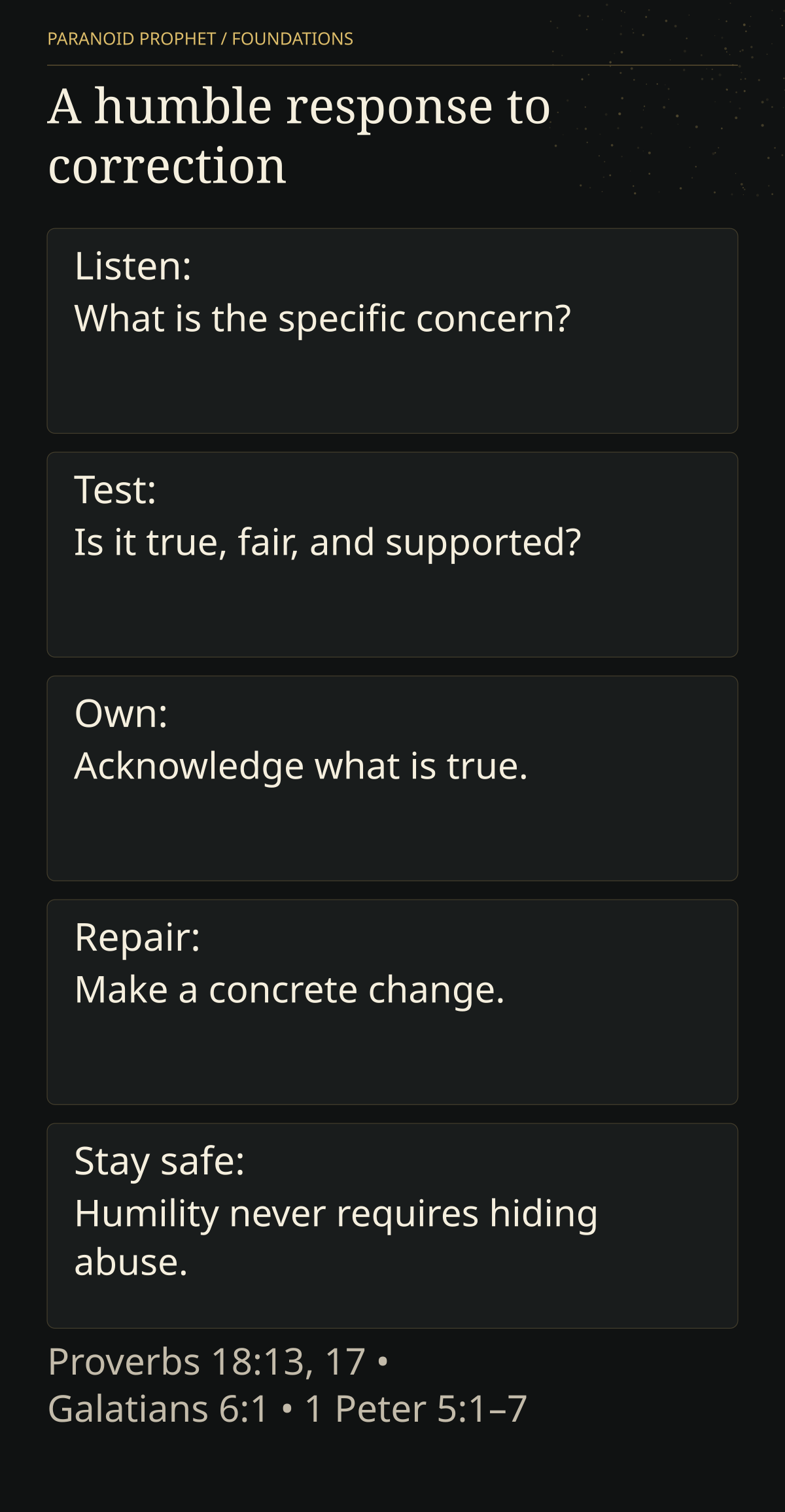
A humble response to correction
- Listen: What is the specific concern?
- Test: Is it true, fair, and supported?
- Own: Acknowledge what is true.
- Repair: Make a concrete change.
- Stay safe: Humility never requires hiding abuse.
This is a practical application of Proverbs 18:13, 17; Galatians 6:1; and 1 Peter 5:1–7. It is not a requirement to meet privately with someone who threatens you or to investigate serious harm on your own.
Repentance goes deeper than looking modest
James 4 places humility inside a confrontation with quarrels, grasping desires, and divided loyalty. Its call to draw near to God includes a real turning away from sin. The mourning in this passage concerns repentance; it is not a command to maintain a miserable personality or reject every experience of joy.
James also places grace at the center. Humbling ourselves before God means abandoning the claim that our desires deserve final authority. The promise that God will lift up the humble should not be turned into a formula for promotion, wealth, or public recognition. Read James 4:1–10.
Ask what you are protecting when you resist correction. A reputation for expertise? The right to have the last word? The belief that your family, church, or preferred public figure could never be wrong? Naming that attachment is more useful than practicing a modest tone while preserving the same demand for control.
Repentance can be quiet and concrete. Give someone proper credit. Stop retelling a story that makes you look better than the facts allow. Correct a claim you posted. Ask forgiveness without attaching a defense to every sentence. Our guide to Repentance and Faith explains the larger relationship between turning from sin and trusting Christ.
Humble leadership and protection from harm
First Peter 5 addresses leaders before it calls the community to humility. Elders must care for the people entrusted to them without greed or domination. The chapter then calls all to humility toward one another and directs anxious believers toward God’s care. Leaders are included in its demands. Read 1 Peter 5:1–7.
A leader who labels every question pride has confused accountability with disloyalty. A gentle voice, impressive platform, or repeated claim to spiritual authority does not settle whether a person’s conduct is trustworthy. Look at whether correction is possible, facts can be checked, and people can raise concerns without intimidation.
The instruction to humble ourselves before God cannot rightly be used to make someone conceal abuse, abandon personal safety, or give an unsafe person unrestricted access. Someone being harmed does not need to prove humility by remaining within reach of further harm. Seek help from trustworthy people outside the alleged abuser’s control, and use appropriate professional or civil authorities when needed. If there is immediate danger, prioritize getting to safety and contacting local emergency services.
Ordinary disagreement and abuse also require different responses. We should not label every uncomfortable conversation abusive, nor reduce coercion and violence to a communication problem. The details matter. Our guide to Christian Forgiveness and Reconciliation explains why forgiveness, restored trust, and renewed access are distinct questions.
Receiving help can itself be difficult for someone accustomed to being the capable one. Admitting that you need support is consistent with depending on God. Anxiety or trauma symptoms are not, by themselves, evidence that a person is proud or spiritually deficient.
Practicing humility this week
Choose one ordinary setting where your concern for status tends to take over. Keep the practice specific enough to evaluate.
- In a conversation: Let the other person finish. Describe their point accurately before challenging it.
- At work or in ministry: Name another person’s contribution where it will actually be heard. Invite a capable person to check your work.
- When you receive praise: Accept it truthfully, thank those who helped, and avoid turning gratitude into a speech about your importance.
- When you discover an error: Correct it in proportion to its reach. A public mistake may need a visible correction.
- When you serve: Ask what is useful rather than assuming your preferred kind of help is needed. Respect a person’s ability to decline.
These practices are applications, not a scorecard for proving your spiritual rank. A week of quiet service can still become material for boasting. A failure can become another opportunity to tell the truth and begin again.
At the end of the week, ask: Did I listen more accurately? Did I take responsibility for something real? Did another person benefit? Was I able to receive help? Growth is often visible in these small responses long before it becomes a feeling about yourself. For the broader process, read What Is Sanctification?.
Common questions
Can a Christian be humble and confident?
Yes. Confidence can rest on preparation, a well-supported conviction, or trust in God. It becomes dangerous when it refuses evidence, correction, or ordinary limits. You can state a conclusion clearly while acknowledging what you do not know.
Does humility mean thinking everyone is more capable than I am?
No. Different people have different abilities and responsibilities. Christian humility recognizes those differences without turning them into a hierarchy of human worth. Sometimes serving well means using your expertise and accepting responsibility.
Can I disagree with a pastor or other leader?
Yes. Disagreement should be truthful and proportionate, with attention to the relevant evidence and Scripture. A leader’s role does not make every interpretation, decision, or allegation correct. Serious concerns may require independent accountability rather than another private conversation.
How do I know whether I am being humble or avoiding conflict?
Ask whether your silence serves truth and your neighbor, or mainly protects you from discomfort. Sometimes patience is wise. Sometimes love requires a difficult conversation. For ordinary disputed choices, What Is Christian Conscience? helps distinguish moral obligations from personal preferences.
Sources and further reading
The main biblical texts are linked beside the sections they support: Philippians 2:1–11; John 13:1–17; Romans 12:3–8; Luke 18:9–14; Proverbs 18:13–17; Galatians 6:1–5; James 4:1–10; and 1 Peter 5:1–7. Read each passage in its surrounding chapter rather than treating a phrase as a complete argument.
Scripture is summarized in the author’s words. Links open the New International Version for comparison. The practical examples and correction guide are applications of these passages, rather than quotations or additional biblical commands.
Christian humility leaves us free to tell the truth: about God’s grace, our failures, our responsibilities, and the good we have received. Follow Jesus into that freedom. Receive correction. Offer service. Give credit. Protect your neighbor’s dignity, and remember that your own is also a gift to steward.