
You do not need a microphone to have something worth offering the church. Someone explains a difficult passage clearly. Someone notices the person everyone else walks past. Someone organizes practical help so a struggling family actually receives it. Much of the church’s life depends on people whose names never appear on a conference poster.
Spiritual gifts are expressions of God’s grace through which the Holy Spirit equips believers to serve others and build up Christ’s church. Understanding them begins with Jesus, the people he calls us to love, and the teaching of Scripture. The question is larger than finding a label for yourself: how can what God has entrusted to you help other people grow?
GUIDED ARTICLE EXPERIENCE
What Are Spiritual Gifts? Discovering Ways to Serve the Church
Read along as the narration moves through the article.
Browser narration · No stored audio or site tracking
CONTINUE GUIDED TOUR
Continue where you left off.
GUIDED TOUR COMPLETE
You have reached the end of this study.
Study record saved on this device.
GUIDED TOUR
What Are Spiritual Gifts? Discovering Ways to Serve the Church
Narrator: Paranoid Prophet Recommended Voice Native device narration
Prepare to follow the article as it is narrated.
VOICE & TOUR OPTIONS
Voice & Listening
NARRATOR
Finding a narrator…
Checking the best narrator available on this device.
Restores the site recommendations available in this browser.
Our listening picks lead when available; other voices are ranked for narration. Known novelty voices are hidden. Browser-provided voices may use an online voice service.
Screen-awake support will be checked when narration starts.
Optional: improve your device voices
Listening works with the voices already available here. Your device may offer additional free voices through its own settings.
iPhone or iPad: Settings → Accessibility → Read & Speak (or Spoken Content) → Voices → English. Look for Premium or Enhanced choices, then return here.
If offered, preview Ava or Zoe for U.S. English, or Serena or Jamie for British English. An explicit Premium or Enhanced version can improve on its compact version.
Mac: System Settings → Accessibility → Read & Speak → System voice. Open the voice list to preview or download additional choices.
Windows: Settings → Accessibility → Narrator → Add natural voices. Browser availability varies; a Narrator voice may not appear on websites. Edge may also expose online Natural voices without a model download.
Android: Open Accessibility → Text-to-speech output (the location varies by device). In the preferred engine settings, look for voice data and English choices.
Download sizes vary; some enhanced voices exceed 100 MB. This website cannot install system voices, and an installed voice appears here only if your browser exposes it.
Apple voice guide · Windows voice guide · Android voice guide
CHOOSE A NARRATOR
Recommended on this device
Our listening picks: Aaron, Martha, then Daniel, when available here. Otherwise, automatic uses the highest-ranked suitable voice. Preview alternatives or save your own choice.
Preparing the guided article experience…
RESUME GUIDED TOUR?
Continue where you left off.
GUIDED TOUR COMPLETE
You have reached the end of this study.
Jump to discovering ways to serve, gifts debated today, or evaluating ministry.
Article Guide9 sections
The short answer: receive grace, serve people, keep learning
The New Testament connects spiritual gifts with service, shared benefit, and dependence on God. In 1 Corinthians 12:4–11, gifts differ, but their source is the same Spirit. Their purpose is the common good. The Spirit distributes them according to his will.
If you do not know where you fit, start here:
- Read the gift passages in their surrounding chapters.
- Ask a trustworthy, mature Christian who knows you where they see you helping others.
- Try a manageable opportunity to serve, with appropriate guidance.
- Pay attention to whether people are genuinely helped, and stay open to correction.
- Keep growing in love, whether or not you settle on a particular gift label.
That is a practical starting point, not a biblical formula promising an immediate answer. You can begin serving before you can describe every aspect of your gifting. You also do not have to accept every request made of you.
For the larger foundation behind this subject, begin with who the Holy Spirit is. This guide focuses on the use of gifts in the life of the church.
Different gifts, one body
Paul develops his teaching in a congregation troubled by rivalry and division. Read 1 Corinthians 12 alongside chapters 13 and 14, and his concern becomes clear: people must learn to value one another and use what they have received for the church’s good.
His picture is a body. An ear does not become useless because it is not an eye. A hand cannot tell the foot it is unnecessary. In 1 Corinthians 12:14–26, members that appear weaker are indispensable, and the body shares both suffering and honor.
That challenges two familiar habits. We can envy someone else’s public role until we overlook the people we could help. We can also become impressed with our own ability and start treating other people as optional. Paul gives neither attitude room to grow.
A congregation needs people who teach and people who organize, encourage, give, help, and show mercy. Public visibility does not establish a person’s spiritual importance. A church that celebrates the speaker while ignoring everyone who quietly carries its burdens has misunderstood its own body.
This also means your belonging does not depend on how much work you can perform. Illness, disability, age, exhaustion, and caregiving responsibilities can change your capacity. The body Paul describes cares for its members. It does not discard them when their output falls. Our guide to what the church is explains that shared life more fully.

Read the gift passages together
The New Testament gives several descriptions of gifts and service. They overlap without forming one standardized questionnaire. Reading them together prevents us from forcing every believer into a rigid modern classification.
Romans 12: humble service in everyday church life
Romans 12:3–8 begins with sober judgment about ourselves. Paul names prophecy, serving, teaching, encouraging, giving, leading, and showing mercy. He connects their exercise with qualities such as generosity, diligence, and cheerfulness.
The surrounding passage matters. The chapter begins with a life offered to God and continues with sincere love, hospitality, patience in suffering, and care for others. Gifts belong inside that ordinary life of obedience. They do not create a special class of Christians exempt from it.
First Corinthians 12–14: shared benefit, love, and intelligibility
First Corinthians 12 names gifts including messages of wisdom and knowledge, faith, healings, miracles, prophecy, distinguishing between spirits, tongues, and interpretation. Later in the chapter, Paul also mentions helping and guidance or administration, alongside other ministries.
Chapter 13 confronts the emptiness of impressive activity without love. Chapter 14 addresses how the gathered church is built up through understandable and orderly contributions. These chapters belong together. Selecting the dramatic manifestations while skipping love and accountability distorts Paul’s teaching.
Ephesians 4: leaders who equip the whole church
Ephesians 4:11–16 speaks of apostles, prophets, evangelists, pastors, and teachers as Christ’s gifts to his people. The purpose is to equip believers for service so the body grows toward maturity in Christ.
This passage is about Christ providing for the church’s growth. It should not be reduced to a personality inventory in which everyone must claim one of five titles. Christians differ on how some of these ministries continue today, but the passage plainly directs our attention toward equipping others, sound teaching, maturity, and love.
First Peter 4: steward what you have received
First Peter 4:7–11 places gifts alongside prayer, earnest love, and hospitality. Peter broadly describes speaking and serving. Both require responsibility: speaking with reverence toward God’s words and serving in the strength God supplies.
The goal is that God is glorified through Jesus Christ. That gives the question of gifts a helpful simplicity. What have you received, and how can you use it faithfully for someone else’s good?
How can I discover ways I am equipped to serve?
The Bible does not prescribe a spiritual-gifts test. It does give us a community in which service can be practiced, observed, corrected, and encouraged.
Start with a real need
Look at the people around you. Is someone isolated? Does a ministry need dependable administrative help? Is there an opportunity to learn alongside an experienced teacher? Could you encourage someone through a difficult week?
You do not have to prove that you possess a special gift of mercy before showing kindness. Every Christian is called to love, even though particular capacities and responsibilities differ. A gift label should never become an excuse to avoid ordinary obedience.
Choose something suitable to your ability and circumstances. Ministry involving children, vulnerable adults, counseling, finances, or teaching needs the relevant screening, training, oversight, and safeguards. Enthusiasm does not replace them.
Invite honest observations
Ask people who know your character and have seen you serve: Where have I been genuinely useful? What do I need to learn? Am I overlooking something because it seems unimpressive?
Listen for specific observations rather than flattery. Someone saying that you explain a passage carefully and welcome questions gives you more to work with than someone announcing that you are destined for a huge platform.
Community feedback is helpful, but a leader’s opinion is not infallible. Healthy guidance can be questioned. It does not demand secrecy, financial dependence, or obedience to someone’s personal claim of divine authority.
Practice, learn, and evaluate
A gift does not remove the need for preparation. Teachers need to study. Those organizing care need to listen and follow through. Encouragement becomes more useful when it is truthful and attentive to the person receiving it.
After a reasonable period of service, review what happened. Were people helped? Did you handle responsibility faithfully? What did others notice? Is the work sustainable alongside your other obligations?
For example, imagine someone who enjoys explaining Scripture but has little experience teaching. Helping a mature teacher prepare a lesson may be a better beginning than launching a public ministry. Feedback might confirm a developing ability, expose gaps in understanding, or reveal that a different form of service fits better. None of those outcomes makes the effort wasted.
Treat quizzes as prompts, not verdicts
A spiritual-gifts questionnaire may help you notice interests or start a useful conversation. Its result is a human assessment based on its questions and your answers. It cannot certify the Spirit’s activity, establish a church office, or tell you what God requires for the rest of your life.
Do not let a quiz overrule Scripture, demonstrated character, the needs of your community, or responsible counsel. Equally, do not assume that a disappointing result means you have nothing to offer. Our guide to discerning God’s will explores decisions without turning every uncertain step into a secret code to solve.
Gifts, talents, and character are related, but distinct
Natural abilities and learned skills can become valuable means of service. Someone with experience managing a schedule may help a church coordinate care. A skilled communicator may learn to teach faithfully. We should be cautious about declaring a precise boundary Scripture does not draw between every natural capacity and every expression of spiritual gifting.
Ability alone, however, does not establish maturity. A compelling voice can carry bad teaching. A generous donor can still treat people cruelly. Organizational strength can be used to help people or control them.
First Corinthians 13:1–7 makes love essential to the exercise of gifts. Galatians 5:22–23 describes the fruit of the Spirit, including patience, kindness, faithfulness, gentleness, and self-control. Christians need that growth in character across every area of service.
Gifting also does not automatically qualify someone for church leadership. The qualifications in 1 Timothy 3:1–13 give serious attention to character, conduct, and tested responsibility. Popularity cannot stand in for those requirements. See what sanctification means for more on growth in holiness over time.
What about prophecy, tongues, and healing today?
Christians disagree about whether certain gifts associated with the apostolic period continue in the church today. A short guide should describe that disagreement honestly rather than pretend the question has never been debated.
Continuationists believe gifts such as prophecy, tongues, and healing remain available today. Their understanding and practice vary. For a representative Pentecostal position, the Assemblies of God’s paper on modern-day prophecy affirms its continuation while emphasizing discernment and correction of abuse.
Cessationists hold that certain revelatory or sign gifts fulfilled a foundational role in the apostolic era and ceased. This does not mean that all spiritual gifts have ceased or that God cannot answer prayer in extraordinary ways. Richard B. Gaffin Jr.’s explanation published by the Orthodox Presbyterian Church explicitly distinguishes the disputed gifts from the many continuing gifts of service.
These are representative accounts, not exhaustive descriptions of every position. The disagreement deserves careful study, including attention to the passages each view uses. We should neither manufacture experiences to prove spiritual status nor dismiss the Spirit’s work simply because it does not fit our expectations.
Whatever position your church holds, claims about spiritual gifts require accountability. No claimed revelation authorizes contradicting Scripture, manipulating someone into giving money, concealing abuse, or demanding an intimate relationship. A healing claim does not justify telling someone to abandon appropriate medical care.
Four questions worth asking about any ministry
The following questions summarize themes from Paul’s teaching. They are a guide for evaluating service, not a test that identifies a person’s gift or proves every claim genuine.
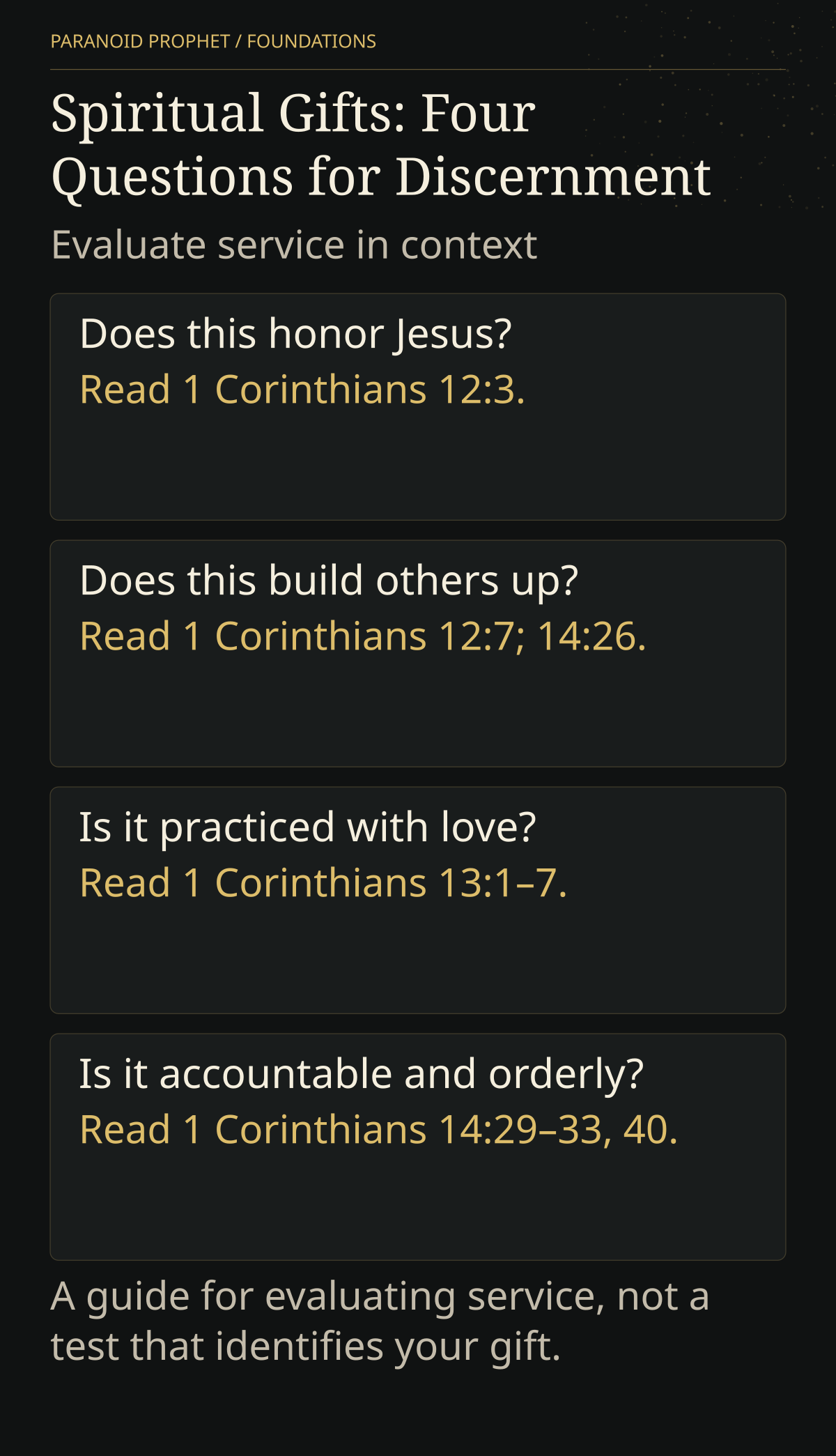
Spiritual Gifts: Four Questions for Discernment
Evaluate service in context
- Does this honor Jesus? In 1 Corinthians 12:3, Paul connects the Spirit’s work with the confession of Jesus as Lord. Words and practice should be evaluated together. Read 1 Corinthians 12:3.
- Does this build others up? First Corinthians 12:7 and 14:26 direct gifts toward shared benefit and the strengthening of the church. Read 1 Corinthians 12:7; 14:26.
- Is it practiced with love? First Corinthians 13:1–7 rejects the assumption that extraordinary ability makes loveless conduct acceptable. Read 1 Corinthians 13:1–7.
- Is it accountable and orderly? First Corinthians 14:29–33 and 40 describe weighing prophetic speech and maintaining order in the gathering. Read 1 Corinthians 14:29–33, 40.
A guide for evaluating service, not a test that identifies your gift.
PARANOID PROPHET / FOUNDATIONS
In its immediate context, chapter 14 also requires interpretation when tongues are spoken publicly and limits who speaks and when. Paul does not treat intensity or spontaneity as permission to ignore the people listening. His concern is a congregation that can understand, evaluate, and benefit from what takes place.
A ministry that cannot tolerate questions deserves scrutiny. So does one that measures success only through attention, money, or devotion to its leader. The name of Jesus should never be used to make responsible examination feel disloyal.
Common questions about spiritual gifts
Does every Christian have something to contribute?
First Corinthians 12:7 and 1 Peter 4:10 speak of gifts entrusted to each for the good of others. You may need time to recognize how you can serve. Your place in Christ’s body is not suspended while you figure it out.
Should every Christian have the same gift?
No. Paul’s questions in 1 Corinthians 12:29–30 expect negative answers: all are not apostles, teachers, or workers of miracles, and all do not speak in tongues or interpret. His argument depends on the body’s diversity. Christians differ about how this passage relates to other uses of tongues, but it cannot support making one public ministry everyone’s assignment.
Can the way I serve change?
Yes. Opportunities, responsibilities, training, health, and capacity can change. Scripture does not require you to keep the same volunteer role for life. Reconsidering a role with honesty and wise counsel can be responsible stewardship rather than failure.
What if I need help more than I can give right now?
Receive care. In 1 Corinthians 12:26, the members suffer together. Christian community includes being supported when your strength is limited. You do not owe a church constant productivity in exchange for belonging.
Take one faithful step
You do not have to settle every debate about gifts before you can make a useful contribution. Read the passages. Pray for wisdom. Notice a real need. Ask for trustworthy guidance. Begin with a responsibility you can carry faithfully, and let others help you grow.
The church becomes healthier as its people learn to serve one another under Christ. Quiet faithfulness belongs in that story. So do patience, correction, practical skill, and love that remains when nobody is watching.
Scripture and further reading
The main passages for this guide are Romans 12:3–13; 1 Corinthians 12–14; Ephesians 4:1–16; and 1 Peter 4:7–11. Read the whole sections rather than treating the gift lists as isolated inventories. Scripture is primarily paraphrased in this article; linked passages open the NIV for further reading.
The two denominational resources linked above represent different positions on the continuation of certain gifts. They are included to make that distinction transparent, not to suggest that every Christian within either tradition agrees on every detail.