


Someone has to notice when the hospital stay becomes a month. Someone has to bring the meal, listen to the question, admit the mistake, and pray when the right words will not come. Christian community becomes real in ordinary moments like these.
The church is the people Jesus gathers to Himself, living together under His lordship through the Holy Spirit. Christians worship, learn, receive baptism and the Lord’s Supper, care for one another, and bear witness to Him. A congregation gives that shared life a local, visible home. Here is what Scripture teaches about belonging, what to look for in a church, and how to seek community without surrendering discernment.
GUIDED ARTICLE EXPERIENCE
What Is the Church? Why Following Jesus Is Not a Solo Life
Read along as the narration moves through the article.
Browser narration · No stored audio or site tracking
CONTINUE GUIDED TOUR
Continue where you left off.
GUIDED TOUR COMPLETE
You have reached the end of this study.
Study record saved on this device.
GUIDED TOUR
What Is the Church? Why Following Jesus Is Not a Solo Life
Narrator: Paranoid Prophet Recommended Voice Native device narration
Prepare to follow the article as it is narrated.
VOICE & TOUR OPTIONS
Voice & Listening
NARRATOR
Finding a narrator…
Checking the best narrator available on this device.
Restores the site recommendations available in this browser.
Our listening picks lead when available; other voices are ranked for narration. Known novelty voices are hidden. Browser-provided voices may use an online voice service.
Screen-awake support will be checked when narration starts.
Optional: improve your device voices
Listening works with the voices already available here. Your device may offer additional free voices through its own settings.
iPhone or iPad: Settings → Accessibility → Read & Speak (or Spoken Content) → Voices → English. Look for Premium or Enhanced choices, then return here.
If offered, preview Ava or Zoe for U.S. English, or Serena or Jamie for British English. An explicit Premium or Enhanced version can improve on its compact version.
Mac: System Settings → Accessibility → Read & Speak → System voice. Open the voice list to preview or download additional choices.
Windows: Settings → Accessibility → Narrator → Add natural voices. Browser availability varies; a Narrator voice may not appear on websites. Edge may also expose online Natural voices without a model download.
Android: Open Accessibility → Text-to-speech output (the location varies by device). In the preferred engine settings, look for voice data and English choices.
Download sizes vary; some enhanced voices exceed 100 MB. This website cannot install system voices, and an installed voice appears here only if your browser exposes it.
Apple voice guide · Windows voice guide · Android voice guide
CHOOSE A NARRATOR
Recommended on this device
Our listening picks: Aaron, Martha, then Daniel, when available here. Otherwise, automatic uses the highest-ranked suitable voice. Preview alternatives or save your own choice.
Preparing the guided article experience…
RESUME GUIDED TOUR?
Continue where you left off.
GUIDED TOUR COMPLETE
You have reached the end of this study.
Article Guide11 sections
What Is the Church in the Bible?
The church is the community that belongs to Jesus Christ. The New Testament uses the word for local assemblies, such as the church in Corinth, and for the people of Christ considered together. Buildings, legal organizations, and Sunday programs can serve that community, but none provides its ultimate identity.
Jesus speaks of building His church in Matthew 16:18. Paul identifies Christ as its head in Colossians 1:18. Its life begins with what Jesus has done through His death and resurrection, rather than with a leader’s personality or a community’s ability to impress. For that foundation, read What Is the Gospel?.
Christians disagree about how the church’s spiritual reality relates to particular institutions, sacraments, and ministries. We will address those differences below. This guide approaches the question from a Scripture-centered Protestant perspective while representing other traditions in their own terms.
Choose your next step: If you are looking for a congregation, start with how to recognize a healthy church. If a church has harmed you, go to safety and rebuilding trust. For the biblical foundations, continue here.
How Does the Bible Describe the Church?
Scripture uses several images because a single illustration cannot express everything God is doing among His people.
A body with many members
In 1 Corinthians 12:12–27, Paul describes believers as members of one body. Their gifts differ, and their lives are connected. Members who seem less impressive deserve care and honor. When one suffers, the others have a reason to pay attention.
That challenges a spectator approach to church. It also challenges a congregation organized around its most visible people. A quiet person who listens faithfully, a caregiver who rarely reaches the platform, and a new believer with honest questions all matter. Belonging cannot depend on being useful to the leader’s ambitions.
A household brought together through Christ
Ephesians 2:11–22 describes Gentile believers being brought near through Christ and sharing access to the Father with Jewish believers in one Spirit. Those once treated as outsiders now belong to God’s household.
Paul’s argument has a particular setting: reconciliation between Jews and Gentiles through the cross. Its implications reach into how Christians treat differences of background, status, and culture. A church should resist the habit of treating people who resemble its established members as more fully at home.
Family language carries responsibility. It should mean patient care and faithful presence. It must never become a demand to keep misconduct secret to protect the family’s reputation.
A temple being built together
In the same Ephesians passage, Christ is the cornerstone and His people are being built together as God’s dwelling by the Spirit. 1 Peter 2:4–5 similarly describes believers as living stones in a spiritual house.
These images concern people joined to Christ and to one another. They give dignity to small congregations meeting in borrowed rooms as well as to congregations with permanent buildings. A beautiful sanctuary can serve worship, but the size of the property cannot tell us whether the people inside are faithful.

What Do Christians Do Together?
Acts 2:42–47 describes the Jerusalem believers devoting themselves to apostolic teaching, fellowship, breaking bread, and prayer. They also responded generously to material needs. This account gives us a rich picture of early Christian life, rather than an exhaustive service schedule every congregation must reproduce.
Receive and practice the teaching of Jesus and His apostles
Churches should help people understand Scripture, follow Christ, and grow in discernment. A sermon should make its handling of the text visible enough that listeners can examine it. Questions deserve answers that do more than appeal to the speaker’s authority.
Teaching also belongs in conversations, patient instruction, and shared practice. A congregation can help a person learn to pray, confess a lie, manage an honest disagreement, or care for someone in grief. For how the Spirit equips people to serve and mature, see Who Is the Holy Spirit?.
Worship, pray, and receive baptism and the Lord’s Supper
Colossians 3:16–17 connects teaching, singing, gratitude, and life in Jesus’ name. Worship can include joy, confession, silence, lament, and reverence. Its worth cannot be measured by how intensely every person feels on a particular morning.
Jesus commands baptism as part of making disciples in Matthew 28:18–20. Paul teaches the church about the Lord’s Supper in 1 Corinthians 11:17–34. Christians differ over their meaning and administration, but these practices have a central place in Christian community.
Paul’s correction of the Corinthians also shows why shared worship and everyday conduct belong together. Their divisions and humiliation of those with little undermined their gathering. A beautiful service cannot excuse contempt for the people attending it.
Share burdens and respond to need
Galatians 6:1–10 brings together gentle restoration, bearing burdens, personal responsibility, and doing good. Care might mean a meal, transportation, financial help handled responsibly, or a trusted person sitting beside someone through a difficult appointment.
People need room both to contribute and to receive. Illness, disability, grief, poverty, or caregiving can limit someone’s visible participation. Treating them as a drain on the ministry misses Paul’s account of the body.
Serve and bear witness
1 Peter 4:10–11 describes gifts as something to use in serving others. Matthew 28 connects the church’s outward mission with making disciples and teaching obedience to Jesus.
A congregation therefore looks beyond its own attendance and programs. Members can speak truthfully about Christ, practice hospitality, and care for neighbors without making help conditional on conversion. The work continues in homes, workplaces, hospitals, and ordinary encounters throughout the week.
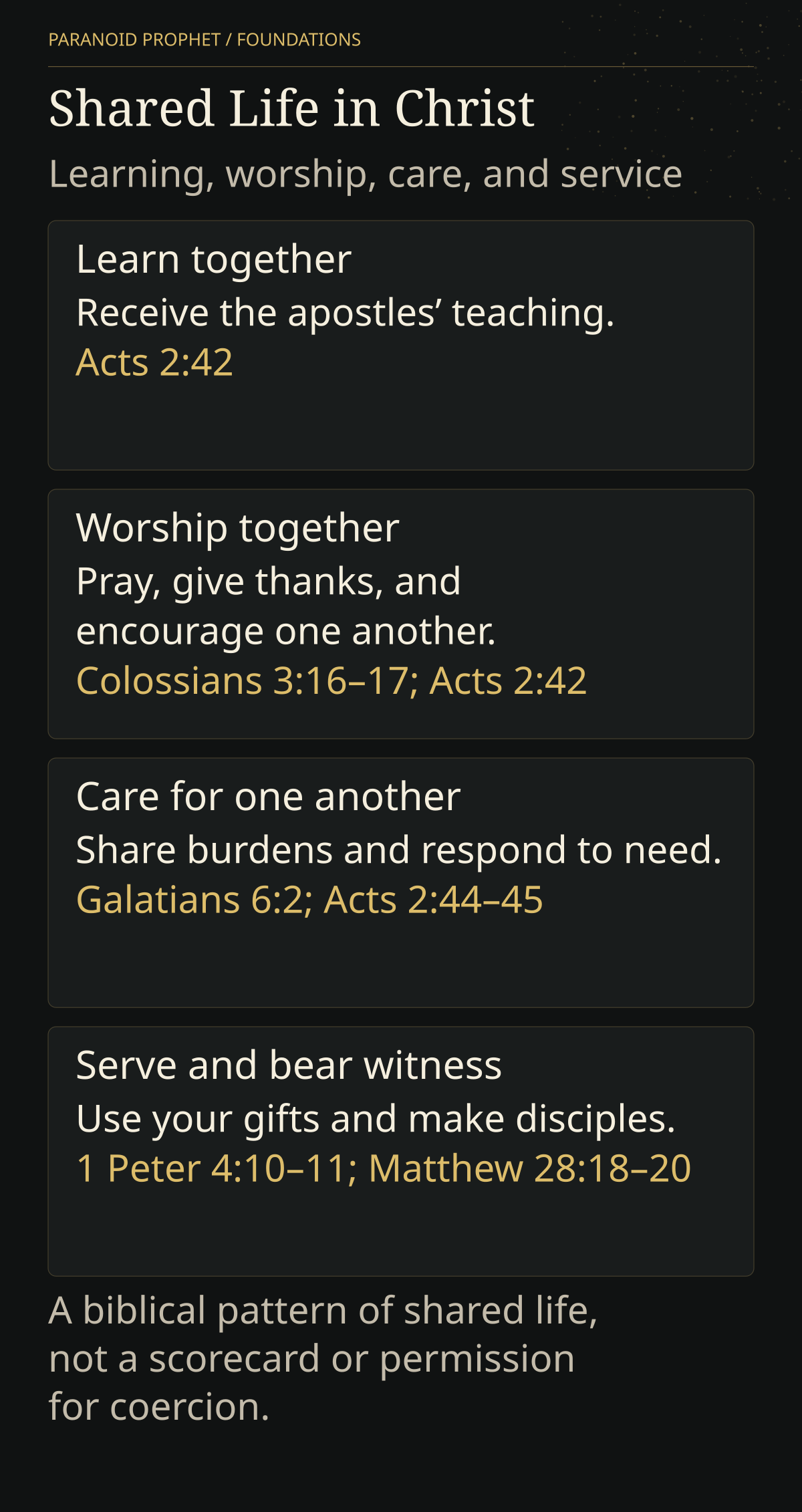
Learning, worship, care, and service
- Learn together
Receive the apostles’ teaching.
Acts 2:42 - Worship together
Pray, give thanks, and
encourage one another.
Colossians 3:16–17; Acts 2:42 - Care for one another
Share burdens and respond to need.
Galatians 6:2; Acts 2:44–45 - Serve and bear witness
Use your gifts and make disciples.
1 Peter 4:10–11; Matthew 28:18–20
A biblical pattern of shared life, not a scorecard or permission for coercion.
PARANOID PROPHET / FOUNDATIONS
Why Does Gathering Matter If I Can Pray and Read at Home?
Private prayer and Bible reading are valuable. Shared Christian life involves responsibilities that solitude cannot fulfill by itself. We are called to encourage, serve, forgive, learn from, and bear with other people. Those relationships expose habits we might never notice alone, while also giving us help we cannot manufacture for ourselves.
Hebrews 10:19–25 connects gathering with confidence in Christ, holding to hope, and encouraging love and good deeds. Read in that setting, the passage is richer than an attendance demand. The aim is faithful perseverance together.
There are real barriers to gathering. Some believers are homebound, isolated by geography, living under persecution, or navigating unsafe situations. Others work demanding shifts or care for someone who cannot be left alone. Their circumstances deserve practical care rather than quick judgments about commitment. A church can arrange visits, accessible transport, smaller gatherings, calls, or other appropriate support.
For someone who can participate safely, an online sermon can supplement a local community. It usually offers far less opportunity to be known, share responsibility, and receive personal care. Ask whether your present pattern allows other Christians to know your life and whether you know theirs.
The related guide Spiritual but Not Religious explores the appeal of private spirituality. Here the positive invitation is to a community that learns to love truthfully in ordinary life.
How Can You Recognize a Healthy Church?
A friendly welcome is a good beginning. Discernment takes more than one conversation or an impressive service. Look for patterns over time, and ask specific questions. The following are practical applications of biblical teaching, not a scoring system that can guarantee any congregation’s safety or faithfulness.
Christ and the gospel remain central. Listen for who Jesus is and what He has done, rather than a constant return to the leader, a political identity, promised wealth, or the superiority of the group. A church can address public life without making loyalty to a party the measure of belonging to Christ.
Scripture is handled in context. You should be able to see how the teaching follows from the passage. Honest leaders can acknowledge interpretive disagreement and correct a mistake. The congregation’s written beliefs should clarify its commitments rather than conceal them until after you join.
Leaders show character and accept accountability. 1 Timothy 3:1–13 emphasizes qualities such as self-control, hospitality, gentleness, and freedom from greed. 1 Peter 5:1–4 calls elders to willing care and example rather than domination. Ask who can examine a complaint against the senior leader and what happens when a leader fails.
Vulnerable people are protected. Ask about safeguarding policies, supervision of work with children, complaint routes, and whether concerns can be reported outside the immediate leadership team. A policy document is only a starting point. How people respond when someone raises a concern tells you more.
Money and power can be questioned. It is reasonable to ask how spending is overseen, who approves compensation, and whether meaningful financial information is available. Pressure to give beyond your means, promised miracles in exchange for money, or secrecy justified by spiritual status deserves scrutiny.
Ordinary people receive patient care. Notice who is listened to, who gets interrupted, and whether people with little influence are treated with dignity. A church’s public message about love should be recognizable in its treatment of newcomers, exhausted parents, grieving people, and those who disagree respectfully.
No congregation will practice these things perfectly. A meaningful distinction is whether people acknowledge failures and respond with truth, repair, and accountability, or protect the institution by denying what happened.
What If a Church Has Harmed You?
Religious language can be used to excuse coercion, threats, exploitation, and abuse. Those actions do not become faithful leadership because the person doing them holds a ministry title. Christ’s people should be able to name harm without being told that protecting a leader’s reputation comes first.
Leaving an unsafe congregation does not require you to abandon Jesus. You do not owe an abusive leader continued access to you, and you should not be pressured into a private confrontation that puts you at risk. Seek support from trustworthy people outside the implicated leadership structure. Where safety or suspected criminal conduct is involved, appropriate safeguarding professionals and civil authorities have a role; an internal church process must not be used to prevent their involvement.
Matthew 18:15–20 concerns dealing with sin in the community. It should not be turned into a rule requiring a victim to meet a dangerous person alone before seeking protection. Nor does forgiveness settle questions of evidence, consequences, restitution, or future access. Our guide to Repentance and Faith explains those distinctions further.
If trust has been damaged, rebuilding it can take time. You may need support from a qualified counselor, a careful pastor outside that setting, or both. You can move toward healthy Christian relationships gradually, without pretending that a new service or an apology erases what happened.
There is also a difference between abuse, serious misconduct, ordinary conflict, and a disagreement over preferences. Naming situations accurately helps people respond well. You can take harm seriously without treating every disappointment as proof that all congregations are dangerous.
Why Do Christian Traditions Define the Church Differently?
The differences involve genuine questions about authority, sacraments, membership, and continuity with the apostles. They cannot be reduced to music preferences or competing brand names.
Catholic teaching identifies the church’s visible unity with shared apostolic faith, sacraments, and bishops in communion with the pope. It also recognizes elements of sanctification and truth outside its visible boundaries and acknowledges other baptized Christians as brothers and sisters, while maintaining a distinctive claim about the fullness of the means of salvation. See the Catechism, paragraphs 811–822.
Orthodox teaching understands the church as the one body of Christ, expressed in apostolic faith, sacramental life, and the historical communion of the Orthodox Church. It does not treat all denominations as interchangeable branches of a merely invisible organization. The Orthodox Church in America’s explanation describes that unity, holiness, fullness, and apostolic life.
Lutheran teaching, in Augsburg Confession VII, identifies the church with the assembly in which the gospel is taught rightly and the sacraments are administered rightly. It distinguishes that unity from requiring identical human ceremonies everywhere.
Reformed teaching, represented by Westminster Confession XXV, distinguishes the whole church known to God from the visible church of those professing the true religion and their children. It acknowledges differences in the purity of particular churches and centers Christ’s headship.
Baptist teaching, represented by Baptist Faith and Message VI, describes a local church as an autonomous congregation of baptized believers, joined in covenant, observing Christ’s ordinances and exercising gifts and responsibilities under Him. It also speaks of the church as all the redeemed.
These summaries identify representative teachings, not every variation within each tradition. Read a congregation’s actual statement of faith, ask how it receives members, and ask what authority its leaders claim. The goal is to understand a real community’s commitments before making promises you do not understand.
How Do You Begin Participating?
You do not have to know every theological term before walking through the door. Begin honestly about where you are and what you need.
- Read the church’s beliefs and practical information. Look for a clear account of Jesus, Scripture, salvation, baptism, the Lord’s Supper, and leadership. Check accessibility or childcare arrangements if they matter for your visit.
- Visit and listen. Notice the teaching and how people treat one another. Ask about something you genuinely want to understand.
- Meet someone responsible for pastoral care. Explain that you are exploring or returning. You can ask what baptism, Communion, membership, and ongoing care involve there.
- Build a few real relationships. A small group, shared meal, or ordinary conversation can help people become more than faces in a room. You do not have to disclose private experiences before you feel safe.
- Consider a sustainable way to participate. Receiving help and learning are legitimate parts of belonging. Service should fit your circumstances rather than become a test of loyalty or a route to exhaustion.
If you are newly trusting Christ, What Happens When You Become a Christian? explains the larger picture of new life. Questions about your standing with God belong with the promises of Christ, not the number of church activities you can manage; see Can a Christian Be Sure of Salvation?.
Questions About Belonging to a Church
Can a house church be a real church?
The New Testament refers to churches meeting in homes, including Romans 16:3–5. A dedicated building is therefore unnecessary. A small gathering still needs to consider teaching, worship, pastoral care, accountability, and its relationship to other believers. Meeting in a house does not automatically settle those questions.
Does joining a church save you?
Joining a membership roll cannot substitute for reconciliation with God through Christ. Christian traditions nevertheless understand the relationship between church membership, baptism, faith, and salvation differently, so it would be misleading to say the church has no role in salvation. In the Protestant approach of this guide, church participation follows and nurtures a life received through God’s grace. For the underlying question, read Salvation by Grace.
What does “catholic” mean in the ancient creeds?
The term describes the church’s universality or fullness. It was not originally simply a modern denomination label. Catholic, Orthodox, and Protestant Christians interpret the church’s catholicity in different ways, as their representative teachings above illustrate. A Protestant congregation reciting an ancient creed is not necessarily declaring allegiance to the pope.
Belonging That Reaches Into Ordinary Life
A healthy church helps people hear Christ’s word, worship God, care for their neighbors, and grow in truthful love. Much of that work is quiet. Someone remembers a name, corrects an error, shares a meal, or stays when a conversation becomes difficult.
The New Testament gives us reason to seek that life together with hope and discernment. Christ is the head of His church. Its leaders and members remain responsible to Him for how they teach, serve, and treat the people entrusted to their care.
Sources and Reading Notes
Biblical teaching above is paraphrased. Scripture links open the cited passages in the NIV; the World English Bible was also consulted during preparation. The biblical images and practical applications should be read in the context of the full passages, rather than used as isolated slogans.
The denominational summaries draw on the named churches’ catechisms, confessions, and teaching resources. They describe those positions without implying that all their claims are shared by this site. The practical questions about accountability and safety are applications for readers, not an exhaustive accreditation standard for churches.