


Marriage appears in Scripture amid ordinary life: companionship, work, desire, children, disappointment, and the difficult business of keeping promises. The Bible also places it within a larger story of creation and redemption. Reading its teaching well requires more than collecting wedding verses or using one sentence to win an argument at home.
The Bible presents marriage as a faithful covenant joining husband and wife in a shared life before God. Jesus grounds it in creation, and the New Testament calls spouses to fidelity, sacrificial love, honor, and mutual care. Historic Christianity understands this union as between a man and a woman, though some denominations now affirm same-sex marriage. Scripture also honors singleness, confronts betrayal, and never gives a spouse permission to abuse another person.
GUIDED ARTICLE EXPERIENCE
What Does the Bible Teach About Marriage?
Read along as the narration moves through the article.
Browser narration · No stored audio or site tracking
CONTINUE GUIDED TOUR
Continue where you left off.
GUIDED TOUR COMPLETE
You have reached the end of this study.
Study record saved on this device.
GUIDED TOUR
What Does the Bible Teach About Marriage?
Narrator: Paranoid Prophet Recommended Voice Native device narration
Prepare to follow the article as it is narrated.
VOICE & TOUR OPTIONS
Voice & Listening
NARRATOR
Finding a narrator…
Checking the best narrator available on this device.
Restores the site recommendations available in this browser.
Our listening picks lead when available; other voices are ranked for narration. Known novelty voices are hidden. Browser-provided voices may use an online voice service.
Screen-awake support will be checked when narration starts.
Optional: improve your device voices
Listening works with the voices already available here. Your device may offer additional free voices through its own settings.
iPhone or iPad: Settings → Accessibility → Read & Speak (or Spoken Content) → Voices → English. Look for Premium or Enhanced choices, then return here.
If offered, preview Ava or Zoe for U.S. English, or Serena or Jamie for British English. An explicit Premium or Enhanced version can improve on its compact version.
Mac: System Settings → Accessibility → Read & Speak → System voice. Open the voice list to preview or download additional choices.
Windows: Settings → Accessibility → Narrator → Add natural voices. Browser availability varies; a Narrator voice may not appear on websites. Edge may also expose online Natural voices without a model download.
Android: Open Accessibility → Text-to-speech output (the location varies by device). In the preferred engine settings, look for voice data and English choices.
Download sizes vary; some enhanced voices exceed 100 MB. This website cannot install system voices, and an installed voice appears here only if your browser exposes it.
Apple voice guide · Windows voice guide · Android voice guide
CHOOSE A NARRATOR
Recommended on this device
Our listening picks: Aaron, Martha, then Daniel, when available here. Otherwise, automatic uses the highest-ranked suitable voice. Preview alternatives or save your own choice.
Preparing the guided article experience…
RESUME GUIDED TOUR?
Continue where you left off.
GUIDED TOUR COMPLETE
You have reached the end of this study.
Article Guide10 sections
Marriage Begins With Companionship and Covenant
In Genesis 2, God declares the man’s solitude unsuitable and provides a corresponding partner. The woman shares his humanity. The account culminates in a man leaving his parents, joining his wife, and becoming one flesh with her.
“One flesh” describes an embodied union with implications for an entire shared life. Leaving and joining establish a new family allegiance, without canceling responsibilities toward parents. The text gives marriage a depth that exceeds attraction or convenient companionship.
Genesis 1:26–28 already identifies both male and female as bearers of God’s image. Neither spouse acquires human worth from being married, earning more money, or having greater physical strength. Understanding what it means to be made in God’s image supplies a foundation for honoring each other.
Malachi 2:13–16 explicitly calls a wife a covenant companion while condemning treachery against her. Covenant therefore involves accountable faithfulness. A marriage’s outward appearance cannot excuse betrayal within it.
Jesus Teaches the Seriousness of Marital Faithfulness
In Matthew 19:3–12, Jesus answers a test about whether a man may divorce his wife for any reason. He brings the discussion back to creation and God’s joining of husband and wife. His answer challenges the assumption that a spouse can be discarded whenever the relationship becomes inconvenient.
Jesus distinguishes God’s intention from Moses’ accommodation to human hardness of heart. The distinction matters: a regulated practice in Israel’s history does not automatically express the full goodness of creation. Similarly, biblical stories describing polygamy do not establish it as the Christian ideal.
His teaching makes marriage weighty, but the same conversation recognizes a life without marriage for the kingdom’s sake. Commitment to God is not reserved for married people.
Matthew’s exception concerning sexual immorality and Paul’s later teaching about abandonment require careful attention. They should be read alongside the strong prohibition in Mark 10:2–12, rather than erased or turned into a simple checklist for someone else’s crisis.
The Historic Christian Conviction and Today’s Differences
The historic Christian understanding is a faithful, exclusive union of one man and one woman, intended for life. Its reasoning connects Genesis’ male-and-female creation account, the one-flesh union, and Jesus’ appeal to both. Catholic and Orthodox churches and many Protestant churches continue to teach this understanding.
Some contemporary denominations affirm same-sex marriage. The United Methodist Church’s Social Principles, for example, include marriages between two consenting adults. Affirming Christians understand covenant fidelity and the wider biblical call to love differently in relation to same-sex couples. Traditional Christians maintain that these commitments do not change the male-and-female pattern they see as constitutive of marriage.
This is a substantial interpretive disagreement, not a difference over whether faithfulness matters. An introductory article cannot settle every biblical argument involved. It can explain the historic conviction accurately while acknowledging that Christians today do not speak with one voice.
Disagreement provides no justification for contempt, harassment, or reducing anyone to a category. The duty to love our neighbors applies when convictions differ as well as when they agree.
Ephesians 5 Connects Marriage With Christlike Love
Ephesians 5:21–33 belongs within a call to Spirit-filled living. Verse 21 describes believers submitting to one another out of reverence for Christ. The following instructions address wives and husbands, connecting marriage with Christ’s love for the church.
Husbands are commanded to love with the pattern of Christ’s self-giving and to nourish and cherish their wives. The analogy intensifies a husband’s responsibility; it does not make him his wife’s savior or give him Christ’s divine authority.
Complementarian Christians understand the passage as teaching equal dignity alongside distinct marital responsibilities, including a husband’s loving leadership. The Danvers Statement is a representative account that rejects harsh or selfish leadership.
Egalitarian Christians understand the passage’s mutual submission as supporting shared marital authority, reading its household instructions in their ancient setting. CBE International represents this position. These labels describe disagreements about responsibility and authority, not necessarily disagreements about who may marry. CBE, for example, also affirms marriage between a woman and a man.
Neither interpretation warrants intimidation or coercion. Reading a command to a spouse as a weapon for demanding compliance already evades the passage’s searching demands on one’s own conduct. Careful reading in context keeps the whole argument in view.

First Corinthians 7 Emphasizes Mutual Responsibilities
First Corinthians 7 answers questions from a particular church about marriage, sexual relations, singleness, and divided religious households. Paul gives instructions to both spouses, rather than addressing only what wives owe husbands.
His discussion of sexual relations is strikingly reciprocal: each spouse has responsibilities toward the other, and a temporary period of abstinence for prayer involves agreement. The passage challenges self-centered withdrawal and one-sided entitlement alike.
It must never be used to demand sex, override consent, or disregard pain, illness, trauma, or exhaustion. Christian marital intimacy calls for freely given participation and attentive care. A spouse’s body cannot be treated as property available for force or pressure. Elsewhere, 1 Peter 3:7 commands husbands to honor their wives as fellow heirs of grace, making their conduct toward them a matter of accountability before God.
Paul also tells a believer not to end an existing marriage merely because the other spouse is an unbeliever willing to remain. He addresses the household people actually inhabit, with its responsibilities and uncertainties. His distinction between a command from the Lord and his own instruction concerns whether he is applying a recorded teaching of Jesus to that situation, rather than offering permission to ignore his apostolic counsel.
Is Marriage a Sacrament?
Christians differ about how marriage relates to the church’s sacraments, while broadly treating its promises as morally serious.
Catholic teaching holds that Christ raised marriage between baptized persons to a sacrament. It signifies the union of Christ and the church and communicates grace for faithful married life. The Catechism’s summary of Matrimony joins the good of the spouses with the generation and education of children.
Orthodox teaching also understands marriage sacramentally, often using the language of holy mystery. The Orthodox Church in America’s explanation emphasizes the couple’s union in Christ and the Spirit’s transforming work in their life together.
Many Protestants regard marriage as a God-given covenant or vocation rather than a sacrament instituted by Christ. The Westminster Confession, chapters 24 and 27, provides one Reformed example: it affirms marriage while recognizing Baptism and the Lord’s Supper as the two gospel sacraments. Protestant language and practice vary.
Marriage Is Good, and Singleness Is Honorable
Paul explicitly calls marriage permissible and good while commending singleness for undivided devotion to the Lord. His counsel in 1 Corinthians 7 also reflects the community’s present distress. It should not become a universal demand that everyone marry or that everyone remain single.
Jesus lived without marrying. Following Him cannot require a marital status He did not possess. A congregation that treats single people as unfinished adults has lost sight of the New Testament’s understanding of discipleship.
Children are a blessing within Scripture’s account of family, but infertility does not make a marriage defective or prove spiritual failure. Couples without children still share genuine responsibilities, companionship, and opportunities to serve. Churches should offer support without intrusive questions or promises that enough faith will produce a pregnancy.
Single, widowed, divorced, and married believers belong within the church’s shared life. Hospitality and friendship should cross household boundaries. No spouse can meet every human need, and no Christian should have to marry to receive ordinary belonging.
Abuse, Separation, Divorce, and Remarriage Require Care
Submission never licenses abuse, sexual coercion, threats, isolation, or control. Abuse must not be dismissed as a communication problem or blamed on the person experiencing it. If you are in immediate danger, seek local emergency help and safe support. A specialist domestic-abuse service can help assess options and plan for safety; use a safer device if yours may be monitored.
The National Domestic Violence Hotline warns against couples counseling with an abusive partner, because it can expose the person being harmed to additional danger. Specialist support and individual safety planning differ from ordinary marriage counseling.
Forgiveness does not require unsafe reconciliation. Restored trust cannot be demanded, and an apology does not establish that danger has ended. Church leaders should protect vulnerable people rather than pressure them to preserve appearances. The U.S. Catholic bishops’ pastoral guidance likewise rejects using biblical passages to justify abuse and distinguishes forgiveness from pretending abuse never happened.
Christians disagree about when divorce and remarriage are permissible. Matthew 19 includes an exception concerning sexual immorality; 1 Corinthians 7:15 addresses an unbelieving spouse’s departure. Traditions interpret the scope and consequences of these passages differently.
Catholic teaching holds that a valid, consummated sacramental marriage cannot be dissolved. It nevertheless recognizes that separation can be legitimate; the Catechism discusses these distinctions. A declaration of nullity concerns whether a valid marriage existed, rather than ending a valid bond.
Orthodox practice may permit remarriage following divorce through pastoral and episcopal discernment, as the OCA’s guidance explains. Many Protestants permit divorce and remarriage in specified circumstances, commonly adultery or abandonment. Others apply stricter limits, and approaches to abuse differ.
No overview can responsibly decide a person’s case. Qualified pastoral counsel, independent abuse specialists where needed, and appropriate legal advice serve different purposes. Protection need not wait for every doctrinal question to be resolved. People navigating marital breakdown deserve truthful, compassionate care without assumptions about their guilt.
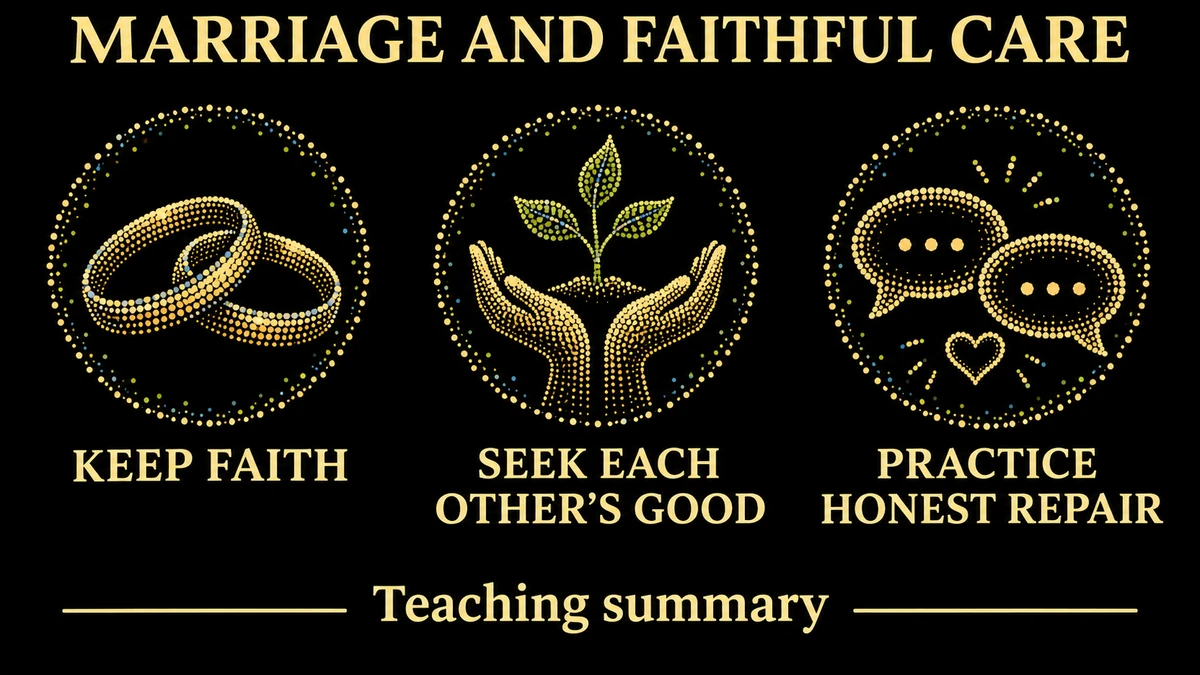
Marriage and faithful care: keep faith; seek each other’s good; practice honest repair. Teaching summary, not a quotation of Scripture. Abuse requires protection and specialist support, rather than pressure to reconcile.
A Worked Example: Sharing a Difficult Week
Consider this illustrative situation, not a reported case: a married couple repeatedly argues because one spouse’s paid work has expanded while the other carries nearly all the household tasks. Both feel unseen. There is no intimidation or abuse in this example; those circumstances require the different response described above.
First, they describe the actual work rather than making accusations. They list paid hours, meals, cleaning, caregiving, appointments, and the planning that makes those tasks happen. Each listens to responsibilities they had overlooked.
Next, they connect biblical responsibility with a concrete adjustment. For the coming week, one takes full responsibility for evening meals and shopping; the other handles two agreed administrative tasks. They protect a rest period for each person and revisit the arrangement after seven days.
Finally, they acknowledge specific wrongs without making the apology conditional on the other’s apology. They can pray together, but prayer accompanies changed behavior rather than replacing it.
The Bible does not assign a universal household spreadsheet. Its call to love, honor, and faithfulness gives them a reason to address the actual burden. Keeping a small, clear commitment becomes one ordinary expression of covenant care. Christians undertake that work through dependence on Christ’s grace, with room for honest repentance and help from others.
Frequently Asked Questions About Marriage in the Bible
Does Everyone Need to Marry?
No. Jesus recognizes a life without marriage for the kingdom, and Paul honors singleness in 1 Corinthians 7. Marriage is a good calling, not a condition of salvation, maturity, or full membership in Christian community.
Does Submission Mean a Spouse Must Obey Every Demand?
No. No spouse has authority to require sin, sexual compliance, concealment of abuse, or surrender of personal safety. Christians disagree about marital roles, but those disagreements do not authorize coercion. Seek safe, qualified support when religious language is being used to threaten or control.
Is Marriage Only About Having Children?
No. Scripture also emphasizes companionship, fidelity, mutual care, and shared life. Christian traditions understand openness to children differently, but inability to conceive does not erase a marriage’s value. Childless people should not be treated as spiritually unsuccessful.
Will People Be Married in the Resurrection?
Jesus says that people neither marry nor are given in marriage in the resurrection (Matthew 22:23–33). Christians differ about how existing relationships are fulfilled in the coming kingdom. His answer places our final hope in God’s resurrection life, beyond the present organization of households.