
Two Christians read the same Bible and make different choices about a meal, a celebration, or a form of entertainment. One participates with gratitude. The other cannot do so with a clear conscience. Does somebody have to win before they can share a church?
The New Testament takes conscience seriously without treating it as an infallible voice. Paul teaches believers to examine their judgments, refuse actual wrongdoing, and receive one another in matters where freedom remains. That combination protects both conviction and fellowship. It also challenges the person who uses freedom to pressure others and the person who turns a personal restriction into everybody else’s law.
GUIDED ARTICLE EXPERIENCE
What Is Christian Conscience? Conviction, Freedom, and Disagreement
Read along as the narration moves through the article.
Browser narration · No stored audio or site tracking
CONTINUE GUIDED TOUR
Continue where you left off.
GUIDED TOUR COMPLETE
You have reached the end of this study.
Study record saved on this device.
GUIDED TOUR
What Is Christian Conscience? Conviction, Freedom, and Disagreement
Narrator: Paranoid Prophet Recommended Voice Native device narration
Prepare to follow the article as it is narrated.
VOICE & TOUR OPTIONS
Voice & Listening
NARRATOR
Finding a narrator…
Checking the best narrator available on this device.
Restores the site recommendations available in this browser.
Our listening picks lead when available; other voices are ranked for narration. Known novelty voices are hidden. Browser-provided voices may use an online voice service.
Screen-awake support will be checked when narration starts.
Optional: improve your device voices
Listening works with the voices already available here. Your device may offer additional free voices through its own settings.
iPhone or iPad: Settings → Accessibility → Read & Speak (or Spoken Content) → Voices → English. Look for Premium or Enhanced choices, then return here.
If offered, preview Ava or Zoe for U.S. English, or Serena or Jamie for British English. An explicit Premium or Enhanced version can improve on its compact version.
Mac: System Settings → Accessibility → Read & Speak → System voice. Open the voice list to preview or download additional choices.
Windows: Settings → Accessibility → Narrator → Add natural voices. Browser availability varies; a Narrator voice may not appear on websites. Edge may also expose online Natural voices without a model download.
Android: Open Accessibility → Text-to-speech output (the location varies by device). In the preferred engine settings, look for voice data and English choices.
Download sizes vary; some enhanced voices exceed 100 MB. This website cannot install system voices, and an installed voice appears here only if your browser exposes it.
Apple voice guide · Windows voice guide · Android voice guide
CHOOSE A NARRATOR
Recommended on this device
Our listening picks: Aaron, Martha, then Daniel, when available here. Otherwise, automatic uses the highest-ranked suitable voice. Preview alternatives or save your own choice.
Preparing the guided article experience…
RESUME GUIDED TOUR?
Continue where you left off.
GUIDED TOUR COMPLETE
You have reached the end of this study.
Article Guide12 sections
What Is Christian Conscience?
Christian conscience is a person’s moral judgment about their own conduct, being formed under the authority of God. It can accuse us when we believe we have done wrong or reassure us when we believe we have acted rightly. Christians seek to train that judgment through Scripture, prayer, wise counsel, and faithful practice.
Conscience is a human capacity, not something possessed only by Christians. In Romans 2:14–16, Paul describes conscience bearing witness as people’s thoughts accuse or defend them. Its verdict matters, but its verdict is not the final judgment of God. Paul makes that distinction about himself in 1 Corinthians 4:1–5: being unaware of a charge against himself does not establish his innocence before the Lord.
A quiet conscience can be mistaken. A troubled conscience can need correction as well as comfort. Neither confidence nor distress settles the truth by itself.
If you need a practical starting point, go to four questions for a disputed choice. For the biblical argument, read Romans 14–15 and 1 Corinthians 8–10. If someone is pressuring you, see the limits of conscience language. If you feel trapped in repeated moral checking, see conscience and persistent fear.
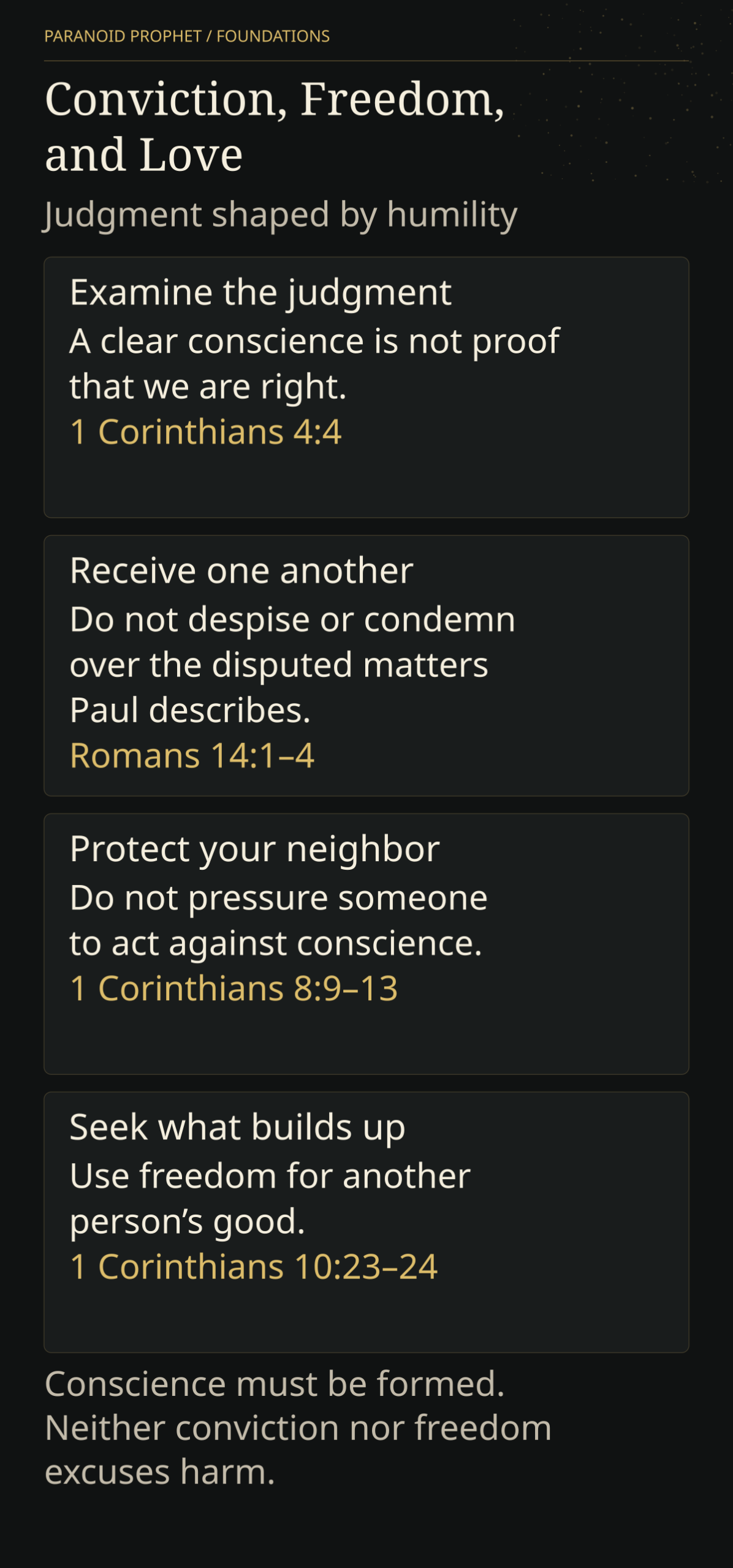
Conviction, Freedom, and Love (image text)
Judgment shaped by humility
- Examine the judgment
A clear conscience is not proof
that we are right.
1 Corinthians 4:4 - Receive one another
Do not despise or condemn
over the disputed matters
Paul describes.
Romans 14:1–4 - Protect your neighbor
Do not pressure someone
to act against conscience.
1 Corinthians 8:9–13 - Seek what builds up
Use freedom for another
person’s good.
1 Corinthians 10:23–24
Conscience must be formed. Neither conviction nor freedom excuses harm.
PARANOID PROPHET / FOUNDATIONS
Four Questions for a Disputed Choice
Before deciding whether a disagreement is a conscience issue, slow down enough to identify the claim. These questions are a practical aid, not a new set of biblical categories that settles every case.
1. Is this a command or prohibition that applies here? Scripture’s teaching about truthfulness, sexual faithfulness, justice, and love cannot be cancelled by saying, “My conscience allows it.” Read the relevant passage in context and consider whether you have applied it accurately. Serious ethical disputes require that work; they do not become harmless preferences because sincere Christians disagree.
2. Am I convinced that this particular action would be wrong for me? You may be unable to participate faithfully, even when another believer has good reasons to think the action is permissible. Do not force yourself through that conviction to impress a friend or prove that you are mature. Make room to study it without treating it as a permanent rule for everyone.
3. Could an otherwise permissible choice be unwise or harmful in these circumstances? Your responsibilities, past experiences, vulnerabilities, and the people present can change what love requires. An activity might be permissible in general and still be a poor choice tonight. Considering that difference is part of maturity.
4. Is this simply what I prefer? Disliking a musical style, a menu, or a harmless tradition does not automatically make it sinful. We can ask for consideration without claiming God’s authority for our tastes.
When you cannot yet tell which question applies, pause the optional action, name the uncertainty, and seek help from someone who will reason from Scripture rather than reward your agreement. The goal is a faithful decision with enough understanding to act, not endless investigation until you feel incapable of making any choice.
Romans 14–15: Receive the Believer You Disagree With
Romans 14 addresses disputes about food and the observance of days. Paul describes one believer eating broadly while another eats vegetables, and one regarding a day as special while another regards days alike. He directs both groups toward honoring the Lord.
The eater must not despise the abstainer. The abstainer must not condemn the eater. God has received the believer whom the other person is tempted to dismiss. Paul makes accountability to the Lord a reason for humility, not a reason to stop caring how we live.
That context matters. Paul is not declaring every moral question optional. He is addressing practices in which he recognizes room for different conduct before God. Whether a particular modern disagreement belongs in that category must be argued from Scripture, not assumed from the existence of disagreement.
Paul also has a theological judgment about the food: he regards it as clean in itself. Yet that judgment does not justify pushing another believer into eating what they believe is wrong. In Romans 14:23, the person who eats while doubting acts against their conviction. Knowing an action is permissible does not make pressuring someone into it loving.
The passage asks more of the confident person than winning the argument. Pursue peace. Build up the other believer. Refuse to damage a person over food. These are demanding instructions because they ask us to put another person’s faithfulness ahead of the pleasure of demonstrating our own freedom.
Romans 15:1–7 continues the argument: the strong are to bear with the weak and seek their neighbor’s good, following Christ’s example. “Strong” and “weak” concern the convictions at issue. They should not become permanent labels for someone’s intelligence, worth, or standing with God.
A church can therefore teach patiently while welcoming people who are still working through a disputed practice. Welcome does not require pretending that every judgment is equally well grounded. It does require refusing contempt.
First Corinthians 8–10: Freedom Has Real Boundaries
In 1 Corinthians 8, the dispute involves food associated with idols. Some believers know that an idol is no real god. Others, shaped by their former involvement in idolatry, still experience eating the food as participation in it.
Paul warns the knowledgeable believer about the effect of their example. Someone who sees them eating in an idol’s temple may be encouraged to do what that person still believes is wrong. Wounding the believer in that way is serious enough for Paul to describe it as sin against Christ.
Here, causing someone to stumble involves more than the fact that somebody dislikes a choice. It includes encouraging a person toward sin or against conscience. This does not make distress irrelevant. It means we should identify the actual danger instead of using “I’m offended” as a shortcut that ends every conversation.
Paul develops the argument across three chapters. In chapter 9, he describes surrendering rights for the sake of the gospel. Then chapter 10 draws a firm boundary: participation in idolatrous worship is forbidden. Christian freedom does not authorize fellowship with idols.
At the same time, Paul permits eating meat sold in the market without investigating its history, and eating what an unbelieving host serves without raising conscience questions. If someone specifically identifies the food as sacrificial, he instructs the believer to abstain for the sake of the person who raised it and that person’s conscience.
The distinctions are precise. Actual idolatrous participation is forbidden. Ordinary food is not automatically forbidden because of its history. Love can still require abstaining in a particular encounter. A faithful reading keeps all three points in view.
The guiding question becomes: Will this choice build someone up and serve their good? Freedom supplies an opportunity to love, not a demand that we exercise every permissible option.
What Does This Look Like at a Shared Table?
Imagine inviting a Christian friend to dinner. A dish reminds them of a religious ceremony they formerly participated in, and they tell you they cannot eat it with a clear conscience. You do not share that association and do not believe eating the dish would be worship.
You can offer another dish without laughing at their concern or demanding that they prove their freedom. If they want to talk, listen first. You can explain why you understand the food differently while giving them time to consider it. Hospitality is not a test they must pass.
Your friend’s abstention also does not establish that every Christian must avoid the dish forever. They can state their boundary without accusing you of idolatry merely for eating ordinary food. Both of you can remain accountable to Scripture and refuse to weaponize the disagreement.
The same pattern can help with some entertainment choices or cultural customs, though each case needs its own facts. Ask what the activity actually involves, why someone objects, and whether participation could draw a person toward wrongdoing. A label alone cannot answer those questions.
How Can a Conscience Be Trained?
A conscience needs formation because sincerity does not guarantee accuracy. Titus 1:15–16 describes conscience as capable of corruption. Scripture also shows people needing to grow in their understanding of what faithfulness requires.

Start with the passage rather than a slogan. Ask who is being addressed, what conduct is in view, and how the instruction fits the surrounding argument. Our guide to reading the Bible in context explains that process in more detail.
Name the reason for your judgment. “I cannot do this faithfully because…” gives you something to examine. “People like us never do that” may reveal a custom that needs evaluation. “I deserve to do whatever I want” may reveal a desire that is borrowing the language of freedom.
Seek counsel from a trustworthy pastor or mature Christian who can explain their reasoning and hear disagreement. Healthy counsel can challenge you without shaming you or demanding secrecy. If a decision affects another person, listen to the person who may bear its consequences.
Then act on what you understand, remain teachable, and correct course when needed. Growth in sanctification includes clearer moral judgment, repentance where we have done wrong, and freedom from burdens God has not imposed. Formation is ongoing; it is not a technique for becoming incapable of error.
What Christian Traditions Emphasize
Christians share substantial ground on the need to take conscience seriously and to form it. They differ about how scriptural interpretation, church authority, and tradition guide that process.
In the Reformed tradition, Westminster Confession chapter 20 emphasizes God’s lordship over conscience and rejects demands contrary to his Word. The same chapter rejects using Christian liberty as permission to sin. Liberty of conscience does not eliminate moral responsibility or every legitimate form of authority.
The Catholic Catechism’s teaching on conscience stresses following conscience and the duty to form it through God’s Word, prayer, counsel, and the Church’s teaching. Its discussion of erroneous judgment distinguishes a person’s responsibility for an error from the moral quality of the act itself.
Those traditions do not resolve every question in the same way. Neither presents sincerity as a blanket permission to do whatever feels right. When discussing a disputed practice across traditions, explain the actual authority claim rather than assuming your conversation partner has no principles.
When Conscience Language Becomes Pressure
“My conscience requires this” can explain a person’s boundary. It does not automatically authorize them to control another person’s life. Likewise, “You are free in Christ” does not authorize a leader or friend to demand participation in an activity you believe is wrong.
Be especially careful when someone invokes conscience to excuse dishonesty, exploitation, intimidation, or abuse. Those claims need examination, not automatic deference. A person’s confidence about their own motives does not remove the harm they cause or the responsibility to address it.
If someone tells you that reporting abuse, seeking appropriate help, or refusing unsafe access will make you a stumbling block, that is not a sound application of Paul’s concern for vulnerable believers. Protecting a person from harm and involving appropriate authorities can be necessary. Fellowship does not require concealing wrongdoing.
You can respect another person’s refusal to participate without accepting every accusation they make. You can offer a reasoned challenge without forcing them to act against conscience. Our guide to forgiveness and reconciliation addresses why forgiveness does not remove the need for truth, boundaries, and accountability.
Conscience and Persistent Fear
Ordinary moral concern is part of life. Persistent, unwanted fears that lead to repeated checking, confession, or requests for reassurance may need additional care. The International OCD Foundation describes religious or moral obsessions and compulsions under the term scrupulosity.
This article cannot diagnose what you are experiencing. An intrusive thought is not, by itself, a settled intention or a reliable verdict about your character. If fear is consuming your time or disrupting daily life, consider a qualified mental-health professional familiar with OCD alongside supportive pastoral care. You do not have to turn every unwanted thought into another spiritual investigation.
A Cleansed Conscience and a Teachable Life
Christian hope rests in Christ, not in achieving a flawless internal record. Hebrews 9:11–14 connects the cleansing of conscience with Christ’s sacrifice and service to the living God. Grace gives us reason to face the truth about ourselves without pretending that our own judgment can save us.
When you have done wrong, acknowledge it, seek forgiveness, and take appropriate steps to repair the harm. When you have inherited an unnecessary burden, allow Scripture and wise counsel to examine it. When another believer needs patience, offer it without surrendering honesty.
A well-formed conscience helps us become people who can hear correction, exercise freedom responsibly, and live beside Christians who do not share every conclusion. Christ remains Lord of both the person who abstains and the person who participates faithfully. That is a strong foundation for conviction without contempt.
Questions About Christian Conscience
Is conscience the Holy Spirit?
Conscience is our moral judgment and can be mistaken. Christians believe the Holy Spirit guides and forms believers, but a feeling of certainty should not be automatically identified with God’s direct speech. Test your understanding against Scripture and seek wise counsel. See also discerning God’s will.
Can my conscience change?
Yes. Better understanding can reveal that an action you once accepted is wrong, or that a restriction you once treated as binding is unnecessary. Change should follow honest formation rather than pressure to fit in. Do not rush into an optional action while you still believe it would be wrong.
Must I stop whenever another Christian objects?
Not every objection creates a universal prohibition. Ask whether your conduct involves actual wrongdoing, could encourage someone to violate conscience, or creates a concrete risk of harm. Paul’s teaching calls for sacrificial love and patient explanation. It does not give the most controlling person unlimited authority over the church.
Sources and Reading Notes
Biblical teaching is summarized and paraphrased in this guide. Scripture links open the NIV for further reading. The principal passages are Romans 14:1–15:7 and 1 Corinthians 8–10; read the whole arguments rather than treating a single sentence as a rule for every disagreement.
- Romans 14 and its food-and-days disputes, followed by Romans 15:1–7.
- First Corinthians 8–10, on idol-associated food, surrendered rights, idolatry, and a neighbor’s good.
- Westminster Confession of Faith, chapter 20, a primary Reformed source on Christian liberty and liberty of conscience.
- Catechism: formation of conscience and erroneous judgment, primary Catholic sources, paragraphs 1783–1785 and 1790–1794.
- International OCD Foundation: OCD and scrupulosity, a clinical education resource. The pastoral discussion above is not a diagnosis or treatment plan.