

A farmer scatters seed. A widow keeps asking for justice. A father welcomes a son who has wasted his inheritance. Jesus’ parables are easy to remember, but familiarity can hide their force. We may turn them into reassuring moral lessons or hunt for secret meanings in every object while missing the question Jesus is answering.
Christians should interpret Jesus’ parables by reading their Gospel setting, following the story’s movement, giving priority to Jesus’ explanations, and responding to the truth He teaches. Symbolism belongs where the text supports it. Application should grow from that meaning. The goal is to hear Jesus faithfully, including when His story challenges the role we would prefer to play.
GUIDED ARTICLE EXPERIENCE
How Should Christians Interpret Jesus’ Parables?
Read along as the narration moves through the article.
Browser narration · No stored audio or site tracking
CONTINUE GUIDED TOUR
Continue where you left off.
GUIDED TOUR COMPLETE
You have reached the end of this study.
Study record saved on this device.
GUIDED TOUR
How Should Christians Interpret Jesus’ Parables?
Narrator: Paranoid Prophet Recommended Voice Native device narration
Prepare to follow the article as it is narrated.
VOICE & TOUR OPTIONS
Voice & Listening
NARRATOR
Finding a narrator…
Checking the best narrator available on this device.
Restores the site recommendations available in this browser.
Our listening picks lead when available; other voices are ranked for narration. Known novelty voices are hidden. Browser-provided voices may use an online voice service.
Screen-awake support will be checked when narration starts.
Optional: improve your device voices
Listening works with the voices already available here. Your device may offer additional free voices through its own settings.
iPhone or iPad: Settings → Accessibility → Read & Speak (or Spoken Content) → Voices → English. Look for Premium or Enhanced choices, then return here.
If offered, preview Ava or Zoe for U.S. English, or Serena or Jamie for British English. An explicit Premium or Enhanced version can improve on its compact version.
Mac: System Settings → Accessibility → Read & Speak → System voice. Open the voice list to preview or download additional choices.
Windows: Settings → Accessibility → Narrator → Add natural voices. Browser availability varies; a Narrator voice may not appear on websites. Edge may also expose online Natural voices without a model download.
Android: Open Accessibility → Text-to-speech output (the location varies by device). In the preferred engine settings, look for voice data and English choices.
Download sizes vary; some enhanced voices exceed 100 MB. This website cannot install system voices, and an installed voice appears here only if your browser exposes it.
Apple voice guide · Windows voice guide · Android voice guide
CHOOSE A NARRATOR
Recommended on this device
Our listening picks: Aaron, Martha, then Daniel, when available here. Otherwise, automatic uses the highest-ranked suitable voice. Preview alternatives or save your own choice.
Preparing the guided article experience…
RESUME GUIDED TOUR?
Continue where you left off.
GUIDED TOUR COMPLETE
You have reached the end of this study.
Article Guide10 sections
1. Recognize What a Parable Is Doing
A parable teaches through comparison. Jesus draws on farming, family life, debts, meals, work, and conflict to disclose something about God’s kingdom and the people who encounter it. Some comparisons are brief; others unfold through several characters and a surprising conclusion.
These stories do more than decorate a sermon. They can expose self-justification, awaken hope, announce judgment, or challenge expectations about mercy. Ask what the story does to its audience as well as what it describes. Does it reassure discouraged disciples, confront confident critics, or demand a decision?
Identifying literary form protects us from asking the wrong questions. A parable’s truth does not depend on proving that its characters were identifiable historical individuals. Its authority rests in Jesus’ teaching. For the broader reading method, see How to Read the Bible in Context. Here the particular task is learning to follow the comparisons Jesus makes.
2. Begin with the Audience and the Trigger
Read the verses immediately before a parable. Look for a question, complaint, encounter, or editorial explanation. The Gospel writer may have already supplied the interpretive clue you are searching for.
In Luke 15:1–2, tax collectors and sinners approach Jesus while Pharisees and scribes complain about His welcome and shared meals. The lost sheep, lost coin, and father with two sons address that situation. Their recurring celebration challenges the complaint. A reading that discusses forgiveness but ignores resentment toward forgiven people leaves a major part of the chapter unheard.
Likewise, Luke introduces the Pharisee and tax collector by identifying people confident in their righteousness who despise others (Luke 18:9). That framing prevents us from treating the story as a technique for sounding humble while feeling superior.
Who is addressed does not exhaust who can learn. Christians today may recognize the same attitudes in themselves. But that application should begin with the actual encounter rather than an unrelated modern concern. Bible.org’s introduction to the parables usefully emphasizes the presenting question and literary context. Those are starting tools, not permission to import every conclusion a commentator draws.
3. Let Jesus Explain His Own Symbols
A blanket rule that every detail has a hidden meaning goes too far. A blanket rule that parables never contain allegorical features goes too far in the other direction. Jesus sometimes assigns specific meanings to characters and objects.
In Matthew 13:18–23, He explains the seed and soils in relation to hearing the kingdom message. In Matthew 13:36–43, He identifies the field, the good seed, the weeds, the enemy, the harvest, and the reapers. These correspondences come from Jesus’ explanation, so readers should receive them rather than dismiss them as excessive symbolism.
The discipline is to distinguish explained symbolism from invented symbolism. An interpretation needs evidence from the passage, its setting, or a demonstrable scriptural connection. A creative resemblance alone cannot establish meaning.
Nor does one explanation create a universal symbol dictionary. In the sower, the seed concerns the word; in the weeds, the good seed represents the kingdom’s children. The same agricultural image serves different comparisons. Read each story on its own terms before importing an association from elsewhere.
4. Understand Why Parables Both Reveal and Conceal
Jesus’ answer to the disciples in Matthew 13:10–17 complicates the idea that He used stories simply to make everything easy. Understanding the kingdom is given to them, while others hear without understanding. His citation of Isaiah connects this failure with hardened hearts.
Mark 4:10–12 states the concealing function sharply. Christians differ over how to explain the relationship between divine judgment, human resistance, and the wording drawn from Isaiah. We should acknowledge that difficulty rather than reduce the passage to a cheerful teaching tip.
Several points remain clear: hearing sound is not the same as receiving truth; understanding is a gift; and the disciples themselves need Jesus’ instruction. Their questions should discourage the assumption that difficulty proves someone is insincere. The appropriate response is humble attention and continued learning.
Matthew also connects Jesus’ parabolic teaching with Scripture in 13:34–35. Prophecies About Jesus’ Ministry explores that fulfillment setting. For interpretation, the immediate lesson is that parables belong within Jesus’ kingdom mission, including its welcome and its warnings.

5. Worked Example: Read the Sower from Beginning to End
Read Matthew 13:1–23 as a connected unit. The public story, the disciples’ question, and Jesus’ explanation belong together. Skipping verses 10–17 removes the discussion of hearing and understanding that stands between the story and its interpretation.
First, observe the repeated action. Seed is scattered across different kinds of ground. What changes is its reception and outcome. Some is taken away, some grows briefly, some is choked, and some produces a crop. This pattern prepares the reader for Jesus’ explanation.
Second, use the meanings Jesus supplies. The roadside concerns hearing without understanding and the evil one’s activity. Rocky ground concerns an initially joyful reception that fails under trouble or persecution. Thorns concern worldly cares and the deceitfulness of riches. Good soil concerns hearing, understanding, and fruitfulness. These are textual explanations, not guesses about farming equipment or secret numbers.
Third, state the emphasis without flattening it. Receiving the kingdom message involves more than exposure or initial enthusiasm. Its reception becomes evident through enduring fruitfulness. The story offers several related warnings under that central concern. It does not supply a percentage forecast for every evangelistic conversation or a scale for ranking Christians by crop yield.
Fourth, apply the actual diagnosis. Ask where fear of rejection, fascination with wealth, or consuming anxiety obstructs obedience to Jesus. Choose a concrete response: seek help with a persistent compromise, change a habit that feeds greed, or ask a mature Christian to help you endure pressure faithfully.
The parable invites serious self-examination. It does not authorize a confident verdict on another person’s final standing before God based on one difficult season. Its first demand on the reader is to hear.
6. Worked Example: Hear the Widow’s Whole Appeal
Luke 18:1–8 supplies both an introduction and a conclusion. Luke says the parable concerns persistent prayer without giving up. Jesus ends by asking about faith when the Son of Man comes. Keep both ends in view.
A widow repeatedly asks an unjust judge to vindicate her against an adversary. The judge neither fears God nor respects people. He eventually acts because her persistence troubles him. Jesus then directs attention to God’s chosen people crying to Him day and night.
The comparison depends on contrast. If even this unjust judge eventually acts, how much more can God’s people trust the God who hears them? The judge’s indifference is not a portrait of God’s character. Otherwise the reader transfers the very fault that makes Jesus’ reasoning work into the conclusion about God.
Notice what the widow requests: justice. Notice what Jesus promises: God’s vindication. Notice the closing horizon: the coming of the Son of Man and the persistence of faith. Reducing the story to getting any desired outcome through sufficient repetition loses all three.
The relationship between delay and the promise of swift vindication has generated discussion. The passage does not give readers a timetable for every unanswered prayer. It does call them to keep trusting God amid injustice. An abused or threatened person can pray persistently while seeking protection and practical help; the story does not command passive exposure to harm.
A faithful application might be continued prayer for a wrong to be addressed, accompanied by truthful testimony and appropriate action. It cannot become a formula that blames sufferers for insufficient repetition. For a wider treatment of Christian prayer, see How Should Christians Pray?.
7. Use Historical Background without Inventing Motives
Historical knowledge can sharpen the surprise in a parable. In Luke 10:25–37, a Samaritan shows the mercy that a priest and Levite fail to show. Jewish-Samaritan tensions help explain why that choice matters. Jeannine K. Brown’s Working Preacher commentary places the story within Luke’s broader attention to Samaritans.
But Luke does not explain the priest’s or Levite’s private reasoning. Concern about ritual impurity is a proposed explanation, not a statement in the story. Presenting it as certain can make an attractive sermon less faithful to the text.
Use three levels of confidence. The text states that the two men pass by and the Samaritan acts compassionately. The context supports the conclusion that Jesus challenges a restrictive approach to neighbor-love. Background proposals may suggest additional motives, but they need evidence and should remain distinguishable from the narrative.
Avoid treating Jewish people, Pharisees, or religious leaders as uniform villains. Jesus’ exchange begins with Israel’s commands to love God and neighbor. His correction belongs within that scriptural conversation. Historical care should make our reading more precise, not provide religious stereotypes.
8. Follow the Main Movement without Erasing the Details
Looking for a central emphasis is useful. Insisting that every parable can teach exactly one proposition can become restrictive. Some stories develop several connected truths through their characters, contrasts, and endings.
In Luke 15, the younger son’s return matters, the father’s compassionate welcome matters, and the older son’s refusal to celebrate matters. Stopping when the younger son is restored misses the father’s appeal to the brother outside. The conclusion returns us to the opening complaint about welcoming sinners.
Meaningful details need not be secret symbols. The Samaritan’s bandaging, transport, payment, and promised follow-up show the practical cost of mercy. We can attend to those details without assigning the oil, animal, and coins separate doctrinal identities.
A useful test is to ask whether your interpretation accounts for the beginning, decisive contrast, and ending. If it depends on one minor object while leaving the story’s main action unexplained, reconsider it. Keep the larger subject in view as well: Jesus announces the kingdom of God. Individual comparisons illuminate that mission without each becoming a complete account of it.
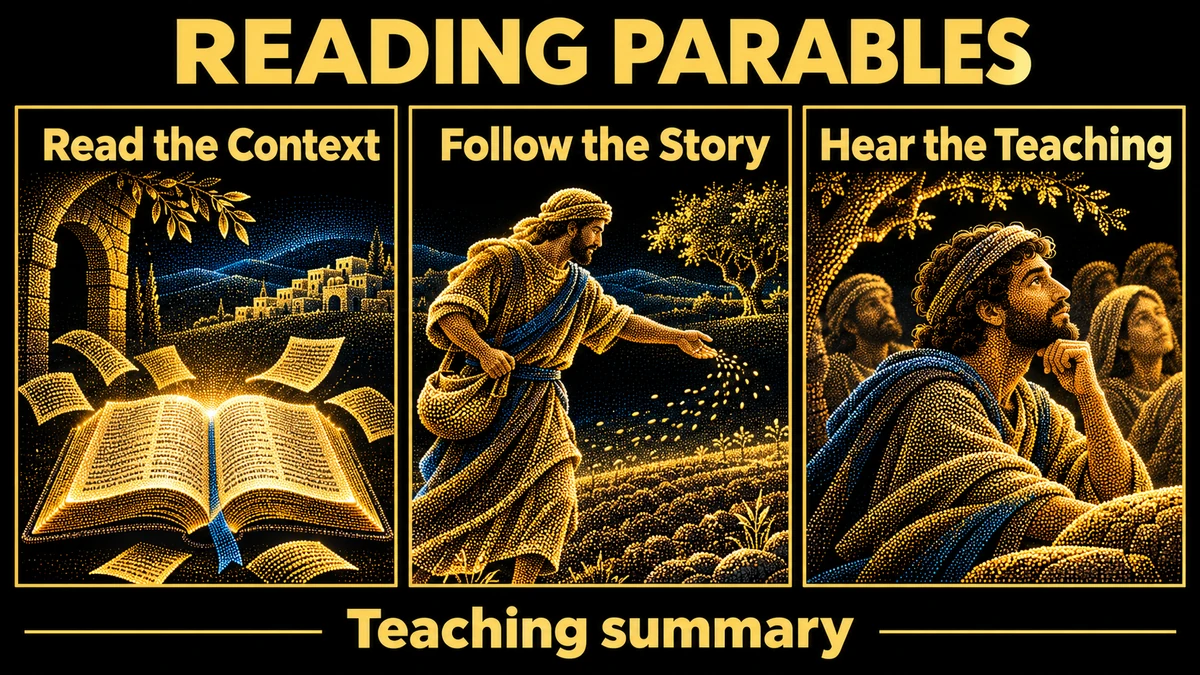
Reading Parables: read the context; follow the story; hear the teaching. Teaching summary, not a quotation of Scripture.
9. Use a Repeatable Reading Sequence
For personal study or a small group, work through these steps before searching for a ready-made interpretation:
- Read the whole passage aloud. Include its introduction, conclusion, and nearby conversation. Mark any audience change.
- Name the occasion. Write down the question, attitude, or need that prompts the story. If it is not supplied, say so.
- Trace the movement. Identify the main characters, repeated actions, contrast, surprise, and final exchange.
- Collect the interpretive clues. Prioritize Jesus’ explanations and the Gospel writer’s framing. Separate observation from inference.
- Check what remains uncertain. Consult a reliable commentary for historical claims or difficult wording. Compare parallel Gospel accounts without erasing their distinct settings.
- State the meaning and respond. Write a short summary that explains the story, then choose an application that follows from it.
In a group, ask each person to point to the words supporting their proposal. Disagreement becomes more fruitful when everyone can distinguish a textual observation from a devotional association.
Prayer belongs throughout this work. Ask God for humility to receive correction, patience to examine the passage, and courage to obey what becomes clear. A striking interpretation that never reaches repentance, mercy, trust, or faithful action has not completed the task Jesus places before His hearers.
10. Frequently Asked Questions about Jesus’ Parables
Does every detail in a parable symbolize something?
No. Some details establish setting or make the action concrete. Others carry symbolic significance, especially where Jesus explains them. Begin with what the passage identifies and supports. An unexplained detail is not automatically meaningless, but it is not an invitation to invent a doctrine.
Should Christians always find only one main point?
Look for a governing emphasis, but allow the story’s structure to teach several related truths. The father and both sons in Luke 15 deserve attention. A short summary is a tool for clarity, not a rule that allows us to discard a character or ending.
Can a parable teach doctrine?
Yes. Jesus’ parables teach about God’s kingdom, judgment, mercy, prayer, and discipleship. Interpret those teachings within the whole passage and the rest of Scripture. Avoid building a detailed doctrine on an incidental feature that neither Jesus nor the Gospel writer explains.
What if sincere Christians interpret a parable differently?
Compare the evidence behind each reading. Ask which interpretation best explains the audience, narrative movement, explicit explanation, and conclusion. Some details may remain debated while the principal call is clear. Keep studying without postponing the obedience the passage already requires.
Scripture references and paraphrases in this article follow the public-domain World English Bible (WEB). Explanations and suggested applications are the author’s commentary, not additional biblical quotations.