

A proverb can sound like a promise that good choices will produce an orderly life. Then Job suffers despite his integrity, and Ecclesiastes asks what our work can finally secure. Reading these books together can unsettle a familiar approach to Scripture. It can also teach us to recognize the difference between faithful obedience and trying to control God through it.
Christians should read biblical wisdom by identifying the kind of speech, following the speaker and the book’s argument, and applying its teaching with reverence for God rather than demanding a guaranteed outcome. Proverbs trains judgment, Job tests explanations of suffering, and Ecclesiastes examines life within human limits. Their different forms belong together without making their voices interchangeable.
GUIDED ARTICLE EXPERIENCE
How Should Christians Read Biblical Wisdom? Proverbs, Job, and Ecclesiastes
Read along as the narration moves through the article.
Browser narration · No stored audio or site tracking
CONTINUE GUIDED TOUR
Continue where you left off.
GUIDED TOUR COMPLETE
You have reached the end of this study.
Study record saved on this device.
GUIDED TOUR
How Should Christians Read Biblical Wisdom? Proverbs, Job, and Ecclesiastes
Narrator: Paranoid Prophet Recommended Voice Native device narration
Prepare to follow the article as it is narrated.
VOICE & TOUR OPTIONS
Voice & Listening
NARRATOR
Finding a narrator…
Checking the best narrator available on this device.
Restores the site recommendations available in this browser.
Our listening picks lead when available; other voices are ranked for narration. Known novelty voices are hidden. Browser-provided voices may use an online voice service.
Screen-awake support will be checked when narration starts.
Optional: improve your device voices
Listening works with the voices already available here. Your device may offer additional free voices through its own settings.
iPhone or iPad: Settings → Accessibility → Read & Speak (or Spoken Content) → Voices → English. Look for Premium or Enhanced choices, then return here.
If offered, preview Ava or Zoe for U.S. English, or Serena or Jamie for British English. An explicit Premium or Enhanced version can improve on its compact version.
Mac: System Settings → Accessibility → Read & Speak → System voice. Open the voice list to preview or download additional choices.
Windows: Settings → Accessibility → Narrator → Add natural voices. Browser availability varies; a Narrator voice may not appear on websites. Edge may also expose online Natural voices without a model download.
Android: Open Accessibility → Text-to-speech output (the location varies by device). In the preferred engine settings, look for voice data and English choices.
Download sizes vary; some enhanced voices exceed 100 MB. This website cannot install system voices, and an installed voice appears here only if your browser exposes it.
Apple voice guide · Windows voice guide · Android voice guide
CHOOSE A NARRATOR
Recommended on this device
Our listening picks: Aaron, Martha, then Daniel, when available here. Otherwise, automatic uses the highest-ranked suitable voice. Preview alternatives or save your own choice.
Preparing the guided article experience…
RESUME GUIDED TOUR?
Continue where you left off.
GUIDED TOUR COMPLETE
You have reached the end of this study.
Article Guide10 sections
Start With the Kind of Wisdom You Are Reading
Proverbs contains parental instruction, poetic invitations, short sayings, comparisons, and commands. Job places extended speeches inside a story whose beginning and ending shape how those speeches should be heard. Ecclesiastes presents the reflections of a Teacher, called the Preacher in some translations, within an introductory and concluding frame.
Those differences affect application. A character’s accusation in Job requires a different reading process from a command in Proverbs. A question about the value of work in Ecclesiastes belongs to a developing reflection, not an isolated declaration that nothing matters.
Begin with three questions: What kind of passage is this? Who is speaking? How does the surrounding book guide my response? The guide to the books of the Bible provides a wider map, while reading the Bible in context explains the method across other genres.
Authorship should be handled carefully. Proverbs names Solomon but also identifies other contributors and later collection activity, including Hezekiah’s men in 25:1. Job does not identify its author or establish a precise date of composition. Ecclesiastes uses royal, Davidic language traditionally associated with Solomon, but its authorship and date remain debated. We can attend closely to the finished texts without pretending those historical questions are settled.
Let Proverbs 1:1–7 Define the Reading Task
Read Proverbs 1:1–7 before choosing a favorite saying. Its opening describes what the collection is for: instruction, understanding, prudent conduct, righteousness, justice, and equity. The desired reader becomes morally discerning, not merely better at achieving personal ambitions.
Notice the audience. The inexperienced need prudence, the young need discretion, and the wise are still expected to listen and learn. Wisdom does not divide humanity into people who need correction and people who have graduated beyond it. A reader who uses Proverbs only to diagnose everyone else’s foolishness has already missed part of the introduction.
Verse 6 also expects readers to learn how to understand sayings and riddles. That matters because a memorable sentence may require interpretation rather than immediate, mechanical execution. The collection trains readers through its form as well as through its individual statements.
Verse 7 locates knowledge in the fear of the Lord. This includes reverence, moral seriousness, and willingness to receive correction from God. It is more than a feeling of anxiety and more than respectful language. For a closer treatment, see the meaning of Proverbs 9:10.
Write a one-sentence reading aim before continuing: I am learning to judge and act faithfully before God. That aim will challenge a second, often unspoken aim: I want a technique that prevents disappointment.
Distinguish Moral Instruction From Predicted Results
Calling every proverb merely a generalization is too blunt. Proverbs includes direct prohibitions, descriptions of character, observations about consequences, and assertions about God’s judgment. Ask what a particular saying does before assigning it a category. A prohibition against deceit retains moral force when a liar temporarily prospers.
Likewise, teaching about diligence can describe the connection between responsible work and provision without promising that every diligent worker becomes wealthy. Illness, exploitation, economic disruption, and other people’s choices do not disappear because someone works faithfully. Neither poverty nor abundance is a reliable spiritual report card.
Read the sentence’s own qualifications, contrasts, and reasons. Then compare nearby sayings and the book’s wider teaching. Proverbs 25, for example, commends fitting speech while warning against hastiness and the misuse of words. Its images ask readers to recognize suitability, not simply collect slogans.
BibleProject’s Proverbs overview helpfully distinguishes the book’s longer framing instruction from its central collections of short sayings. Keep that literary insight without reducing everything in the book to statistical advice. The authority of Scripture includes its moral claims and its training in judgment, not a promise that readers can calculate every earthly outcome.

Work Through Proverbs 26:4–5 Without Flattening It
Proverbs 26:4–5 deliberately places two opposing instructions beside one another. Verse 4 says not to answer a fool according to his folly; verse 5 says to answer. Read the reasons before deciding that one verse cancels the other.
The first warns against becoming like the fool. The second warns against leaving the fool wise in his own eyes. Those are different dangers. A response can descend into the same dishonesty or contempt it claims to correct. Silence can sometimes leave a damaging claim looking unanswerable.
The pair requires discernment about the response, its manner, and the circumstances. It does not give us a mechanical division in which silence is always private and correction is always public. Nor does the tension make the text useless. The juxtaposition makes the reader weigh what a wise answer would accomplish and what an unwise answer would imitate.
Imagine a discussion in which someone makes an unsupported accusation against a colleague. Joining the insults would reproduce the folly. A calm request for evidence, or a brief factual correction, may challenge it without adopting its methods. If the speaker merely repeats abuse, ending the exchange may become the wiser response. Protecting someone from harm can also require reporting misconduct through appropriate channels rather than continuing an argument.
Ask: Am I trying to serve truth or win? Who might be harmed by silence? Will my response clarify anything? Have I understood the claim? The verses train responsible judgment; they do not license calling every person who disagrees with us a fool.
Read Job’s Speakers Through the Story’s Frame
Begin Job with chapters 1 and 2. The narrator introduces Job as upright and God affirms his integrity. His losses therefore cannot be explained by assuming the book has secretly identified him as a hypocrite. Readers receive information that Job and his friends do not possess.
The heavenly scenes also do not authorize us to announce the hidden cause of another person’s suffering. We know what this story tells us about Job. We are not given comparable access to explain a neighbor’s bereavement, illness, or unemployment.
Now turn to Job 42:7–9. God rebukes Eliphaz and his two friends for failing to speak rightly about Him as Job has. They must bring offerings, and Job is to pray for them. This evaluation prevents us from lifting a friend’s impressive theological sentence out of the debate and presenting it automatically as God’s verdict on the sufferer.
The reverse shortcut is also unsafe. God’s commendation does not require treating every anguished statement Job made as an exhaustive theological conclusion. In 42:1–6, Job himself acknowledges speaking beyond his understanding. The book can honor his integrity while exposing the limits of his knowledge.
Keep a speaker note beside each passage: narrator, Job, a named friend, or God. Then ask how the opening, God’s speeches, and the ending evaluate what you have read. BibleProject’s Job overview offers a useful map of the narrative and debate, but the text’s own evaluations must govern the reading.
Let Job Change How You Speak to Sufferers
The friends begin by weeping and sitting with Job in silence. Their presence in Job 2 contrasts painfully with the explanations that follow. Readers should notice that a desire to defend God can become an excuse to accuse someone without evidence.
Before applying a speech from Job, name the claim being made and who makes it. Then test it against what the story has already disclosed. Does the proposed explanation depend on assuming that severe suffering proves severe wrongdoing? The opening has already blocked that inference in Job’s case.
This does not mean human choices never bring painful consequences. It means the existence of pain does not tell us, by itself, whose fault it is. Confession belongs where wrongdoing is known; accusation requires evidence. Compassion should not wait for a complete explanation.
Job’s later restoration is also a narrated outcome, not a timetable for every faithful sufferer. We should not promise doubled possessions or imply that new blessings make bereavement insignificant. The guide to suffering and Christian hope explores the wider pastoral question. Here the reading lesson is precise: distinguish what happened to Job from what God has promised every reader.
Follow Ecclesiastes 3 Beyond the Familiar Poem
Read Ecclesiastes 3:1–15 as a whole. The famous pairs in verses 1–8 range across birth and death, mourning and dancing, silence and speech. They describe life’s changing occasions. They are not a personalized schedule revealing when your grief will end or your plans will succeed.
The poem’s mention of killing and war also does not, by itself, authorize a particular violent act. Describing the range of human experience differs from giving moral permission for everything named. Ethical judgments require the surrounding biblical teaching and the facts of the situation.
Verse 9 then asks about the worker’s gain. Verse 11 holds God’s ordering of time together with humanity’s inability to comprehend His work from beginning to end. Reading only the attractive first half of that verse can conceal the limit expressed in its second half.
Verses 12–13 commend rejoicing, doing good, and receiving ordinary enjoyment as God’s gift. Verse 14 directs attention to the permanence of God’s work and reverence before Him. The passage moves from life’s seasons through human limits toward grateful, accountable living.
For application, suppose a carefully planned career change stalls. The passage does not identify a secret divine calendar. It invites you to acknowledge what you cannot see, continue doing good, and receive available gifts without pretending you control the whole story. That posture connects with Christian contentment, while leaving room for planning, honest disappointment, and necessary change.
Hear the Teacher Within Ecclesiastes’ Conclusion
Ecclesiastes introduces the Teacher’s words in chapter 1. Near its close, 12:9–14 speaks about the Teacher and evaluates his work. This shift in voice matters even while readers debate the book’s compositional history.
The conclusion commends the Teacher’s wisdom and careful instruction. It also directs the reader toward fearing God, keeping His commands, and remembering divine judgment. We should neither dismiss the preceding reflections as worthless cynicism nor extract their most troubled sentences as the book’s entire message.
BibleProject’s Ecclesiastes overview highlights the distinction between the Teacher’s voice and the framing voice. That distinction helps us hear the questions fully while attending to how the finished book asks us to live. The frame guides interpretation rather than erasing the difficulty of the questions.
Read Proverbs, Job, and Ecclesiastes together in that spirit. Obedience matters. Suffering cannot be decoded from circumstances alone. Human wisdom has real value without making us masters of time or providence. None of those convictions requires abandoning the others.
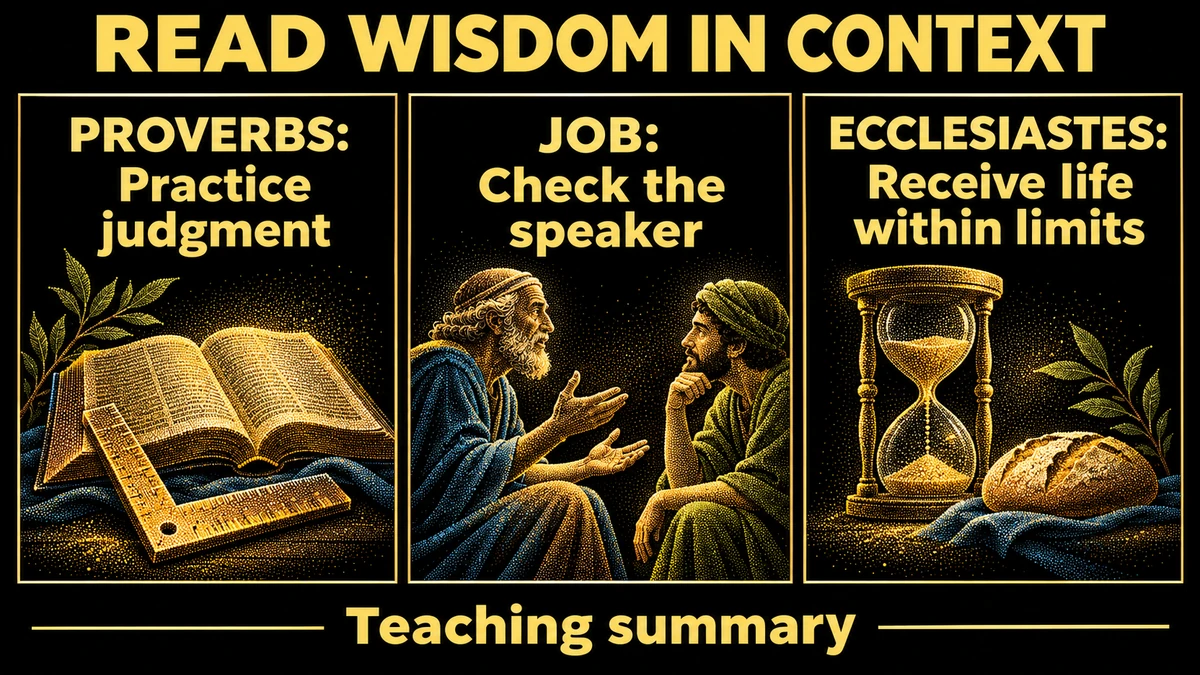
Read Wisdom in Context. Proverbs: practice judgment. Job: check the speaker. Ecclesiastes: receive life within limits. Teaching summary, not a quotation of Scripture.
Use a Five-Line Wisdom Worksheet
After reading a complete passage, write five short lines. Keep observations separate from conclusions so you can see where your interpretation might need correction.
Passage and form: Record the reference and identify a saying, instruction, dialogue, poem, or reflection. For Proverbs 26:4–5, write paired instructions with contrasting reasons.
Speaker and setting: Name who speaks and who is addressed. For a speech in Job, include the speaker’s name rather than labeling the entire paragraph God’s advice.
What the passage actually says: Summarize its claim and reasons in your own words. Avoid inserting a promise the passage never makes.
What the book adds: Note a relevant surrounding passage or framing judgment. For Ecclesiastes 3, include both the limits in 3:11 and the accountability in 12:13–14.
One faithful response and one limit: Choose an action, then state what you cannot infer. For Proverbs 26, you might offer one calm correction while refusing an insulting exchange. You cannot guarantee that the other person will accept it.
This worksheet is a tool for slower reading, not an additional rule imposed on Scripture. Used with prayer, careful study, and wise counsel, it helps turn interpretation into accountable action.
Frequently Asked Questions About Biblical Wisdom
Are the sayings in Proverbs promises?
Do not treat every saying as an unconditional prediction of your circumstances. Identify whether the passage gives a command, a moral judgment, a comparison, or an observation about consequences. Some statements express enduring truths about God. Reading each kind faithfully avoids both prosperity formulas and the opposite mistake of reducing all Proverbs to optional advice.
Do Proverbs 26:4 and 26:5 contradict each other?
They give opposing instructions with different stated reasons. One warns against becoming like the fool; the other against leaving folly self-satisfied. Their placement asks the reader to judge when and how to respond. Simply discarding either verse misses the training in discernment supplied by their pairing.
Can Christians quote Job’s friends as biblical truth?
A friend’s statement must be identified and evaluated within the debate. Scripture truthfully records speeches that its own narrative criticizes. Job 42:7–9 explicitly rebukes three friends, so their words cannot automatically become God’s explanation of someone’s suffering. Read the statement, its speaker, and the book’s evaluation together.
Is Ecclesiastes teaching that life has no meaning?
That description flattens the book. Ecclesiastes confronts mortality, frustrated work, and limited understanding while also commending goodness, enjoyment as God’s gift, and reverence. Read the Teacher’s reflections through their developing argument and the conclusion in 12:9–14. The book challenges our demand for control without making obedience or ordinary gifts worthless.
All biblical summaries here are paraphrases of the World English Bible; the worksheet and modern examples are illustrative applications, not biblical quotations.