
GUIDED ARTICLE EXPERIENCE
What Do Hindus Believe? Hinduism and Christianity Compared
Read along as the narration moves through the article.
Private device narration · No hosted audio or tracking
CONTINUE GUIDED TOUR
Continue where you left off.
GUIDED TOUR COMPLETE
You have reached the end of this study.
Study record saved on this device.
GUIDED TOUR
What Do Hindus Believe? Hinduism and Christianity Compared
Narrator: Paranoid Prophet Recommended Voice Native device narration
Prepare to follow the article as it is narrated.
VOICE & TOUR OPTIONS
Voice & Listening
NARRATOR
Finding a narrator…
Checking the best narrator available on this device.
Restores the best curated narrator available on this device.
Narrator choices are curated for clear, long-form listening on this device.
Screen-awake support will be checked when narration starts.
CHOOSE A NARRATOR
Curated for this device
Choose a verified narrator for this browser, or use System Narrator. Automatic mode uses the best reliable route exposed by this device; your chosen narrator is preserved even if this device needs a temporary fallback.
Preparing the guided article experience…
RESUME GUIDED TOUR?
Continue where you left off.
GUIDED TOUR COMPLETE
You have reached the end of this study.
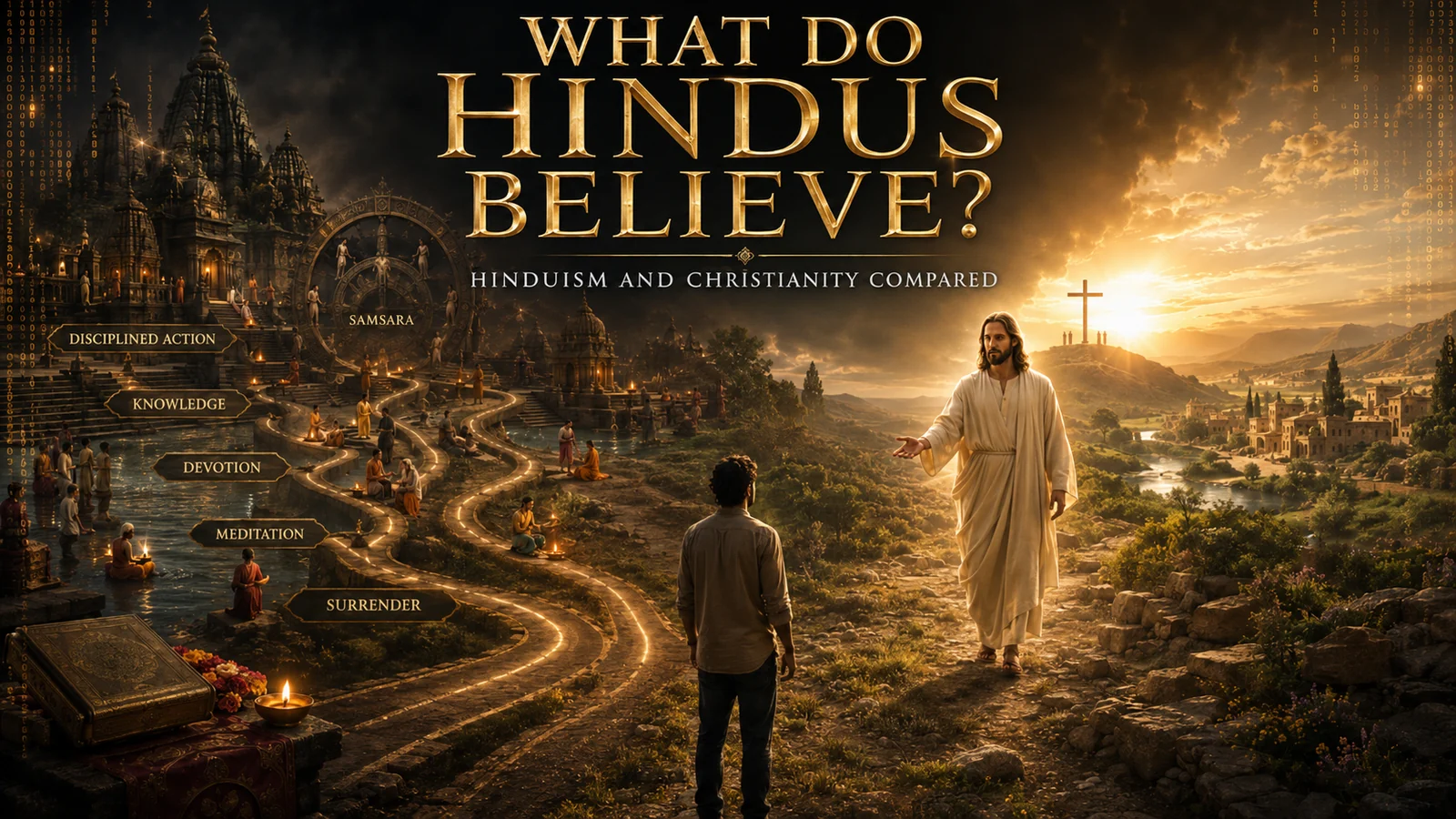
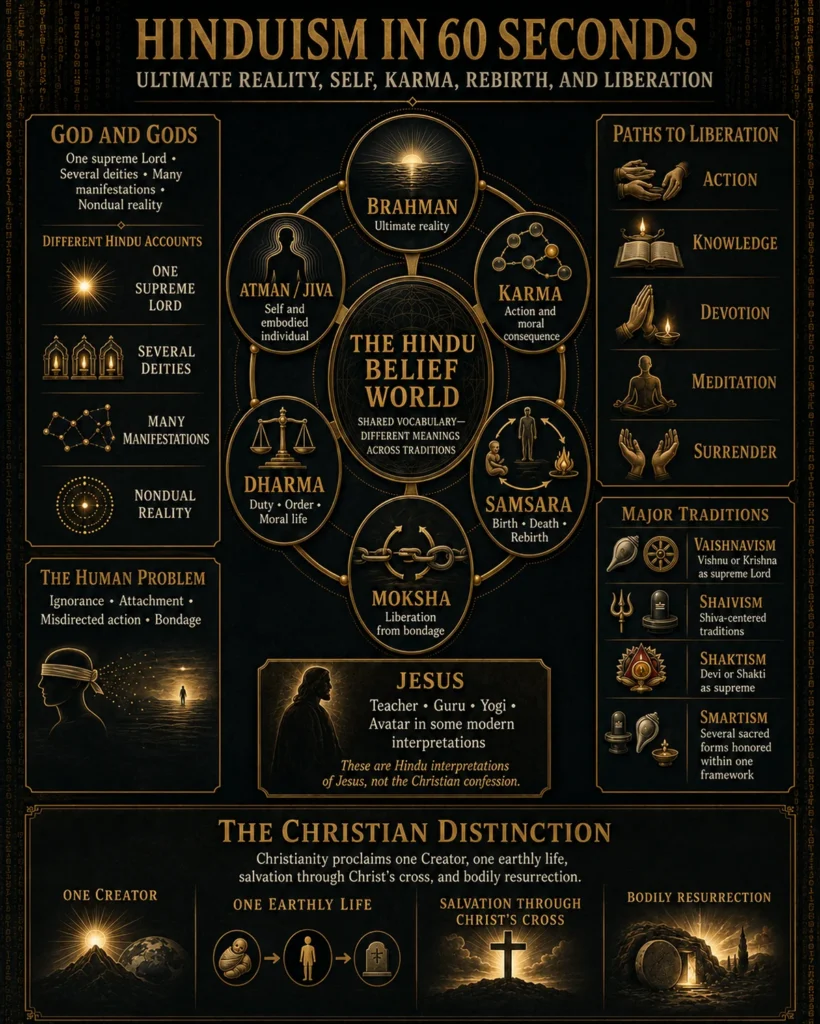
What do Hindus believe? The shortest honest answer is that Hinduism contains several related but genuinely different answers. Many Hindus believe in an ultimate reality called Brahman, a moral order shaped by karma and dharma, repeated birth called samsara, and liberation called moksha. They may worship Vishnu, Shiva, Devi, Krishna, Rama, Ganesha, or other deities; understand those deities as forms of one supreme reality, distinct divine persons, or something in between; and follow devotion, knowledge, disciplined action, meditation, or a combination of paths.
That diversity makes Hinduism easy to caricature. Calling it simply polytheistic misses the many Hindus who confess one supreme Lord. Calling it simply monistic misses traditions that insist God and individual souls remain distinct. Treating every Hindu as a philosopher misses the household worship, festivals, pilgrimages, family customs, and local loyalties through which Hindu life is usually practiced.
This profile explains Hindu beliefs in their own categories before comparing them with historic Christianity. The goal is neither to blend two faiths into a vague spirituality nor to score points with a crude contrast. It is to ask what each tradition says is ultimately real, what has gone wrong with human beings, how release or salvation comes, and who Jesus is. Those questions reveal both real points of contact and deep contradictions.
Article Guide18 sections
Short Answer: What Do Hindus Believe?
Most forms of Hinduism share a recognizable vocabulary without giving every term one fixed meaning. Ultimate reality may be spoken of as Brahman. The enduring self is often called atman, while an embodied living self may be called jiva. Actions bear moral consequences through karma. Beings move through samsara, the cycle of birth, death, and rebirth. Dharma concerns moral, religious, social, and cosmic order. Moksha is liberation from bondage to samsara.
Beyond that shared vocabulary, the differences become decisive. Some Hindus identify atman with Brahman at the deepest level. Others say souls depend on God but never become identical with God. Some envision liberation as awakening to nonduality; others as loving communion with a personal Lord. Some honor several deities while worshiping one as supreme. Some focus on temple devotion, some on philosophical inquiry, some on meditation, and many combine practices.
Hindu traditions also disagree about how liberation occurs. Disciplined action can purify desire. Knowledge can remove ignorance. Devotion can unite the worshiper to a gracious Lord. Meditation can still the mind. Renunciation, ritual, mantra, pilgrimage, moral discipline, and a guru may all matter, but their place depends on the tradition.
Historic Christianity shares some moral and devotional concerns with Hindu traditions, including self-control, compassion, reverence, and the danger of disordered desire. But it tells a different story. Christianity teaches that God freely creates a world distinct from Himself. Hindu schools differ over whether the world is ultimately distinct from God, dependent within Him, an expression of divine reality, or a conditioned appearance. Each person lives one earthly life and remains a creature accountable to God. The central human problem is not merely ignorance, attachment, or accumulated karma, but sin against a holy and personal Creator. Salvation is God’s gift through the once-for-all death and bodily resurrection of Jesus Christ, not release through repeated lives.
60-Second Hindu Belief Map
- Ultimate reality: Brahman, interpreted impersonally, personally, or as exceeding that distinction.
- God and gods: Hindus may worship one supreme deity, several deities, or multiple forms of one divine reality.
- Human identity: atman or jiva, understood differently across schools.
- Human predicament: ignorance, attachment, misdirected action, and bondage within samsara.
- Moral order: karma and dharma shape action, consequence, obligation, and spiritual progress.
- Goal: moksha, with different traditions describing it as realization, freedom, or communion with God.
- Paths: disciplined action, knowledge, devotion, meditation, surrender, and combinations of these.
- Jesus: no universal Hindu view; interpretations range from respect for a teacher to inclusion as an avatar.
What Is Hinduism—and Is It One Religion?
No Single Founder or Creed
Hinduism is an umbrella term for religious and philosophical traditions that developed over many centuries in South Asia. Unlike religions organized around one central originating figure and proclamation, Hinduism does not begin with one universally recognized historical founder. It has no single creed recited by all Hindus, no one institution governing doctrine, and no compact list of scriptures accepted with equal authority everywhere.
The English word Hinduism is comparatively recent, but the traditions it gathers are ancient. Many Hindus use Sanatana Dharma, often translated “eternal dharma” or “eternal way,” as a self-description. That term can express the conviction that truth and right order are not inventions of a recent teacher. Yet not every Hindu uses it in precisely the same way, and it should not be treated as a substitute name that erases the traditions’ historical development.
A Hindu identity can involve temple worship, household ritual, inherited community, pilgrimage, festivals, sacred stories, philosophical commitments, ethical duties, and loyalty to a chosen deity. For some people, metaphysical beliefs are explicit and carefully studied. For others, Hindu belonging is carried mainly through family practice and community memory. The same distinction appears in other religions: official teaching and lived religion overlap, but they are not identical.
Family Resemblances and Real Diversity
It is better to picture Hinduism as a family of traditions than as either one seamless system or a pile of unrelated religions. Vedic inheritance, reverence for sacred texts, karma, samsara, dharma, moksha, yoga, worship, and the authority of teachers create family resemblances. But those common elements are interpreted through competing theologies.
A devotee of Krishna, a worshiper of Shiva, a devotee of the Goddess, and a philosopher of nondual Vedanta may all be Hindu while answering basic questions differently. Is the highest reality personal? Is the world ultimately real? Does the individual self remain forever distinct? Is one deity supreme? Can liberation come through divine grace? Their answers cannot be collapsed without loss.
Geography deepens the diversity. Hindu life in Tamil Nadu, Bengal, Gujarat, Bali, Trinidad, Nepal, the United Kingdom, and the United States is not culturally interchangeable. Caste location, language, gender, migration, and family lineage also affect practice. A fair profile therefore uses phrases such as “many Hindus,” “some traditions,” and “this school teaches” when the evidence requires them. That is the same discipline proposed in How to Compare Religions Fairly: compare representative claims at the same level rather than selecting one tradition’s best philosophy and another tradition’s worst practice.
Where Do Hindu Teachings Come From?
Shruti, the Vedas, and the Upanishads
Hindu texts are often organized into shruti, “that which is heard,” and smriti, “that which is remembered.” Shruti holds the highest formal status in many Hindu accounts. It refers chiefly to the Vedas: Rig, Sama, Yajur, and Atharva. Each Vedic collection contains layers associated with hymns, ritual explanation, forest reflection, and philosophical teaching. The Government of India’s Vedic Heritage Portal identifies these layers as Samhitas, Brahmanas, Aranyakas, and Upanishads.
The oldest Vedic hymns praise deities and powers such as Agni, Indra, Varuna, and Soma in a ritual world quite different from many later Hindu practices. The Upanishads turn sustained attention to questions about the self, death, knowledge, Brahman, and liberation. Famous sayings associate the deepest self with ultimate reality, but the Upanishads are not a single systematic textbook. Later Vedanta schools disagree because they read the same inherited passages through different interpretive frameworks.
Saying “the Vedas teach” can therefore conceal historical and literary layers. A hymn, a ritual commentary, and an Upanishadic dialogue do not perform the same function. Nor does high scriptural status mean that every Hindu reads the Vedas directly. In lived practice, stories, songs, temple traditions, teachers, and regional languages are often more immediate.
Smriti, Epics, and the Bhagavad Gita
Smriti is a broad category that includes remembered tradition and many influential texts. Among these are Dharma literature, Puranas, and the great epics, the Ramayana and Mahabharata. The Bhagavad Gita, embedded in the Mahabharata, is one of the most widely known Hindu scriptures. It presents a dialogue between the warrior Arjuna and Krishna on duty, action, knowledge, devotion, divine manifestation, and liberation.
The Gita’s influence is immense partly because different traditions can emphasize different strands within it. Readers have interpreted it through disciplined action without attachment, knowledge of the self, devotion to Krishna, surrender to God, and combinations of these themes. In the text, Krishna teaches that the embodied self passes through bodily stages and death (Gita 2:13), commands action without attachment to its fruit (Gita 3:19), and describes divine appearance when dharma declines (Gita 4:7). Near its close, Krishna calls Arjuna to take refuge in him (Gita 18:66).
The Puranas narrate cosmic histories, genealogies, sacred geography, and the deeds of deities. They are especially important to devotional worlds centered on Vishnu, Shiva, and Devi. Agamas and Tantras guide theology, ritual, temple construction, image consecration, mantra, and spiritual discipline in several traditions. These are not peripheral to the way millions of Hindus worship simply because they do not belong to the oldest Vedic layer.
Commentary, Guru, and Lived Authority
Texts do not interpret themselves. Hindu schools have produced extensive commentaries on the Upanishads, the Brahma Sutras, and the Bhagavad Gita. Shankara, Ramanuja, and Madhva became especially influential Vedanta interpreters, and each argued that the authoritative texts supported a different account of God, world, and self.
The guru may serve as teacher, spiritual guide, initiator, or living embodiment of a lineage. Authority can also be mediated by temple priests, parents, ascetics, devotional poets, community leaders, and modern organizations. Philosophy and practice continually shape one another. The result is not lawlessness; traditions have real boundaries. But Hindu authority is distributed across text, commentary, lineage, ritual, and community rather than concentrated in one worldwide teaching office.
This matters when someone quotes a single verse as “the Hindu answer.” A responsible account asks: Which text? Which school? Which commentary? How is the passage practiced? A line that sounds nondual in isolation may be read differently by a devotional theologian. A devotional statement may be interpreted symbolically by a nondualist. The source is important, but so is the tradition of interpretation.
What Do Hindus Believe About God and Ultimate Reality?
Brahman Is Not Brahma
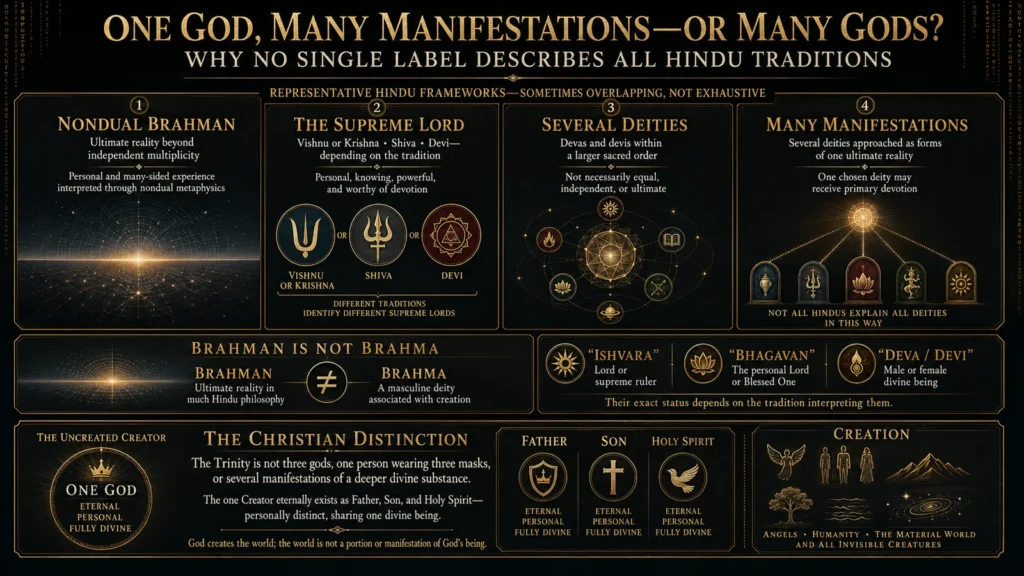
Brahman is ultimate reality in much Hindu philosophy. Brahma, by contrast, is a masculine deity associated with creation and commonly placed with Vishnu and Shiva in the trimurti. The similar spellings cause confusion, but the terms are not interchangeable. Brahman is a metaphysical term; Brahma is a deity with stories, iconography, and a place within a larger sacred world.
Hindu thinkers describe Brahman in more than one way. Nirguna Brahman means Brahman without qualities or limiting attributes; saguna Brahman means Brahman with qualities. Classical Advaita places the personal Lord within the empirical religious order while treating nirguna Brahman as ultimate; other Vedanta schools reject any suggestion that divine personality belongs to a subordinate standpoint. Other schools reject the idea that divine personality is lower. They understand Brahman as the infinitely perfect personal God, possessing knowledge, goodness, power, and beauty without creaturely limitation.
It is therefore misleading to define Brahman simply as “an impersonal force.” That description fits some modern summaries and points toward some nondual accounts, but it does not represent the personal theism of major Hindu traditions. It is equally misleading to translate Brahman directly as the Christian God. The words can occupy roughly parallel positions in a comparison while carrying different claims about creation, personality, distinction, and revelation.
Ishvara, Bhagavan, and Devas
Ishvara commonly means Lord or supreme ruler. In some philosophical systems, Ishvara is the personal Lord who governs the cosmos. Bhagavan is a richly personal title often translated “the Lord” or “the Blessed One” and applied to deities such as Krishna or Vishnu. Deva and devi refer to male and female divine beings, often translated “god” and “goddess.” Those translations are useful, but English readers should not assume that every deva is regarded as an independent ultimate being competing on equal terms.
For a Vaishnava, Vishnu or Krishna may be the supreme personal reality from whom all else depends. For a Shaiva, Shiva may occupy that place. For a Shakta, Devi, the Goddess, is supreme and divine power is not secondary to a male god. Smartas may honor several major deities as legitimate forms through which one ultimate reality is approached. Local and family traditions add further texture.
That is why a picture of a Hindu shrine does not by itself settle the worshiper’s theology. Two people can stand before an image of Krishna while understanding Krishna differently: as the supreme Lord, an incarnation of Vishnu, a chosen form of the one divine, or a beloved deity within a larger sacred order.
One God, Many Manifestations—or Many Gods?
Is Hinduism monotheistic or polytheistic? Both labels can illuminate something, and both can mislead. Hindu traditions include devotion to one supreme personal God, worship of many deities, nondual metaphysics, and forms of inclusive worship in which multiple deities express one reality. Terms such as monism, henotheism, panentheism, and qualified monotheism sometimes clarify a school, but no one label covers the whole family.
Contemporary belief also resists a simple count. In a major survey of Indian religious life, Pew Research Center found that most surveyed Hindus who affirmed God said there is one God with many manifestations, while smaller shares chose only one God or many gods. That result describes surveyed Hindus in India, not every Hindu worldwide, and a poll cannot define the theology of an ancient tradition. It does show why “Hindus believe in 330 million gods” is a poor summary.
Christianity also requires careful language. Christians confess one God in three persons, not three gods and not one person wearing three masks. The Trinity is not the claim that many deities are manifestations of a deeper divine substance. The Father, Son, and Holy Spirit eternally share one divine being, while remaining personally distinct. Similar-sounding phrases about unity and plurality must therefore be tested by their actual meanings.
Major Hindu Traditions and Vedanta Schools
Vaishnavism, Shaivism, Shaktism, and Smartism
Vaishnavism centers worship on Vishnu and his forms or avatars, especially Krishna and Rama. Its communities include multiple lineages with different philosophies. Many emphasize loving devotion, divine grace, sacred names, temple worship, and service. Krishna devotion can be intensely personal: God is not an abstract absolute but the Lord who knows, loves, reveals, and draws the devotee.
Shaivism centers on Shiva. Some Shaiva traditions are strongly devotional and dualistic; others teach sophisticated forms of nondualism. Shiva may be worshiped through anthropomorphic images or through the linga, a sacred form whose meaning cannot be reduced to the crude description sometimes given by outsiders. Shaiva practice can include temple ritual, mantra, asceticism, yoga, and household devotion.
Shaktism worships Devi or Shakti as supreme. The Goddess appears in forms such as Durga, Kali, Lakshmi, Saraswati, and regional manifestations. Shakta traditions emphasize divine power, motherhood, protection, wisdom, destruction of evil, and the energy through which the cosmos exists. They range from public devotional religion to esoteric Tantric paths.
Smartism is commonly associated with a broad, nonsectarian pattern of worship and with Advaita Vedanta. Worshipers may honor Shiva, Vishnu, Devi, Ganesha, Surya, and Skanda as valid forms of the one ultimate reality while choosing one as a preferred deity. Real Hindu life does not always fit a single category: a family can participate in practices and festivals connected to several traditions.
Advaita Vedanta
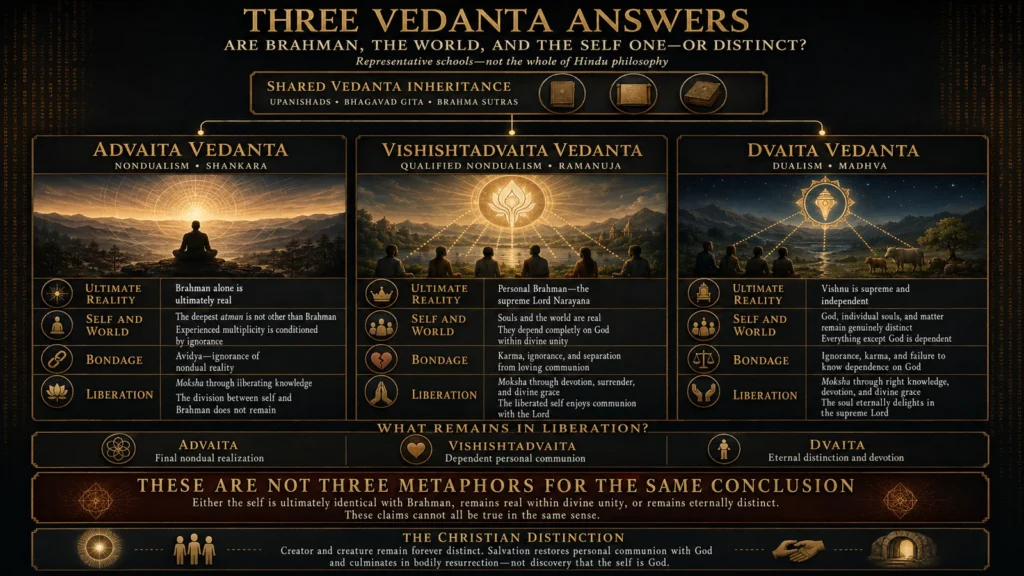
Advaita means “nondual.” The school associated especially with Shankara teaches that Brahman alone is ultimately real and that the deepest self, atman, is not other than Brahman. The ordinary experience of being an isolated individual in a world of separate things is conditioned by avidya, ignorance, and maya, the power or appearance through which multiplicity is experienced.
Maya should not be flattened into “nothing exists.” Advaita makes distinctions between levels of reality. The experienced world functions, moral action matters, and spiritual discipline is required. Yet from the highest standpoint, division between knower, known, and ultimate reality does not remain. Liberating knowledge is not merely collecting facts; it is the realization of one’s identity with Brahman.
The Internet Encyclopedia of Philosophy’s account of Advaita emphasizes this nondual reading while also showing its disciplined argumentation. It should not be confused with the casual claim that “we are all God” in an ego-enhancing sense. Advaita’s claim undercuts the independent ego rather than divinizing its preferences.
Vishishtadvaita Vedanta
Vishishtadvaita, often translated “qualified nondualism,” is associated especially with Ramanuja. It affirms one Brahman, understood as the personal Lord Narayana, while insisting that individual selves and the world are real. They depend completely on God and belong within God’s unity, but their reality is not erased as mere illusion.
Ramanuja’s theology is devotional. Knowledge matters, but loving devotion and surrender to God are central. Liberation is not discovery that the devotee never differed from an impersonal absolute. It is release from karma and joyful communion with the supreme personal Lord. The Internet Encyclopedia of Philosophy’s study of Ramanuja highlights his personal theism, the reality of individuals, and the significance of devotion and divine grace.
This is one reason the slogan “Hinduism teaches that everything is one” is unreliable. A Vishishtadvaita theologian affirms divine unity without dissolving all distinctions. The school may sound closer to Christian theism than Advaita does at certain points, yet major differences remain concerning creation, incarnation, karma, rebirth, and salvation.
Dvaita Vedanta
Dvaita means “dual” or “dualistic” and is associated especially with Madhva. It teaches a real and enduring distinction between Vishnu, individual souls, and matter. God is independent; everything else is dependent. Liberation does not reveal that the soul is identical with Brahman. The liberated soul remains a creature who knows and delights in the supreme Lord.
Dvaita emphasizes devotion, right knowledge of dependence on God, and divine grace. It also articulates real differences among souls and a more complex account of spiritual destiny than popular summaries usually mention. The Internet Encyclopedia of Philosophy’s profile of Madhva shows how far this school stands from a universal nondual interpretation of Hinduism.
Why These Differences Matter
The three Vedanta schools do not merely use different metaphors for the same conclusion. They disagree about reality. If atman and Brahman are ultimately identical, a theology of permanent creature-Creator distinction is false. If God and souls remain eternally distinct, the Advaita account of final nonduality is false. If the world and individual persons are enduringly real in dependence on God, they are not only provisional appearances to be transcended.
That disagreement is philosophically healthy to acknowledge. It shows Hindu thinkers taking truth seriously, offering arguments, interpreting texts, and criticizing rival positions. It also blocks an easy pluralism in which every religious sentence is true after being translated into one preferred metaphysics. Before asking whether Hinduism and Christianity agree, we must first admit that Hindu schools disagree with one another in meaningful ways.
What Do Hindus Believe About the Self?
Atman and Jiva
Atman is often translated “self” or “soul,” but no English word carries every philosophical nuance. It can refer to the deepest self, distinct from changing body, sensation, and mental state. Jiva commonly refers to the living, embodied individual caught in karma and samsara. The exact relationship between atman, jiva, God, and Brahman depends on the school.
In Advaita, the deepest atman is identical with Brahman, while the jiva’s sense of separate individuality belongs to ignorance. In Vishishtadvaita, individual selves are real, conscious, dependent modes within the unity of personal Brahman. In Dvaita, souls are eternally distinct from God. Other Hindu philosophical systems offer still other analyses, including Samkhya’s distinction between many conscious selves and material nature.
The common Western phrase “Hindus believe the soul reincarnates” is serviceable at an introductory level, but it leaves important questions unanswered. What exactly continues? Is personal memory necessary to identity? Is the true self an individual center of consciousness forever, or is individuality ultimately transcended? Different Hindu accounts answer differently.
Does Individuality Remain in Liberation?
For many devotional Hindus, the prospect of loving God eternally is not an inferior concession for people unable to grasp nonduality. It is the highest good. The liberated self enjoys the Lord’s presence without becoming the Lord. For Advaita, however, final knowledge dissolves the ignorance that generated the perceived separation between self and Brahman. Language about union can therefore conceal opposing meanings: communion between two who remain distinct is not identity in which duality is overcome.
Christianity affirms both embodied personal identity and permanent creature-Creator distinction. Human beings are made in God’s image, male and female, as creatures who receive life rather than as portions of God’s being (Genesis 1:26-27). Salvation perfects relationship with God; it does not disclose that the self was God all along. The resurrection hope also restores embodied life instead of treating embodiment itself as the cycle from which salvation must finally escape.
This difference affects love. Historic Christianity understands love as an eternal reality in God and a redeemed relationship between persons. Lover and beloved can be profoundly united without being ontologically identical. A Hindu devotional tradition may make a partially parallel affirmation, while an Advaita framework gives final distinction a different status. The word “union” cannot do all the comparative work by itself.
What Are Karma, Samsara, Dharma, and Moksha?
Karma and Samsara
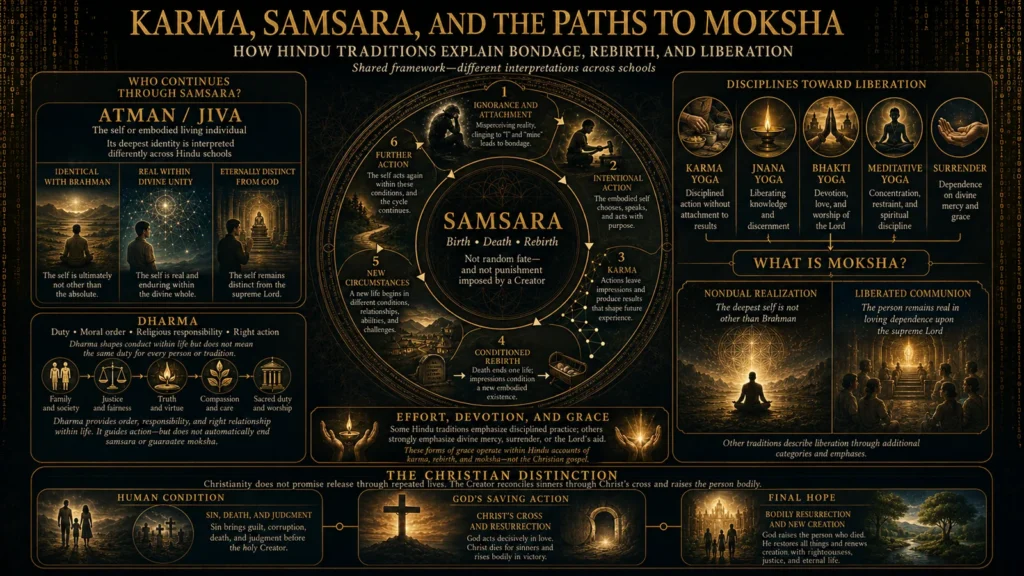
Karma literally concerns action, but in religious use it includes the morally consequential relation between action and result. Intentional deeds shape character, circumstances, and future experience. Karma is not merely “what goes around comes around” within a few months. Its consequences may unfold across lives, helping explain why beings are born into different conditions and why bondage continues.
Samsara is the recurring cycle of birth, death, and rebirth. It is not usually celebrated as endless opportunities for self-improvement. It is bondage marked by impermanence, ignorance, craving, loss, and repeated suffering. A favorable rebirth may be preferable to a miserable one, and moral action may produce better conditions, but even heavenly enjoyment can remain within the cycle. The ultimate religious goal is release.
Hindu theories vary on how karma adheres to a person and how it is exhausted. Some distinguish accumulated karma, karma already bearing fruit in the present life, and karma newly generated. Devotional traditions may give divine grace a powerful role in breaking bondage. It is inaccurate to imagine karma only as a mechanical cosmic vending machine with no place for God, repentance, ritual, knowledge, or grace.
Dharma and Svadharma
Dharma has no single English equivalent. Depending on context, it can refer to moral law, religious duty, right order, teaching, virtue, or the pattern that sustains life and society. Svadharma is one’s own duty, often connected to stage of life, ability, social role, and concrete responsibility. In the Bhagavad Gita, Arjuna’s crisis concerns whether he should fight a devastating war involving relatives and teachers. Krishna’s teaching addresses action, detachment, selfhood, devotion, and Arjuna’s particular duty.
Dharma can be universal and role-specific. Truthfulness, self-control, generosity, non-harm, hospitality, and care for family may appear as broad virtues, while other obligations differ by station and situation. This layered meaning helps explain why dharma cannot be reduced either to private morality or to rigid social conformity.
It also creates moral questions. What happens when an inherited role perpetuates injustice? Hindu reformers have appealed to conscience, devotion, spiritual equality, and reinterpretation of scripture against oppressive customs. Christians face a parallel duty to distinguish God’s commands from social conventions baptized by religious communities. Tradition deserves understanding, but no tradition is exempt from moral judgment.
Moksha Is Not One Uniform Goal
Moksha means liberation or release from samsara. In Advaita, moksha is liberating knowledge of the nonduality of atman and Brahman. Ignorance is removed; the true self is recognized as never actually bound. In theistic traditions, moksha may mean freedom from karma and rebirth in loving communion with the supreme Lord. Some descriptions stress God’s abode, vision, service, bliss, or the soul’s restored nature.
Liberation can also be discussed as jivanmukti, freedom while living, or as release associated with bodily death. Different schools debate whether embodied life continues for the liberated knower, what causal residue remains, and what can meaningfully be said about final experience.
Christians should not translate moksha immediately as “heaven.” Heaven in popular speech can be vague, but the biblical hope culminates in resurrection, judgment, and renewed creation. Moksha addresses bondage to rebirth; Christian salvation addresses reconciliation to God, forgiveness of sin, victory over death, and resurrected life. Both are ultimate hopes, but their maps of the human problem and destination are different.
What Paths Lead to Liberation?
Action, Knowledge, and Devotion
Hindu teaching often speaks of several yogas, disciplined paths or ways of spiritual integration. Karma yoga is the path of action performed without selfish attachment to results. The goal is not frantic religious achievement but purified action, duty, and relinquishment of possessiveness. The Gita’s counsel to act without clinging to the fruit of action is foundational for this path.
Jnana yoga is the path of knowledge or insight. It includes disciplined study, hearing authoritative teaching, reasoning, meditation, discrimination between the enduring and transient, and direct realization. In Advaita, liberating knowledge removes ignorance about the identity of atman and Brahman. Jnana is therefore more than information about religion; it is transformative insight into reality.
Bhakti yoga is the path of devotion. It can involve love of God, prayer, singing, remembrance, service, surrender, temple worship, and repetition of the divine name. In many Vaishnava, Shaiva, and Shakta communities, bhakti is not one optional technique beside an impersonal summit. Personal relationship with the Lord or Goddess is the heart of spiritual life and its fulfillment.
Meditation and Classical Yoga
Raja yoga is a modern umbrella phrase often associated with meditative discipline and the classical yoga system. Patanjali’s Yoga tradition analyzes mental fluctuations, ethical restraints, bodily posture, breath, sensory withdrawal, concentration, meditation, and absorption. The classical philosophy of Yoga is not merely stretching for health. Its disciplines serve a religious and metaphysical goal: freedom of consciousness from bondage to material nature.
Modern postural yoga can be practiced as exercise, stress reduction, a spiritual discipline, or a blend. Its meaning depends on the teacher, setting, intention, and practices involved. Christians need not panic over every breathing exercise, but neither should anyone pretend that all yoga is historically detached from Hindu and other Indian religious traditions. Clear attention is more useful than either alarmism or denial.
Surrender, Grace, and the Question of Equal Paths
Some summaries portray Hinduism as self-salvation through spiritual technique. That is unfair to traditions in which God’s grace and the devotee’s surrender are central. Krishna promises care for devoted worshipers (Gita 9:22), and the Gita culminates in a call to seek refuge in him. Ramanuja’s heirs developed rich accounts of devotion and surrender. Other bhakti traditions sing of grace that cannot be reduced to moral bookkeeping.
Yet “grace” does not automatically mean the same theology in Hinduism and Christianity. Who gives grace? What bondage does it overcome? Does the soul have one life or many? Is forgiveness grounded in atonement? Does salvation preserve creaturely identity? Shared religious vocabulary can mark a genuine analogy without establishing doctrinal identity.
Nor do all Hindus teach that every path leads to the same destination. Some modern Hindu teachers present the yogas as complementary approaches suited to different temperaments. Some sectarian traditions claim a particular deity or revelation is supreme. Some philosophical schools reject rivals’ conclusions. Diversity within Hinduism is evidence against the easy slogan that Hinduism is simply the belief that all religions are equally true.
How Do Hindus Worship and Practice?
Puja at Home and Temple
Puja is a central form of Hindu worship. It can be simple or elaborate: lighting a lamp, offering flowers, water, food, or incense, reciting prayers, ringing a bell, bathing and dressing a sacred image, or receiving blessed food called prasad. The pattern resembles the welcome and honor shown to an esteemed guest, but the recipient is the deity. Puja may be performed daily at a home shrine or publicly by trained priests in a temple.
Household practice is often the center of Hindu religious life. A family shrine can hold images of a chosen deity, other deities, honored teachers, and deceased relatives. Family members may pray before work or school, mark festival days, keep vows, fast, or tell sacred stories. Practices differ by region, lineage, and household; there is no universal Hindu Sunday service.
Temples are understood as dwelling places or specially concentrated sites of divine presence. Worshipers may come for darshan, make offerings, sponsor rituals, receive prasad, circumambulate a shrine, or seek blessing at a life transition. Many temples serve one primary deity while housing related forms and attendants. The priest ordinarily facilitates ritual access; a sermon need not be the center of the visit.
Festival, Pilgrimage, Mantra, and Guru
Hindu calendars are crowded with festivals whose meaning varies across communities. Diwali can involve light, prosperity, family gathering, and stories connected with Rama, Krishna, Lakshmi, or regional tradition. Holi celebrates spring and is associated especially with Krishna traditions. Navaratri and Durga Puja honor the Goddess in different regional forms. Janmashtami celebrates Krishna’s birth; Maha Shivaratri centers on Shiva. A festival’s shared name does not guarantee one theological explanation everywhere.
Pilgrimage connects sacred story to geography. Rivers, mountains, cities, temples, and sites associated with divine acts or saints may be approached as places of unusual holiness. Bathing in the Ganges, visiting Varanasi, traveling to a regional temple, or walking a local pilgrimage route can express repentance, devotion, hope, thanksgiving, and solidarity with other pilgrims.
Mantra is sacred utterance: a word, phrase, divine name, or Vedic formula recited aloud or inwardly. Its significance may involve meaning, sound, lineage, and disciplined repetition. Devotional singing, called bhajan or kirtan in common contexts, gathers worshipers around names and stories of the divine. A guru can transmit teaching and practice, though Hindus differ sharply about the degree of authority a guru should hold. Abuse by a teacher is no more excused by the title guru than abuse by a pastor is excused by the title Christian.
Ethics, Food, and Daily Life
Ahimsa, non-harm, is an influential Hindu ethical ideal, though its interpretation varies. Truthfulness, generosity, purity, hospitality, self-control, compassion, family duty, and care for living beings also appear across Hindu traditions. Cow protection is connected to the animal’s religious, agricultural, and maternal symbolism, but diet is not uniform. Many Hindus are vegetarian; many are not. Survey evidence from India shows both the importance of dietary identity and substantial regional variation.
Life-stage rites can mark birth, naming, initiation, marriage, and death. Cremation is common and is often interpreted through beliefs about returning the body to the elements while the jiva continues according to karma, though funerary beliefs and practices vary. Mourning and ancestor observances bind metaphysical belief to family responsibility.
No practice list should turn Hindus into museum specimens. A Hindu software engineer in Dallas may pray at a home shrine, call parents in India for a festival, attend a temple occasionally, practice yoga as exercise, and hold beliefs that do not fit one philosophy textbook. Another Hindu may be an initiated devotee with rigorous daily disciplines. As with Christians, identity ranges from inherited culture to conscious conviction, often combining both.
What Are Murti and Darshan?
Consecrated Form and Sacred Presence
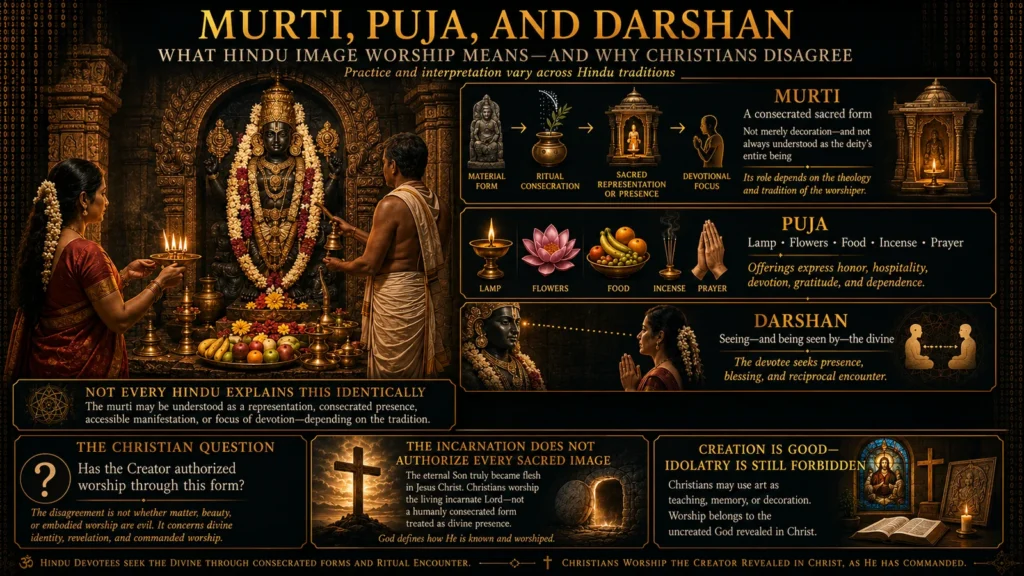
A murti is a sacred form or image of a deity. It may be carved, cast, painted, naturally formed, or represented symbolically. Outsiders often say Hindus worship “statues,” suggesting that devotees mistake stone or metal for an independent god. That description does not capture how informed practitioners understand a consecrated murti.
In temple traditions, rites of consecration invite or establish divine presence so that the murti functions as a real locus of encounter. The Harvard Pluralism Project’s explanation of murti notes that the image is cared for and approached as the deity’s embodied presence, not as a merely decorative reminder. Different Hindu theologians explain that presence differently, just as they explain God and material reality differently.
Analogies help only so far. A photograph can mediate relationship without being the person photographed, but a consecrated murti is usually regarded as more than a photograph. A royal seal can make authority present without being the ruler, but that too is incomplete. The worshiper’s tradition determines whether the form is understood as manifestation, dwelling, embodiment, accessible presence, or symbol.
Darshan and the Christian Question
Darshan means seeing and being seen by the divine. The worshiper comes before the deity’s visible form, receives the deity’s gaze, and may experience blessing through that reciprocal encounter. This helps explain why the image’s eyes, unveiling, decoration, processions, and accessibility matter. The central act is not always listening to information; it is entering a presence.
A Christian can understand the practice accurately and still conclude that worship through murti is forbidden. Biblical monotheism does not reject images because matter is unreal or because artistic representation is inherently evil. Christians believe the Son truly became flesh. Christianity does not leave humanity without a visible revelation of God: the eternal Son becomes flesh and is ‘the image of the invisible God,’ but this divine self-revelation does not authorize worship through other created forms. The objection is that the Creator has authority to name how he is worshiped, and worship must not be redirected to created forms or other deities. Paul describes humanity’s characteristic exchange of the Creator’s glory for images and created things as rebellion, not simply as a culturally unfamiliar route to the same God (Romans 1:18-25).
That disagreement should be stated without mockery. “They think the rock is God” is not a serious account of Hindu worship. “Christians reject murti because they fear matter” is not a serious account of Christian worship. The real disagreement concerns revelation, divine identity, commanded worship, and whether a deity made present in a consecrated form is the God who spoke through Israel and became incarnate in Jesus Christ.
What Is the Role of Caste in Hinduism?
Varna and Jati
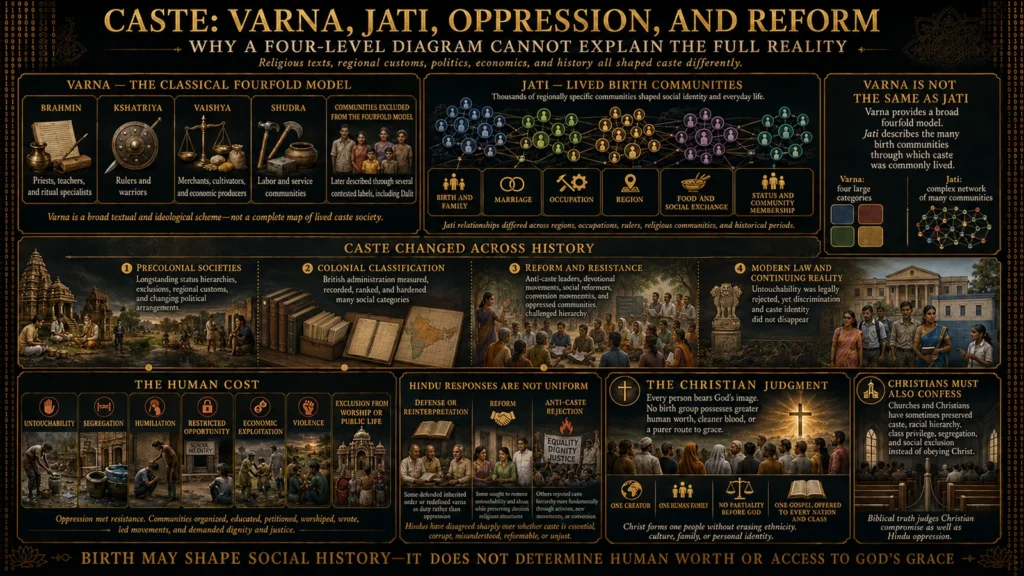
Discussions of caste require two terms. Varna is the classical fourfold scheme of Brahmin, Kshatriya, Vaishya, and Shudra, often associated respectively with priestly learning, political or martial responsibility, commerce and agriculture, and service. Communities placed outside this scheme have endured exclusion and have used or received names including Dalit, a modern self-assertive identity meaning “broken” or “oppressed.” Jati refers to the thousands of birth communities that historically structured marriage, occupation, status, food exchange, and local social life.
Varna and jati overlap but are not identical. The fourfold textual model is too simple to describe India’s actual social organization. Local jatis can have contested rank, regional power, specialized occupations, and histories that do not map neatly onto a single national ladder. Scholarly work on varna schemes and Indian social organization cautions against treating the ideal model as a photograph of lived society.
Caste has been justified through ideas about inherited duty, purity, hierarchy, and karma. It has also been challenged from within Hindu traditions. Devotional movements elevated saints from marginalized communities and proclaimed access to God beyond elite ritual status, though spiritual teaching did not always dissolve social practice. Modern reformers, Dalit activists, Hindu organizations, and India’s constitutional order have opposed untouchability and caste discrimination in different ways.
Oppression, Reform, and Colonial Change
Two opposite claims should be rejected. Caste was not simply invented by British colonial administrators; forms of inherited hierarchy and exclusion long predated colonial rule. But caste was not a frozen, uniform system unchanged from ancient India either. Colonial censuses, law, scholarship, and administration classified fluid communities, privileged selected texts, and reshaped identities. Recent historical reassessment of caste in colonial India stresses both precolonial histories and colonial transformation.
Caste is also not confined neatly to Hindu belief. South Asian Muslims, Christians, Sikhs, Buddhists, and others can retain caste-like identities and marriage patterns. Pew’s survey of caste attitudes in India found caste identification and opposition to inter-caste marriage across religious communities. This does not erase Hindu caste theology; it prevents a religiously selective account of a social institution.
The harm is not theoretical. Untouchability, segregation, degrading labor, blocked opportunity, humiliation, and violence have marked real lives. Fairness does not require a neutral tone toward oppression. It requires locating responsibility accurately, listening to those harmed, recognizing reform, and refusing to make every contemporary Hindu personally answerable for every historical abuse.
Christian Accountability and Biblical Judgment
Christians cannot use caste as an effortless proof of moral superiority. Churches in India have sometimes preserved caste divisions, and churches elsewhere have defended slavery, segregation, ethnic supremacy, and class privilege. Christian misconduct does not refute Christian teaching, but neither can it be hidden when Christians judge another community’s failures.
The New Testament condemns status-based partiality inside worship and commands love of neighbor without favoritism (James 2:1-9). Christian doctrine gives a basis for that judgment: all people share creation in God’s image, all stand guilty under sin, and all who belong to Christ are received by the same grace. No birth group possesses a purer route to God.
The proper Christian response is therefore confession and reform as well as critique. Where churches reproduce inherited hierarchy, their practice contradicts their Lord. Where Hindus resist caste oppression, Christians should recognize the justice of that resistance rather than pretending courage and compassion exist only on one side of a religious boundary.
What Do Hindus Believe About Jesus?
No Universal Hindu Doctrine of Jesus
Hinduism has no council, creed, or universally binding scripture that defines Jesus. Many Hindus know him through Christian schools, churches, art, neighbors, popular culture, colonial history, or modern spiritual teachers. Some admire him without integrating him into a developed Hindu theology. Others have little interest in making any claim about him.
Respect can be sincere. A Hindu may honor Jesus’ compassion, sacrifice, teaching, or spiritual power while continuing to worship Krishna, Shiva, or Devi. In an inclusive framework, adding Jesus need not require abandoning inherited devotion. That hospitality can feel more generous than a Christian claim that Jesus uniquely reveals God. But welcome and agreement are different. A Jesus placed inside another religion’s metaphysics may be honored under a new identity.
Modern Hindu interpretations also arose within encounters with colonial power and missionary Christianity. Hindu intellectuals could resist Western claims of superiority while presenting Jesus as a teacher whose deepest message harmonized with Vedanta. Their readings should be understood historically rather than treated as timeless Hindu consensus.
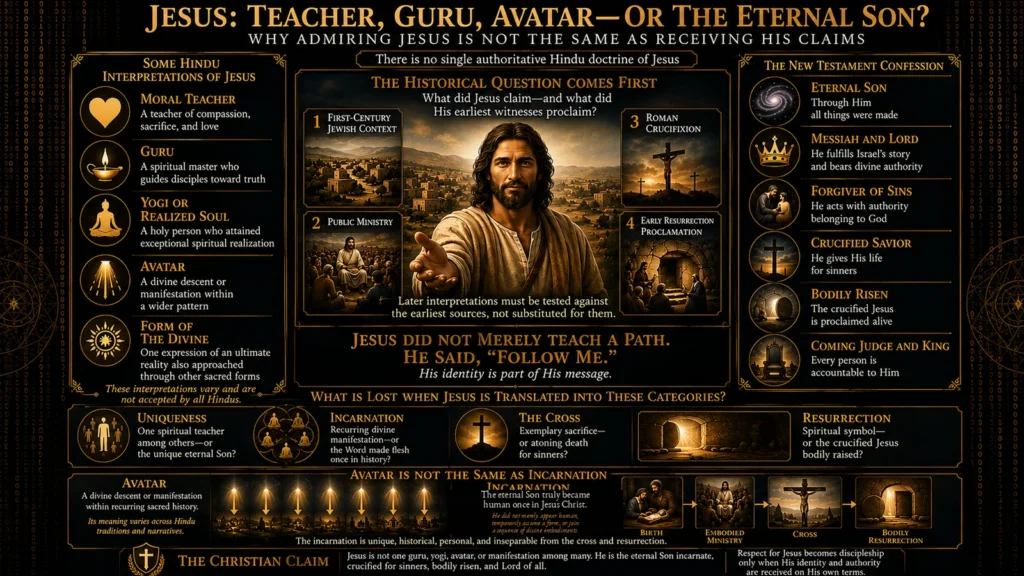
Jesus as Avatar, Guru, Yogi, or Moral Teacher
Some Hindus interpret Jesus as an avatar, a descent or manifestation of God. Some call him a guru who guides people toward realization. Some emphasize him as a yogi, mystic, or enlightened master. Others see him as a moral teacher and healer. The Ramakrishna and Vedanta movement, for example, presents Jesus among divine incarnations and religious teachers within a pluralist account. Its own explanation of avatar explicitly includes Jesus while affirming multiple divine descents.
Such interpretations are not necessarily attempts to deceive Christians. They can express genuine reverence and a desire to recognize holiness beyond one’s community. Vivekananda’s presentation of Jesus as a supreme yogi likewise treated him as spiritually significant. Scholarship on Jesus in Vivekananda and modern Hinduism shows, however, that this admiration also recast Jesus through a Vedanta account of self-realization.
Historic Christianity asks a different question: not merely whether Jesus can be honored, but whether he is received according to his apostolic identity and acts. The New Testament calls him the eternal Word made flesh (John 1:1-18), the unique image of the invisible God through whom and for whom all things were created (Colossians 1:15-20), and the crucified and risen Lord. Those are not honorific decorations that can be removed while the same Jesus remains.
Is Jesus an Avatar?
What Avatar Means
Avatar derives from a word for descent. In Vaishnava settings, it commonly refers to the supreme deity’s descent or manifestation in the world to restore dharma, defeat evil, protect devotees, or reveal divine purpose. Lists differ, but well-known avatars of Vishnu include Rama and Krishna. Some accounts distinguish full and partial manifestations or extend avatar language more broadly.
The Gita’s language is central: Krishna declares that when dharma declines and unrighteousness rises, he manifests himself to protect the good, destroy evildoers, and reestablish dharma. The pattern can recur from age to age. It belongs to a cosmos of repeated ages, multiple divine manifestations, karma, and samsara.
Real Parallels, Decisive Differences
Avatar and incarnation have a real surface analogy: divine reality enters or becomes present within earthly history in a personal form. Both can involve revelation, deliverance, righteous teaching, and divine action accessible to human beings. That is enough to make comparison worthwhile.
The differences are greater. The Christian incarnation is not one episode in a recurring series of divine descents. The eternal Son assumes a complete human nature without ceasing to be God, is born within Israel’s history, fulfills God’s covenant promises, dies once for sins, rises bodily, and remains the incarnate Lord. His humanity is not a temporary costume or appearance. The hymn in Philippians 2:5-11 joins his real humiliation and death to his universal lordship.
The purposes differ too. An avatar restores dharma within a karmic and cosmic order. Jesus bears sin and reconciles enemies to God. He describes his mission as giving his life “as a ransom for many” (Mark 10:45). The apostles proclaim not a divine appearance recurring across ages but a unique death and resurrection within public history.
Why Inclusion Can Redefine Jesus
Calling Jesus an avatar can sound like accepting the Christian claim and adding it to a larger vision. But classification changes meaning. If Jesus becomes one manifestation among others, his uniqueness is denied. If his cross becomes an inspiring display rather than atonement for sin, his mission is changed. If his resurrection becomes a symbol of spiritual awakening or recurring divine presence, the apostolic claim is changed.
Christians can therefore appreciate the respect while declining the category. The disagreement is not over whether Jesus was spiritually impressive. It is over whether the Hindu framework has authority to reinterpret him. The earliest Christian message identifies a specific Jesus who died, was buried, appeared alive to named witnesses, and claimed allegiance as Lord (1 Corinthians 15:3-8). The historical question cannot be settled by fitting him into a metaphysical pattern in advance. See How Early Is the Resurrection Claim? and What the First Witnesses Claimed About the Risen Jesus for the evidence behind that point.
Did Hinduism and Christianity Teach the Same Truth?
Real Overlap and Different Worlds
Hindu traditions and Christianity can recognize real moral and religious truths in common. Both can condemn selfish attachment, commend generosity and self-control, value prayer and devotion, honor sacrificial love, and insist that visible life is not all that exists. Devotional Hindus and Christians may both speak warmly of grace, surrender, love of God, sacred song, and service. Christians need not deny every truth outside the church in order to confess Christ.
But overlap does not produce one underlying doctrine. Compare the larger worlds in which those virtues live:
| Question | Representative Hindu Answers | Historic Christian Answer |
|---|---|---|
| Ultimate reality | Brahman understood nondually, as personal Lord, or through other Hindu metaphysics | One personal Creator, eternally Father, Son, and Holy Spirit |
| The world | Real, dependent, cyclic, or ultimately conditioned appearance, depending on school | Freely created by God, fallen through sin, and destined for renewal |
| The self | Atman or jiva; identical with Brahman, dependent within Brahman, or eternally distinct | An embodied creature made in God’s image, always distinct from God |
| Central problem | Ignorance, attachment, karma, and bondage in samsara | Sin, guilt, corruption, alienation from God, and death |
| Final hope | Moksha: nondual realization or liberated communion with the Lord | Forgiveness, reconciliation, bodily resurrection, judgment, and renewed creation |
| Jesus | Variously teacher, guru, yogi, avatar, or not doctrinally central | The unique incarnate Son, crucified for sins, bodily risen, and returning as Lord |
Even the closest parallels remain qualified. A personal Hindu Lord may resemble Christian theism more than impersonal nondualism does, but creation and incarnation still differ. Bhakti may resemble Christian devotion, but the objects and saving narratives differ. Grace may be central in both, but Christian grace is anchored in Christ’s atoning death and resurrection.
Are All Religions Paths Up One Mountain?
The mountain metaphor says religions begin on different sides but climb toward one summit. It encourages humility and peace, but it smuggles in the speaker’s view from above. How does anyone know there is one summit, that all paths ascend, or that contradiction disappears at altitude? A pluralist who says Advaita, Dvaita, Christianity, and Buddhism all reach the same reality has overruled their rival truth claims with a new theory.
Contradictions are not insults. Either individual souls are ultimately identical with Brahman or they are not. Either humans live repeatedly or they do not. Either Jesus is one avatar among several or the unique incarnate Son. Either his body was raised from death as the beginning of new creation or resurrection is merely a symbol. Opposing claims may both contain partial insights, but they cannot all be true in the same sense.
Religious peace does not require pretending disagreement is unreal. It requires protecting neighbors, listening before answering, opposing coercion, and pursuing truth without hatred. Christians are commanded to give a reason for hope with gentleness and respect. Hindus deserve arguments aimed at their strongest views, not slogans aimed at an imaginary religion.
Which Diagnosis of the Human Problem Is True?
What Hindu Traditions See Clearly
Hindu traditions often see with painful clarity that desire can enslave, that actions shape the actor, that surface identity is unstable, and that pleasure does not overcome death. Disciplines of attention expose how thoughts race and attachments govern behavior. The law of karma expresses a moral intuition Christians share: conduct has consequences, and the universe is not finally indifferent to evil.
Devotional Hinduism also exposes the thinness of a purely intellectual religion. Songs, service, surrender, pilgrimage, and longing insist that human beings need more than an argument. Hindu critics can rightly point to Christians whose lives display little prayer, self-control, generosity, or love. A true creed mouthed without repentance does not honor Christ.
The Christian claim is not that Hindu experience contains no insight. It is that the Bible gives the fuller diagnosis. Human beings suppress truth, worship created things, harm neighbors, and refuse the God whose image they bear. Ignorance matters, but it is not innocent. We often avoid truth because truth would dethrone us. Our problem includes guilt and a will turned against God, not only mistaken perception.
Karma, Judgment, Grace, and the Cross
Karma preserves moral seriousness: deeds bear fruit. Yet it raises hard questions. If present suffering results from forgotten lives, how can a sufferer understand or answer the specific wrong? What establishes the moral law, connects personal identity across rebirths, and guarantees a proportionate result? If karma is administered by God, what makes release merciful and just? Hindu schools offer different answers, and simplistic objections should not pretend there are none.
Christianity also teaches judgment according to deeds. Grace does not mean moral consequence evaporates or God pretends evil is harmless. The sharper Christian claim is that all have sinned and cannot justify themselves, while God acts in Christ to remain just and justify the guilty who trust him (Romans 3:9-26). The cross is not divine indifference to karma-like justice. It is God the Son bearing judgment in the place of sinners.
That gift is personal reconciliation. Paul says God was reconciling the world to himself in Christ and made the sinless one to be sin for us (2 Corinthians 5:18-21). Christians do not climb toward identity with God. God comes to enemies, forgives them at cost to himself, adopts them, and begins their transformation. Good works follow salvation as its fruit; they do not purchase the cross or place God in debt.
This is not the slogan “Hindus earn, Christians receive.” Many Hindu devotees plead for grace, and many nominal Christians try to earn divine favor. The fair contrast is between systems as their strongest teachers present them. Christian salvation uniquely rests on a completed historical act of atonement by the incarnate Son, received in repentant faith, from which a life of obedience grows. See Why Did Jesus Die? and Was Jesus Crucified? for the historical and theological case.
Samsara, Resurrection, and the Historical Question
Reincarnation can seem more hopeful than final judgment because it offers additional lives. Yet the cycle is also a sentence of repeated death, and memory loss makes the supposed education difficult to inspect. Christian Scripture says human beings die once and then face judgment (Hebrews 9:27). That sounds severe until it is joined to the next truth: Christ was offered once to bear sins and will appear again to save those waiting for him.
Resurrection is not reincarnation into another mortal body. It is God’s defeat of death and transformation of the person into immortal embodied life. Jesus’ empty tomb and appearances are therefore central evidence, not an optional myth around a timeless teaching. If Jesus rose, history has revealed the shape of humanity’s future and authenticated his authority. If he did not rise, Christianity fails by its own standard.
This makes the comparison testable at a crucial point. A person need not solve every question about Brahman before investigating Jesus. Ask what the earliest sources claim, how soon resurrection belief appears, whether the crucifixion is historically secure, and what explains the disciples’ testimony. Resurrection vs. Reincarnation develops the two hopes directly, while Is Jesus the Son of God? Evidence and Meaning examines the identity at stake.
Frequently Asked Questions
Is Hinduism monotheistic or polytheistic?
Hinduism includes one-God devotion, worship of multiple deities, and nondual accounts of ultimate reality. Many Hindus understand several deities as manifestations of one supreme reality; others worship one deity as the supreme Lord. Neither “monotheistic” nor “polytheistic” describes every Hindu tradition without qualification.
What is Brahman?
Brahman is ultimate reality in much Hindu philosophy. Advaita understands Brahman as nondual reality beyond limiting attributes. Theistic Vedanta traditions understand Brahman as the infinitely perfect personal Lord. The term is central, but its meaning is disputed rather than uniform.
Is Brahman the same as Brahma?
No. Brahman is a term for ultimate reality. Brahma is a masculine deity associated with creation and often named alongside Vishnu and Shiva. Their similar English spellings conceal a major difference in meaning.
Do Hindus believe every person is God?
Not all do. Advaita teaches that the deepest self is not other than Brahman, but this is not a claim that the everyday ego is an all-powerful deity. Vishishtadvaita and Dvaita preserve real distinctions between individual souls and the supreme Lord.
What is karma?
Karma concerns action and its morally consequential results. Actions shape the actor and future experience, potentially across lives. Hindu traditions differ over how karma operates and how knowledge, devotion, disciplined action, ritual, surrender, and divine grace free a person from its bondage.
What is moksha?
Moksha is liberation from karma and samsara. Advaita describes it as realization of atman’s nonduality with Brahman. Theistic traditions may describe it as freedom from rebirth and enduring communion with the personal Lord. It should not be treated as a simple synonym for Christian heaven.
Do all Hindus believe in reincarnation?
Rebirth is a widely shared Hindu teaching, but personal belief and interpretation vary. Schools disagree about what continues across lives and what liberation preserves. Some culturally identified Hindus may also doubt or reinterpret traditional teachings, just as members of other religions vary in personal conviction.
Do Hindus worship idols?
Many Hindus worship through consecrated sacred forms called murti, but informed devotees do not usually believe an unconnected piece of stone is an independent god. They approach the murti as manifestation, embodiment, or locus of divine presence. Christians can describe that belief accurately while still rejecting the practice as unauthorized worship.
What is the caste system?
Caste refers to layered systems of inherited social identity and hierarchy. Varna is a classical fourfold model; jati refers to thousands of lived birth communities. Caste predates British rule but was reshaped under colonial administration. It has enabled severe oppression, faced Hindu and secular reform, and also persists among some non-Hindu South Asian communities.
Do Hindus believe Jesus is an avatar?
Some do, especially within modern pluralist Vedanta movements, but there is no universal Hindu doctrine of Jesus. Other Hindus may view him as a guru, yogi, saintly teacher, or figure outside their own devotional life. Hindu interpretations differ substantially.
Are Krishna and Jesus the same?
No. Comparisons can identify surface parallels, including divine presence, teaching, and deliverance. But Krishna belongs to Hindu accounts of avatar, dharma, and recurring cosmic ages. Christianity presents Jesus as the unique incarnate Son who dies once for sins, rises bodily, and will return as Lord.
Can Christians practice yoga?
Christians should distinguish ordinary exercise from practices carrying Hindu worship, mantra, initiation, or incompatible spiritual aims. Not every posture is an act of worship, and not every yoga class is religiously neutral. The teacher, setting, language, intention, and actual practice all matter; informed discernment is better than blanket panic or uncritical participation.
Do Hindus believe all religions lead to God?
Some modern Hindu teachers affirm a broad religious pluralism, but not all Hindus or Hindu schools do. Traditions make competing claims about God, self, scripture, and liberation. The popular idea that every religion reaches one summit is itself a theological position, not a neutral summary of Hinduism.
Sources and Further Reading
- Primary Hindu texts: the Vedic Heritage Portal for the Vedic corpus and IIT Kanpur’s Gita Supersite for the Bhagavad Gita and classical commentary.
- Hindu philosophy and history: the Internet Encyclopedia of Philosophy overview of Hindu philosophy, with its specialist entries on the Upanishads, Vedanta, Ramanuja, Madhva, and Yoga.
- Lived religion: the Harvard Pluralism Project’s studies of puja, murti, and darshan, plus Pew Research Center’s 2021 survey of religion in India.
- Caste and social history: the Cambridge studies linked in the caste section, read alongside Pew’s reporting on contemporary caste identity and marriage attitudes.
- Jesus and pluralism: the Vedanta Society’s insider account of avatar and the peer-reviewed study of Vivekananda’s interpretation of Jesus linked above.
- Christian Scripture and evidence: the biblical passages linked throughout the article and Paranoid Prophet’s World Religions studies.
Jesus Is More Than an Avatar or Guru
Hindu traditions deserve more than a dismissive label. They contain ancient texts, disciplined arguments, profound devotion, moral seriousness, artistic beauty, costly renunciation, and centuries of disagreement about reality and liberation. Hindu neighbors are not illustrations in a Christian argument. They are people to be heard, loved, and treated with the dignity due every bearer of God’s image.
That respect also requires clarity. Jesus does not merely awaken people to a divine identity hidden beneath ignorance. He is the eternal Word who was with God and was God, through whom all things were made, and who truly became flesh. He is Israel’s promised Messiah and the holy, sinless Savior. He does not enter history simply to restore balance within a recurring age. He comes into the world he created to rescue creatures estranged from their Creator.
Our need is deeper than lack of insight. We are guilty of worshiping created things, using neighbors for ourselves, and refusing God’s rightful rule. Sin corrupts love, bends reason, and ends in death. No sequence of births can make evil innocent. No spiritual technique can put God in our debt. Yet the Christian gospel is not a message of despair. The Judge acts to save.
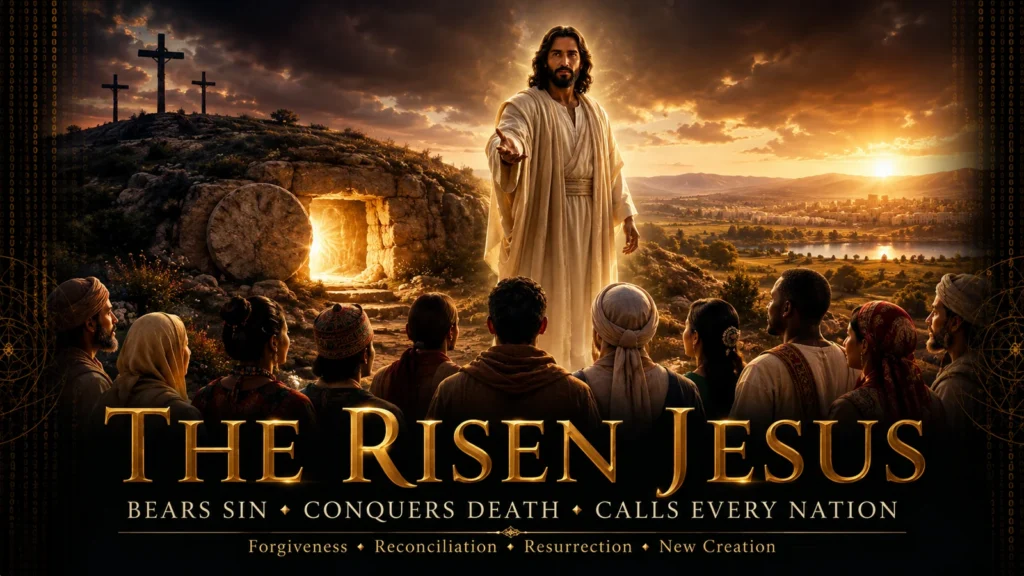
Jesus willingly bears sin at the cross, accomplishing atonement and reconciliation rather than offering only an example of detachment. He is buried, then rises bodily in the same history in which he was crucified. His resurrection is God’s vindication of his identity, the defeat of death, and the beginning of the promised new creation. The first Christians did not announce that Jesus’ spirit lived on as one teacher among many. They announced that his tomb was empty and that they had seen him alive.
That announcement invites investigation. Read the Gospels as claims about a person in history. Examine the crucifixion, the early resurrection testimony, and the transformation of the witnesses. Ask whether Jesus permits the category of avatar or guru to contain him, or whether his own identity overturns every framework we bring.
The risen Jesus offers forgiveness, reconciliation, adoption, and eternal embodied life to those who turn to him in faith. He will return not as another figure in an endless cycle, but as the universal Judge and King before whom every person stands. Hindu traditions offer many accounts of liberation. Jesus Christ comes as the one Lord who bears sin, conquers death, and calls every nation to himself.