
You ask God to change you. Then someone interrupts you, an old temptation returns, or a difficult conversation exposes the same impatience you thought you had left behind. Has anything really changed?
The Bible takes that question seriously. God calls His people to holiness, supplies His Spirit, and teaches them to live differently. Christians also need correction, forgiveness, and help along the way. Sanctification helps us understand that continuing work without excusing sin or expecting a flawless life by next Tuesday.
GUIDED ARTICLE EXPERIENCE
What Is Sanctification? How Christians Grow and Why They Still Struggle With Sin
Read along as the narration moves through the article.
Browser narration · No stored audio or site tracking
CONTINUE GUIDED TOUR
Continue where you left off.
GUIDED TOUR COMPLETE
You have reached the end of this study.
Study record saved on this device.
GUIDED TOUR
What Is Sanctification? How Christians Grow and Why They Still Struggle With Sin
Narrator: Paranoid Prophet Recommended Voice Native device narration
Prepare to follow the article as it is narrated.
VOICE & TOUR OPTIONS
Voice & Listening
NARRATOR
Finding a narrator…
Checking the best narrator available on this device.
Restores the site recommendations available in this browser.
Our listening picks lead when available; other voices are ranked for narration. Known novelty voices are hidden. Browser-provided voices may use an online voice service.
Screen-awake support will be checked when narration starts.
Optional: improve your device voices
Listening works with the voices already available here. Your device may offer additional free voices through its own settings.
iPhone or iPad: Settings → Accessibility → Read & Speak (or Spoken Content) → Voices → English. Look for Premium or Enhanced choices, then return here.
If offered, preview Ava or Zoe for U.S. English, or Serena or Jamie for British English. An explicit Premium or Enhanced version can improve on its compact version.
Mac: System Settings → Accessibility → Read & Speak → System voice. Open the voice list to preview or download additional choices.
Windows: Settings → Accessibility → Narrator → Add natural voices. Browser availability varies; a Narrator voice may not appear on websites. Edge may also expose online Natural voices without a model download.
Android: Open Accessibility → Text-to-speech output (the location varies by device). In the preferred engine settings, look for voice data and English choices.
Download sizes vary; some enhanced voices exceed 100 MB. This website cannot install system voices, and an installed voice appears here only if your browser exposes it.
Apple voice guide · Windows voice guide · Android voice guide
CHOOSE A NARRATOR
Recommended on this device
Our listening picks: Aaron, Martha, then Daniel, when available here. Otherwise, automatic uses the highest-ranked suitable voice. Preview alternatives or save your own choice.
Preparing the guided article experience…
RESUME GUIDED TOUR?
Continue where you left off.
GUIDED TOUR COMPLETE
You have reached the end of this study.
Article Guide11 sections
What Does Sanctification Mean?
Sanctification is God’s work of setting people apart for Himself and forming them in holiness through Jesus Christ and the Holy Spirit. It includes belonging to God and growing in the life He calls His people to live.
Holiness reaches ordinary decisions: telling the truth, controlling anger, honoring commitments, refusing exploitation, and loving people whose needs interrupt our plans. Its source is God, and its shape is increasingly visible faithfulness to Christ.
This guide approaches the subject from a Protestant Christian perspective while identifying meaningful differences among traditions. If you need practical help right now, begin with What Can You Do This Week?. If you are discouraged by repeated failure, go to What If You Keep Falling Into the Same Sin?.
What Can You Do This Week?
Begin with one real area of obedience. You do not need a complete life overhaul before taking an honest next step.
Read a passage in context. Try Ephesians 4:17–32 over several days. Notice how Paul moves from renewed thinking to truthful speech, useful work, generosity, and kindness. Ask what the passage actually requires before applying it to someone else.
Name a specific pattern. “I need to do better” is hard to act on. “I exaggerate when I want respect” or “I use sarcasm to punish people” gives you something concrete to confess and address.
Practice the corresponding good. Paul tells the person who stole to work honestly and have something to share. The change includes a new way of serving a neighbor. In your situation, that might mean telling the plain truth, listening before answering, or keeping a promise when nobody will applaud. Read Ephesians 4:17–32.
Ask for help before the familiar moment arrives. Pray honestly. Tell a trustworthy, mature Christian what you are trying to change. Make a practical plan for the circumstance in which you usually fail. Dependence on God can include accepting help and changing your routines.
Review without turning the week into a verdict on your soul. What happened? Whom did it affect? What needs repairing? What helped you obey? These questions support repentance and learning. Constantly measuring whether you felt holy enough usually does neither.
Participate in the worship and care of a faithful local church as you are able. A reading plan or private discipline belongs within a shared Christian life. Circumstances such as disability, caregiving, or illness can limit attendance and energy; they do not make your ordinary faithfulness less valuable.

Set Apart, Growing, and Looking Ahead
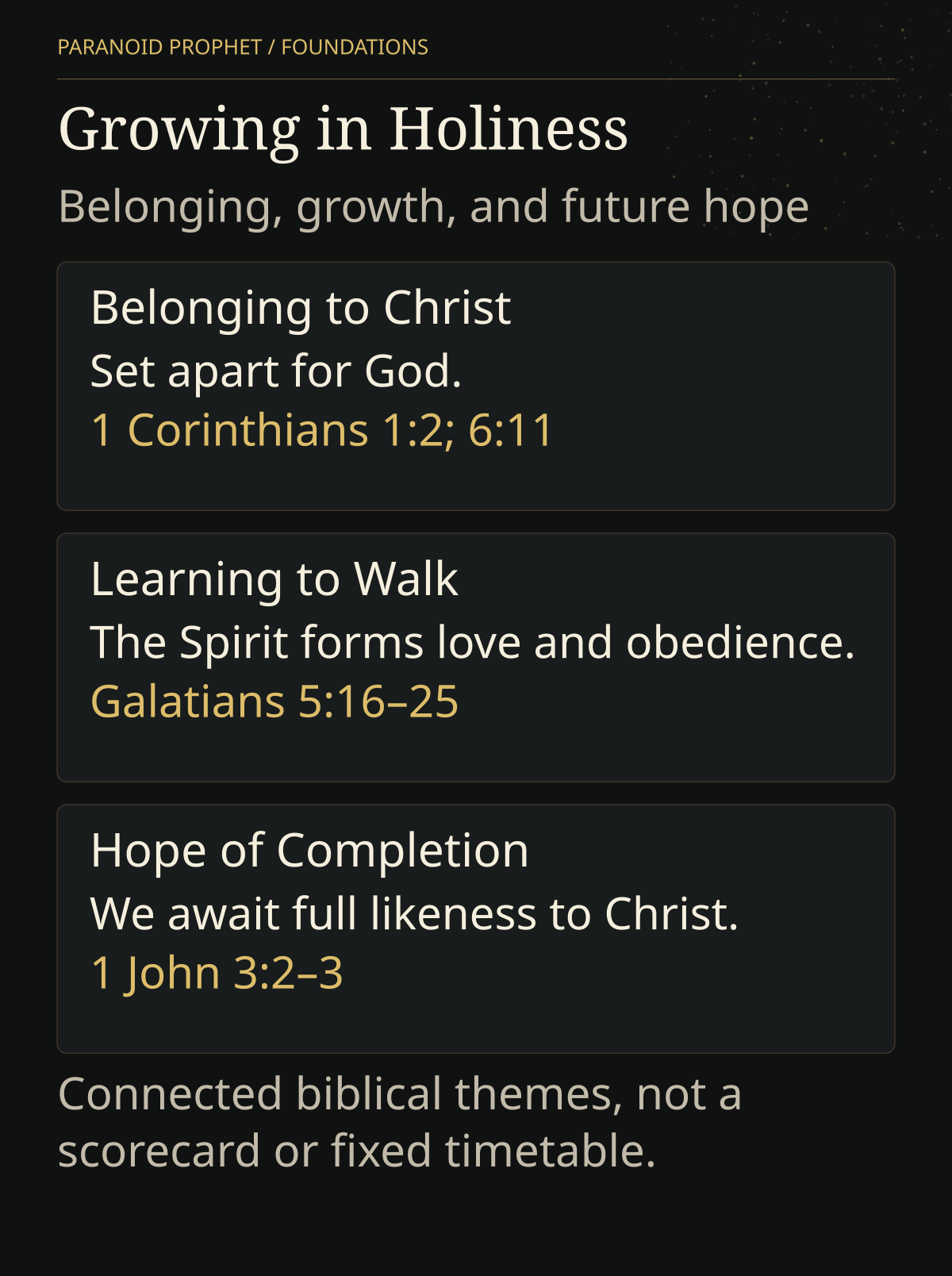
The New Testament speaks about holiness in more than one way. Keeping these uses together prevents a common misunderstanding: assuming that every reference to sanctification describes a slow improvement in behavior.
Belonging to Christ
Paul addresses the Corinthians as people sanctified in Christ, even while correcting serious failures in their congregation. In 1 Corinthians 6:11, he also speaks of their washing, sanctification, and justification as a decisive change connected with Jesus and the Spirit. Read 1 Corinthians 1:1–9 and 6:9–11.
Their moral problems are real, but Paul does not tell them to earn the right to belong to Christ by first reaching spiritual maturity. He calls them to live in keeping with the Lord to whom they belong. For more about that beginning, see What Happens When You Become a Christian?.
Learning to Walk
The same people need ongoing formation. In 1 Thessalonians 4:1–8, sanctification includes sexual holiness, self-control, and refusing to wrong another person. Paul connects the command with God’s gift of the Holy Spirit. Read the passage.
This is why Christian teaching often uses the expression progressive sanctification for continuing growth. Progress can involve learning, struggle, setbacks, and recovery. A smooth upward chart cannot capture every person’s life.
Hope of Completion
In 1 John 3:2–3, believers await likeness to Christ when He appears, and that hope calls them to purity now. Christian growth looks toward something God will bring to completion beyond our present weakness. Read 1 John 3:1–3.
Belonging, growth, and future hope are connected biblical themes. They are useful distinctions, but they do not settle every Christian disagreement about the order or timing of salvation. Nor do they assign every person a measurable spiritual level.
Growing in Holiness (image text)
Belonging, growth, and future hope
- Belonging to Christ
Set apart for God.
1 Corinthians 1:2; 6:11 - Learning to Walk
The Spirit forms love and obedience.
Galatians 5:16–25 - Hope of Completion
We await full likeness to Christ.
1 John 3:2–3
Connected biblical themes, not a scorecard or fixed timetable.
PARANOID PROPHET / FOUNDATIONS
How Is Sanctification Different From Justification?
In the Protestant framework used here, justification concerns God’s acceptance of sinners as righteous through Christ, received by faith. Sanctification concerns their being set apart and renewed in holy living. Both depend on God’s grace, and both belong to life in Christ.
That distinction matters when you fail. You cannot purchase God’s favor with a week of improved behavior. It also matters when you are tempted to treat grace as permission to remain unchanged.
Romans 6 begins with that very objection. If grace answers sin, should we keep sinning? Paul’s answer is forceful. Belonging to the crucified and risen Jesus calls believers into a new way of life. He urges them to offer themselves to God rather than remain at sin’s disposal. Read Romans 6.
Christians disagree about how justification and inward renewal relate. Catholic teaching, for example, includes sanctification and renewal within its account of justification (Catechism 1989). Those differences deserve careful attention, but they need not take over this practical guide. Our Salvation by Grace article examines faith, works, Paul, James, and the major comparisons in detail.
Is Growth God’s Work or Our Responsibility?
Philippians 2:12–13 brings God’s action and human obedience together. Paul calls the church to work out its salvation and grounds that call in God working within them. The surrounding verses concern humility, unity, obedience, and life together. This is larger than a private self-improvement project. Read Philippians 2:1–18.
God’s work gives believers reason to act. They pray, resist temptation, seek wisdom, and serve because they depend on His grace. Passive waiting for obedience to become effortless misses Paul’s instruction. Treating progress as a self-made achievement misses its source.
Galatians 5 gives this life its recognizable character. Paul describes love, joy, peace, patience, kindness, goodness, faithfulness, gentleness, and self-control as the Spirit’s fruit. The setting includes conflict, jealousy, conceit, and the practical command to serve one another. Growth should affect the way people experience our presence. Read Galatians 5:13–26.
For the broader biblical account of His work, see Who Is the Holy Spirit?. Here the practical point is simple: ask for the Spirit’s help, then attend to the obedience Scripture actually places before you.
Why Do Christians Still Struggle With Sin?
The New Testament addresses believers who face temptation, divided desires, and learned patterns of wrongdoing. Becoming a Christian does not instantly erase every habit or heal every relationship. In Galatians 5:17, Paul describes conflict between the flesh and the Spirit. His instruction is to walk by the Spirit, not to treat the conflict as a reason to surrender.
The “flesh” in this discussion is not a claim that the physical body is inherently evil. Paul’s list includes envy, rivalry, and divisions as well as bodily misconduct. Sin reaches thinking, desires, relationships, and actions. The body itself belongs in faithful service to God.
Struggle also needs careful definition. Encountering temptation or an unwanted thought is different from deliberately embracing it. A tired person may need rest; an injured person may need treatment; someone caught in a destructive pattern may need skilled help. Spiritual language should help us tell the truth about a situation rather than hide its practical needs. Our What Is Sin? guide explores these distinctions more fully.
Yet continued struggle cannot become a permanent excuse. Paul warns against the destructive practices he names. John rejects claims of sinlessness while calling people into honesty and cleansing. Together, these passages give us grounds to confess sin seriously and return to God with hope. Read 1 John 1:5–2:2.
What If You Keep Falling Into the Same Sin?
Repeated failure calls for more than another vague promise. Bring the particular pattern into the light, look honestly at the harm, and seek practical help addressing it.
Consider anger. Someone may apologize after shouting, feel relieved, and then repeat the pattern. A more serious response asks what happens before the outburst, removes excuses, accepts boundaries, and learns another way to respond. If intimidation or violence is involved, the safety of the people harmed comes first. Their protection must not depend on the offender’s account of spiritual progress.
Or consider dishonesty. Confession may require correcting a misleading impression and accepting the cost of the truth. Growth includes what you do when honesty threatens the image you want others to have of you.
The next step should fit the actual problem. It might involve restitution, accountability, changing access to a temptation, pastoral counsel, or qualified professional treatment. Prayer and appropriate treatment can belong together. This article cannot diagnose the causes of a compulsive behavior or prescribe a treatment plan.
When someone has been harmed, your desire to feel forgiven does not give you a right to demand contact or restored trust. Our Repentance and Faith guide explains confession, repair, and responsible boundaries in more detail.
If your concern has become a relentless cycle of checking whether you are truly saved, continue with Can a Christian Be Sure of Salvation?. Questions about growth should lead toward Christ and faithful action, rather than endless inspection of your feelings.
What Does Real Growth Look Like?
Growth often becomes visible in ordinary relationships. A person who once defended every mistake can listen to correction. Someone who used generosity to control others can learn to give without demanding influence. A familiar temptation can lose some of its power as healthier practices and honest relationships take root.
These examples illustrate the kind of change Scripture commends. They are not a test that allows us to declare another person’s salvation from a distance.
Ask questions that keep attention on truth and love:
- Am I becoming more honest about my actions and motives?
- Do the people affected by my behavior have room to speak safely?
- Am I learning to accept correction without immediately retaliating?
- Is my knowledge of Scripture leading to patient, concrete service?
- When I fail, do I seek repair and wise help rather than protect my image?
Look over time and listen to trustworthy people. A difficult week can conceal real growth, while an impressive public performance can conceal serious wrongdoing. Popularity, productivity, and spiritual vocabulary are unreliable substitutes for character.
The purpose of this reflection is responsible discipleship. If it becomes compulsive self-surveillance, step back and seek wise support. You do not need to score every conversation before you can rest.
Does Suffering Automatically Make Us Holy?
Hebrews 12 describes God’s fatherly discipline and the fruit it can produce. The chapter also calls weary people to endurance, peace, and holiness. It gives Christians grounds to seek God’s help through hardship. Read Hebrews 12:1–14.
That does not authorize us to identify the hidden reason for every illness, loss, or injury. Nor does it make cruelty holy because someone claims it is teaching another person a lesson.
People can respond to suffering with compassion, endurance, bitterness, fear, or a mixture that changes over time. A grieving person needs care, not a demand to produce an inspiring testimony on schedule. Christians can seek safety, justice, relief, and treatment while entrusting themselves to God.
Holiness can include receiving help. Nobody needs to remain in an abusive situation to prove that they are being sanctified.
Why Do Christian Traditions Describe Sanctification Differently?
Christians broadly affirm God’s call to holiness, dependence on grace, and the need for a life shaped by love. They differ over how renewal relates to justification, what perfection in this life means, and how grace is received and lived within the church.
Reformed teaching distinguishes justification from sanctification and describes renewal as extending through the whole person while remaining incomplete in this life. The Westminster Confession attributes that continuing growth to Christ, His Word, and His Spirit. Westminster Confession, chapter XIII.
Wesleyan teaching emphasizes sanctifying grace and the possibility of being perfected in love. The United Methodist explanation describes a heart increasingly filled with love for God and neighbor, rather than freedom from mistakes, temptation, or the possibility of failure. Related Holiness traditions use the language of entire sanctification, with differences in how they explain its experience and timing. United Methodist explanation.
Catholic teaching calls all believers to holiness and growth toward intimate union with Christ. It places that growth within sacramental life, charity, and continuing dependence on Christ’s gifts. Its account of justification and merit differs from the Protestant distinction used above. Catechism, paragraphs 2012–2016.
Orthodox teaching emphasizes sharing in God’s holiness through Christ and the Holy Spirit. This belongs within its broader account of salvation as communion with God and transformation in the life of the church. Such language does not make human beings equal to God or erase the distinction between Creator and creature. Orthodox Church in America, Holiness.
These are representative descriptions, not a complete map of every Christian community. Differences should be examined through Scripture and each tradition’s actual teaching. They should not distract us from the shared seriousness of the call to love God and our neighbors.
A Faithful Next Step
You may not be able to explain every stage of your growth. You can still bring one honest need to God, read His Word, ask for help, and act faithfully toward the person in front of you.
The closing prayer of 1 Thessalonians places believers’ holiness in the hands of the faithful God who calls them. That confidence encourages continued obedience. Read 1 Thessalonians 5:12–24.
Begin with what is clear. Tell the truth. Make the necessary apology without demanding a response. Receive correction. Serve quietly. Keep returning to Christ with the people He has given you.
For the foundation beneath this continuing life, return to What Is the Gospel?.
Sources and Translation Note
Biblical teaching is chiefly paraphrased here, with linked passages opening in the NIV for reading in context. Denominational descriptions draw on the primary church sources linked in the comparison section. Practical examples are illustrations, not accounts of named individuals or a method for determining another person’s salvation.