
You have prayed about the decision, listed the options, and asked someone you trust. The deadline is getting closer. You still do not have a voice from heaven telling you which job to take, where to live, or what to do next.
Christians can take God’s guidance seriously without treating every decision as a hidden message to decode. Scripture teaches us to trust the Father, follow Jesus, seek wisdom, and walk by the Spirit. It also gives us room to acknowledge what we do not know.
GUIDED ARTICLE EXPERIENCE
How to Discern God’s Will: A Biblical Guide to Everyday Decisions
Read along as the narration moves through the article.
Browser narration · No stored audio or site tracking
CONTINUE GUIDED TOUR
Continue where you left off.
GUIDED TOUR COMPLETE
You have reached the end of this study.
Study record saved on this device.
GUIDED TOUR
How to Discern God’s Will: A Biblical Guide to Everyday Decisions
Narrator: Paranoid Prophet Recommended Voice Native device narration
Prepare to follow the article as it is narrated.
VOICE & TOUR OPTIONS
Voice & Listening
NARRATOR
Finding a narrator…
Checking the best narrator available on this device.
Restores the site recommendations available in this browser.
Our listening picks lead when available; other voices are ranked for narration. Known novelty voices are hidden. Browser-provided voices may use an online voice service.
Screen-awake support will be checked when narration starts.
Optional: improve your device voices
Listening works with the voices already available here. Your device may offer additional free voices through its own settings.
iPhone or iPad: Settings → Accessibility → Read & Speak (or Spoken Content) → Voices → English. Look for Premium or Enhanced choices, then return here.
If offered, preview Ava or Zoe for U.S. English, or Serena or Jamie for British English. An explicit Premium or Enhanced version can improve on its compact version.
Mac: System Settings → Accessibility → Read & Speak → System voice. Open the voice list to preview or download additional choices.
Windows: Settings → Accessibility → Narrator → Add natural voices. Browser availability varies; a Narrator voice may not appear on websites. Edge may also expose online Natural voices without a model download.
Android: Open Accessibility → Text-to-speech output (the location varies by device). In the preferred engine settings, look for voice data and English choices.
Download sizes vary; some enhanced voices exceed 100 MB. This website cannot install system voices, and an installed voice appears here only if your browser exposes it.
Apple voice guide · Windows voice guide · Android voice guide
CHOOSE A NARRATOR
Recommended on this device
Our listening picks: Aaron, Martha, then Daniel, when available here. Otherwise, automatic uses the highest-ranked suitable voice. Preview alternatives or save your own choice.
Preparing the guided article experience…
RESUME GUIDED TOUR?
Continue where you left off.
GUIDED TOUR COMPLETE
You have reached the end of this study.
Article Guide13 sections
How Do Christians Discern God’s Will?
Begin with what God has revealed in Scripture. Pray for wisdom, examine your motives, seek trustworthy counsel, consider the facts and your responsibilities, and make a faithful decision with humility. A powerful feeling, a convenient opportunity, or another person’s certainty does not establish a command from God.
This guide concerns ordinary decisions. If the question involves immediate danger, urgent medical care, abuse, or a legal obligation, seek appropriate help rather than postponing safety while waiting for a sign.
For a practical starting point, use the decision questions. For uncertainty about feelings or circumstances, see peace and open doors. For a concrete example, jump to choosing between two jobs.
Start with the Will God Has Already Revealed
The Bible sometimes speaks of God’s will in connection with His purposes and rule over history. It also uses that language for the life He calls His people to live. Those meanings should not be collapsed into the idea that every event announces what God morally approves.
In 1 Thessalonians 4:1–12, Paul identifies holiness as God’s will and applies it to sexual conduct, treatment of others, love, and ordinary work. In 1 Thessalonians 5:16–22, prayer, gratitude, and testing spiritual claims belong to the church’s life in Christ.
We can be preoccupied with discovering a future location while neglecting honesty in the place we already live. A decision that depends on deception does not become faithful because the opportunity is exciting. A ministry invitation does not cancel the duty to treat people truthfully and with care.
Romans 12:1–8 connects discerning God’s will with a renewed mind, humble judgment, and service within Christ’s body. Paul addresses people being transformed by God’s mercy. Discernment grows within that larger life, rather than functioning as a technique that predicts every outcome.
For the broader account of that growth, read What Is Sanctification?. This article addresses the decisions we make while that growth is still underway.
What You Do Not Know Is Not a Failure of Faith
Some decisions involve a clear moral command. Others require choosing wisely among options Scripture does not name individually. The Bible will not supply the street address of every faithful home or the employer of every faithful worker.
Deuteronomy 29:29 distinguishes what belongs to God from what He has revealed for His people to obey. Its setting is Israel’s covenant life, not a modern career seminar. Yet it reminds readers of a basic boundary: obedience does not require possession of all God’s hidden knowledge.
There can also be genuine freedom within a biblical boundary. Addressing widows, Paul says a woman may marry someone she chooses who belongs to the Lord, while also offering his judgment about remaining unmarried. That particular instruction does not settle every relationship question, but it shows choice and spiritual responsibility together. Read 1 Corinthians 7:39–40.
You should take serious choices seriously. You do not need to pretend God has dictated your preference in order to make one. “I believe this is a wise step, and I am open to correction” can be a more honest statement than “God told me” when the evidence is ordinary judgment.
Pray for Wisdom, Then Pay Attention
James 1:2–8 invites people facing trials to ask a generous God for wisdom. The surrounding discussion concerns endurance and maturity. It does not promise that the next thought entering your head is an infallible answer.
The warning about divided trust is serious. It should not be converted into a test in which an involuntary worry or unresolved question means God refuses to help you. Bring those concerns honestly to Him. Ask for willingness to receive correction as well as help choosing a path.
A simple prayer can name the actual decision: Father, help me see what is true, desire what is good, and treat the people affected with love. Expose what I am overlooking. Give me courage to obey and humility about the outcome.
Then do the ordinary work the decision requires. Read the offer. Ask about the hours. Get the medical explanation from a qualified clinician. Learn what your proposed commitment would demand. Prayer can accompany careful investigation without making that investigation less spiritual.
For a fuller guide to prayer, including distraction and unanswered requests, see How Should Christians Pray?.
Questions to Ask Before a Significant Decision
These questions are a practical synthesis of biblical teaching. They are not a formula that produces a divine answer or guarantees success.
1. What does Scripture actually require here?
Identify any clear duties, prohibitions, or relevant principles. Read the passages in their context. A verse addressed to a particular person in a particular event should not automatically become a personalized instruction about your circumstances.
If you are unsure how to make that distinction, use How to Read the Bible in Context. The goal is to receive what the text says before deciding how it applies.
2. What is driving my preference?
Ambition, fear, resentment, love, and duty can be mixed together. Naming a motive does not always settle the decision, but it makes honest examination possible.
James 3:13–18 contrasts envy and selfish ambition with wisdom marked by humility, mercy, sincerity, and peaceable conduct. Ask how your preferred course treats people, especially those who cannot benefit you in return. An impressive spiritual explanation cannot repair a dishonest motive by itself.
3. Which responsibilities and people are affected?
Consider commitments already made, dependents, your health, your congregation, and those who will bear the consequences. An additional ministry role might be worthwhile, but it can still exceed your available time. Refusing a request is sometimes responsible stewardship of obligations you already have.
Avoid assuming that the most exhausting option must be the holiest. Also avoid using comfort as the final authority. Wisdom weighs the actual situation.
4. Who can help me see what I am missing?
Proverbs 15:22 commends counsel. Seek people who know your circumstances, can explain their reasoning, and are willing to disagree without controlling you.
For specialized questions, add relevant expertise. A pastor may help you examine moral responsibilities; a qualified professional may be needed to explain a contract, treatment, or technical risk. One person need not answer every kind of question.
5. What is a reasonable next step?
Sometimes the next step is collecting missing information. Sometimes it is declining an unethical option. Sometimes both remaining options are permissible, and you must choose between real tradeoffs.
For significant decisions, identify a reasonable decision date and a way to review what happens afterward. A trial period may help when it is genuinely available. Do not promise yourself that every choice can be undone, or rush an irreversible commitment to escape discomfort.
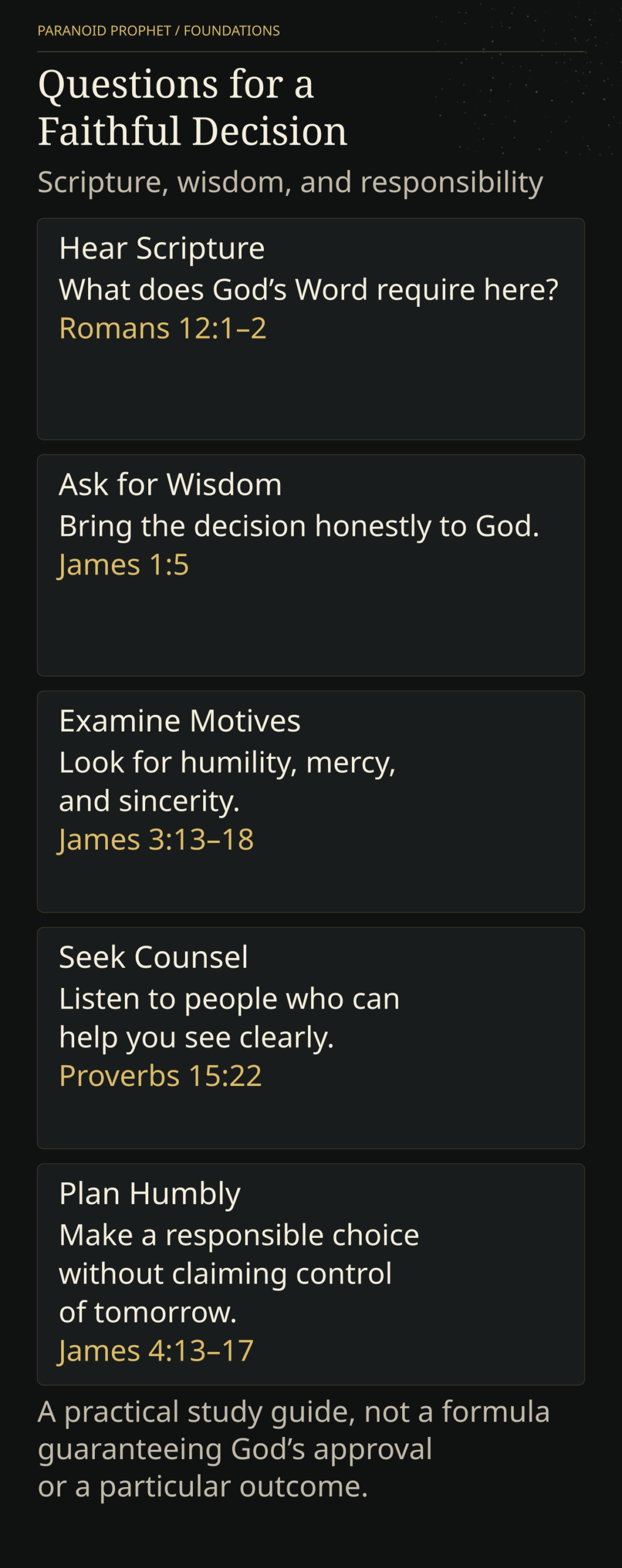
Questions for a Faithful Decision (image text)
Scripture, wisdom, and responsibility
- Hear Scripture
What does God’s Word require here?
Romans 12:1–2 - Ask for Wisdom
Bring the decision honestly to God.
James 1:5 - Examine Motives
Look for humility, mercy,
and sincerity.
James 3:13–18 - Seek Counsel
Listen to people who can
help you see clearly.
Proverbs 15:22 - Plan Humbly
Make a responsible choice
without claiming control
of tomorrow.
James 4:13–17
A practical study guide, not a formula guaranteeing God’s approval or a particular outcome.
PARANOID PROPHET / FOUNDATIONS
Does Feeling Peace Mean God Is Saying Yes?
Peace matters, but its meaning requires care. In Colossians 3:12–17, Christ’s peace appears within a passage about forgiveness, love, teaching, gratitude, and the life of one body. Paul is not giving a standalone rule that a calm feeling identifies the correct purchase or job.
Philippians 4:4–9 connects prayer with God’s guarding peace and calls believers toward what is true and good. The passage offers comfort in Christ, not a promise that emotional calm certifies every plan.
Notice your feelings without making them your only evidence. Relief may follow a wise decision. It may also follow avoiding a difficult responsibility. Fear may identify a genuine danger, or accompany an unfamiliar but responsible step. A person can trust God while still feeling anxious.
The same caution applies to open doors. An opportunity is something to assess. In 1 Corinthians 16:8–9, Paul describes a fruitful opportunity alongside substantial opposition. Ease and faithfulness are not interchangeable. Difficulty does not prove you should stay, either; it asks for discernment rather than a slogan.
How Should We Test Impressions and Claims of Guidance?
The New Testament records particular guidance, including the events in Acts 16:6–10. It would be wrong to erase those accounts. It would also be wrong to assume that every modern hunch has the authority of the guidance narrated there.
Christians disagree about the continuation and interpretation of prophecy and other gifts. Our Holy Spirit guide explains those differences. Whatever position someone holds, claiming spiritual authority is not an exemption from examination.
Paul tells the Thessalonians both to avoid contempt for prophecy and to test what they receive. 1 John 4:1–6 addresses false prophets and the truth about Jesus Christ. Its doctrinal setting matters: it is not a method for confirming every personal prediction by repeating a phrase.
Ask what is being claimed, what supports it, whether it contradicts Scripture, and whether the person permits honest testing. Distinguish a scriptural command from advice, a personal conviction, and a prediction. Those categories should not carry identical authority.
If someone says God requires you to marry them, give them money, keep abuse secret, or refuse appropriate outside help, do not let their claim replace your judgment and safety. Seek independent support. A leader’s confidence does not make coercion holy.
Conscience Deserves Care, Not Automatic Infallibility
Romans 14 deals with disputes about food and days. Paul opposes contempt and pressure, calls believers to act toward the Lord, and warns against acting against conviction. He also distinguishes between stronger and weaker understanding. Conscience matters, but it can require instruction.
That means two errors are worth avoiding. Do not bulldoze a genuine moral concern because other people are impatient. Do not assume every guilty feeling identifies an actual sin or imposes the same rule on everyone else.
Ask what the concern is about and what Scripture teaches. Talk with a trustworthy pastor or mature believer who will listen. If repeated checking and fear keep consuming your day, appropriate professional support can accompany pastoral care. You do not need to solve an anxiety pattern by making increasingly elaborate tests of God’s approval.
A Worked Example: Choosing Between Two Job Offers
Imagine two offers. One pays more but requires frequent travel. The other pays less and gives a more predictable schedule. Neither requires dishonesty. You have prayed, and you like different parts of both.

Start with facts. Compare actual pay after expenses, expectations, travel, stability, benefits, and the effect on people who depend on you. Ask questions rather than inventing an ideal version of either role.
Next, examine motives. The higher salary might provide needed stability; it might also feed a desire to impress someone. Staying nearby might honor an important responsibility; it might also reflect fear of change. Similar external choices can arise from different situations.
Bring the decision to people who understand both your life and the work. Listen especially for facts you missed. Counsel adds perspective without transferring your responsibility to the loudest adviser.
Then choose using the best information available. You can explain the decision without claiming a revelation: the travel would currently strain a serious family responsibility, so you are accepting the steadier role. Another Christian with different responsibilities might faithfully choose the traveling role.
If the chosen job later becomes difficult, investigate what changed. A bad quarter does not prove your prayer was ignored. New information may call for adjustment, perseverance, or a different decision. None of those possibilities requires pretending you had certainty you never possessed.
What If I Have Already Chosen Badly?
Name what actually happened. Did you knowingly do wrong, overlook available information, or make a reasonable decision that had a painful outcome? Those are different situations.
Where there is sin, respond with repentance and faith, honesty, and appropriate repair. Where there is a practical mistake, learn and revise what can responsibly be changed. Where the outcome was beyond your knowledge, avoid turning hindsight into proof that you should have known everything.
James 4:13–17 challenges arrogant certainty about tomorrow. It does not forbid planning. Christians can plan and act while acknowledging that their lives and outcomes depend on God.
Your confidence ultimately rests in Christ, not in a flawless history of personal decisions. For that deeper question, read Can a Christian Be Sure of Salvation?.
Common Questions About God’s Guidance
Should I ask for a sign like Gideon’s fleece?
Judges 6:36–40 describes Gideon asking for confirmation of something God had already promised. The account does not command Christians to arrange tests involving coincidences. Asking God for help is appropriate; treating an arbitrary result as binding revelation goes beyond what this story teaches.
Should I open the Bible at random for an answer?
Read the passage you encounter, but do not detach its words from their author, audience, and purpose. A command given to a biblical figure is not automatically a command for you to repeat that action. Begin with attentive reading, rather than using Scripture as a collection of fortune slips.
Can I make a decision before I feel completely certain?
Often, yes. Consider the seriousness of the choice, what information is reasonably available, and whether you can act with integrity. More time is useful when it will answer a real question. Waiting indefinitely for emotional certainty can also prevent responsible action.
Does trusting God mean I should stop reasoning?
Proverbs 3:5–7 warns against self-reliance and being wise in your own eyes. Within a book devoted to learning wisdom, that warning calls for humble, God-directed understanding. Careful thought, teachability, and dependence on God belong together.
Take the Next Faithful Step
You may finish your reflection with a clear moral obligation. You may finish with a wise preference among several permissible options. Be honest about the difference.
Keep learning from Scripture. Pray. Listen to good counsel. Care for the people affected. Make the best responsible decision you can, and remain willing to learn.
Following Jesus reaches into ordinary choices as well as dramatic moments. Faithfulness today is worth your attention even while tomorrow remains partly hidden.
Sources and Translation Note
Biblical teaching in this guide is paraphrased, with linked NIV passages for reading in context. The practical decision questions and job illustration are applications, not a quoted biblical procedure or a promise of particular results. Interpretive distinctions are explained beside the passages that support them. For this site’s approach to evidence and interpretation, see Sources and Verification.