


Fasting can sound like a practice for unusually serious Christians. Someone mentions a breakthrough, another recommends a schedule, and suddenly the question becomes how much discomfort you should be willing to endure before God takes you seriously.
That is a heavy burden to place on a person who came looking for God. Christian fasting belongs within a life of prayer, repentance, worship, and mercy. To understand it, we need to pay attention to the people Scripture addresses, the purposes it describes, and the warnings it gives. An empty plate cannot tell the whole story.
GUIDED ARTICLE EXPERIENCE
What Is Christian Fasting? Purpose, Prayer, and Wise Practice
Read along as the narration moves through the article.
Browser narration · No stored audio or site tracking
CONTINUE GUIDED TOUR
Continue where you left off.
GUIDED TOUR COMPLETE
You have reached the end of this study.
Study record saved on this device.
GUIDED TOUR
What Is Christian Fasting? Purpose, Prayer, and Wise Practice
Narrator: Paranoid Prophet Recommended Voice Native device narration
Prepare to follow the article as it is narrated.
VOICE & TOUR OPTIONS
Voice & Listening
NARRATOR
Finding a narrator…
Checking the best narrator available on this device.
Restores the site recommendations available in this browser.
Our listening picks lead when available; other voices are ranked for narration. Known novelty voices are hidden. Browser-provided voices may use an online voice service.
Screen-awake support will be checked when narration starts.
Optional: improve your device voices
Listening works with the voices already available here. Your device may offer additional free voices through its own settings.
iPhone or iPad: Settings → Accessibility → Read & Speak (or Spoken Content) → Voices → English. Look for Premium or Enhanced choices, then return here.
If offered, preview Ava or Zoe for U.S. English, or Serena or Jamie for British English. An explicit Premium or Enhanced version can improve on its compact version.
Mac: System Settings → Accessibility → Read & Speak → System voice. Open the voice list to preview or download additional choices.
Windows: Settings → Accessibility → Narrator → Add natural voices. Browser availability varies; a Narrator voice may not appear on websites. Edge may also expose online Natural voices without a model download.
Android: Open Accessibility → Text-to-speech output (the location varies by device). In the preferred engine settings, look for voice data and English choices.
Download sizes vary; some enhanced voices exceed 100 MB. This website cannot install system voices, and an installed voice appears here only if your browser exposes it.
Apple voice guide · Windows voice guide · Android voice guide
CHOOSE A NARRATOR
Recommended on this device
Our listening picks: Aaron, Martha, then Daniel, when available here. Otherwise, automatic uses the highest-ranked suitable voice. Preview alternatives or save your own choice.
Preparing the guided article experience…
RESUME GUIDED TOUR?
Continue where you left off.
GUIDED TOUR COMPLETE
You have reached the end of this study.
Article Guide11 sections
What is Christian fasting?
Christian fasting ordinarily means abstaining from food for a religious purpose, turning toward God in prayer, repentance, or earnest dependence. Christian traditions differ about its form and frequency. Some also use the word more broadly for setting aside ordinary comforts or distractions. Those practices can support devotion, though they should be distinguished from the food fasting described in many biblical passages.
Fasting does not purchase forgiveness, make God indebted to you, or establish that you are more faithful than someone who eats. Nor is involuntary hunger a spiritual assignment. Someone who cannot afford food needs nourishment and practical help.
If you are considering a food fast, read the health section first. This guide explains Christian teaching; it does not prescribe a fasting schedule.
Jump to: Health and wise boundaries · Jesus on fasting · Mercy in Isaiah 58 · Christian traditions · Common questions
Health and wise boundaries
Your body is not an obstacle you must defeat to reach God. Food restriction can be unsafe, and religious language does not remove that risk.
If you are pregnant or breastfeeding, under 18, have diabetes, are medically vulnerable, take medication affected by meals, or have a current or past eating disorder, do not begin restricting food on the strength of this article. Seek advice from an appropriate healthcare professional. For someone with an eating-disorder history, the safest participation may involve no food restriction at all. You do not need to prove devotion by putting recovery at risk.
Johns Hopkins Medicine identifies several groups for whom intermittent fasting is unsuitable, including pregnant or breastfeeding people, children, and people with eating-disorder histories. Although its article concerns a different kind of fasting, those cautions matter when religious practice involves restricting food. NIDDK also explains that skipped meals and fasting can increase low-blood-glucose risk with insulin and certain diabetes medicines.
Do not change prescribed medication, deny yourself needed hydration, or treat feeling unwell as evidence of spiritual progress. Seek medical help if symptoms arise. A pastor can help you think through a spiritual practice; that does not replace clinical advice about your health.
Church leaders should make room for private exceptions without requiring people to disclose diagnoses publicly. A congregation can pray together while its members participate differently. No one should have to choose between necessary care and belonging.
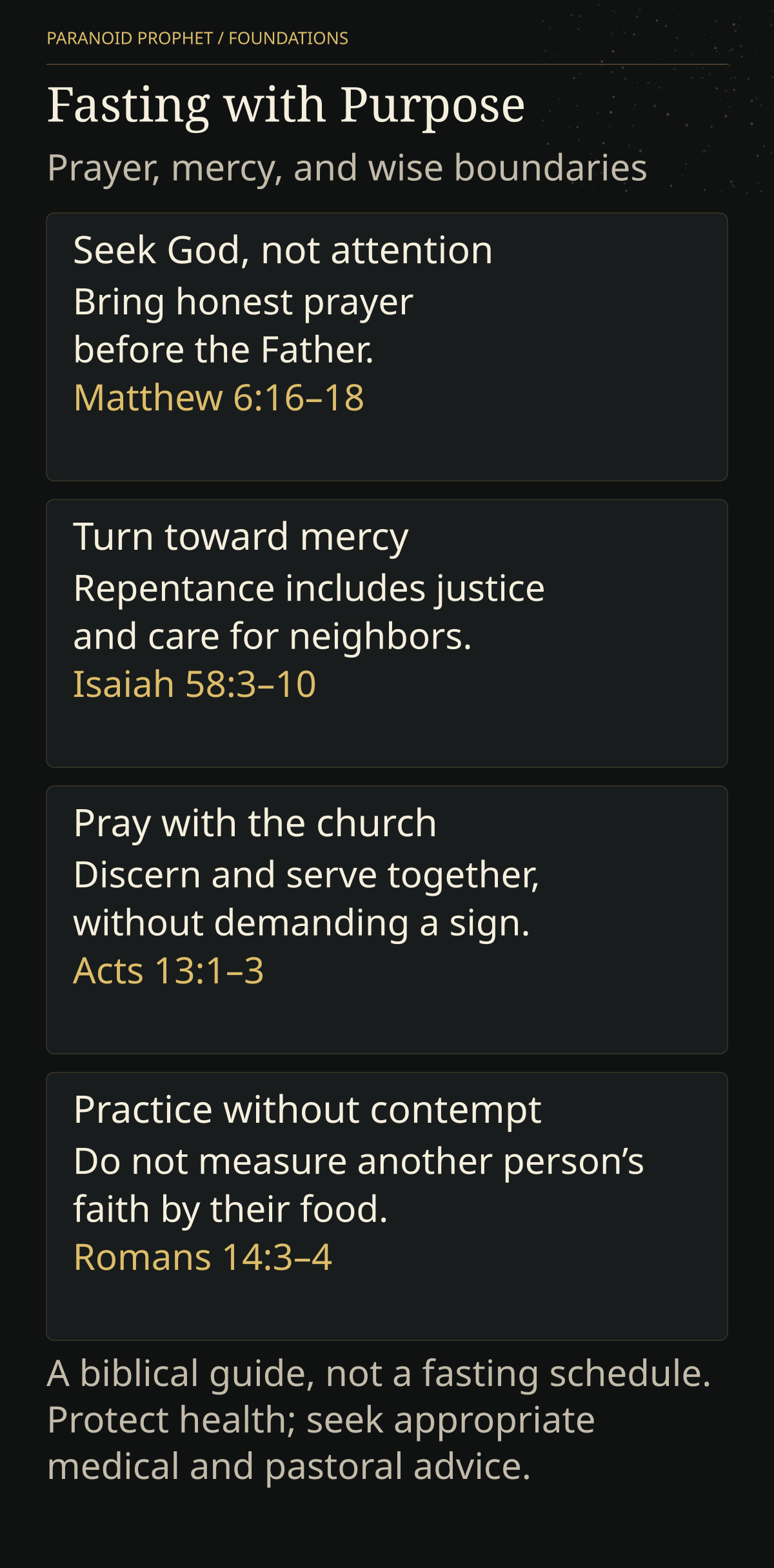
Fasting with Purpose: text version
Prayer, mercy, and wise boundaries
- Seek God, not attention
Bring honest prayer
before the Father.
Matthew 6:16–18 - Turn toward mercy
Repentance includes justice
and care for neighbors.
Isaiah 58:3–10 - Pray with the church
Discern and serve together,
without demanding a sign.
Acts 13:1–3 - Practice without contempt
Do not measure another person’s
faith by their food.
Romans 14:3–4
A biblical guide, not a fasting schedule. Protect health; seek appropriate medical and pastoral advice.
PARANOID PROPHET / FOUNDATIONS
Jesus on fasting
Matthew 6: the Father sees what an audience cannot
In Matthew 6:16–18, Jesus addresses fasting alongside other practices that can become public performances. He warns against arranging your appearance so everyone notices your deprivation. Ordinary grooming is part of his instruction because the goal is attention to the Father, rather than admiration from spectators.
That warning reaches beyond an ancient street corner. A spiritual practice can become a personal brand, a competition, or a way of making someone else feel small. Before announcing a fast, it is worth asking why an audience needs to know.
Privacy, however, does not require deception. You may need to tell a spouse, clinician, household member, or church leader. Jesus’ warning about showing off should never become an excuse to conceal unsafe restriction. Necessary communication and religious display have different purposes.
The passage promises that the Father sees and rewards. It does not identify a guaranteed job offer, healed illness, financial return, or answer on your timetable. We should resist adding those promises ourselves.
Matthew 9: fasting belongs to the story of Christ
In Matthew 9:14–17, Jesus is asked why his disciples do not fast as others do. He answers with the picture of wedding guests and a bridegroom. His presence explains their joy; he also speaks of a time when the bridegroom will be taken away and they will fast.
This places fasting within the disciples’ relationship to Jesus. It is more than a portable technique for becoming disciplined. Christian life includes joy, thanksgiving, longing, and grief, all shaped by who Christ is and what he has done.
There is room for a shared meal and room for solemn prayer. Constant deprivation is not the measure of mature faith. The question is how a practice serves faithful attention to Christ in the circumstances before you.
Repentance involves the heart
In Joel 2:12–17, God calls his people to return wholeheartedly. Fasting accompanies mourning and communal prayer. Yet the outward act does not substitute for an inward return. The passage directs attention to God’s mercy and compassion.
Joel addresses a covenant people in a particular crisis. We should not lift its summons out of that setting and turn it into a command for every reader to copy every detail. Its enduring challenge is honest repentance before God.
A person can complete an impressive religious exercise while avoiding the apology they owe, the dishonesty they need to confess, or the behavior they must change. Fasting gives no exemption from those responsibilities. For a fuller treatment of that response to God, read Repentance and Faith.
Repentance also differs from self-punishment. You do not need to make yourself miserable enough to deserve mercy. Begin with the truth about your sin and the truth about God’s character. The point is to return to him.
Mercy in Isaiah 58
Isaiah 58 confronts people who appear eager for God while exploiting workers and engaging in conflict. They ask why their fasting has gone unnoticed. God’s response exposes the contradiction between their religious activity and their treatment of other people.
The chapter turns toward freedom from oppression, sharing food, providing shelter and clothing, and refusing to abandon those who need care. Fasting cannot be separated from justice and mercy. The passage does not merely replace a bodily practice with a vague instruction to be nice. It challenges a people whose outward devotion coexists with concrete harm.
That is a searching test for any of us. Who bears the cost of my religious commitments? Am I becoming more attentive to a neighbor, or more impressed with myself? Is there an unfair practice I can stop, a hungry household I can help, or someone whose dignity I have ignored?
Isaiah’s restoration promises belong to this prophetic and covenant setting. They should not be repackaged as a guarantee that a particular fast will cure an individual illness. Read the whole chapter before turning its language into a promise to someone who is suffering.
Practical mercy need not be dramatic. Buy groceries for a household that needs them. Pay someone fairly. Correct a damaging lie. Give without making a recipient perform gratitude. Our guide to biblical giving develops the connection between generosity, responsibility, and accountable care.

Fasting and prayer with the church
In Acts 13:1–3, the church at Antioch is worshiping and fasting when the Holy Spirit directs that Barnabas and Saul be set apart. Prayer, fasting, laying on hands, and sending follow. The setting is a worshiping community preparing for mission.
This is a description of what happened, not a mechanism for manufacturing a message from God. The passage never instructs readers to fast until a private impression becomes unquestionable. It also gives no basis for someone to demand obedience by saying their own fast makes their judgment infallible.
For a church facing a serious decision, the passage encourages a posture of dependence and shared prayer. Fasting should not silence questions, bypass accountability, or pressure people into a leader’s preferred outcome.
If you are seeking direction, continue doing the ordinary work of discernment: read Scripture in context, consider your responsibilities, seek wise counsel, and examine the effects of your choices. See How to Discern God’s Will. If prayer itself feels unfamiliar, begin with How Should Christians Pray?.
How Christian traditions approach fasting
Christians broadly recognize fasting in Scripture, but they differ about calendars, obligations, permissible foods, and pastoral practice. A short overview helps prevent one community’s custom from being presented as the only Christian approach.
Catholic practice: The U.S. Conference of Catholic Bishops distinguishes fasting from abstinence and explains the Latin Catholic calendar’s obligations, including Ash Wednesday and Good Friday. Eastern Catholics follow the law of their own churches. Catholics should consult their own church’s current guidance and their pastor about individual circumstances rather than treating a general internet guide as a substitute.
Orthodox practice: The Orthodox Church in America’s explanation connects bodily fasting with prayer, almsgiving, humility, and turning from sin. It explicitly rejects fasting as punishment or payment for salvation. Orthodox practice includes substantial communal tradition; personal application belongs within pastoral care, rather than competitive imitation of someone else’s observance.
Protestant practice: There is considerable variety. Some churches observe seasons such as Lent; others emphasize voluntary fasting for particular occasions. The United Methodist Church’s explanation, for example, commends fasting or abstinence as people are able, connects it with prayer and generosity, and cautions against extremes. That is one Protestant tradition’s account, not a universal Protestant rule.
Understanding those differences does not require pretending they are unimportant. It does require describing them fairly. Ask what your church teaches, why it teaches it, and how it provides care for people whose health or circumstances require a different approach.
Fasting cannot become a spiritual ranking system
In Luke 18:9–14, Jesus describes a man who includes fasting among his reasons for feeling superior to others. The tax collector instead asks for mercy. Jesus’ verdict overturns the assumption that visible religious achievement proves a person righteous before God.
The warning is painfully recognizable. It is possible to turn almost anything into evidence that we belong nearer the front of the line. Fasting can become one more credential.
That is why the question of grace has to remain central. Christian obedience grows from dependence on God’s mercy. Our article on salvation by grace explains that foundation more fully. A discipline cannot take Christ’s place.
Romans 14:1–6 addresses disagreements about foods and days. It is not a complete manual on fasting, but its warning against contempt and judgment applies here. You do not know another person’s medical history, conscience, or private responsibilities by looking at their plate.
Common questions about Christian fasting
Is there one biblical fasting schedule everyone must follow?
The passages examined here describe different settings and purposes rather than a single schedule for every Christian. Church traditions may prescribe particular observances, but that is a further question requiring attention to their teaching and pastoral guidance.
This article offers no duration, meal plan, or progression toward more demanding fasts. A longer restriction is not proof of deeper faith. Do not imitate an exceptional biblical event as though it were an ordinary health recommendation.
What about the Daniel fast?
Daniel 10:1–3 describes Daniel mourning and abstaining from particular foods and wine. It records his circumstances; it does not command every Christian to adopt a modern program marketed under his name. Distinguish the passage from later devotional practices and commercial claims about what they will achieve.
Can I set aside social media instead of food?
Setting aside a distracting activity can create room for prayer, Scripture, and attention to others. Many Christians call this a fast in a broader sense. Being clear about that usage preserves the distinction from biblical food fasting without dismissing the value of the practice.
If food restriction is unsuitable for you, prayer, generosity, service, and wise limits on distractions remain available. You are not a second-class Christian. You also do not have to replace an unsafe practice with another punishing test of endurance.
What if I do not receive the answer I hoped for?
An unanswered request does not establish that you failed to fast intensely enough. Avoid anyone who promises a specific result and then blames your faith when it does not happen. Bring disappointment honestly to God and to trustworthy people who can support you.
Christian hope has room for grief and unresolved questions. Suffering and Christian Hope explores that reality without promising immediate relief.
A grounded next step
Before choosing a practice, name the concern you want to bring before God. Read one of the passages above in its surrounding chapter. Ask whether your intended response leaves room for humility, needed care, and practical love for other people.
If food fasting is under consideration, address health and pastoral questions before acting. If it is unsuitable, turn your attention to prayer and service without apology. You can begin by praying honestly, putting away a distraction, and helping someone whose need you already know.
There is no need to make the practice impressive. Faithfulness may be quiet, ordinary, and unseen. Let the attention you hoped to give God extend into the way you treat the person in front of you.
Sources and reading notes
Scripture links open the NIV for convenient comparison. Biblical passages are paraphrased here; the surrounding chapters should be read alongside the explanation. Denominational links describe their own traditions and are included for fair comparison, not as interchangeable authorities. Medical sources support the safety cautions only. This is Christian education, not individualized medical advice.