
The message is written, and your thumb is hovering over Send. You know it will wound someone. Or a small dishonest shortcut has started to sound reasonable because nobody will notice. Temptation often arrives inside an ordinary decision, long before it looks like a dramatic spiritual crisis.
Christians resist temptation by depending on Christ, recognizing the choice before them, and taking concrete steps toward obedience. That includes leaving avoidable situations, asking for trustworthy help, and changing habits that keep feeding the same failure. You do not have to pretend the struggle is easy. You also do not have to surrender your next choice to it.
GUIDED ARTICLE EXPERIENCE
How Can Christians Resist Temptation? Practical Help Without Shame or Excuses
Read along as the narration moves through the article.
Browser narration · No stored audio or site tracking
CONTINUE GUIDED TOUR
Continue where you left off.
GUIDED TOUR COMPLETE
You have reached the end of this study.
Study record saved on this device.
GUIDED TOUR
How Can Christians Resist Temptation? Practical Help Without Shame or Excuses
Narrator: Paranoid Prophet Recommended Voice Native device narration
Prepare to follow the article as it is narrated.
VOICE & TOUR OPTIONS
Voice & Listening
NARRATOR
Finding a narrator…
Checking the best narrator available on this device.
Restores the site recommendations available in this browser.
Our listening picks lead when available; other voices are ranked for narration. Known novelty voices are hidden. Browser-provided voices may use an online voice service.
Screen-awake support will be checked when narration starts.
Optional: improve your device voices
Listening works with the voices already available here. Your device may offer additional free voices through its own settings.
iPhone or iPad: Settings → Accessibility → Read & Speak (or Spoken Content) → Voices → English. Look for Premium or Enhanced choices, then return here.
If offered, preview Ava or Zoe for U.S. English, or Serena or Jamie for British English. An explicit Premium or Enhanced version can improve on its compact version.
Mac: System Settings → Accessibility → Read & Speak → System voice. Open the voice list to preview or download additional choices.
Windows: Settings → Accessibility → Narrator → Add natural voices. Browser availability varies; a Narrator voice may not appear on websites. Edge may also expose online Natural voices without a model download.
Android: Open Accessibility → Text-to-speech output (the location varies by device). In the preferred engine settings, look for voice data and English choices.
Download sizes vary; some enhanced voices exceed 100 MB. This website cannot install system voices, and an installed voice appears here only if your browser exposes it.
Apple voice guide · Windows voice guide · Android voice guide
CHOOSE A NARRATOR
Recommended on this device
Our listening picks: Aaron, Martha, then Daniel, when available here. Otherwise, automatic uses the highest-ranked suitable voice. Preview alternatives or save your own choice.
Preparing the guided article experience…
RESUME GUIDED TOUR?
Continue where you left off.
GUIDED TOUR COMPLETE
You have reached the end of this study.
Article Guide13 sections
What Should You Do When Temptation Is Immediate?
Pause before acting, step away from an avoidable opportunity to sin, ask God and a trustworthy person for help, and choose one concrete action that serves what is good. You may still feel the pull. Faithfulness does not require the feeling to disappear before you can act wisely.
Here is a practical sequence:
- Pause. Name the actual choice. “I am about to exaggerate this claim to make myself look better” is more useful than “I am having a bad day.”
- Step away. Close the draft, leave the conversation, or put physical distance between yourself and an avoidable opportunity. Do not keep bargaining with a situation you already know is pulling you toward harm.
- Ask for help. Pray plainly. If appropriate, call a trustworthy person before the decision, rather than waiting to explain it afterward.
- Choose the good. Correct the number, refuse to pass along the rumor, or speak truthfully without attacking. Give your attention to a useful next action.
- Review later. Once the immediate situation has passed, make one sensible change to the conditions that keep repeating.
These are pastoral applications, not a sequence quoted from one biblical passage. They are not a ritual to repeat until you feel perfectly clean or certain. If your struggle involves unwanted intrusive thoughts rather than an intended action, see the section on scrupulosity before treating every thought as a trigger you must escape.
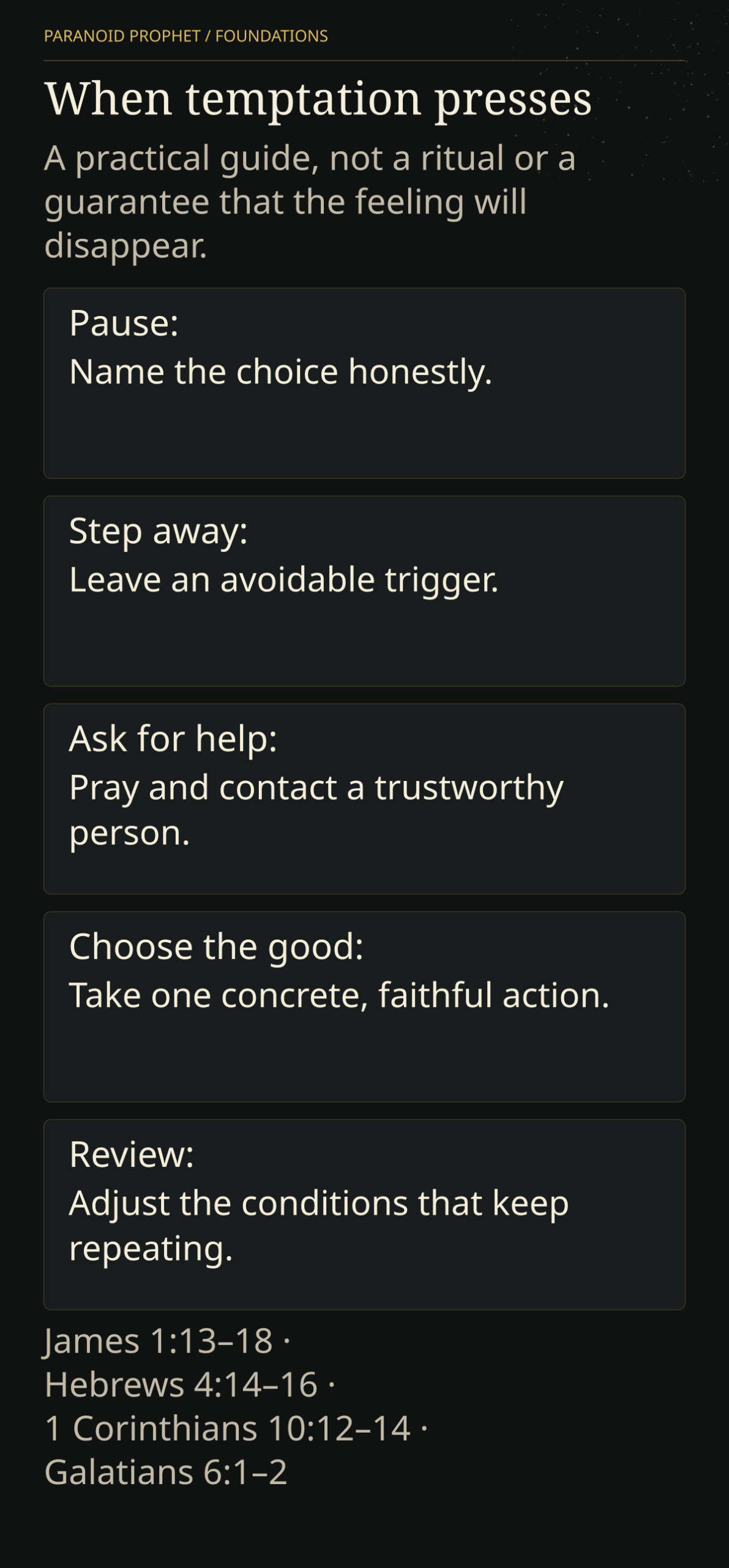
Visual Guide: When Temptation Presses
The visual guide’s full text is provided here for reading and listening:
- Pause: Name the choice honestly.
- Step away: Leave an avoidable trigger.
- Ask for help: Pray and contact a trustworthy person.
- Choose the good: Take one concrete, faithful action.
- Review: Adjust the conditions that keep repeating.
A practical guide, not a ritual or a guarantee that the feeling will disappear. Scripture connections: James 1:13–18; Hebrews 4:14–16; 1 Corinthians 10:12–14; Galatians 6:1–2.
PARANOID PROPHET / FOUNDATIONS
Is Being Tempted Already a Sin?
Being tempted does not mean you have already chosen the thing being suggested. Hebrews 4:14–16 presents Jesus as the sinless high priest who truly understands temptation. The passage invites struggling believers to approach God for mercy and timely help.
An unwanted thought appearing in your mind is different from deliberately welcoming, rehearsing, or acting on it. An intrusive image is not a reliable confession of your values. Nor does an involuntary reaction, by itself, establish what you intend.
This distinction should not become an excuse for cultivated hatred or lust. Christian traditions describe the moral status of disordered desires differently. The practical point here is narrower: do not equate an uninvited mental event with deliberate consent, and do not rename deliberate cultivation as something you had no part in choosing.
For the wider biblical meaning of wrongdoing, see What Is Sin?. This guide focuses on responding to temptation without turning every passing thought into a trial of your salvation.
What Does James Teach About Desire and Responsibility?
James 1:12–18 moves from endurance under trial to the danger of temptation. James rejects the idea that God entices people into evil. He describes desire drawing a person toward sin and sin producing death, then directs attention to God’s goodness and life-giving work.
The warning exposes a familiar escape route: blaming God, another person, or the pressure of the moment for a choice we are making. Circumstances matter, and coercion can limit a person’s freedom. Yet ordinary frustration does not make deception or cruelty inevitable.
Consider resentment after a disagreement. You cannot rewrite the conversation. You can decide whether to keep inventing accusations, recruit an audience, or approach the matter honestly. The earlier you recognize that movement, the more opportunities you have to interrupt it.
James is describing the destructive growth of sin. He is not giving a clinical account of involuntary intrusive thoughts or declaring that every disturbing thought automatically develops into an act. Use the passage to take responsibility for real choices, not to endlessly reconstruct every mental flicker.
How Did Jesus Respond to Temptation?
In Matthew 4:1–11, Jesus faces temptation in the wilderness after fasting. The offers concern hunger, a spectacular demand for protection, and authority obtained through false worship. He answers from Deuteronomy, holding to faithfulness to his Father.
The tempter also quotes Scripture. That detail matters. A biblical phrase can be used to justify presumption when it is detached from the larger witness of Scripture. Jesus refuses to turn God’s protection into permission to manufacture a crisis.
Read the episode as part of Matthew’s account of the faithful Son, not merely as a list of motivational techniques. Christians rely on the Savior who remained faithful; they are not left to reproduce his wilderness experience through sheer determination.
Practical lessons follow. Learn Scripture in context before the crisis. Question a proposal that offers a good-looking result through a dishonest means. Do not demand a dramatic sign when a clear duty is already in front of you. Jesus’ forty-day fast is not a regimen prescribed here for readers.
Our guide to reading the Bible in context explains how to avoid making a verse serve a conclusion it was never meant to support.
Does God Always Provide a Way Out?
First Corinthians 10:1–14 warns Christians through Israel’s failures. Paul challenges overconfidence, speaks of God’s faithfulness in temptation, and immediately tells his readers to flee idolatry.
The promised help is not a reason to linger near wrongdoing to test your strength. Sometimes the faithful response is an unglamorous exit: decline the arrangement, leave the gathering, stop the private exchange, or ask someone to help you follow through.
The passage also does not promise that every kind of suffering will stay within your individual capacity. “God never gives you more than you can handle” is too broad a conclusion. Paul is addressing temptation and endurance here. Needing other people, professional care, or practical protection is not evidence that you have failed his instruction.
You may need to refuse the same temptation repeatedly. Continued difficulty does not prove that God’s help was absent, and it does not make a harmful choice unavoidable. Look for the faithful action available now instead of demanding that the whole struggle end first.
What Makes the Same Temptation Keep Returning?
Repeated failures deserve more than a larger promise to try harder. Look at the circumstances you can actually change.
If every late-night argument becomes insulting, agree to pause difficult conversations when either person is exhausted and return at a specific time. If a particular group chat runs on humiliation, stop contributing and consider leaving. If you routinely alter a report to avoid embarrassment, arrange an honest review before submission.
An ordinary need can also sit underneath a damaging habit. You may be seeking rest, recognition, belonging, or relief. Naming the need can help you seek a healthier response. It does not make the damaging behavior harmless, and it does not explain every person’s situation.
Choose a modest, observable adjustment. “I will draft my response tomorrow morning” is clearer than “I will become less angry.” “I will ask someone to check the figures” is more useful than “I will never be dishonest again.”
Growth usually involves repeated practice, help, and correction. For the broader picture of life being reshaped by God’s grace, read What Is Sanctification?. This practical review is not a scorecard for earning acceptance with God.
What Does Safe Christian Accountability Look Like?
Galatians 6:1–5 calls for gentle restoration, humility about one’s own vulnerability, and shared burdens alongside personal responsibility. The person offering help is not placed above temptation.

Choose someone mature enough to listen without flattery, speak plainly without humiliation, and respect appropriate boundaries. Agree on what help is needed. That might mean a weekly conversation, a call before a difficult meeting, or practical help following through on a decision.
Healthy accountability should have a clear purpose and proportionate limits. It does not require surrendering passwords, accepting constant surveillance, or giving someone unrestricted access to your private life. Share enough to tell the truth without exposing another person’s intimate information unnecessarily. Discuss confidentiality and its safeguarding limits rather than assuming absolute secrecy.
If the issue involves abuse, exploitation, a crime, or an immediate danger, private pastoral conversation may be insufficient. Safety, appropriate reporting, and qualified help take priority over protecting a person’s reputation or a ministry’s image. Never use confession to pressure the harmed person into secrecy or continued contact.
A helpful question is, “What would make obedience more possible this week?” A harmful pattern is making someone dependent on a leader’s approval for every ordinary decision. Seek support that helps you act responsibly and remain connected to trustworthy people.
What Should You Do After You Have Already Failed?
Stop the harmful action. If someone is at risk, address safety first. Then tell the truth about what happened without turning the explanation into a defense.
First John 1:5–2:2 rejects both denial of sin and hopelessness after sin. It calls believers to confession and points to Jesus as their advocate. Forgiveness rests in Christ’s work, not in producing a sufficiently crushing emotional reaction.
A practical response can include:
- Confession: Acknowledge the actual wrong to God. Seek appropriate pastoral support without performing shame for an audience.
- Repair: Correct the false statement, return what was taken, or apologize without blaming the person you harmed.
- Protection: Change the conditions that enabled the harm. Where contact would be unsafe or unwelcome, seek qualified guidance rather than forcing an encounter.
- Follow-through: Accept reasonable consequences and obtain further help for repeated harmful or compulsive behavior.
Repentance does not entitle you to immediate restored trust. The person you hurt may need distance, and your relief cannot become their responsibility. Our guide to forgiveness and reconciliation explains that distinction.
Do not use one failure as permission to continue for the rest of the day. The next truthful decision still matters. Grace gives you reason to return rather than hide. For the relationship between turning from sin and trusting Christ, read Repentance and Faith.
When Does Self-Examination Become a Trap?
Some readers are not trying to excuse wrongdoing. They are terrified that an unwanted thought means they have committed it. More checking can become part of their distress.
The International OCD Foundation’s guide to scrupulosity describes religious or moral obsessions that can accompany OCD. Repeated confession, reassurance-seeking, and mental attempts to cancel unwanted thoughts can become compulsions. These symptoms are not a measure of spiritual seriousness.
An article cannot diagnose OCD. If these experiences consume substantial time or disrupt ordinary life, seek assessment from a qualified mental health professional familiar with OCD and scrupulosity. Pastoral support can complement that care. Do not turn this article’s steps into a mental test you must pass whenever a thought appears.
Leaving a deliberate opportunity for wrongdoing is different from avoiding ordinary life because of intrusive thoughts. If you are receiving treatment, discuss these distinctions with your clinician rather than replacing their guidance with a generic spiritual checklist.
How Can You Prepare Before the Next Difficult Moment?
Keep preparation ordinary and sustainable. Read a manageable passage in context. Pray honestly about the situation you are actually facing. Stay connected to a healthy church community. Take appropriate rest and attend to responsibilities before they become a crisis.
You might identify one recurring situation, one change you can make, and one person you can contact. Write a sentence such as, “When the conversation becomes cruel, I will stop participating and speak to someone directly if there is a real concern.” Then practice that response when the opportunity comes.
Do not make a perfect daily routine the condition for approaching God. Hebrews directs needy people toward mercy. Our guide to Christian prayer offers a grounded starting point if you struggle to know what to say.
For an optional interactive reflection, try Signal Breaker, our Christian game about resisting temptation. Its game results do not measure your faith or moral standing, and it is not a clinical intervention.
Common Questions About Resisting Temptation
Does Every Temptation Come Directly From Satan?
Scripture speaks about the devil, the world, and sinful desire. James emphasizes desire without requiring you to identify an invisible agent behind each experience. You do not need to diagnose the hidden source of a thought before choosing honesty, mercy, and self-control. See Spiritual Warfare Explained for that wider subject.
Is Removing an Opportunity a Sign of Weak Faith?
Taking an avoidable opportunity away can be a wise expression of faith. Paul’s instruction to flee idolatry gives no prize for staying close to the danger. Apply boundaries proportionately, and distinguish them from fear-driven avoidance related to intrusive thoughts.
Does Recurring Temptation Mean God Has Rejected Me?
The recurrence of a temptation is not, by itself, proof that God has rejected you. Take actual wrongdoing seriously, seek help, and look to Christ rather than treating the frequency of an unwanted experience as a verdict. For the larger question, read Can a Christian Be Sure of Salvation?.
Take the Next Faithful Step
You cannot undo a past decision by hating yourself more. You can tell the truth, receive help, repair what can responsibly be repaired, and change what happens next.
When temptation presses, look for the faithful step available to you. It may be closing the message, leaving the room, admitting the truth, or making the call. Christ’s mercy gives struggling people a place to turn, and his commands give them a direction to walk.
Scripture and Further Reading
Scripture is principally paraphrased in this article. Reading links use the New International Version; the explanations and practical examples are editorial applications rather than additional biblical commands.
- James 1:12–18: endurance, desire, responsibility, and God’s goodness.
- Matthew 4:1–11: Jesus’ wilderness temptation and faithful use of Scripture.
- Hebrews 4:14–16: the sinless high priest, mercy, and help.
- 1 Corinthians 10:1–14: warnings against overconfidence and idolatry.
- Galatians 6:1–5: gentle restoration and shared burdens.
- 1 John 1:5–2:2: confession, forgiveness, and Christ’s advocacy.
- International OCD Foundation: What Is OCD and Scrupulosity?: clinical background for the distinction between religious practice and compulsive distress.