
An offering appeal can leave you wanting to help and wondering whether you are being pressured. A church needs support. A neighbor needs groceries. Your own household has bills. Then someone promises that a donation will unlock a blessing, and an ordinary decision suddenly feels like a test of whether you trust God.
The Bible takes generosity seriously. It also takes honesty, responsibility, and the treatment of vulnerable people seriously. A faithful approach to giving should help us love God and our neighbors, handle money responsibly, and recognize claims that Scripture does not authorize.
GUIDED ARTICLE EXPERIENCE
What Does the Bible Teach About Giving? Generosity, Stewardship, and Tithing
Read along as the narration moves through the article.
Browser narration · No stored audio or site tracking
CONTINUE GUIDED TOUR
Continue where you left off.
GUIDED TOUR COMPLETE
You have reached the end of this study.
Study record saved on this device.
GUIDED TOUR
What Does the Bible Teach About Giving? Generosity, Stewardship, and Tithing
Narrator: Paranoid Prophet Recommended Voice Native device narration
Prepare to follow the article as it is narrated.
VOICE & TOUR OPTIONS
Voice & Listening
NARRATOR
Finding a narrator…
Checking the best narrator available on this device.
Restores the site recommendations available in this browser.
Our listening picks lead when available; other voices are ranked for narration. Known novelty voices are hidden. Browser-provided voices may use an online voice service.
Screen-awake support will be checked when narration starts.
Optional: improve your device voices
Listening works with the voices already available here. Your device may offer additional free voices through its own settings.
iPhone or iPad: Settings → Accessibility → Read & Speak (or Spoken Content) → Voices → English. Look for Premium or Enhanced choices, then return here.
If offered, preview Ava or Zoe for U.S. English, or Serena or Jamie for British English. An explicit Premium or Enhanced version can improve on its compact version.
Mac: System Settings → Accessibility → Read & Speak → System voice. Open the voice list to preview or download additional choices.
Windows: Settings → Accessibility → Narrator → Add natural voices. Browser availability varies; a Narrator voice may not appear on websites. Edge may also expose online Natural voices without a model download.
Android: Open Accessibility → Text-to-speech output (the location varies by device). In the preferred engine settings, look for voice data and English choices.
Download sizes vary; some enhanced voices exceed 100 MB. This website cannot install system voices, and an installed voice appears here only if your browser exposes it.
Apple voice guide · Windows voice guide · Android voice guide
CHOOSE A NARRATOR
Recommended on this device
Our listening picks: Aaron, Martha, then Daniel, when available here. Otherwise, automatic uses the highest-ranked suitable voice. Preview alternatives or save your own choice.
Preparing the guided article experience…
RESUME GUIDED TOUR?
Continue where you left off.
GUIDED TOUR COMPLETE
You have reached the end of this study.
Article Guide12 sections
What Is the Bible’s Basic Teaching About Giving?
Christians are called to give willingly and generously, support good work, and care for people in need. Gifts should reflect real circumstances and be handled honestly. Christians disagree about whether a fixed ten percent tithe remains binding, but generosity is a shared Christian responsibility.
Giving belongs within the whole life of discipleship. We receive God’s gifts, work honestly, provide care, share resources, and learn to resist greed. We cannot purchase reconciliation with God or place Him under obligation with an offering. For the foundation of Christian acceptance before God, see Salvation by Grace.
If you are deciding what to give now, begin with the practical questions below. For the percentage debate, go to Christian views of tithing. If a fundraising appeal feels coercive, read the warning signs.
Where Should You Begin With Giving?
Start with an honest picture of your situation rather than a dramatic promise made under pressure.
- Identify the need and the person or organization asking for help.
- Consider your actual resources, necessary household care, existing responsibilities, and any shared financial decisions.
- Decide what you can give willingly. A smaller gift is not an admission that you matter less.
- Ask how the gift will be used and who is responsible for it.
- Revisit the plan as your circumstances change, including when your ability to help increases.
A parent choosing between essential medicine and an emotionally charged appeal needs a different conversation from a wealthy person protecting every luxury. The same call to love applies to both, but faithful discernment requires attention to what each person actually has and whom each person is responsible to care for.
This is a biblical study, not an individualized financial plan. If debt, a financial emergency, or a complicated household situation makes the decision difficult, seek trustworthy pastoral help and appropriately qualified financial guidance. A fundraiser’s urgency should not substitute for either.
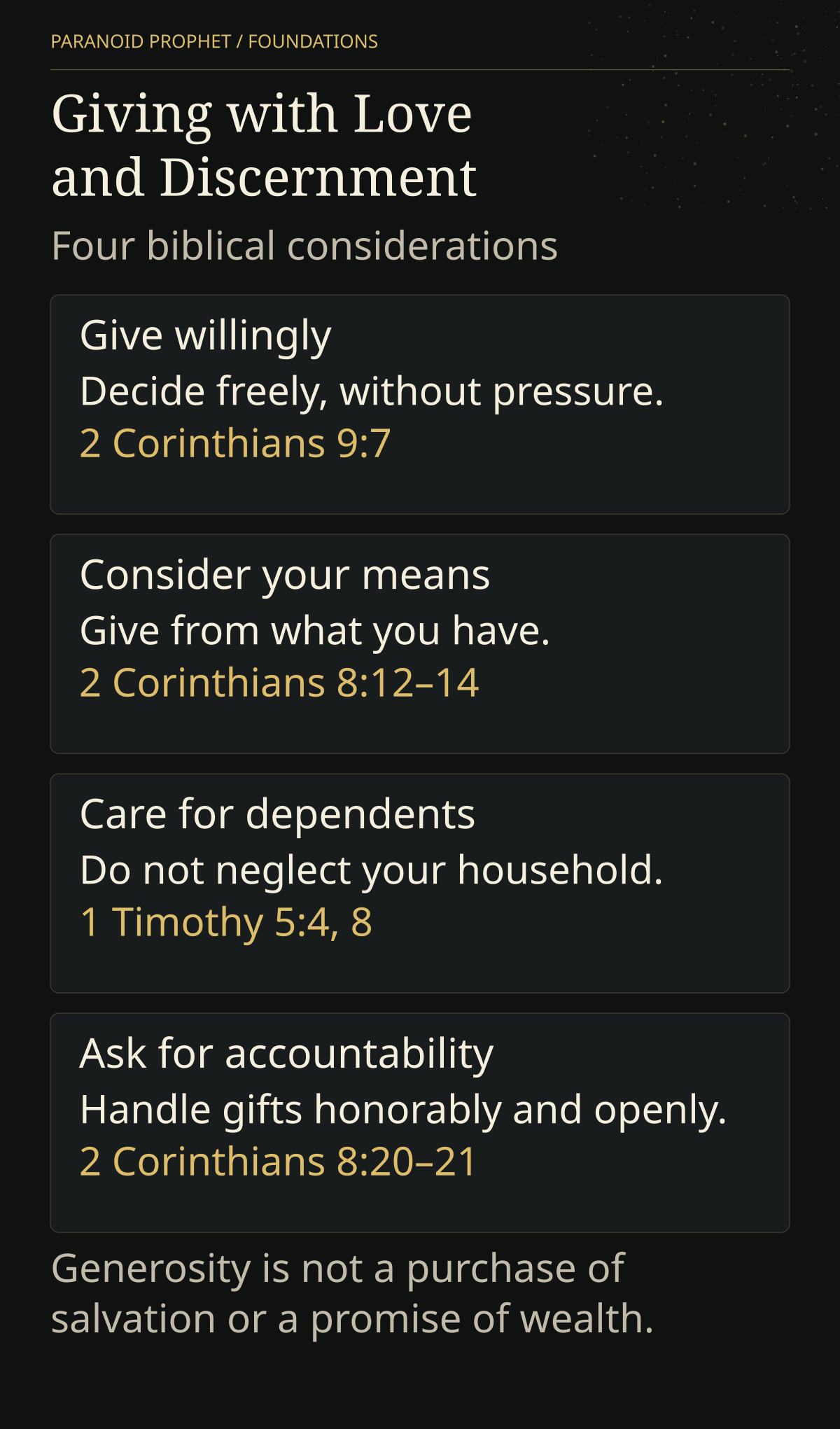
Giving with Love and Discernment (image text)
Four biblical considerations
- Give willingly
Decide freely, without pressure.
2 Corinthians 9:7 - Consider your means
Give from what you have.
2 Corinthians 8:12–14 - Care for dependents
Do not neglect your household.
1 Timothy 5:4, 8 - Ask for accountability
Handle gifts honorably and openly.
2 Corinthians 8:20–21
Generosity is not a purchase of salvation or a promise of wealth.
PARANOID PROPHET / FOUNDATIONS
Why Do Christians Give?
Christian generosity grows from gratitude for God’s grace and love for actual people. Feeding someone matters because that person is hungry. Supporting faithful teaching matters because people need to hear and understand the Gospel. Helping a family with a crisis matters even when nobody posts a photograph of the gift.
Jesus warns against performing charitable acts to gain admiration. In Matthew 6:1–4, the issue is the motive and audience of our giving. Confidential records and responsible oversight can still be appropriate; secrecy about organizational finances is not what Jesus commands.
Later in the chapter, Jesus connects treasure with the heart and warns against serving money as a master. Possessions can become a source of identity and false security. Generosity challenges that attachment, but the amount on a donation receipt cannot tell the whole story of someone’s heart. Read Matthew 6:19–24.
Our resources also include time, hospitality, skills, and attention. Those forms of service have genuine value. They should not become an excuse for a person with abundant money to refuse material help, nor should someone with little money be treated as having nothing to contribute.
What Was a Tithe in the Old Testament?
A tithe is a tenth. In the Old Testament, tithing appears within several settings that should be read carefully before applying them to a modern paycheck.
Abraham gives a tenth of the spoils after a military victory in Genesis 14:17–24. Jacob promises a tenth in the setting of his vow in Genesis 28:18–22. These passages precede the Mosaic law, but they do not themselves provide a detailed church budget policy. Their significance for Christian practice is part of the later disagreement.
Under Israel’s law, tithes were connected with produce, livestock, the support of Levites, worship, and care for people without secure provision. Numbers 18:21–32 describes support for the Levites. Deuteronomy 14:22–29 includes a worship meal and provision for Levites, foreigners, orphans, and widows.
Interpreters discuss how these instructions relate to one another and calculate Israel’s obligations differently. We should therefore resist the easy claim that Israel’s entire arrangement was simply identical to giving ten percent of a modern salary to one congregation.
The texts still teach enduring concerns: honor God, support worship and service, and make provision for people who could otherwise be overlooked. The question is how those concerns apply through Christ and the New Testament’s teaching.
Are Christians Required to Give Ten Percent?
Christians who take Scripture seriously answer this differently. The debate concerns the relationship between the covenants, the significance of pre-Mosaic examples, Jesus’ words, and the New Testament’s instructions to churches.
Some understand the tithe as a continuing obligation or a baseline for Christian giving. Others teach proportionate, generous giving without imposing a universal ten percent requirement. Recognizing the disagreement should lead to careful reading, not contempt for believers who reach another conclusion.
A continuing tithe or giving benchmark
Supporters of continued tithing often appeal to Abraham and Jacob, the tithe’s place in Israel, and Jesus’ words in Matthew 23:23–24. There Jesus rebukes religious leaders for neglecting justice, mercy, and faithfulness while affirming that they should not neglect the other duties either. The dispute is how that teaching, addressed before the cross within Israel’s covenant life, applies to the church.
The United Methodist explanation of tithing presents it as a minimum goal and a benchmark toward and beyond which members are encouraged to grow. It also explicitly recognizes responsibility for basic family needs.
The Seventh-day Adventist statement on tithe treats a tenth of income as belonging to God and directs its return through the church’s organized ministry. These examples show real commitments, although they do not represent every Christian who practices tithing.
Generosity without a universal percentage
Other Christians argue that the Mosaic tithe does not carry over as a fixed requirement for every believer. They emphasize the New Testament’s instructions about willingness, proportion, real need, and accountability.
Thomas Schreiner presents this position, while William Barcley offers a contrary argument for continued tithing. These are named Protestant interpreters presenting arguments, not official statements for all Protestants.
Catholic teaching likewise should not be reduced to a universal ten percent rule. Catechism 2043 states the duty to provide for the Church’s material needs according to one’s abilities; that paragraph does not prescribe a percentage.
The clear common ground is that Christian generosity involves real sacrifice, care, and responsibility. A percentage can be a useful discipline. It can also become a ceiling for someone capable of much more, or a burden imposed without regard for circumstances. Ask your congregation to explain its teaching from Scripture, and examine the argument in context.
What Does Paul Teach About Willing and Responsible Giving?
In 2 Corinthians 8–9, Paul is arranging relief for fellow believers. These chapters address a concrete collection rather than a generic promise that every donor will become wealthy.
Paul praises the Macedonian churches’ extraordinary voluntary generosity. He also says a willing gift is accepted in relation to what a person has, and explains that he is not seeking relief for others by crushing the Corinthians. His concern is mutual provision. Both sacrifice and capacity matter in 2 Corinthians 8:1–15.
Paul urges the Corinthians to complete what they had planned. Willing giving can therefore involve preparation and dependable follow-through. It need not wait for a strong feeling at the moment of collection. Yet 2 Corinthians 9:5–7 rejects grudging or compelled giving.
He also organizes accountable handling of the money. Trustworthy companions accompany the collection so its administration is honorable before God and people. Second Corinthians 8:18–21 gives no support to a leader who treats ordinary questions about funds as rebellion.
Does Giving Guarantee Wealth or Healing?
No fundraiser can promise a particular financial return, healing, promotion, or rescue from hardship in exchange for your donation on the authority of these passages.
The sowing and reaping language in 2 Corinthians 9:6–15 belongs to a discussion of generosity, provision for good work, righteousness, and thanksgiving. Paul’s focus is not a guaranteed multiplication of personal spending money. God’s provision equips generosity; it is not a contract a ministry can sell.
Malachi 3:6–12 addresses Israel’s covenant unfaithfulness, the storehouse, and blessings involving the land and its produce. Christians draw differing applications from it, but a present-day speaker cannot simply insert their own ministry’s payment link into that promise and guarantee a donor’s profit.
God can provide materially. Christians can pray for help and give thanks when it comes. We should also remember that faithful people can experience poverty, illness, and loss. A person’s hardship does not establish that they failed to donate enough. Our guide to Suffering and Christian Hope explores that distinction more fully.
What About Household Needs, Poverty, and Sacrifice?
Paul’s instruction in 1 Timothy 5:3–8 concerns family care, particularly for widows. It treats provision for one’s household as a serious Christian responsibility. The passage should not be used to shame someone whose disability, unemployment, or circumstances leave them unable to meet needs. It challenges neglect where care is owed.
Honoring family responsibilities and resisting selfishness belong together. Necessary food, shelter, and care cannot be dismissed as failures of faith. At the same time, calling every preferred purchase a necessity can conceal an unwillingness to share.
Jesus notices the widow who gives two small coins in Mark 12:38–44. Her gift exposes how little a simple comparison of donation totals reveals. The surrounding passage also condemns religious leaders who exploit widows. Readers differ about the emphasis of the scene, but it should never become a fundraising tool for extracting a vulnerable person’s last resources.
If you need help, receiving it is not a moral failure. Churches are communities of mutual care. People who give in one season may need support in another. See What Is the Church? for the larger picture of shared life.
How Can You Recognize Manipulative Fundraising?
A legitimate need can be presented honestly and urgently. The problem is using spiritual authority to remove a person’s freedom to ask questions or make a responsible decision.
Pause when an appeal includes:
- A guaranteed miracle, return, or change in God’s favor tied to a payment.
- Threats that questioning the request proves rebellion or brings a curse.
- Pressure to borrow, conceal a gift from someone who shares responsibility for the money, or neglect essential care.
- Refusal to explain who receives the money, how it is spent, or what oversight exists.
- Public ranking, humiliation, or special spiritual status based on donation size.
These are warning signs for further examination, not a verdict on every person involved. Ask for an explanation, appropriate records, and independent oversight. Healthy accountability protects donors, recipients, and honest ministry leaders.
Giving quietly to a real need can be deeply faithful. Refusing a dishonest solicitation can be responsible too. The decision should not depend on how confidently someone claims to speak for God. Our guide to Discerning God’s Will offers a broader approach to testing counsel and impressions.

Should Giving Go to a Church or Directly to People in Need?
The New Testament includes both support for those who teach and material relief for people in need. First Timothy 5:17–18 addresses support for elders who labor in teaching. The Corinthian collection supplies the needs of other believers. These responsibilities need not be forced into a competition.
Churches differ about how a tithe should be directed, and local circumstances differ too. Avoid claiming that every gift outside one institution is disobedience, or that institutional support never benefits people. Ask whether the work is faithful, whether the need is real, and whether its handling of resources is trustworthy.
Money can fund food, wages, buildings, care, and mission. Evaluate those uses thoughtfully rather than assuming that any paid staff member or building expense proves corruption. Equally, a religious label does not make spending immune from scrutiny.
A Simple Next Step
Choose one concrete act of generosity that you can undertake responsibly. It might be a planned gift, a meal, help with a practical need, or a conversation about receiving help yourself. Decide without using a promised miracle as part of the calculation.
Then review your habits over time. Are you becoming more attentive to need, more honest about your resources, and less dependent on possessions for your sense of worth? Those questions are more searching than whether a gift looked impressive.
Christian giving should make the love of God and neighbor tangible. Keep the need real, the decision willing, and the handling of money honest.
Sources and Reading Notes
Biblical teaching is primarily paraphrased; Scripture links open the NIV for reading in context. The tithing section distinguishes biblical texts from named churches’ teaching and individual interpreters’ arguments. Those sources are linked where their positions are discussed. This guide does not settle every denominational question or replace personal financial advice.
For broader context, continue with Salvation by Grace, What Is the Church?, and How to Read the Bible in Context.