


A basket of fresh eggs is one of the best parts of keeping chickens. It is also food coming straight from an animal enclosure. The brown shell and familiar hen do not make an egg free of bacteria.
This guide explains how to store fresh chicken eggs, what to do with dirt or damage, and why cleaning, refrigeration and cooking belong in the same routine. The goal is a dependable household practice, not a contest over whose eggs can sit longest on the counter.
GUIDED ARTICLE EXPERIENCE
Collecting, Cleaning & Storing Fresh Backyard Chicken Eggs
Read along as the narration moves through the article.
Private device narration · No hosted audio or tracking
CONTINUE GUIDED TOUR
Continue where you left off.
GUIDED TOUR COMPLETE
You have reached the end of this study.
Study record saved on this device.
GUIDED TOUR
Collecting, Cleaning & Storing Fresh Backyard Chicken Eggs
Narrator: Paranoid Prophet Recommended Voice Native device narration
Prepare to follow the article as it is narrated.
VOICE & TOUR OPTIONS
Voice & Listening
NARRATOR
Finding a narrator…
Checking the best narrator available on this device.
Restores the best curated narrator available on this device.
Narrator choices are curated for clear, long-form listening on this device.
Screen-awake support will be checked when narration starts.
CHOOSE A NARRATOR
Curated for this device
Choose a verified narrator for this browser, or use System Narrator. Automatic mode uses the best reliable route exposed by this device; your chosen narrator is preserved even if this device needs a temporary fallback.
Preparing the guided article experience…
RESUME GUIDED TOUR?
Continue where you left off.
GUIDED TOUR COMPLETE
You have reached the end of this study.
Article Guide13 sections
Quick Answer: Collect, Inspect and Refrigerate
Collect eggs at least once or twice daily, check every shell, and refrigerate promptly in a clean carton at 40°F or below. Discard cracked, leaking or heavily contaminated eggs. A small dry mark on an intact shell may be removed gently with a clean dry brush or cloth. Keep the collecting equipment separate from kitchen food preparation.
CDC’s backyard-poultry guidance recommends frequent collection, discarding cracked eggs, dry removal of dirt and refrigeration. Washing is a separate decision, discussed below. Neither washing nor an intact bloom makes a raw egg guaranteed safe.
Collect Often and Keep the Nests Clean
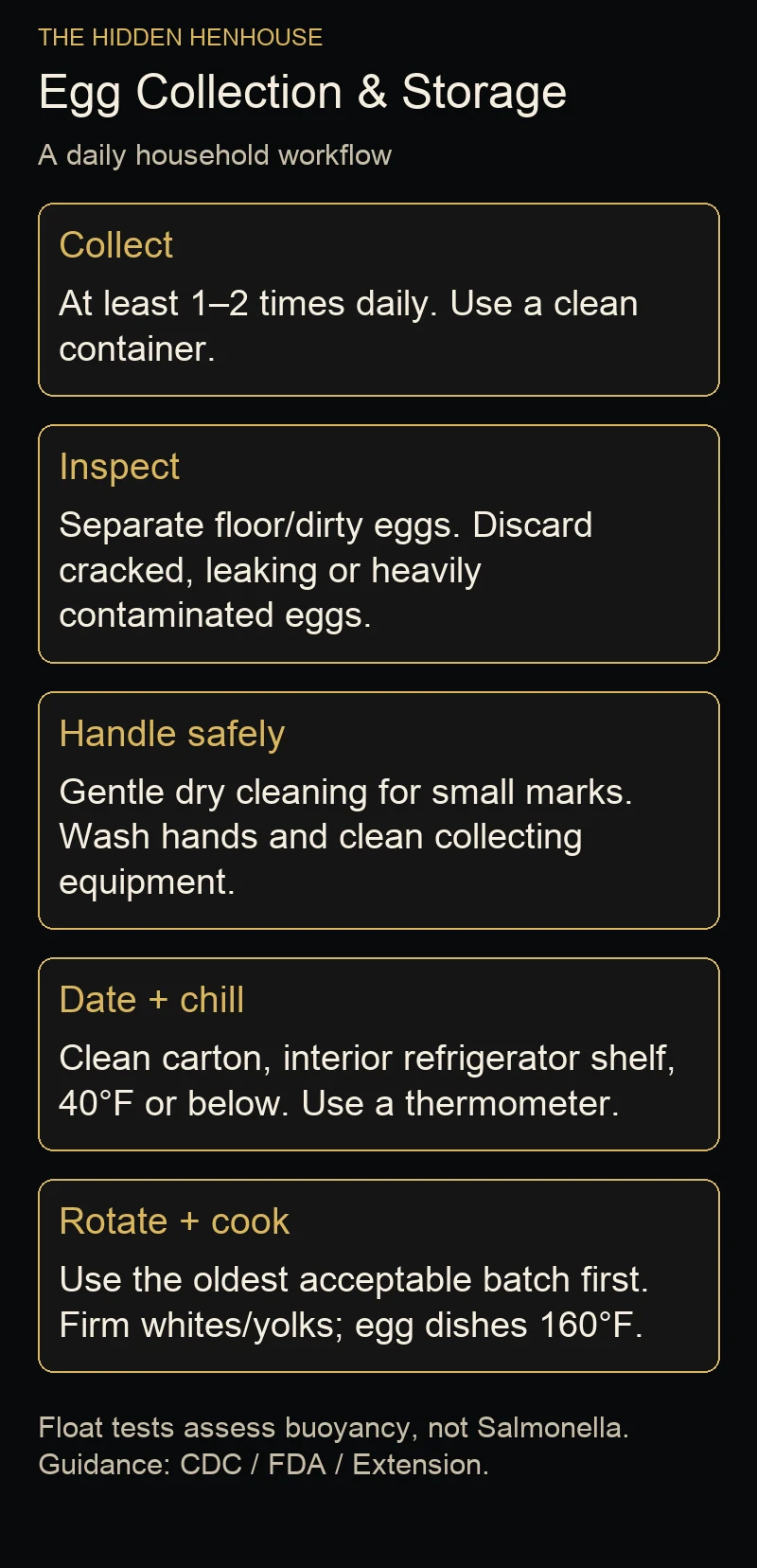
Arizona Extension’s September 2025 egg-safety guide recommends collection at least one or two times a day. Add checks when weather, broken eggs or a busy favored nest make that sensible. A collection schedule is easier to maintain than a pile of eggs whose dates nobody remembers.
Use a clean container and avoid stacking so deeply that lower eggs crack. Look at the nest as well as the egg: wet bedding, manure and shell fragments call for attention. Remove visibly dirty or damp nesting material and restore clean, dry bedding. The coop-cleaning guide covers the larger routine.
Nest design affects where eggs turn up. A sheltered, accessible box is more useful than a beautiful box the hens ignore. Sleeping in nests also makes eggs harder to keep clean. The nesting-box and roost guide addresses access and sleeping placement, rather than simply adding more bedding over manure.
Sort Eggs Before They Enter the Kitchen
- Intact and clean: date and refrigerate promptly.
- Intact with a small dry mark: gently remove the mark with a clean dry brush or cloth. If contamination cannot be removed safely, discard.
- Heavily manure-soiled or persistently wet/contaminated: discard. Do not turn a badly contaminated egg into a cleaning project.
- Cracked or leaking: discard, even if the contents look normal.
- Floor-laid or hidden: assess condition and collection history separately. A clean-looking shell does not establish how long it has been there.
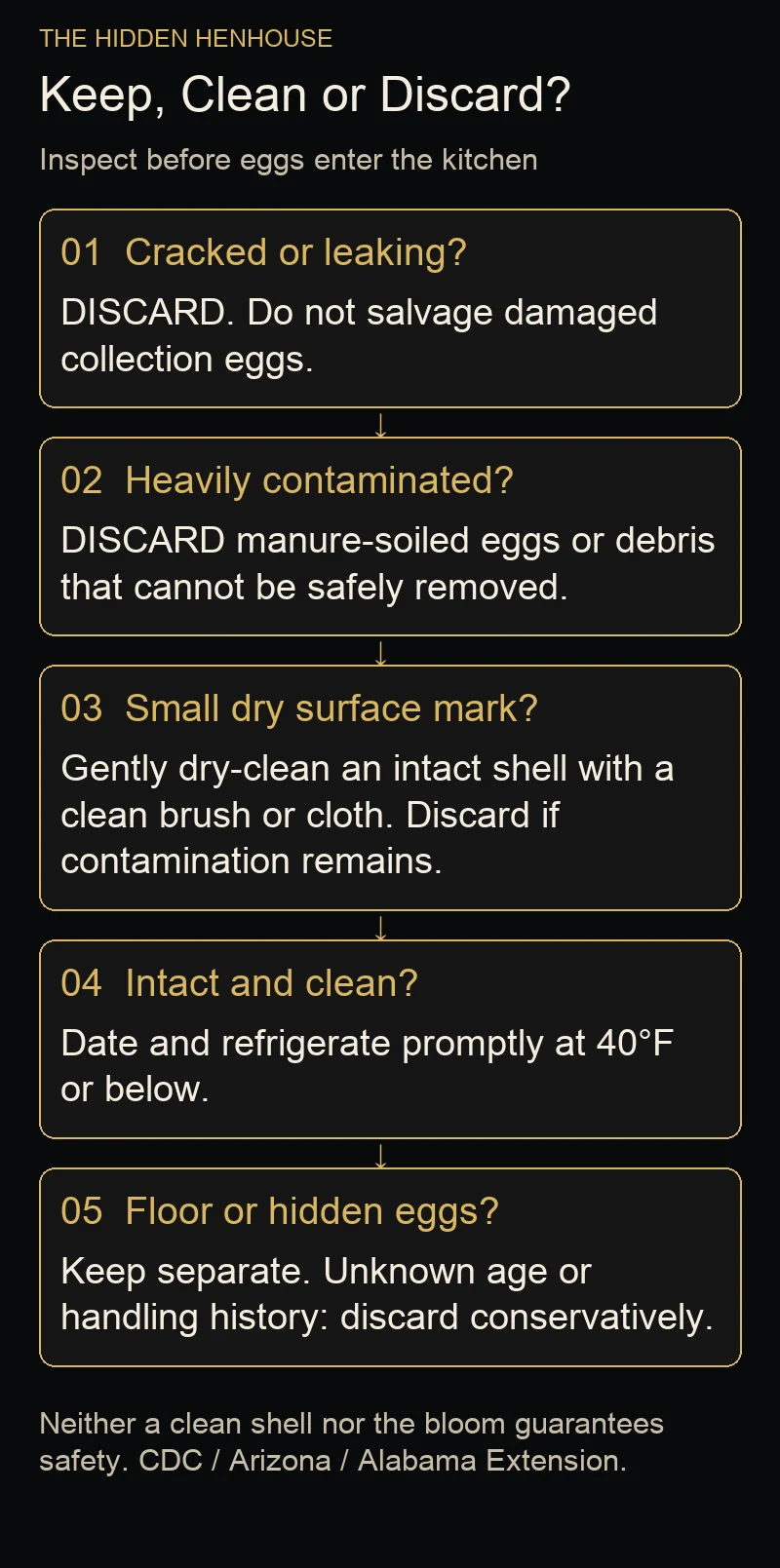
Our conservative editorial rule is to discard eggs when their age, damage or contamination history cannot be established well enough for household use. Floor location alone is not a laboratory result; neither is a reassuring appearance. An egg found in an old hidden clutch should not be treated like one observed freshly laid in a clean nest.
A crack compromises the shell barrier. Cooking is important, but this guide does not recommend using it to salvage cracked, leaking or heavily contaminated collection eggs. Keep rejected eggs away from the clean batch and wash your hands afterward.
The Bloom Helps, but It Is Not a Safety Certificate
The cuticle, often called the bloom, is a protective coating deposited on the shell. Alabama Extension’s small-flock egg-quality guide explains its antimicrobial role and the effect of water washing on that coating.
Protection is not sterility. Healthy-looking chickens can carry Salmonella, and contamination can occur on the shell or inside an egg. An unwashed shell does not remove those possibilities. Compare food quality and production systems in Backyard Eggs vs. Store-Bought Eggs; neither source of eggs justifies skipping safe handling.
Should You Wash Fresh Backyard Eggs?
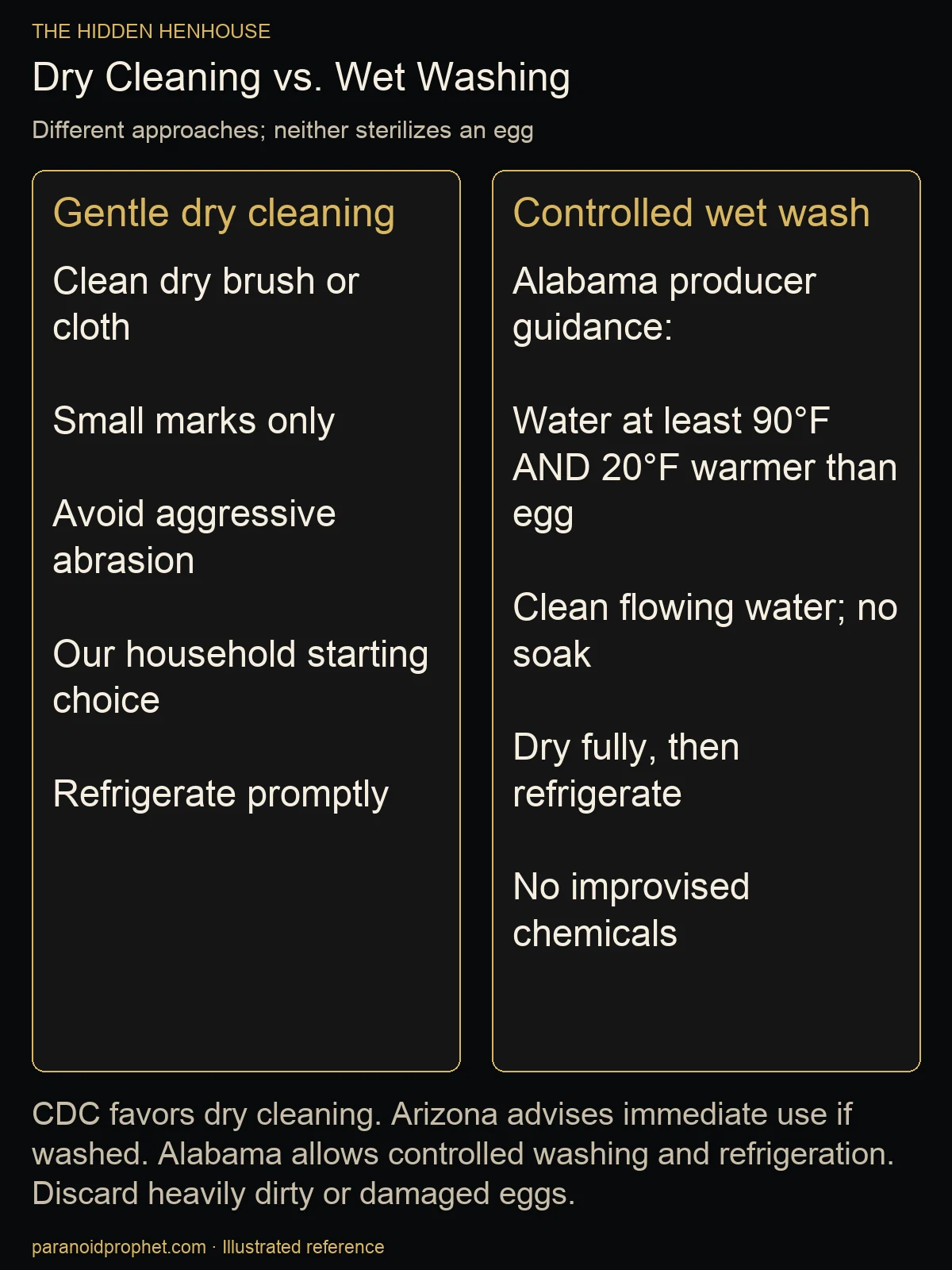
The authoritative guidance is not identical. CDC favors careful dry cleaning and warns against washing warm fresh eggs with cold water. Arizona advises avoiding washing and using a washed egg immediately. Alabama’s producer guidance describes properly controlled washing followed by drying and refrigeration. These are different handling approaches, not evidence that every wash is dangerous or that every wash makes eggs safer.
For a small household collection, our preferred starting routine is clean nests, frequent collection, gentle dry cleaning only where needed, and prompt refrigeration. That reduces the need for a washing process you may not be equipped to control. If wet washing is required for your market or chosen handling system, use current Extension and applicable regulatory guidance for that process.
Dry cleaning
Use a clean, dry brush or cloth on a small surface mark. Work gently; do not scour the shell aggressively or spread debris over the other eggs. Dry cleaning removes visible material. It does not disinfect the contents or establish that a shell is pathogen-free.
Controlled wet washing
Alabama’s guidance calls for water warmer than the egg, rather than a cold bath. Its 2025 washing-to-cooking guide specifies wash water at least 90°F and at least 20°F warmer than the egg. Both conditions apply: 90°F water is not sufficient for an egg already at 85°F.
Use clean flowing water rather than soaking a batch together. Cold water around a warm egg can favor movement of contamination inward through shell pores; soaking can spread contamination between eggs. Dry eggs fully before putting them into a clean carton and refrigerate promptly. Do not use household detergent, an improvised bleach recipe or an unlabeled cleaning product on eggs.
Those producer-process temperatures are not instructions to take refrigerated eggs out for hours to prepare a wash. Avoid cycling eggs between cold storage and the counter. If you cannot meet a controlled process, discard the contaminated egg rather than improvising.
Refrigerator Storage, Dates and Rotation
Use a refrigerator thermometer. A temperature dial labeled “cold” cannot tell you the actual temperature. FDA’s household egg-safety guidance uses 40°F or below. Store cartons on an interior shelf rather than the door, where temperatures fluctuate.
Use a clean carton and record the collection date. Keep batches identifiable and use the oldest acceptable eggs first. Do not combine new eggs with a mixed-age carton whose date has become a guess. A reusable collecting basket can be cleaned; a dirty absorbent carton should not be assumed easy to disinfect.
How long do refrigerated backyard eggs last?
Published limits answer different questions. FDA recommends using purchased shell eggs within three weeks for best quality. Arizona describes two to three months for unwashed refrigerated backyard eggs and a storage limit of 45°F. That longer interval is not a guarantee for every household’s collection history, shell condition or refrigerator.
We use the stricter 40°F household target and recommend regular rotation rather than building a months-long reserve. FDA’s three-week best-quality advice is useful planning context, not a freshly laid egg’s universal expiration date. Discard eggs with uncertain handling, damaged shells, spoilage or unacceptable contamination. A date alone cannot certify safety.
Can unwashed eggs stay on the counter?
This guide recommends refrigeration promptly after collection, including unwashed eggs. The bloom does not make indefinite countertop storage safe. Once eggs are refrigerated, keep them refrigerated rather than repeatedly moving them in and out for display. Condensation and warmer holding conditions add handling problems without helping the household routine.
Freshness Tests Do Not Test for Salmonella
USDA explains that an egg floats when its air cell becomes large enough to make it buoyant. That is a quality clue. It does not measure bacteria.
A sinking egg is not proof of safety, and a floating egg is not automatically proof of contamination. Smell and appearance can reveal spoilage after cracking, but a normal smell does not rule out Salmonella. Use known collection and storage history, shell inspection and safe cooking, rather than a bowl of water as permission to eat an uncertain egg.
When Children Help Collect
Egg collection inside poultry living or roaming areas is a job for capable children age five or older, with adult supervision and handwashing afterward. Keep children under five out of those areas and do not let them handle the birds. They can help with a clean egg-count chart away from poultry and their equipment.
Supervision does not remove the under-five boundary. CDC guidance covers both bird contact and the places where poultry live and roam. For age-appropriate household roles, see our chickens-and-children guide.
Cook Eggs Safely, Especially for Higher-Risk Eaters
Cook shell eggs until whites and yolks are firm, and cook egg dishes to 160°F, checking with a food thermometer. For recipes served raw or undercooked, use commercially pasteurized shell eggs or pasteurized egg products. A backyard origin is not a substitute for pasteurization.
Pregnancy, young age, older age and weakened immunity make careful preparation especially important. FDA’s pregnancy food-safety guidance explains the pasteurized alternatives. Clean hands, utensils and work surfaces after raw-egg contact, and keep raw eggs away from ready-to-eat food.
Refrigerate cooked egg dishes promptly. FDA advises no more than two hours unrefrigerated, or one hour when temperatures exceed 90°F. Sharing breakfast outdoors does not suspend that rule.
Sharing or Selling Surplus Eggs
Our household has shared surplus eggs, and generosity brings a practical obligation: pass along eggs with a known history and a clear keep-refrigerated message. Do not give away the eggs you would reject for your own kitchen.
Selling adds legal requirements that differ by jurisdiction and sales channel. This food-handling guide does not establish your local exemption, labeling or licensing rules. Use the surplus-egg selling guide as an orientation and verify current rules with the responsible local or state authority before selling.
Frequently Asked Questions
Should I refrigerate eggs if I have not washed them?
Yes. Prompt refrigeration at 40°F or below is our conservative household recommendation. An intact cuticle does not guarantee freedom from pathogens.
Can I wash a heavily manure-covered egg clean?
Discard it. Alabama’s guidance excludes very dirty eggs from consumption; washing can spread substantial contamination.
Does a soft shell mean the egg only needs extra calcium?
No. Nutrition is one possibility, but age, illness and reproductive problems can also matter. Persistent abnormal eggs deserve assessment. If a hen is straining or unwell, see the egg-binding warning-sign guide and contact a poultry-capable veterinarian.
What if I am collecting fewer eggs?
Check for hidden or broken eggs as well as a production change. Why Chickens Stop Laying Eggs separates those problems without treating every empty nest as disease.
Care That Reaches the Table
Good stewardship continues after the egg leaves the nest. Clean housing, honest dates and safe handling protect the people who receive the flock’s food. The satisfying part is still there: a useful gift from birds in an ordinary backyard, handled with the care it deserves.
Sources and Handling Scope
Sources checked October 8, 2026. This is conservative household guidance for newly collected backyard eggs, not a commercial egg-washing protocol or jurisdiction-specific sales advice.
- CDC: Backyard Poultry, July 2025.
- Arizona Extension: Egg Safety for Backyard Chicken Owners, September 2025. Its washing/storage advice is distinguished above.
- Alabama Extension: Enhancing Egg Quality and Safety in Small Flocks, reviewed April 2022.
- Alabama Extension: From Washing to Cooking, 2025.
- FDA: What You Need to Know About Egg Safety; household storage and preparation.
- USDA: What It Means When an Egg Floats, updated November 2024.