
Someone says, “You need to forgive,” and suddenly the conversation shifts away from what happened. You are expected to stop hurting, restore the relationship, and prove that everything is fine. Scripture calls Christians to forgive, but those are several different demands. They need to be examined separately.
Christian forgiveness grows from the mercy God gives us in Christ. It calls us away from personal revenge and toward mercy, truthful repentance, and peace. Taking that call seriously also means taking harm seriously. Forgiveness does not make someone trustworthy, remove the need for protection, or give an offender the right to control another person’s recovery.
GUIDED ARTICLE EXPERIENCE
Christian Forgiveness and Reconciliation: Trust, Boundaries, and Grace
Read along as the narration moves through the article.
Browser narration · No stored audio or site tracking
CONTINUE GUIDED TOUR
Continue where you left off.
GUIDED TOUR COMPLETE
You have reached the end of this study.
Study record saved on this device.
GUIDED TOUR
Christian Forgiveness and Reconciliation: Trust, Boundaries, and Grace
Narrator: Paranoid Prophet Recommended Voice Native device narration
Prepare to follow the article as it is narrated.
VOICE & TOUR OPTIONS
Voice & Listening
NARRATOR
Finding a narrator…
Checking the best narrator available on this device.
Restores the site recommendations available in this browser.
Our listening picks lead when available; other voices are ranked for narration. Known novelty voices are hidden. Browser-provided voices may use an online voice service.
Screen-awake support will be checked when narration starts.
Optional: improve your device voices
Listening works with the voices already available here. Your device may offer additional free voices through its own settings.
iPhone or iPad: Settings → Accessibility → Read & Speak (or Spoken Content) → Voices → English. Look for Premium or Enhanced choices, then return here.
If offered, preview Ava or Zoe for U.S. English, or Serena or Jamie for British English. An explicit Premium or Enhanced version can improve on its compact version.
Mac: System Settings → Accessibility → Read & Speak → System voice. Open the voice list to preview or download additional choices.
Windows: Settings → Accessibility → Narrator → Add natural voices. Browser availability varies; a Narrator voice may not appear on websites. Edge may also expose online Natural voices without a model download.
Android: Open Accessibility → Text-to-speech output (the location varies by device). In the preferred engine settings, look for voice data and English choices.
Download sizes vary; some enhanced voices exceed 100 MB. This website cannot install system voices, and an installed voice appears here only if your browser exposes it.
Apple voice guide · Windows voice guide · Android voice guide
CHOOSE A NARRATOR
Recommended on this device
Our listening picks: Aaron, Martha, then Daniel, when available here. Otherwise, automatic uses the highest-ranked suitable voice. Preview alternatives or save your own choice.
Preparing the guided article experience…
RESUME GUIDED TOUR?
Continue where you left off.
GUIDED TOUR COMPLETE
You have reached the end of this study.
Article Guide11 sections
What Does Christian Forgiveness Mean?
Christian forgiveness means responding to wrongdoing with the mercy we have received from God, relinquishing personal vengeance and refusing to make another person’s suffering our goal. Reconciliation concerns the repair of a relationship. Trust concerns whether someone can responsibly be relied upon. These belong together, but they are not interchangeable.
Paul grounds forgiveness in God’s action toward us through Christ in Ephesians 4:25–32. In the same passage, he calls believers to truthful speech, changed conduct, and an end to destructive behavior. Mercy is part of a renewed life in which wrong is named and people are treated with care.
Christians differ over whether the word forgiveness should describe the release of personal resentment before an offender repents, or whether interpersonal forgiveness should be distinguished from that readiness to forgive. We will examine the relevant passages below. Neither approach should be used to excuse retaliation, demand secrecy, or require unsafe contact.
Need a particular answer? Go directly to forgiveness and trust, an unrepentant offender, abuse and safety, or what to do when you caused the harm.
Where Can You Begin When Someone Has Hurt You?
Start with the situation you actually face. An insensitive remark, a serious betrayal, and a pattern of coercive abuse require different responses. Calling all three “relationship conflict” can conceal important differences in responsibility and danger.
- Name the wrong accurately. Avoid exaggerating, but also avoid shrinking serious harm into a misunderstanding because the truth is uncomfortable.
- Attend to immediate safety. If there is danger, seek help and protection. You do not need to resolve every question about forgiveness before doing so.
- Bring the hurt to God honestly. Grief, anger, fear, and confusion can be spoken in prayer. Ask for help resisting retaliation without pretending the harm was small.
- Choose a responsible next step. Depending on the circumstances, that could mean a conversation, a boundary, qualified support, reporting a crime, or no direct contact.
- Allow time for discernment. Someone else’s urgency does not establish that trust has been repaired.
These are practical applications rather than a biblical five-step formula. The aim is to respond truthfully and faithfully, with support where it is needed. For help beginning that conversation with God, see How Should Christians Pray?.
Forgiveness, Reconciliation, and Trust
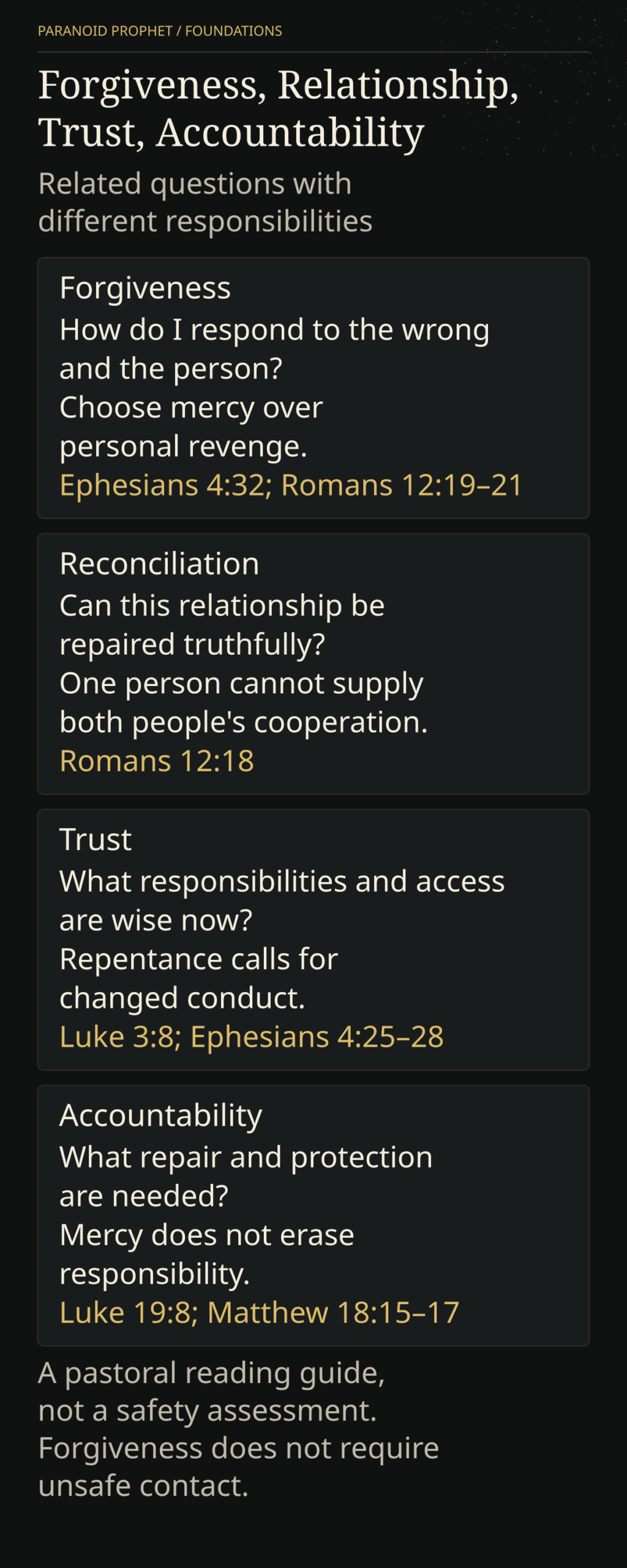
A person can sincerely seek another’s good while recognizing that they should not share a home, bank account, ministry role, or private conversation. Distinguishing these questions makes mercy more concrete.
Forgiveness asks how we respond to the wrong and the person who committed it. We give up making private revenge our project. Where repentance is expressed, we should be willing to forgive rather than keep someone permanently beneath a debt we use to control them.
Reconciliation asks whether the relationship can be repaired. A truthful restoration requires participation from both sides. One person cannot supply another’s honesty, repentance, or willingness to stop causing harm. The shape of a repaired relationship may also differ from what existed before.
Trust asks what responsibilities and access are wise now. Trust should reflect what someone has demonstrated over time. A sincere apology may begin that process, but it does not instantly restore competence, reliability, or safety.
Accountability asks what must happen because of the wrongdoing. Restitution, consequences, church discipline, protective measures, or legal proceedings can remain appropriate. A victim’s personal forgiveness does not erase obligations owed to other people or to the wider community.
Paul urges peace while acknowledging its limits: he qualifies the command with whether it is possible and how much depends on the believer in Romans 12:18–21. We are responsible for our conduct. We cannot guarantee the other person’s cooperation.
Forgiveness, Relationship, Trust, Accountability (image text)
Related questions with different responsibilities
- Forgiveness
How do I respond to the wrong
and the person?
Choose mercy over
personal revenge.
Ephesians 4:32; Romans 12:19–21 - Reconciliation
Can this relationship be
repaired truthfully?
One person cannot supply
both people's cooperation.
Romans 12:18 - Trust
What responsibilities and access
are wise now?
Repentance calls for
changed conduct.
Luke 3:8; Ephesians 4:25–28 - Accountability
What repair and protection
are needed?
Mercy does not erase
responsibility.
Luke 19:8; Matthew 18:15–17
A pastoral reading guide, not a safety assessment. Forgiveness does not require unsafe contact.
PARANOID PROPHET / FOUNDATIONS
Why Does Jesus Speak So Strongly About Forgiveness?
In Matthew 18:21–35, Peter asks how often he must forgive a brother. Jesus answers by refusing Peter’s attempt to set a manageable limit, then tells of a servant released from an enormous debt who harshly refuses mercy to another servant.
The contrast exposes a heart that wants mercy from above while withholding it below. Jesus’ warning is severe. Receiving God’s forgiveness cannot become permission to cultivate cruelty toward others.
The wider chapter also includes confronting sin and responding when a person refuses to listen. Forgiveness and accountability therefore belong in the same conversation. Jesus is not requiring the community to pretend wrongdoing has stopped.
In Matthew 6:9–15, the prayer for forgiveness is joined to forgiving others. We should neither erase the warning nor turn it into a demand for instantly calm emotions. A settled refusal of mercy is different from struggling through grief while asking God for help.
Our ability to forgive does not purchase the cross. The Christian life begins with God’s mercy and is meant to be shaped by it. Read Salvation by Grace for the fuller relationship between grace, faith, and obedience.
What If the Other Person Does Not Repent?
Two passages deserve to be heard together. Luke 17:3–4 joins rebuke, repentance, and repeated forgiveness. Mark 11:25 tells people praying to forgive what they hold against others, without describing an apology first.
Some Christians speak of forgiveness as an inward release of personal vengeance that can begin without the offender’s participation. Others distinguish that merciful disposition from the interpersonal forgiveness offered in response to repentance. This is a genuine question about how to relate the texts, not proof that one group takes sin seriously and another does not.
The practical obligations remain substantial. We must resist revenge, pray honestly, and remain willing to receive genuine repentance. We must also tell the truth about an unresolved wrong. Someone’s denial does not require us to call the relationship restored.
Luke’s repeated-forgiveness instruction must not become a script an offender can recite to demand repeated access. A victim is not equipped with infallible knowledge of another person’s heart. In serious situations, appropriate safeguards and independent accountability remain necessary while a claim of repentance is assessed.
When an offender has died, disappeared, or refuses contact, a restored relationship may be impossible. You can still bring your grief and anger to God and seek help living without revenge as your organizing purpose. No ritual of contacting the offender, their relatives, or their grave is required by these passages.
Does Forgiveness Mean Forgetting?
Memory serves important purposes. Remembering a betrayal can inform a wise boundary. A survivor may also experience painful memories involuntarily. Neither situation, by itself, proves a refusal to forgive.
In Ephesians 4:26–32, Paul addresses anger, harmful speech, bitterness, kindness, and forgiveness together. His concern reaches beyond a passing feeling to the way anger is handled and allowed to shape conduct.
It is worth asking: Am I seeking truth and protection, or rehearsing plans to humiliate? Am I using the past to address a real unresolved pattern, or to punish someone whenever I want an advantage? These questions invite honest reflection. They should not become a test administered to a wounded person by the person who hurt them.
Returning pain does not mean you have failed to complete forgiveness correctly. You may need to bring the same grief to God again, talk with trusted support, and maintain the same wise boundary. For the broader question of gradual Christian growth, see What Is Sanctification?.
What Changes When Abuse or Serious Harm Is Involved?
Abuse involves patterns or acts of harm that require more than ordinary conflict advice. Spiritual language can itself become a tool of coercion when someone demands secrecy, access, or submission in the name of forgiveness.
You do not have to meet an unsafe person alone, return to an unsafe home, or withdraw a truthful report to demonstrate Christian mercy. A call to forgive must never become a threat against someone seeking protection.
The private-conversation instruction in Matthew 18:15–17 addresses dealing with sin within the community. It should not be imposed as a prerequisite to reporting abuse or crime, or as an obligation to confront a dangerous person without help. Church processes do not replace appropriate safeguarding or civil investigation.
If you face immediate danger, contact local emergency services when it is safe to do so. If you are experiencing relationship abuse, a specialist advocate can help you consider your situation and make a safety plan. In the United States, the National Domestic Violence Hotline’s safety-planning resources offer a starting point. Use a safer device if you are concerned your browsing is being monitored.
Trusted pastoral support can matter deeply, but choose people who take the harm seriously and recognize when specialist help is needed. A leader with a conflict of interest should not control the entire response. Our guide to the church discusses accountable leadership and healthy community.
This article provides biblical teaching and general guidance. It cannot determine whether a particular relationship is safe or replace professional safeguarding, legal, or mental-health support.
What Does Repentance Look Like When Trust Has Been Broken?
Repentance gives wrongdoing its proper name and turns toward a different way of living. It goes beyond regretting exposure or asking the injured person to stop being upset. Our Repentance and Faith guide explains that response more fully.
Look for responsibility that does not depend on immediate rewards. A person seeking repair should be willing to acknowledge specific conduct, stop it, accept appropriate consequences, and make restitution where possible. Pressure for instant closeness is a reason for caution, not evidence of spiritual maturity.
Luke 19:1–10 places Zacchaeus’s commitment to restitution within his encounter with Jesus. The story gives repair moral substance. It does not provide a universal payment schedule for every injury or suggest that money can restore everything that was lost.
Consider an ordinary, non-abusive example: a friend spreads a false story. Repair may include admitting what was said, correcting it with the same audience, and respecting your need for time. You may eventually resume friendship while choosing not to share sensitive information yet. Forgiveness, public correction, and cautious trust can coexist.
Even genuine repentance does not guarantee restoration to every previous role. Some responsibilities involve the safety of people who were not parties to the apology. Forgiveness should never be used to bypass the requirements for a position of trust.

What If You Are the Person Who Caused the Harm?
Start with responsibility rather than a request for reassurance. “I lied about you” is clearer than “Mistakes were made.” Describe your conduct without blaming the person you hurt for making you do it.
An apology should leave room for the other person’s reality. Listen if they choose to speak. Do not insist they meet you, comfort you, keep your behavior secret, or provide a quick verdict on your repentance. If contact would violate a boundary or protective order, do not use an apology as a reason to make it.
Seek guidance about appropriate repair. Correct falsehoods, restore what can properly be restored, and accept consequences. Where serious harm is involved, get qualified help and cooperate with appropriate safeguarding and legal processes. An offer of money or reconciliation must not become pressure to stay silent.
You can seek God’s mercy even when the consequences are lasting. The gospel offers hope to guilty people, but receiving grace does not give us ownership of someone else’s timetable. Faithful change can continue without access to the person we harmed.
How Should a Church Support Forgiveness and Restoration?
A church should make it easier to tell the truth. It should protect vulnerable people, address wrongdoing fairly, and refuse to confuse institutional reputation with the honor of Christ.
There is also a danger in making punishment permanent when a person should be received with mercy. In 2 Corinthians 2:5–11, Paul urges forgiveness, comfort, and reaffirmed love toward a person who has undergone the community’s discipline. He warns against leaving that person overwhelmed by sorrow.
The text does not identify every detail of the offense, and we should not pretend it settles every modern safeguarding decision. It does show that restoration is a serious Christian concern. Mercy should be more than a slogan while people remain permanently shamed.
These responsibilities require wisdom together: protect people, establish facts, address harm, and make room for genuine restoration where appropriate. Restoring someone to fellowship and restoring them to authority are different judgments. A church can offer care without returning a person to a role they should no longer hold.
A Next Step Toward Mercy and Truth
You do not need to solve an entire relationship today. You can identify one faithful step: tell a trusted person the truth, seek safety advice, stop a retaliatory action, ask for help praying, or take responsibility for harm you caused.
Christian forgiveness rests in the mercy of Christ and grows within a life being changed by Him. It makes room for compassion without requiring a false account of the past. It allows hope for repair while recognizing that trust, safety, and responsibility need careful attention.
Keep mercy and truth together. That gives the injured person room to heal, calls the offender to meaningful repentance, and prevents forgiveness from becoming another instrument of harm.
Sources and Translation Note
Biblical teaching above is principally paraphrased. Scripture links open the NIV for reading in context; key passages were also checked against the public-domain World English Bible. The distinctions about trust and safeguarding are pastoral applications, not a claim that Scripture supplies a modern clinical or legal procedure. The National Domestic Violence Hotline is linked for specialist safety support, not as an authority on Christian doctrine.