
Illness can make ordinary life feel unfamiliar. There are appointments to keep, questions nobody can answer yet, and nights when even a short prayer feels difficult. Then someone says, “Just have more faith.” The person who needed help has been handed another burden.
Christians should pray for healing plainly and hopefully, ask their church for support, and continue appropriate medical care. Scripture gives us reason to bring sickness to God. It gives us no permission to guarantee someone’s recovery, make them responsible for a disappointing outcome, or turn prayer into a substitute for treatment.
This guide focuses on praying with someone who is sick, understanding James 5, and making church care useful. For the broader foundations of prayer, begin with How Should Christians Pray?.
GUIDED ARTICLE EXPERIENCE
How Should Christians Pray for Healing? Faith, Medical Care, and Caring for the Sick
Read along as the narration moves through the article.
Browser narration · No stored audio or site tracking
CONTINUE GUIDED TOUR
Continue where you left off.
GUIDED TOUR COMPLETE
You have reached the end of this study.
Study record saved on this device.
GUIDED TOUR
How Should Christians Pray for Healing? Faith, Medical Care, and Caring for the Sick
Narrator: Paranoid Prophet Recommended Voice Native device narration
Prepare to follow the article as it is narrated.
VOICE & TOUR OPTIONS
Voice & Listening
NARRATOR
Finding a narrator…
Checking the best narrator available on this device.
Restores the site recommendations available in this browser.
Our listening picks lead when available; other voices are ranked for narration. Known novelty voices are hidden. Browser-provided voices may use an online voice service.
Screen-awake support will be checked when narration starts.
Optional: improve your device voices
Listening works with the voices already available here. Your device may offer additional free voices through its own settings.
iPhone or iPad: Settings → Accessibility → Read & Speak (or Spoken Content) → Voices → English. Look for Premium or Enhanced choices, then return here.
If offered, preview Ava or Zoe for U.S. English, or Serena or Jamie for British English. An explicit Premium or Enhanced version can improve on its compact version.
Mac: System Settings → Accessibility → Read & Speak → System voice. Open the voice list to preview or download additional choices.
Windows: Settings → Accessibility → Narrator → Add natural voices. Browser availability varies; a Narrator voice may not appear on websites. Edge may also expose online Natural voices without a model download.
Android: Open Accessibility → Text-to-speech output (the location varies by device). In the preferred engine settings, look for voice data and English choices.
Download sizes vary; some enhanced voices exceed 100 MB. This website cannot install system voices, and an installed voice appears here only if your browser exposes it.
Apple voice guide · Windows voice guide · Android voice guide
CHOOSE A NARRATOR
Recommended on this device
Our listening picks: Aaron, Martha, then Daniel, when available here. Otherwise, automatic uses the highest-ranked suitable voice. Preview alternatives or save your own choice.
Preparing the guided article experience…
RESUME GUIDED TOUR?
Continue where you left off.
GUIDED TOUR COMPLETE
You have reached the end of this study.
Care note: This is a Christian pastoral guide, not medical advice. Seek qualified medical care for health concerns. Never delay urgent care while waiting for prayer, a church visit, or a healing event. Decisions about treatment belong with the person receiving care and their qualified healthcare team.
In this article: James 5 · Faith and outcomes · Medical care · How to pray · Practical care · Common questions
Article Guide9 sections
What does James 5 say about praying for the sick?
James 5:13–18 places sickness inside the life of the church. Those who suffer should pray. The sick person is to call the elders, who pray and anoint with oil in the Lord’s name. James connects this care with faith, forgiveness, and mutual prayer.
The passage’s language is strong. We should let it encourage real petitions for healing rather than soften it into a vague wish that everyone feels better emotionally. At the same time, its promise needs to be read alongside the rest of Scripture, including faithful people whose suffering continued.
James directs attention toward the Lord who raises the sick. He does not give the patient a technique to perform perfectly. Nor does he tell a congregation to isolate a person until that person produces sufficient confidence.
The mention of sins is conditional. It provides no warrant to assume every illness exposes a hidden offense. Confession can be part of Christian life without becoming an interrogation at a hospital bed.
A useful first step is simple: contact a trusted pastor or elder and ask how your church offers prayer and pastoral care for people who are ill. If you cannot attend in person, ask whether a visit, phone call, or another accessible arrangement is possible. Needing help to make that request is nothing to be ashamed of.
Why do churches approach anointing differently?
Christians differ over the relationship between oil, church ministry, healing, and the sacraments. That difference deserves honest explanation, especially when readers arrive from different traditions.
The Catholic Church understands the Anointing of the Sick as a sacrament. Its Catechism, paragraphs 1508–1513, connects prayer for the sick with the church’s sacramental ministry and acknowledges that even intense prayer does not always bring recovery from illness. Catholic teaching also says the sacrament is not reserved only for the moment of death.
Pentecostal Christians often emphasize the continuing gifts of healing and expect God to act through prayer today. The Assemblies of God’s official position paper on divine healing represents one such position. It also explicitly affirms the work of medical professionals. Churches within other Protestant traditions differ in how they practice anointing and understand the continuing operation of particular gifts.
These examples are not an exhaustive map of Christian traditions. A church’s convictions should be explained before a prayer visit, not imposed on someone when they are exhausted or frightened. Ask before touching or anointing someone. An invitation to prayer is never permission to ignore their wishes.
For the wider discussion of gifts and their differing interpretations, see What Are Spiritual Gifts?.
Does continued illness mean someone lacks faith?
We should not draw that conclusion. Faithfulness cannot be measured by whether a person’s symptoms disappear.
In John 9:1–3, the disciples see a man born blind and ask whose sin caused his condition. Jesus rejects the blame they are trying to assign to him or his parents. The passage directs readers toward God’s work rather than their proposed accusation.
It does not authorize us to tell every sick person exactly why their illness happened. Knowing that God can work in suffering is different from knowing his purpose in a particular diagnosis. We should resist confident explanations that the text never gives us.
In 2 Corinthians 12:7–10, Paul repeatedly asks for his thorn to be removed and receives an answer about the sufficiency of Christ’s grace in weakness. The passage does not identify the thorn precisely. Calling it a particular disease goes beyond what Paul tells us. Its clear point is enough: a faithful apostle’s earnest request did not result in the relief he requested.
Philippians 2:25–30 describes Epaphroditus becoming gravely ill in the course of serving Christ. Paul speaks of him with honor and gratitude. He does not treat illness as proof that his coworker failed spiritually.
A person may pray confidently, struggle to find words, or need someone else to pray beside them. None of those circumstances gives us access to a hidden score of their faith. Chronic illness and disability do not make someone a second-class member of Christ’s church.
If you have been told that continued illness proves you disappointed God, you do not have to accept that accusation. Seek support from a trustworthy pastor who can listen without turning your health into a verdict on your character.
Can Christians pray for healing and receive medical care?
Yes. Christians can ask God for recovery while receiving appropriate care from qualified professionals. Taking an illness seriously is compatible with trusting God.

Jesus’ account of the compassionate Samaritan includes concrete help for an injured person. In Luke 10:33–35, the Samaritan tends wounds, arranges transportation, and provides for continuing care. The passage teaches neighbor-love. Its ancient treatment details should not be copied as modern medical instructions, but its attention to practical need is unmistakable.
That principle applies to how churches behave around illness. Pray for the patient. Pray for the people caring for them. Help them reach an appointment when they want assistance. Respect the work of clinicians and the patient’s right to ask informed questions.
A church leader should not pressure someone to stop prescribed treatment, cancel an appointment, or discard medication to demonstrate trust. Neither a strong feeling nor an emotional prayer gathering establishes that a medical condition has resolved. A person who experiences improvement can give thanks while asking their healthcare team how to assess it and what care remains appropriate.
The same respect applies when the illness involves mental health. Pastoral support and qualified mental healthcare can accompany each other. A spiritual explanation offered by an unqualified observer should never be treated as a diagnosis.
Prayer may include requests for relief, good clinical judgment, clearer information, strength for a difficult conversation, and help with the practical cost of illness. It can also include gratitude for treatment that works. There is no need to turn the presence of medical care into an argument against God’s care.
How can we pray for healing without making promises?
Start by asking the person what they want prayer for. The answer may surprise you. Alongside recovery, they might be worried about their children, an upcoming procedure, disrupted income, or a caregiver who is worn down.
Keep the prayer clear and considerate. A fatigued person may welcome thirty seconds more than a long speech. If they prefer quiet company, respect that too.
A helpful approach has four parts:
- Name the need honestly. Bring the actual concern to God without pretending the situation is easier than it is.
- Ask for healing directly. Christians need not feel embarrassed to ask for recovery or relief.
- Ask for help through the next step. Include the patient, their caregivers, and those providing medical care.
- Entrust the outcome to God. Leave room for grief, uncertainty, and continued prayer without announcing a result you cannot know.
In Matthew 26:36–46, Jesus’ prayer in Gethsemane holds an earnest request together with submission to the Father. His unique approach to the cross should not be flattened into an explanation for every illness. It does show that bringing a deeply desired outcome to God and yielding to his will can belong together.
A simple prayer for someone who is sick
Father, you know what this person is facing. Please bring healing and relief. Give wisdom to those caring for them, strength for what comes next, and people who will stay close. Help us notice what practical support is needed. We entrust the outcome to you and ask you to keep us faithful in love. Through Jesus Christ, amen.
These words are an example, not a required formula. Use the person’s name if they are comfortable with that. Do not add a public account of their diagnosis unless they have allowed it. Prayer groups and church announcements still need to respect privacy.
If you are praying for yourself and have very few words, “Lord, help me” is an honest beginning. You do not need to hide fear in order to ask for help.
What does caring for the sick look like in practice?
A prayer visit should leave someone supported rather than responsible for managing the visitor’s emotions. Ask what would be useful and accept an honest answer.
“Let me know if you need anything” can be difficult to answer when someone is overwhelmed. A specific, flexible offer is easier: “Would a meal on Thursday help?” or “Would you like a ride to your appointment?” Check dietary needs, availability, and preferences rather than making assumptions.
Practical care may include:
- Providing a meal the household can use.
- Helping with an agreed errand, school pickup, or ordinary household task.
- Offering transportation or company when requested.
- Coordinating volunteers through one trusted contact so the patient does not have to manage everybody.
- Checking with a caregiver about their own need for rest and support.
- Making church participation accessible during a long recovery or ongoing disability.
Visits can be tiring. Ask about timing and follow the household’s or care facility’s guidance. A postponed visit is not a rejection of your kindness. Avoid bringing extra people, taking photographs, or posting updates without permission.
Most of all, keep showing up after the first wave of concern has passed. A person with a long-term condition still belongs when there is no dramatic update to share. Ask about the rest of their life too. They are more than the latest symptom report.
Pray for healing. Keep caring.
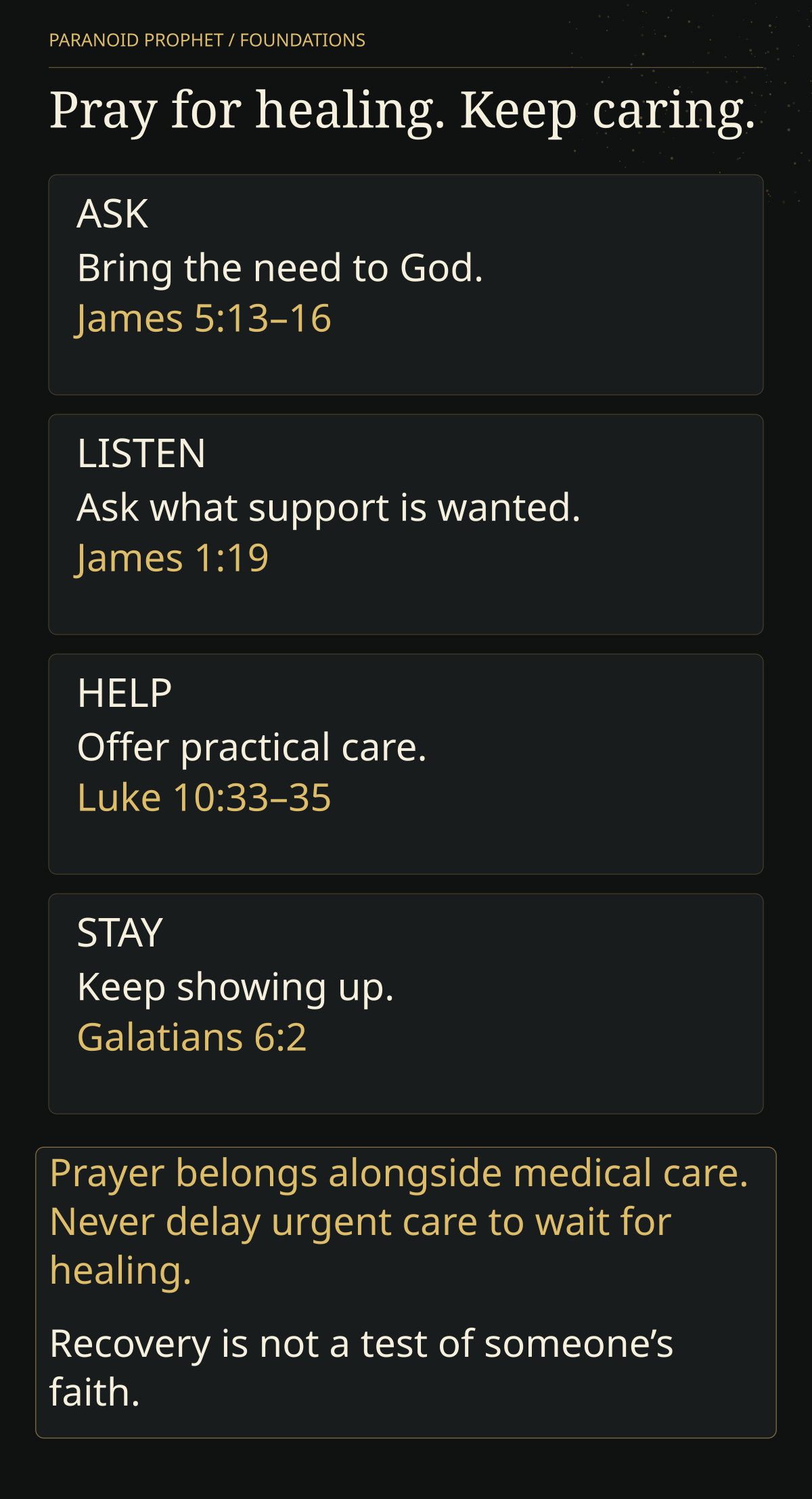
- Ask: Bring the need to God. James 5:13–16.
- Listen: Ask what support is wanted. James 1:19.
- Help: Offer practical care. Luke 10:33–35.
- Stay: Keep showing up. Galatians 6:2.
Prayer belongs alongside medical care. Never delay urgent care to wait for healing. Recovery is not a test of someone’s faith.
What Is the Church? explores why this kind of shared life belongs at the center of Christian community.
How should Christians respond to healing claims?
Gratitude and careful truth-telling belong together. When someone reports improvement, we can be glad for them without claiming more than the available information supports.
A personal testimony, a confirmed change in health, and a conclusion about the cause are different claims. They require different kinds of support. An edited video or an enthusiastic announcement does not settle a medical question. Even a documented recovery does not, by itself, establish every claim a ministry makes about why it occurred.
Avoid circulating another person’s medical story without permission. Do not pressure someone to declare complete healing while they are still being evaluated, or treat an honest report of ongoing symptoms as disloyalty. If a public statement turns out to be inaccurate, correct it plainly.
Be especially cautious when promises of healing are tied to payment, an expensive product, secrecy, or obedience to a particular personality. Nobody should have to buy access to a promised recovery. Christian witness is damaged when vulnerable people are used to build a platform.
Common questions
Should I keep praying if nothing seems to change?
You may continue asking for healing. You may also ask for rest, relief, wisdom, and help carrying the uncertainty. There is no obligation to maintain a public appearance of optimism. For a fuller treatment of lament and unanswered questions, read Suffering and Christian Hope.
Do I need oil or a healing service before God will hear me?
Christians pray in many settings. James describes the church’s care for the sick, including anointing, and traditions understand that practice differently. Ask a trusted church leader how your congregation approaches it. Do not postpone medical attention while arranging a visit or service.
Is it wrong to decline a prayer visit?
You may set boundaries around visits, touch, private information, and the length of a conversation. A considerate church can pray without requiring access you do not want to give. Consent matters even when someone believes their intentions are good.
What if the person dies despite our prayers?
Respond with grief, compassion, and continued care for those who mourn. Do not accuse the person or family of insufficient faith. Christian hope rests in Christ and the promised resurrection, not in a claim that believers will escape death in this life. Bereaved people need companionship, room to grieve, and practical support without a forced explanation.
The next faithful step
If you are ill, ask for the help you need without apologizing for needing it. If you are supporting someone, make one concrete offer and follow through. If you lead a church, make sure your practices protect privacy, welcome medical care, and continue supporting people whose illness remains.
We can ask God for healing with hope and speak about outcomes with humility. The sick person in front of us deserves prayer, truthful words, appropriate care, and a community that stays.
Scripture and further reading
Scripture links use the New International Version. Biblical passages above are summarized rather than reproduced as extended quotations.
- James 5:13–18: prayer, elders, anointing, and mutual care.
- John 9:1–3: Jesus rejects the disciples’ proposed blame.
- 2 Corinthians 12:7–10: Paul’s request and grace in weakness.
- James 1:19 and Galatians 6:2: listening and bearing burdens.
- Catholic Catechism, 1500–1513: one tradition’s teaching on illness and anointing.
- Assemblies of God: Divine Healing: one Pentecostal account, including its affirmation of medical care.