

If your hen is straining, very weak, struggling to breathe, collapsed or showing abnormal tissue at the vent, contact a poultry veterinarian now. Tell the clinic what you can see and ask about urgent assessment and transport. Do not wait overnight to see whether an egg appears.
“Egg bound” is often the first explanation offered for a hen standing strangely or sitting apart from the flock. It is a possibility, but several illnesses can look similar. Your first job is to get the bird appropriate help, not prove the diagnosis at home.
GUIDED ARTICLE EXPERIENCE
Egg-Bound Chicken: Warning Signs & When to Call a Vet
Read along as the narration moves through the article.
Private device narration · No hosted audio or tracking
CONTINUE GUIDED TOUR
Continue where you left off.
GUIDED TOUR COMPLETE
You have reached the end of this study.
Study record saved on this device.
GUIDED TOUR
Egg-Bound Chicken: Warning Signs & When to Call a Vet
Narrator: Paranoid Prophet Recommended Voice Native device narration
Prepare to follow the article as it is narrated.
VOICE & TOUR OPTIONS
Voice & Listening
NARRATOR
Finding a narrator…
Checking the best narrator available on this device.
Restores the best curated narrator available on this device.
Narrator choices are curated for clear, long-form listening on this device.
Screen-awake support will be checked when narration starts.
CHOOSE A NARRATOR
Curated for this device
Choose a verified narrator for this browser, or use System Narrator. Automatic mode uses the best reliable route exposed by this device; your chosen narrator is preserved even if this device needs a temporary fallback.
Preparing the guided article experience…
RESUME GUIDED TOUR?
Continue where you left off.
GUIDED TOUR COMPLETE
You have reached the end of this study.
Article Guide12 sections
Quick Answer: Suspected Egg Binding Needs a Vet
Egg binding means a bird cannot pass an egg normally. In chickens, reproductive obstruction can range from a temporary difficulty to a life-threatening problem. Merck’s backyard-poultry guidance advises veterinary examination as soon as possible when egg binding is suspected.
Do not squeeze the abdomen, break an egg, insert fingers or tools, or attempt manual extraction. This guide does not prescribe oils, medicines, baths or massage routines. An internet treatment sequence can delay assessment of a different disease.
Warning Signs and What They Cannot Tell You
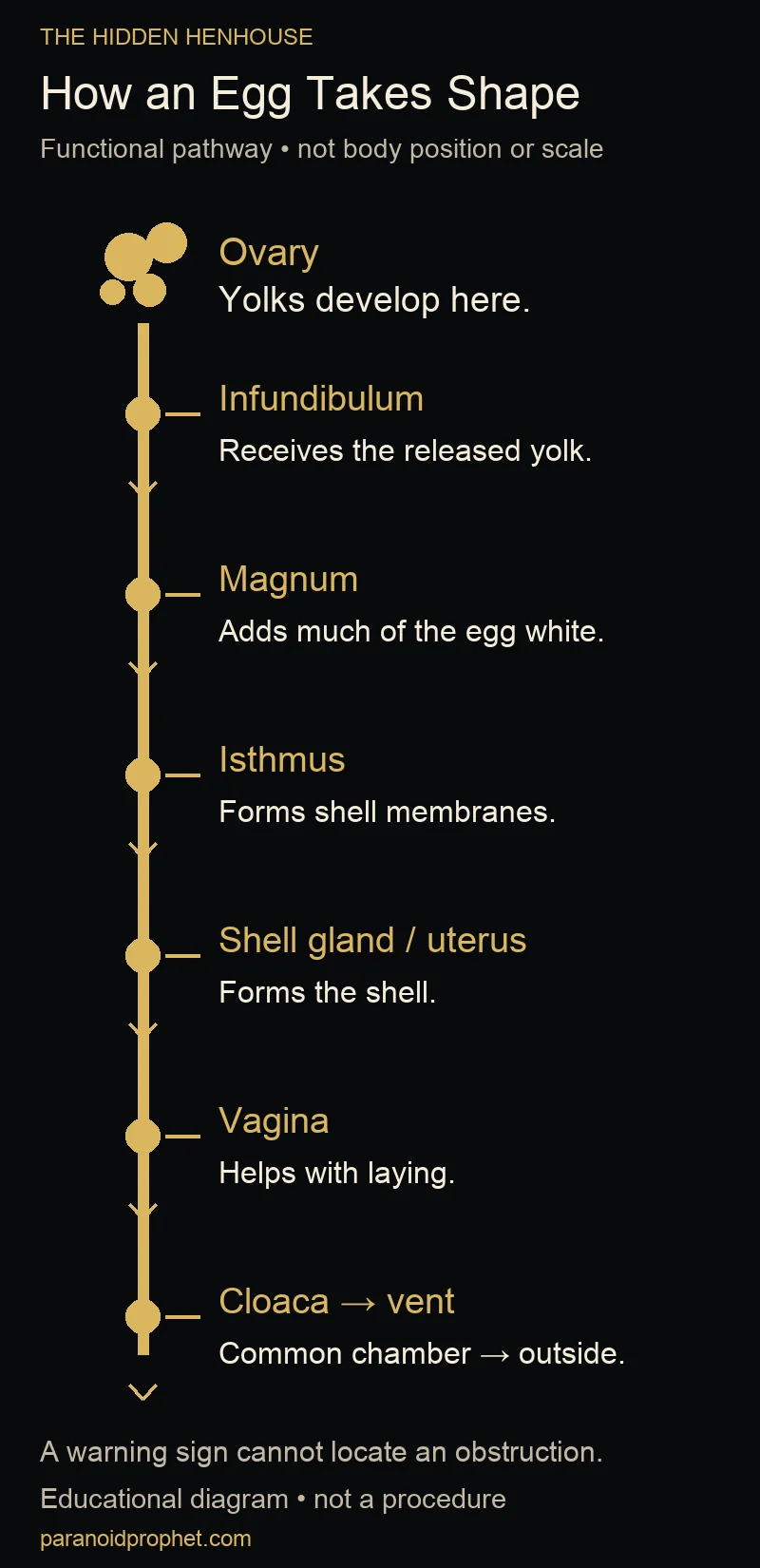
- Repeated straining or difficulty passing an egg or droppings.
- Weakness, inability to stand normally or an unusually withdrawn bird.
- Breathing difficulty, collapse or rapid deterioration.
- A swollen-looking abdomen, bleeding or protruding tissue at the vent.
- A sudden laying change combined with illness.
These signs warrant attention, but none confirms egg binding alone. VCA’s avian veterinary explanation emphasizes that similar signs occur with other illnesses and diagnostic testing is necessary. It concerns birds broadly; its pet-bird laying intervals should not become a wait-and-see rule for a sick chicken.
A penguin-like stance can accompany reproductive disease, including impacted oviducts or egg material in the body cavity. It is not a reliable home test for a single retained egg. Likewise, a hen that misses a day of laying may simply be following her normal pattern. Compare the bird’s condition, not just the calendar.
What Egg Binding Means Inside a Hen
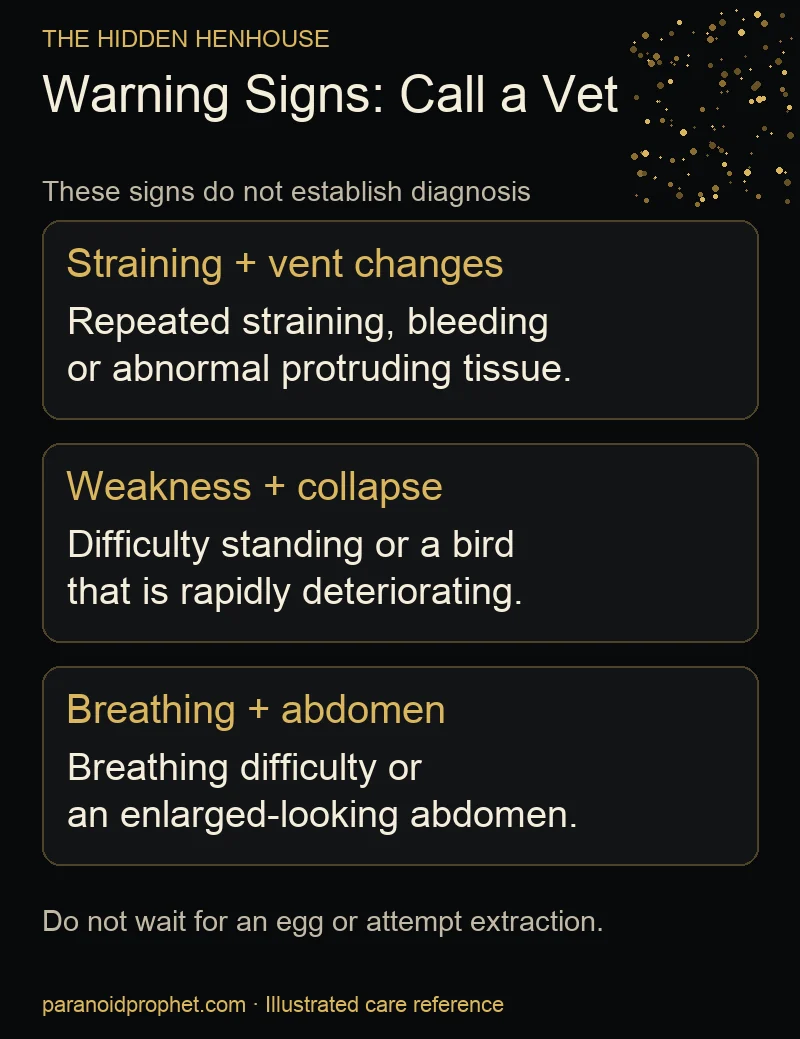
A yolk develops in the ovary and enters the oviduct, where other egg components are added. University of Kentucky poultry Extension describes the successive regions: infundibulum, magnum, isthmus, shell gland and vagina. The formed egg passes through the cloaca and out through the vent.
The cloaca is an internal common chamber. The vent is its external opening. That distinction matters when someone describes a “vent problem,” because visible tissue does not reveal the entire internal situation.
Merck’s poultry reproductive reference identifies an oversized egg, low blood calcium and previous injury as possible reasons an egg lodges near the end of the oviduct. An impacted oviduct can involve accumulated egg material, not merely one intact egg waiting to emerge.
Why Prompt Assessment Matters
Reproductive obstruction can be life-threatening. The useful response is early veterinary assessment, not a claim that every chicken will die within a particular number of hours. The outcome depends on the actual condition, its duration and the bird’s state when treatment begins.
Do not use a home palpation attempt to decide that there is “no egg” and therefore no emergency. Nor should feeling something firm lead you to press on it. The veterinarian may need imaging and a careful examination to understand what is happening.
Other Problems Can Look Similar
Possibilities include oviduct disease or impaction, internal laying, prolapse, injury and other causes of weakness or abdominal enlargement. A hen may have more than one problem. Protruding tissue requires urgent care even if no egg is visible.
Merck’s current pet-bird reproductive overview discusses retained eggs and prolapse. Its species-specific behavioral advice for parrots is not a chicken treatment plan. We use it for general warning-sign context, alongside the chicken-specific references.
Heat illness can also leave a hen weak and breathing abnormally. Mention weather and housing conditions to the clinic rather than choosing between explanations yourself. Our Chicken Heat Stress guide addresses that separate emergency.
What to Do First While Contacting the Clinic
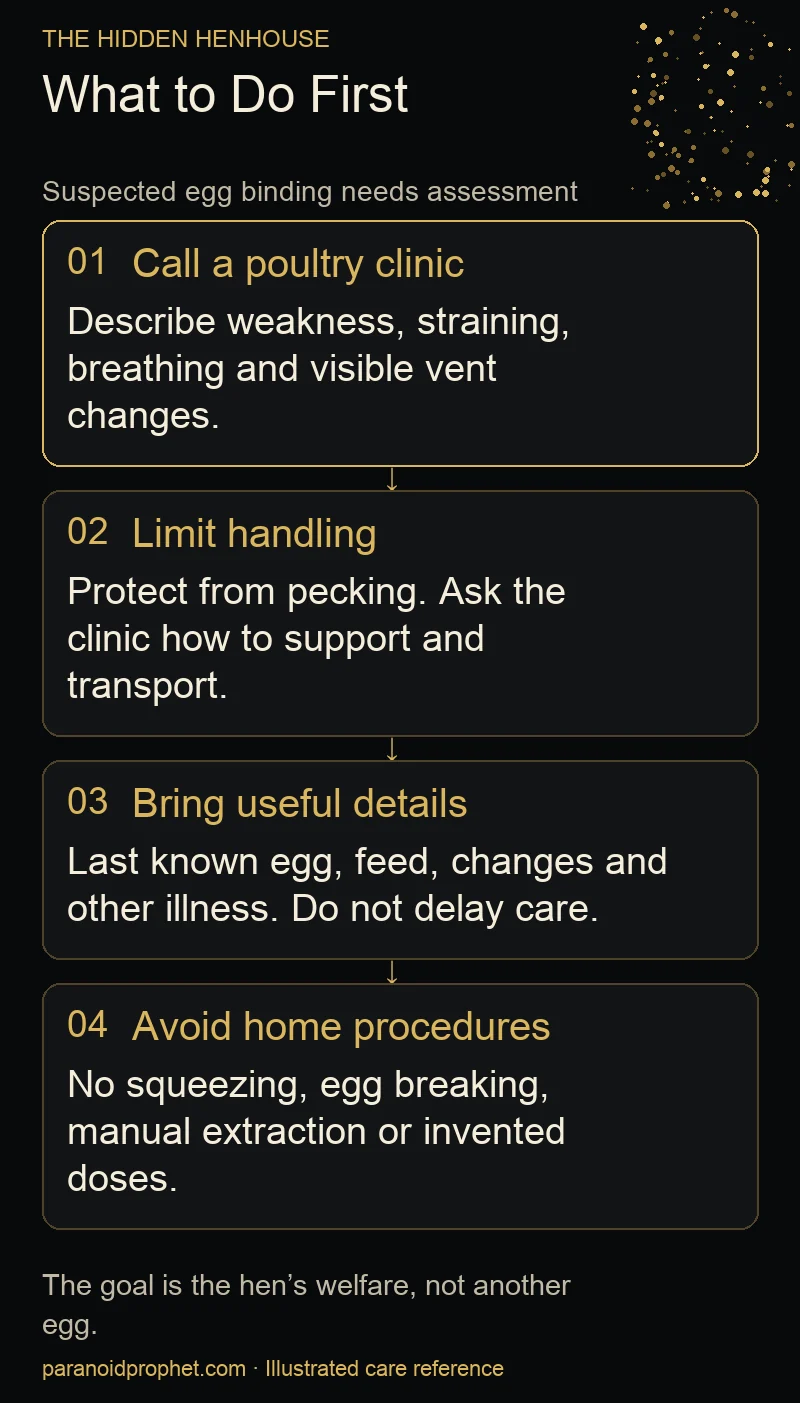
- Call immediately. Confirm that the veterinarian sees chickens. If not, ask for an appropriate referral or emergency service.
- Describe observable signs. Say whether she can stand, how she is breathing, whether she is straining and whether tissue or blood is visible. Describe the onset as accurately as possible.
- Keep handling minimal. Protect her from pecking and disturbance. Follow the clinic’s instructions for a secure, ventilated transport carrier and appropriate comfort conditions.
- Gather useful information without delaying departure. Note the last known egg, appetite, droppings, feed, recent changes and whether other birds are ill.
- Ask before administering anything. Tell the veterinarian if any medicine, supplement or remedy has already been given.
Do not force food or liquids into a weak or breathless bird. Do not experiment with strong heat while deciding whether to seek care. The clinic should direct support and transport for this patient’s condition. See Sick Chicken for the broader observation and veterinary-contact framework.
What Not to Do
Do not squeeze, puncture, break or manually extract an egg. Do not insert tools or fingers into the vent. A procedure described in a veterinary reference is not automatically safe for an untrained keeper to perform.
Do not improvise an oil, bath, massage, calcium dose or medication routine from social media. Treatment depends on diagnosis and the bird’s condition. A visible egg or protruding tissue does not remove that need.
Do not sharply restrict feed to stop laying, and do not assume an extra scoop of oyster shell is emergency treatment. Avoid repeatedly handling the bird to take photographs. One useful observation for the clinic is better than a prolonged home examination.
How a Veterinarian May Assess and Treat Her
The veterinarian will consider her history and overall stability, then may use examination, radiographs or ultrasound to assess the reproductive tract. Depending on the case, care can include stabilization, correction of an identified deficiency, assisted egg passage or surgery. Those are clinical decisions, not a ladder of home remedies.
Ask what was found, whether the diagnosis is confirmed or still provisional, and what follow-up is needed. Chickens are food-producing animals even in a pet flock. If drugs are prescribed, ask for written egg and meat withdrawal instructions before using either for food.
Recovery, Recurrence and Reasonable Prevention
Recovery depends on the cause and any complications. Passage of an egg does not by itself establish that all internal problems are resolved. Follow the veterinarian’s directions for monitoring, housing, medication and review. Ask specifically about recurrence and whether future laying should be managed differently.
For everyday prevention, use a complete ration appropriate to the bird’s life stage, dependable water, opportunities for normal movement and a suitable nesting environment. Avoid obesity and do not push physically immature pullets into production with improvised feeding or lighting changes. Merck identifies immature and overweight hens as relevant risk groups.
These measures reduce avoidable management problems; they cannot guarantee prevention. Calcium requirements also differ between growing birds and laying adults. Obtain a suitable flock feeding plan rather than giving every age the same high-calcium ration.
A healthy hen’s laying pause belongs in the egg-production troubleshooting guide. A sick or straining hen belongs in veterinary assessment.
Frequently Asked Questions
Can I tell by a penguin stance?
No. It can signal reproductive illness, but it does not distinguish a retained egg from other problems.
Should I wait because she laid yesterday?
No. A recent egg does not make today’s weakness, straining or abnormal breathing safe to ignore.
Can extra calcium fix the problem?
A veterinarian may treat an identified calcium problem, but not every obstruction has that cause. Do not improvise a dose or delay care.
What if she passes an egg before the appointment?
Tell the clinic and follow its advice. Continued weakness, straining, abnormal breathing or vent changes still need assessment.
The Bird Comes Before the Egg
In an emergency, the goal is relief and appropriate care for the hen. Restoring the household’s egg supply is secondary. Christian stewardship is expressed in the decision to seek help, accept uncertainty and avoid a risky experiment on a vulnerable animal.
Sources and Responsible Care
Sources checked October 8, 2026. This page is a recognition and escalation guide, not an individual diagnosis or treatment protocol. Invasive procedures in professional references are intentionally not reproduced.
- Merck: Egg-Bound or Impacted Oviducts in Poultry Updated September 2024; chicken-specific mechanisms and risk factors.
- Merck: Management-Related Backyard Poultry Problems Updated April 2025; prompt veterinary examination, imaging and obstruction.
- Merck: Reproductive Disorders of Pet Birds Reviewed and updated May 2026; general warning signs and prolapse, with species scope retained.
- VCA: Egg Binding in Birds Updated September 2023; symptoms are nonspecific and require testing.
- Poultry Extension: Female Avian Reproductive System By Dr. Jacquie Jacob, University of Kentucky; anatomy and egg-formation regions.