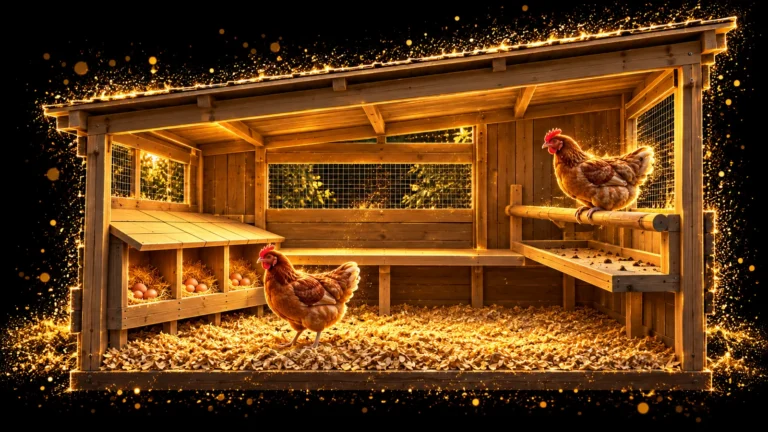


The nesting boxes were busy last week. Today you lift the lid, find nothing, and start counting backward: when did the egg basket get this light?
A drop in egg collection deserves a closer look, but it does not automatically mean something is wrong with every hen. Start with two questions: are the birds well, and are the eggs actually missing?
GUIDED ARTICLE EXPERIENCE
Why Did My Chickens Stop Laying Eggs? Causes & What to Check
Read along as the narration moves through the article.
Private device narration · No hosted audio or tracking
CONTINUE GUIDED TOUR
Continue where you left off.
GUIDED TOUR COMPLETE
You have reached the end of this study.
Study record saved on this device.
GUIDED TOUR
Why Did My Chickens Stop Laying Eggs? Causes & What to Check
Narrator: Paranoid Prophet Recommended Voice Native device narration
Prepare to follow the article as it is narrated.
VOICE & TOUR OPTIONS
Voice & Listening
NARRATOR
Finding a narrator…
Checking the best narrator available on this device.
Restores the best curated narrator available on this device.
Narrator choices are curated for clear, long-form listening on this device.
Screen-awake support will be checked when narration starts.
CHOOSE A NARRATOR
Curated for this device
Choose a verified narrator for this browser, or use System Narrator. Automatic mode uses the best reliable route exposed by this device; your chosen narrator is preserved even if this device needs a temporary fallback.
Preparing the guided article experience…
RESUME GUIDED TOUR?
Continue where you left off.
GUIDED TOUR COMPLETE
You have reached the end of this study.
Article Guide13 sections
Quick Answer: Why Chickens Stop Laying Eggs
Shorter days, molting, broodiness, advancing age, changes in feed or water, heat, stress and illness can all reduce laying. Several causes can overlap. Eggs may also be hidden, broken or eaten before you collect them. Virginia Cooperative Extension’s laying guide separates these management and collection problems.
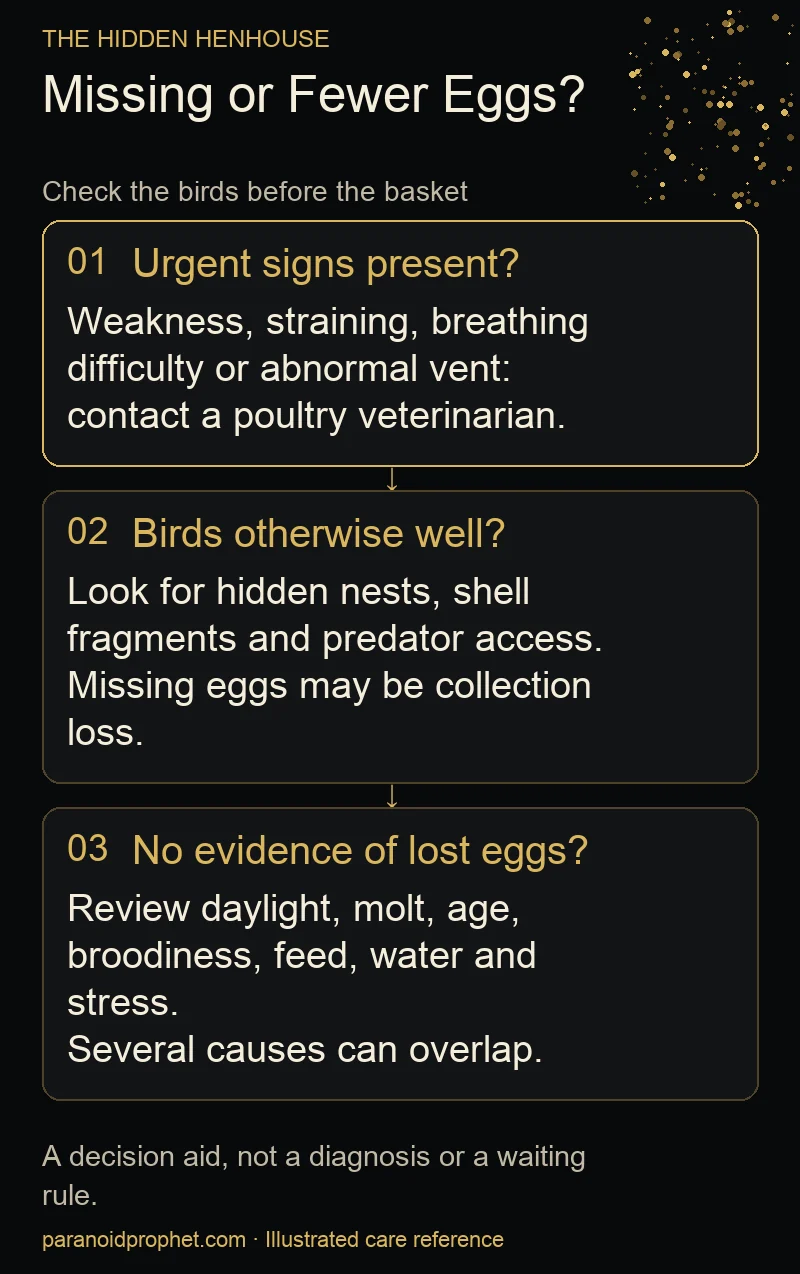
Check the hens before troubleshooting the egg count. Straining, severe weakness, breathing difficulty, a swollen abdomen or protruding tissue at the vent call for prompt veterinary assessment. Posture or an empty nest cannot diagnose egg binding. If several birds suddenly become ill or die, seek flock-level help rather than assuming a seasonal pause. Our Sick Chicken guide explains the first observations to gather.
Did Laying Stop, or Are Eggs Disappearing?
Count what you collect, but do not confuse that number with what the flock produces. A hen can keep laying while your basket stays empty.
- Hidden nests: look in sheltered corners and places the hens can reach outside their usual nesting area.
- Broken eggs: check bedding for damp patches, shell fragments and crowding in a favored box.
- Egg eating: look for evidence rather than blaming whichever hen happens to be nearby.
- Predators: inspect access points and unexplained disturbances. An egg thief does not always leave a clear trail.
- Changed nesting behavior: consider whether a new box, disturbance or flock change coincided with the drop.
Collect regularly and improve the nest setup without frightening the birds or repeatedly moving them. For security problems, use the coop and run predator-proofing checklist. Finding hidden eggs explains collection loss; it does not excuse overlooking an unwell hen.
Your First-Day Troubleshooting Checklist
- Watch the flock before handling. Who is eating, drinking, moving normally or keeping apart?
- Confirm that water flows and is accessible. A full-looking container may still have a blocked outlet or frozen water.
- Check the feed bag, storage and actual feeder access. Note recent ration changes, extra treats or spilled feed.
- Search the nests and safe hiding places, then record today’s collection.
- Look for feather replacement, persistent nest sitting, bullying, heat or evidence of predators.
- Write down the changes you can verify. Correct an obvious access problem immediately; do not add several supplements at once.
This is an observation sequence for a stable flock, not permission to delay care for a sick bird. Merck’s backyard-poultry guidance emphasizes that early illness can be subtle and reproductive obstruction can be life-threatening.
Season, Molt and Age: Normal Reasons for Fewer Eggs
Shorter days change laying patterns
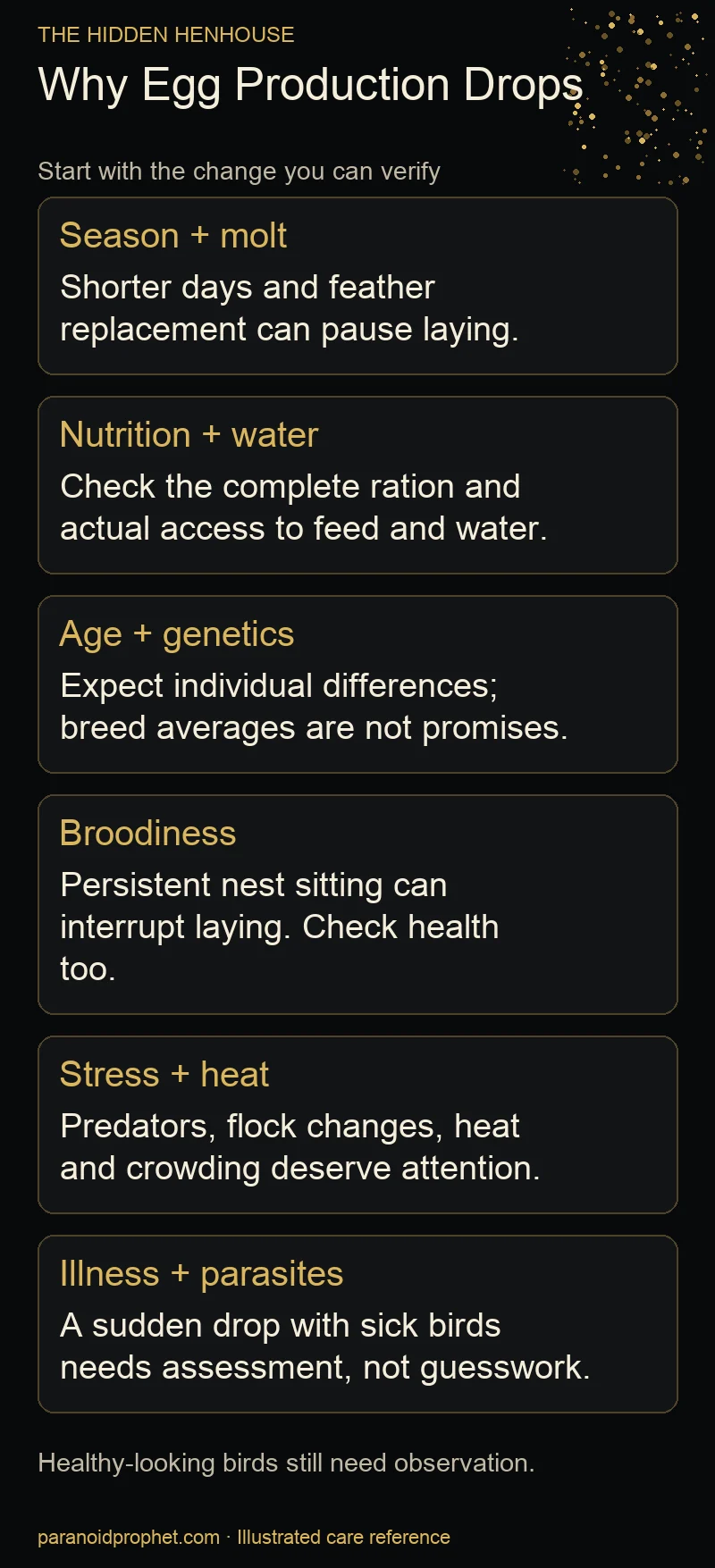
Fall and winter bring less daylight, and many hens lay less. The size of that decline differs among birds and management systems. A seasonal explanation fits better when the birds otherwise behave normally and the change follows the season; it fits poorly when weakness, respiratory signs or sudden deaths accompany it.
Molting often brings an egg pause
Feather replacement and laying are demanding processes. During a natural molt, production often slows or stops. Look at the whole bird: replacement feathers and a seasonal pattern are useful clues, while bleeding, persistent isolated bald patches or obvious parasites deserve a different investigation. Do not withhold feed to force a molt.
Age and genetics change your baseline
A mature flock should not be judged against its best pullet season forever. Egg output generally declines with age, and breed or strain affects the pattern. Keep your own records instead of treating a published breed average as a guarantee for each hen. Minnesota Extension describes the early years as peak production, with seasonal and age-related declines.
Feed, Calcium, Treats and Water
Use the complete laying-hen feeding guide to review ration stage, calcium and grit, and the waterer guide to check usable drinking access. For hens beyond peak production, the older-hen care guide separates laying decline from signs needing assessment.
Start with a complete ration appropriate to the birds’ life stage, not a home mixture designed to make eggs appear quickly. For a flock of actively laying adult hens, complete layer feed is the usual foundation. Keep supplemental calcium separate where appropriate, and check that timid birds can reach feed and water.
Scratch and kitchen scraps are extras, not replacements for a balanced ration. A feeder full of grain does not establish that the diet supplies the necessary protein, minerals and vitamins. Supplements also cannot reliably restart laying when the cause is age, season, broodiness or disease.
A mixed-age or mixed-species flock needs a feeding plan that suits all its members. Do not solve an adult hen’s laying problem by giving high-calcium layer ration to chicks. Follow the feed label and obtain poultry nutrition advice when laying and nonlaying birds share feed. Penn State’s management guidance supports complete diets and explains the different feeding stages.
Water is easy to overlook until an outlet fails. Check it in person, especially during freezing weather or heat. If the problem began after a feed change, keep the old and new bag information for the veterinarian or nutrition adviser.
Broodiness, Stress and the Backyard Environment
A broody hen has a different reproductive priority
A hen that stays on a nest and objects to leaving it may be broody. Broodiness commonly interrupts laying, but sitting still can also be a sign of illness. Check her condition and behavior outside the nest. Use Broody Hen Behavior for humane choices rather than applying a universal breaking deadline.
Changes can matter even when the coop looks familiar
A predator visit, new flock members, bullying, repeated handling or restricted access to resources can disrupt production. Consider what changed immediately before the drop. Adding birds also creates health risks, so follow the quarantine and flock-integration guide.
Our ordinary Southeast backyard began with approximately 16 chickens and two ducks; later we had about 12 chickens. The birds stripped essentially all the grass within roughly the first year. That experience is useful as a warning about yard pressure, not evidence of a particular egg-production rate. A bare run and crowded access points deserve practical attention even when the original flock size sounded manageable.
Hot weather needs its own check
Heat can reduce feed intake and laying. Shade, reliable water and appropriate airflow deserve attention before any egg-boosting product. Panting in hot conditions requires assessment, particularly when a bird becomes weak. See Chicken Heat Stress for the distinction between prevention and an emergency.
Parasites, Illness and Reproductive Problems
A laying decline is a clue, not a diagnosis. Use the mites and lice inspection guide for external-parasite clues. Inspect feathers and skin, note droppings and breathing, and consider whether one hen or the whole flock has changed. Do not automatically deworm or medicate the flock because fewer eggs appeared.
Reproductive problems can include retained eggs, an impacted oviduct, prolapse and other disease. Merck’s poultry reference describes several mechanisms of obstruction. None can be reliably sorted out from an online photograph alone. Our egg-binding warning-sign guide explains safe escalation and the limits of home diagnosis.
When to stop the investigation and call a veterinarian
Seek prompt care for persistent straining, severe weakness, breathing difficulty, collapse, abdominal enlargement, bleeding or abnormal tissue at the vent. Tell the clinic that the patient is a chicken and ask whether it sees poultry. Keep handling minimal while arranging transport. Do not squeeze the abdomen, break an egg or insert fingers or tools into the vent.
For sudden flock illness or unexplained deaths, USDA APHIS biosecurity guidance is a starting point for reporting and preventing spread. Do not move birds between flocks while seeking advice.
Should You Add Winter Lighting?
Accepting fewer winter eggs is a reasonable backyard choice. Supplemental lighting is a management option for production, not a requirement for every well-cared-for flock.
The recommendations are not identical. Minnesota describes about 12–14 hours for continued laying. Virginia and Penn State discuss roughly 14–16 hours for sustained or maximum production. Those sources use different production targets; they do not establish that every backyard hen requires one exact schedule.
If you choose lighting, plan a consistent total day length that includes natural daylight. A timer and morning supplementation allow natural dusk for roosting. Preserve an uninterrupted dark period; do not leave lights on all night. Virginia recommends at least six continuous hours of darkness. Secure any fixture safely away from litter and follow equipment instructions. Sudden schedule changes and unsafe wiring are poor trades for more eggs.
Lighting cannot correct illness, an inadequate ration or advancing age. It also adds management obligations. Decide whether predictable winter output is worth those obligations for your household.
Keep a Three-Day Egg Investigation Log
For birds that are otherwise stable, record the same observations for the next several days. Three days is a convenient starting log, not a recovery promise or a waiting period for an emergency.
- Eggs collected, collection times and hidden or broken eggs.
- Feed type, treats and whether every bird can reach resources.
- Water availability, temperature and daylight or lighting changes.
- Feather replacement, nest sitting and notable flock interactions.
- Appetite, activity, breathing, droppings and any bird needing care.
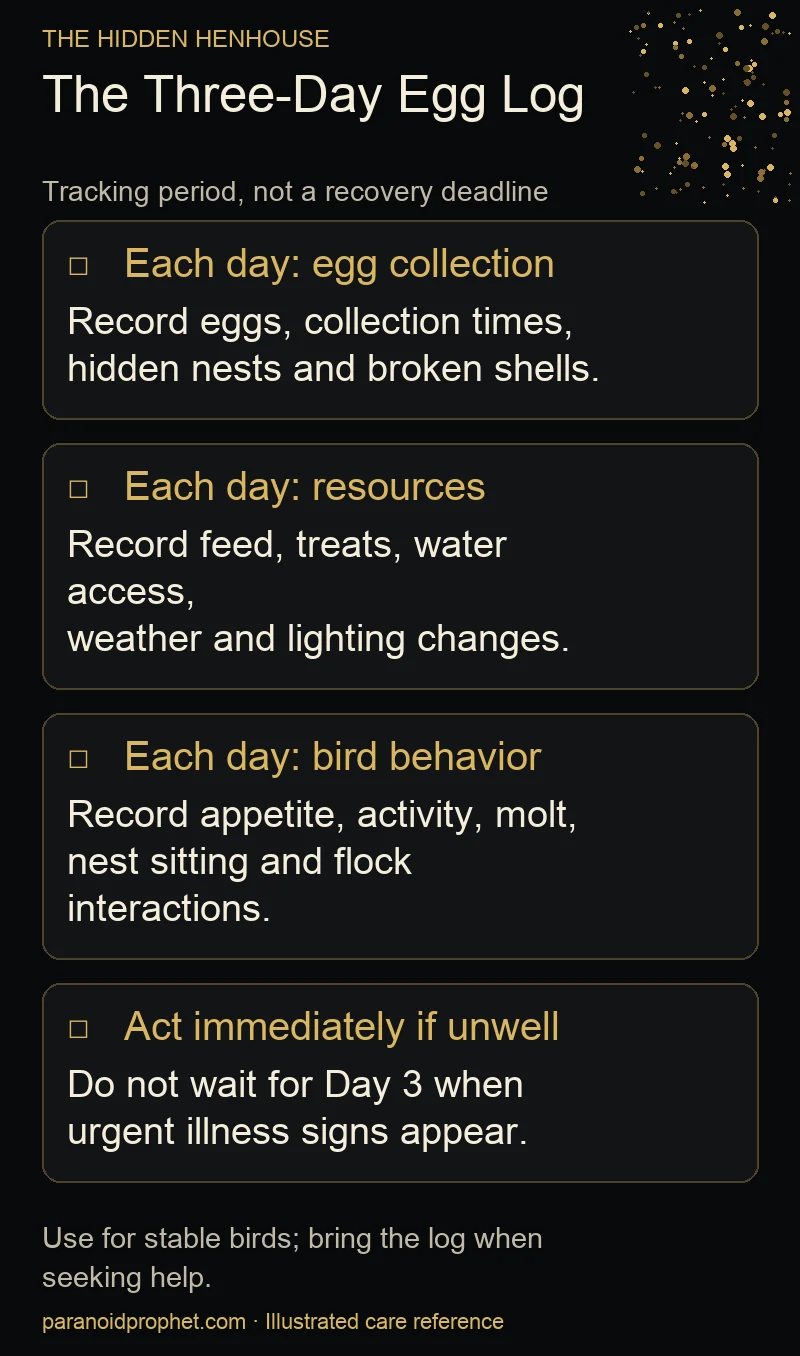
Change what you can justify and record what you changed. A log is much more useful than remembering that you tried “something for laying” earlier in the week.
When Will Eggs Return?
There is no honest universal deadline. Restoring water access is a different problem from a natural molt, an older hen’s declining output or reproductive disease. Healthy seasonal pauses may last weeks or longer; treatment outcomes depend on the diagnosis.
Ask whether the hens are improving, whether the suspected cause fits the observations and whether new signs have appeared. If the explanation remains unclear, get advice instead of increasing supplements or light indefinitely. Prevention is mostly consistent care: suitable feed, dependable water, comfortable housing, biosecurity and attention to each bird.
Frequently Asked Questions
Can chickens stop laying even when they seem healthy?
Yes. Shorter days, molt, age and broodiness can reduce production without obvious illness. Still check for missing eggs and watch for subtle changes in behavior.
Will extra protein or calcium restart laying?
Correcting a nutritional problem matters, but more is not automatically better. Supplements are not a dependable cure for every cause of a laying pause.
Does an upright, penguin-like stance mean egg binding?
No. It is a warning sign that can accompany reproductive disease, not a diagnosis. An unwell or straining hen needs veterinary assessment.
Should I wait three days before calling a vet?
No. The log is for stable birds. Urgent signs require prompt help, regardless of the egg count.
Stewardship Beyond the Egg Basket
Our family has shared surplus eggs, and that is one of the pleasures of keeping chickens. It is also easier to be generous when we do not expect every hen to produce on demand. Care continues through molt, winter and old age. Proverbs 12:10 connects righteousness with care for an animal’s needs. An empty nest is a reason to pay attention, not a reason to value the bird less.
Sources and Responsible Care
Sources checked October 8, 2026. This is a husbandry guide, not an individual diagnosis. Production-oriented recommendations are identified as such.
- Virginia Cooperative Extension: Why Have My Hens Stopped Laying? Published July 2022; collection loss, nutrition, stress and lighting.
- Oregon State: Why Did My Chickens Stop Laying? Older 2003 production guidance; useful seasonal and broodiness context, not a current treatment protocol.
- Minnesota Extension: Raising Chickens for Eggs Reviewed 2025; age and seasonal context.
- Penn State: Management Requirements for Laying Flocks Feeding stages and production-oriented lighting.
- Merck: Management-Related Backyard Poultry Problems Updated April 2025; warning signs and veterinary escalation.
- Merck: Egg-Bound or Impacted Oviducts Updated September 2024; poultry reproductive obstruction.