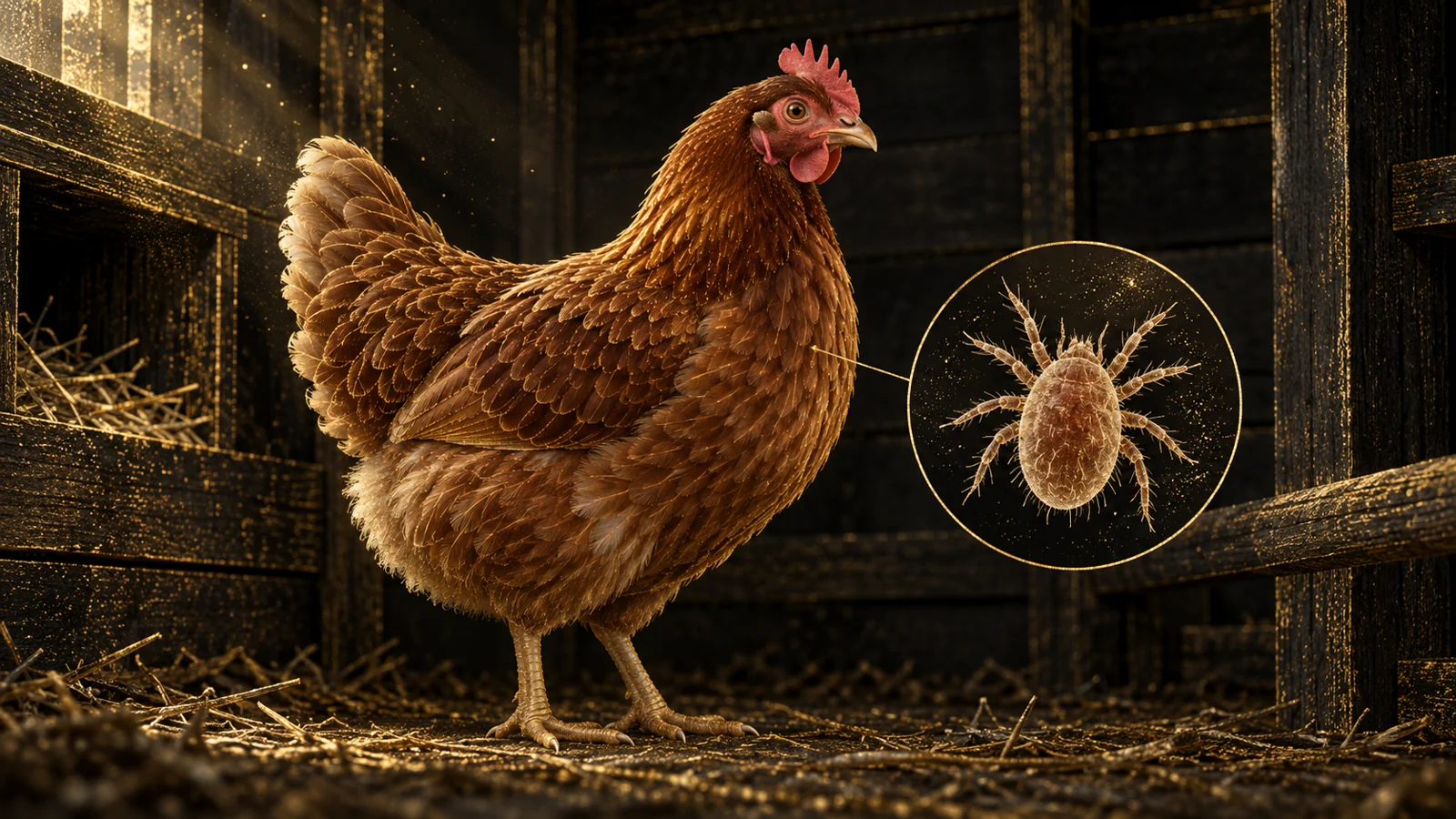

A hen keeps scratching. Feathers around her vent look dirty, and something tiny moves when you part them. Before buying a bottle of treatment, find out what you are looking at. Chicken mites and lice have different habits, and treating the wrong place can leave the problem untouched.
This guide helps you inspect birds and housing, recognize useful clues and build a control plan with a poultry veterinarian or Extension specialist. The illustrations explain broad differences; they cannot identify a parasite species from a blurry speck.
GUIDED ARTICLE EXPERIENCE
Chicken Mites & Lice: Identification, Inspection & Control
Read along as the narration moves through the article.
Private device narration · No hosted audio or tracking
CONTINUE GUIDED TOUR
Continue where you left off.
GUIDED TOUR COMPLETE
You have reached the end of this study.
Study record saved on this device.
GUIDED TOUR
Chicken Mites & Lice: Identification, Inspection & Control
Narrator: Paranoid Prophet Recommended Voice Native device narration
Prepare to follow the article as it is narrated.
VOICE & TOUR OPTIONS
Voice & Listening
NARRATOR
Finding a narrator…
Checking the best narrator available on this device.
Restores the best curated narrator available on this device.
Narrator choices are curated for clear, long-form listening on this device.
Screen-awake support will be checked when narration starts.
CHOOSE A NARRATOR
Curated for this device
Choose a verified narrator for this browser, or use System Narrator. Automatic mode uses the best reliable route exposed by this device; your chosen narrator is preserved even if this device needs a temporary fallback.
Preparing the guided article experience…
RESUME GUIDED TOUR?
Continue where you left off.
GUIDED TOUR COMPLETE
You have reached the end of this study.
Article Guide14 sections
Quick Answer: Inspect Both the Bird and the Coop
Look for moving parasites, feather-base egg clusters, irritated skin and unusual scratching. Northern fowl mites commonly concentrate around the vent. Poultry red mites hide in coop crevices during the day and feed on birds at night. Poultry lice and their eggs are usually found on the bird.
A pale, weak, collapsing or breathing-impaired chicken needs prompt veterinary assessment. A severe infestation can be dangerous, but parasites are not the only explanation for those signs. Use the sick-chicken guide to organize observations while arranging care.
Mites Versus Lice: Useful Differences, Not a Photo Diagnosis
Mites are arachnids; lice are insects. Adult poultry mites have eight legs, while lice have six. There is a catch: mite larvae have six legs too. Size, movement, location and life stage all matter, so leg counting alone is not a dependable backyard identification method.
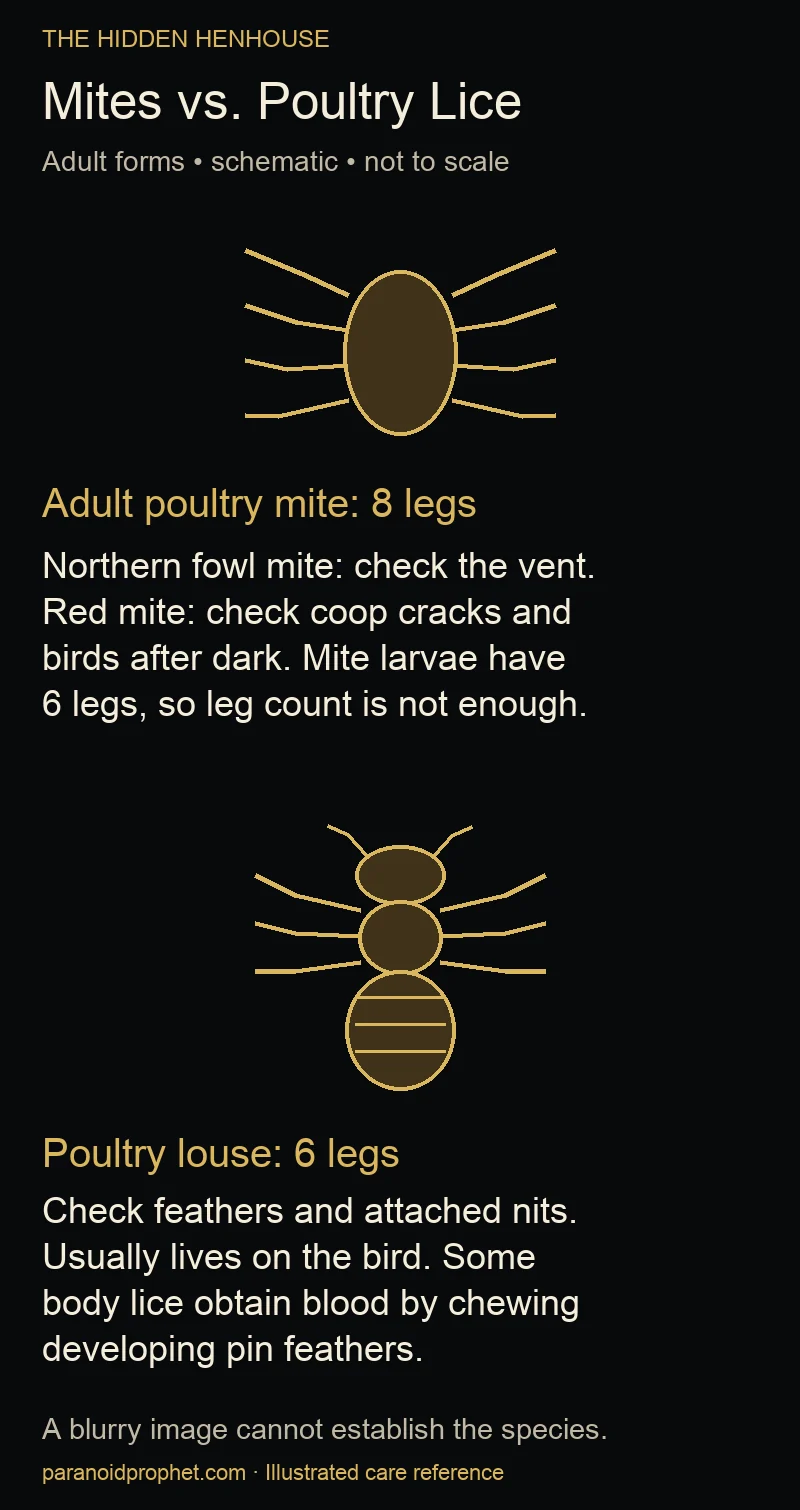
Many poultry lice feed on feathers and skin debris. However, the statement that poultry lice never feed on blood is too broad. The January 2026 Merck lice review notes that chicken body lice can obtain blood by chewing developing pin feathers. They are chewing lice, not the mammalian sucking lice the name may bring to mind.
Feather damage is a reason to investigate, not proof of lice. Molt, pecking and injury can produce overlapping signs. Compare the bird’s overall condition and the pattern of feather replacement with our chicken molting guide.
Northern Fowl Mites: Start Around the Vent
Northern fowl mites spend much of their lives on birds. Gently part feathers around the vent and look for moving dark specks, soiling, crusting and egg material in the feather fluff. A heavy burden can extend beyond that area.
Virginia Tech’s northern fowl mite guide describes feather inspection and the mite’s rapid life cycle. Do not translate that life cycle into an automatic treatment calendar. The product, parasite and veterinary plan determine whether and when another application is appropriate.
“Lives on the bird” does not mean “cannot survive anywhere else.” Northern fowl mites can persist off the host, so shared crates and equipment deserve attention too.
Poultry Red Mites: Check the Roost After Dark
A daytime bird check can miss poultry red mites. Inspect roost supports, nest-box seams and sheltered cracks with a flashlight. A nighttime check can reveal mites feeding on resting birds. Avoid turning this into prolonged handling or chasing a flock around the coop.
The University of Florida red mite profile explains why the housing matters: the mites leave the bird and shelter in the environment. They can persist for months without a meal. An empty coop is not automatically a parasite-free coop.
Color is not enough to identify them. Red mites may look gray or dark before feeding and reddish afterward. A magnified photograph or collected sample reviewed by a qualified specialist is more useful than matching a phone image to an illustration.
Poultry Lice: Look for Nits at Feather Bases
Part feathers under the wings and around the breast, thighs and vent, checking both skin and feather shafts. Lice may be easier to see moving through plumage than tiny mites. Their eggs, called nits, are attached to feathers, often in clusters near the base.
The Veterinary Entomology poultry lice profile describes a life cycle completed on the host. That makes the bird central to control. It does not excuse dirty equipment or justify treating every parasite as though it lives only in coop cracks.
Raised, crusted leg scales suggest a different investigation. Scaly-leg mites burrow in skin and need their own assessment. Do not assume that a product chosen for visible feather parasites is the correct treatment for damaged legs.
How to Inspect Without Adding Stress
- Choose a calm moment. Work with a helper if needed. Keep handling brief and do not compress the chest.
- Look before applying anything. Note where the specks are moving, whether eggs are attached to feathers and which birds are affected.
- Inspect housing separately. Check nest seams and roost junctions as well as birds. Include a nighttime check when red mites are suspected.
- Record useful evidence. Take a clear close-up and a wider location photograph. Ask the clinic or Extension office how it wants a sample collected.
- Protect people. Wash hands after contact and keep poultry-care clothing and equipment out of food-preparation areas.
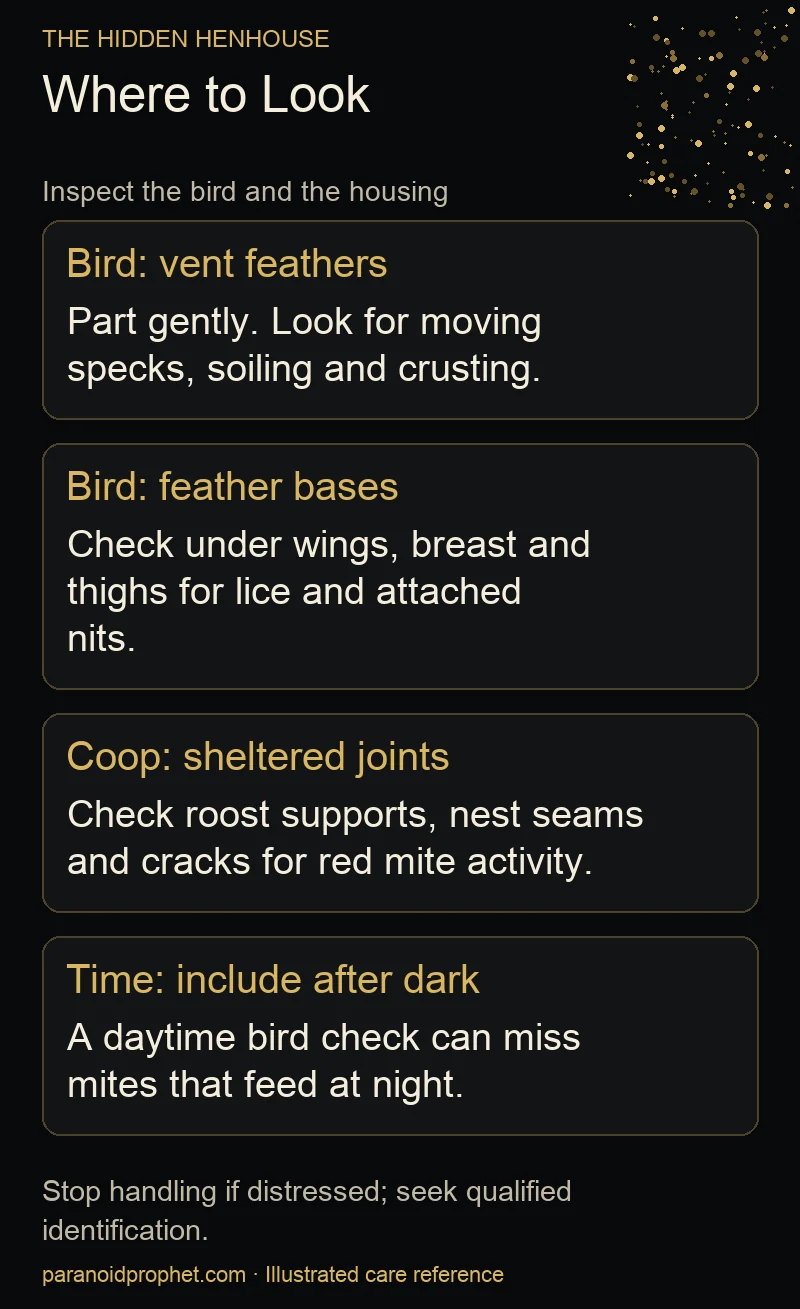
These are practical inspection steps, not a substitute for identification. Stop handling and seek veterinary help if a bird is distressed. Children should not be responsible for restraint, pesticide selection or application.
What an Infestation Can Do to the Flock
Irritation, damaged feathers and disrupted rest affect welfare even when egg numbers have not changed. Blood-feeding mites can cause anemia in heavy infestations. Declining condition or laying deserves investigation, but neither confirms parasites without other evidence.
Our egg-production troubleshooting guide helps separate parasite concerns from seasonal, nutritional and management changes. Treating every empty nest as a mite problem wastes time and can expose healthy birds to unnecessary chemicals.
Build a Control Plan That Matches the Parasite
Start with identification, then decide which birds, housing areas and equipment need attention. A veterinarian or poultry Extension specialist can help distinguish a registered pesticide used on birds from a product permitted only for premises. These uses are not interchangeable.
Control may involve appropriately labeled on-bird treatment, treatment of environmental hiding places, or a prescription medicine for a defined parasite. Follow the exact product label and the veterinarian’s directions. Do not improvise combinations, increase concentrations or copy another keeper’s dose.
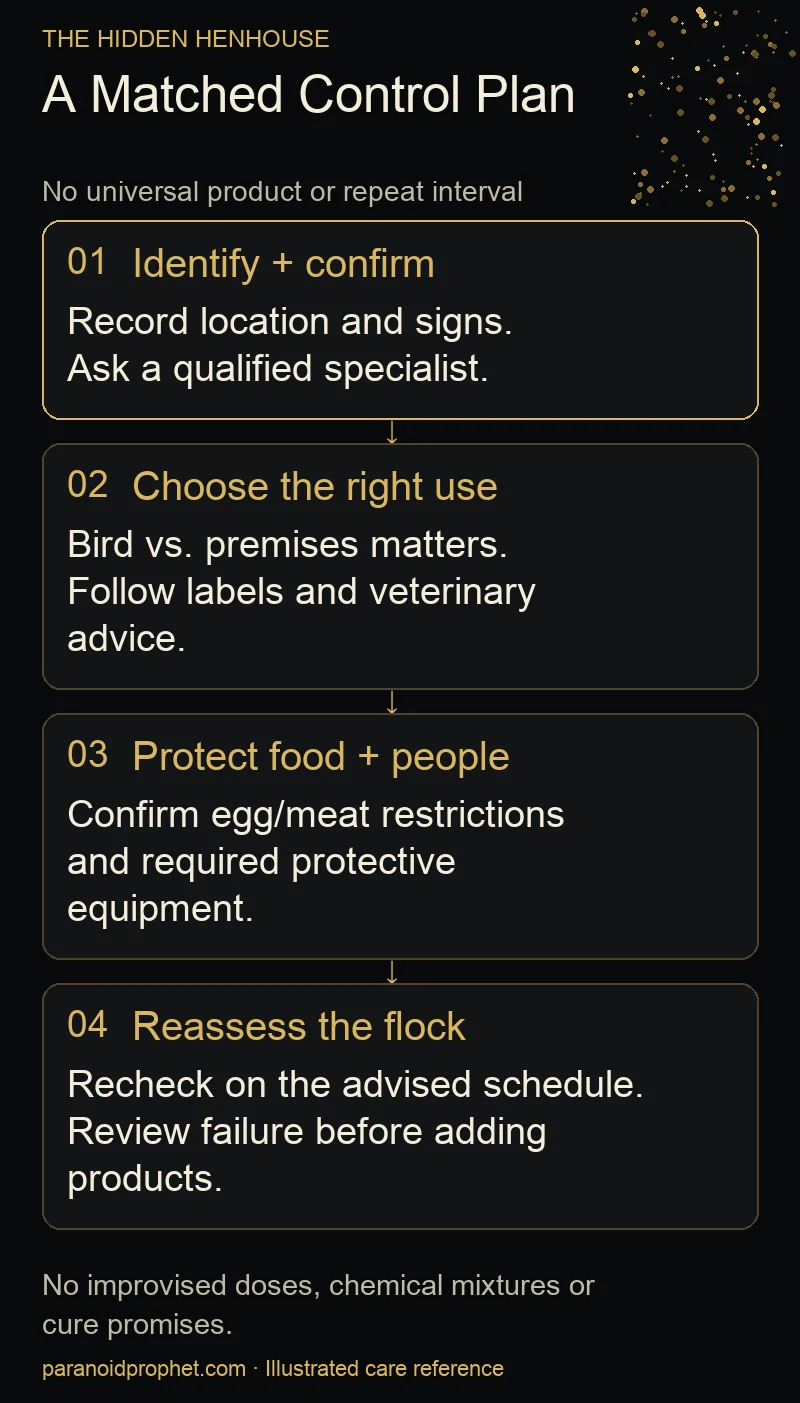
Follow the coop-cleaning sequence to remove contaminated debris and address housing maintenance as part of the plan. Cleaning alone may reduce the burden without eliminating the infestation. Red mites hiding behind nest boxes need a different approach from lice concentrated in plumage.
The Merck backyard infectious-disease guidance emphasizes using current labels for food-producing poultry. A dog or cat flea product is not an appropriate shortcut for laying hens. The label must cover the intended animal and application site, and state restrictions still matter.
Resistance can complicate control. Repeated failure is a reason to reassess identification, application, reinfestation and product suitability with a professional, rather than adding more products at random.
Egg and Meat Withdrawal: Check the Actual Label
A hen remains a food-producing animal even when she is mainly a pet. Before treatment, establish whether eggs must be discarded, how long meat must be withheld and what records to keep. Do not invent a universal withdrawal interval for “mite medicine.”
One current U.S. example shows why precision matters. The Exzolt label revised in August 2026 covers northern fowl mites in specified chickens and requires veterinary authorization. It states no egg discard when used according to labeling, but an 11-day meat withdrawal after the last treatment. That is a label-specific example, not a recommendation for every infestation or permission to substitute another fluralaner product.
This guide provides no medication doses. Ask the prescriber about the exact treatment, egg use and follow-up for your flock.
Dust Baths and Diatomaceous Earth: What the Evidence Actually Says
Ordinary dust bathing is valuable normal behavior. It is not proof that an established parasite problem has been cured.
Authoritative advice differs on diatomaceous earth. The University of Wyoming’s April 2023 backyard-chicken guide advises against it because of respiratory concerns. The more recently reviewed 2026 Merck mite guidance describes reduced northern fowl mite burdens in controlled treated-dust-box research and explicitly warns about ventilation and applicator dust protection.
Those statements address different questions: practical exposure risk and efficacy under specified conditions. Neither supports sprinkling arbitrary powder everywhere, assuming “food grade” means harmless to breathe, or declaring every dust bath a cure. Our practical recommendation is to discuss a treatment plan rather than improvise a dust recipe. Herbs and essential oils likewise should not replace a confirmed, suitable control method.
Recheck, Record and Reduce Reintroduction
Keep a short record of the identified parasite, product, treatment dates, restrictions and inspection findings. Repeat the same bird and housing checks after treatment at the interval advised for that plan. Recheck the flock’s comfort and condition as well as visible parasite counts.
Old nits or debris are not, by themselves, proof that live parasites remain. Ask what evidence should trigger further treatment. Conversely, a cleaner-looking coop does not establish that hidden red mites are gone.
Inspect incoming birds and used equipment, keep dedicated tools where practical and reduce wildlife and rodent access. Follow the separation principles in introducing new chickens. Keep bedding manageable and inspect shelter seams; choosing coop bedding and securing the coop support the wider management plan. They do not make a yard parasite-proof.
Frequently Asked Questions
Can chicken mites bite people?
Some poultry mites can bite people and cause irritation. That does not make them human head lice. Address the bird and environmental source, and seek medical advice for persistent or concerning skin symptoms.
Do I need to treat every bird?
A flock-wide plan may be necessary, but the answer depends on the parasite and treatment. Ask which birds and premises are included before applying anything. Treating one visibly affected hen can miss the wider infestation.
Can I identify mites from an online picture?
A picture can help organize clues. It cannot reliably distinguish similar tiny species or exclude other causes of skin damage. Provide a clear sample or image to a qualified specialist when possible.
How often should treatment be repeated?
Use the actual label and veterinary plan. Life stages and products differ; there is no safe universal interval for every mite, louse and medicine.
Care Means Looking Closely
Good stewardship includes noticing discomfort before it becomes a crisis. A scratching, restless hen deserves attention whether or not she is still laying. Patient inspection and a well-matched treatment plan do more for her than a shelf full of untested remedies.
Sources and Responsible Care
Reviewed October 8, 2026. This is educational guidance, not a diagnosis or a pesticide prescription. Product permissions and labels can change. Current label directions and your poultry veterinarian’s advice govern treatment.
- Merck: Mites of Poultry, reviewed January 2026, updated February 2026. Species habits, welfare risks and treatment evidence.
- Merck: Lice of Poultry, reviewed January 2026. Feeding distinctions and feather-associated eggs.
- Virginia Tech: Northern Fowl Mites. Inspection and life stages.
- UF/IFAS: Chicken Mite. Red mite shelter, feeding and developmental stages.
- Veterinary Entomology: Chicken Lice. Host-based life cycle.
- Merck: Backyard Poultry Infectious Diseases. Parasite management and food-animal label precautions.
- DailyMed: Exzolt U.S. labeling, revised August 2026. Indication, prescription status and withdrawal restrictions.
- Wyoming: Raising Backyard Chickens, April 2023. Respiratory-risk context for diatomaceous earth.