

Parents often wonder whether they are doing enough: reading enough Bible stories, answering questions well, or choosing the right church. Those concerns can become especially heavy when a child struggles, doubts, or grows into an adult who no longer shares the family’s faith. Scripture gives parents meaningful responsibilities without handing them control over another person’s heart.
Parents help children grow in faith through patient teaching, prayer, honest example, and participation in a trustworthy Christian community. They introduce children to Jesus, practice repentance themselves, and make room for questions as understanding develops. These practices matter deeply, but no parenting method guarantees conversion or lifelong belief. Children need faithful care, not pressure to produce a reassuring spiritual performance.
GUIDED ARTICLE EXPERIENCE
How Can Parents Help Children Grow in Faith?
Read along as the narration moves through the article.
Browser narration · No stored audio or site tracking
CONTINUE GUIDED TOUR
Continue where you left off.
GUIDED TOUR COMPLETE
You have reached the end of this study.
Study record saved on this device.
GUIDED TOUR
How Can Parents Help Children Grow in Faith?
Narrator: Paranoid Prophet Recommended Voice Native device narration
Prepare to follow the article as it is narrated.
VOICE & TOUR OPTIONS
Voice & Listening
NARRATOR
Finding a narrator…
Checking the best narrator available on this device.
Restores the site recommendations available in this browser.
Our listening picks lead when available; other voices are ranked for narration. Known novelty voices are hidden. Browser-provided voices may use an online voice service.
Screen-awake support will be checked when narration starts.
Optional: improve your device voices
Listening works with the voices already available here. Your device may offer additional free voices through its own settings.
iPhone or iPad: Settings → Accessibility → Read & Speak (or Spoken Content) → Voices → English. Look for Premium or Enhanced choices, then return here.
If offered, preview Ava or Zoe for U.S. English, or Serena or Jamie for British English. An explicit Premium or Enhanced version can improve on its compact version.
Mac: System Settings → Accessibility → Read & Speak → System voice. Open the voice list to preview or download additional choices.
Windows: Settings → Accessibility → Narrator → Add natural voices. Browser availability varies; a Narrator voice may not appear on websites. Edge may also expose online Natural voices without a model download.
Android: Open Accessibility → Text-to-speech output (the location varies by device). In the preferred engine settings, look for voice data and English choices.
Download sizes vary; some enhanced voices exceed 100 MB. This website cannot install system voices, and an installed voice appears here only if your browser exposes it.
Apple voice guide · Windows voice guide · Android voice guide
CHOOSE A NARRATOR
Recommended on this device
Our listening picks: Aaron, Martha, then Daniel, when available here. Otherwise, automatic uses the highest-ranked suitable voice. Preview alternatives or save your own choice.
Preparing the guided article experience…
RESUME GUIDED TOUR?
Continue where you left off.
GUIDED TOUR COMPLETE
You have reached the end of this study.
Article Guide10 sections
Begin With Love for God in Ordinary Life
Deuteronomy 6:4–9 places children’s instruction within Israel’s covenant relationship with God. Before parents are told to teach, they are called to love God wholeheartedly and keep His words in their own hearts. Teaching grows from a life being shaped by what it teaches.
The passage names ordinary settings: sitting at home, traveling, lying down, and getting up. Its vision reaches beyond a weekly lesson. A meal, an apology, a walk, or a difficult decision can become an opportunity to connect faith with life.
This does not require turning every conversation into a sermon. Start with a manageable rhythm: a short Scripture reading, a question, and a prayer at a time your household can sustain. A parent working nights may find breakfast more realistic than bedtime.
Later in the chapter, a child’s question about God’s commands receives an account of deliverance from Egypt. The answer explains who God is and what He has done. Children deserve reasons and a story, rather than rules detached from the God those rules serve.
Tell God’s Story With Honesty and Hope
Psalm 78:1–8 calls one generation to tell the next about God’s deeds so that children may place their hope in Him. Its audience is a people, not merely isolated parents. Grandparents and the wider worshiping community share responsibility for remembering and teaching.
The psalm also recounts rebellion and failure. Passing on faith does not require polishing the past until earlier believers seem flawless. Children can learn that God’s people have needed mercy, correction, and renewed trust throughout their history.
Read biblical accounts as parts of the larger story of creation, human sin, God’s covenant faithfulness, Christ’s coming, and the hope of renewal. Ask what the passage reveals about God before reducing it to a lesson about being brave or behaving well.
Explain difficult material at a level the child can bear. You can acknowledge violence or wrongdoing without graphic detail or pretending the Bible approves everything it describes. Our guide to reading the Bible in context offers habits parents can practice alongside their children.
Keep Jesus and Grace at the Center
In 2 Timothy 1:3–7, Paul remembers the sincere faith of Timothy’s grandmother Lois and mother Eunice. Their example matters, and Paul recognizes faith in Timothy himself. The passage honors intergenerational influence without presenting belief as something inherited automatically.
Second Timothy 3:14–17 connects Timothy’s childhood knowledge of Scripture with salvation through faith in Christ Jesus. Those childhood Scriptures were principally the writings Christians call the Old Testament. Paul also describes Scripture’s work in teaching, correction, and preparation for good works.
Christian parenting therefore involves more than raising a polite child. Explain the gospel in clear language: God loves His creation, human sin damages our relationship with Him and others, and Jesus died for sins and rose again. We depend on His grace and learn to follow Him.
Avoid making affection contingent on religious answers. A child should not have to recite a conversion story, pray publicly, or conceal uncertainty to remain secure in a parent’s love. Take expressions of faith seriously without demanding an impressive experience. Revisit the gospel as understanding grows, allowing familiar words to gain depth.
Let Children See Repentance and Prayer
Ephesians 6:1–4 addresses children and then directly challenges fathers: they must nurture rather than provoke. Its household instructions make parental conduct accountable to the Lord. Colossians 3:12–21 likewise places family responsibilities alongside compassion, patience, and forgiveness, warning fathers against discouraging their children.
Parents teach through what happens after they fail. A useful apology names the wrong without blaming the child: “I shouted and spoke cruelly. That was wrong. I will take a break before continuing this conversation.” Follow the apology with changed behavior, and do not demand immediate forgiveness or reassurance.
Prayer can include thanks, confession, grief, and requests for help. Let children hear you pray for patience rather than only for their obedience. Avoid using prayer to lecture them indirectly or sharing their private struggles with a group without appropriate permission.
Correction should be calm, proportionate, and suited to the child’s understanding: explain the boundary, help repair harm, and practice a better response. Hitting, humiliation, threats of abandonment, and frightening religious language do not belong in this approach. Biblical obedience never requires a child to accept abuse or keep dangerous secrets.
Adapt Practices to the Child’s Development
For a young child, begin concretely. Read a short account of Jesus welcoming children in Mark 10:13–16, ask what Jesus does, and offer a simple prayer of thanks. A picture, familiar song, or repeated sentence may help more than a lengthy explanation.
An older child might retell a passage, ask why a character acted as they did, or connect generosity with sharing something they value. Explain unfamiliar words such as grace, repentance, and resurrection. Invite understanding rather than rewarding speed or the appearance of certainty.
Age is only a starting point. Children differ in language, attention, sensory needs, learning, and development. Offer accessible formats, movement breaks, quieter spaces, or communication aids where helpful. Ask the child and those who know their needs what makes participation easier. Avoid interpreting limited speech, difficulty sitting still, or sensory distress as spiritual resistance.
A disabled child belongs fully in the church’s care and worship. Participation need not resemble another child’s performance to be meaningful. Work with church leaders on practical access rather than making the family repeatedly explain why ordinary arrangements exclude them. These are adaptable suggestions, not a universal developmental timetable or a test of faith.

Welcome Adolescents’ Questions Without Panic
A teenager may ask whether the resurrection happened, why God allows suffering, or why Christians behave badly. Before answering, find out what prompted the question. Intellectual uncertainty, grief, pressure from friends, and harm experienced in church call for different kinds of attention.
James 1:19–22 urges believers to listen readily, restrain anger, and put God’s word into practice. That counsel applies to parents when a conversation feels threatening. A rushed rebuttal can miss the question being asked.
Try, “Which part is hardest to believe?” or “Would you like to look at the passage together?” Admit when you do not know. Agree on one question to investigate, consult trustworthy sources, and return to the conversation rather than promising an answer and forgetting it.
Give adolescents increasing responsibility for their learning and service. Discuss church participation and household expectations openly while allowing honest disagreement. Do not demand a profession of faith they do not mean. If a question involves mistreatment, address the harm and safety concern first. Protecting an institution’s reputation cannot take priority over protecting a child.
Work Within the Household You Actually Have
Single parents, grandparents, adoptive and foster parents, blended families, and households with differing beliefs may face different constraints. A family need not resemble an idealized picture before it can read Scripture, pray, offer hospitality, or seek help. Support from trusted Christians can make a modest rhythm sustainable.
Where caregivers disagree about religion, discuss practical arrangements respectfully. Do not ask children to carry hostile messages, conceal practices from another caregiver, or choose which adult to love. Respect applicable custody arrangements, and seek appropriate professional advice when responsibilities are disputed. Specific legal situations cannot be resolved by a general parenting article.
When children become adults, the relationship changes. Parents can express convictions, pray, and offer conversation while respecting an adult child’s decisions and boundaries. Ask whether they want to discuss faith. Listen to their account of their upbringing, including criticism that may be painful to hear.
Do not use money, housing, or access to family relationships as leverage for a religious profession. Love can remain active when beliefs differ: share meals, remember important events, apologize for actual wrongs, and offer practical help. Forgiveness and reconciliation require care and truthfulness; trust cannot be restored simply by demanding it in God’s name.
Choose a Church That Teaches and Protects
Children benefit from belonging to the church’s shared life: worship, Scripture, prayer, service, and relationships across generations. Parents need encouragement too. A congregation should help families follow Christ without making parents carry every responsibility alone.
Examine both teaching and safeguarding. Ask about worker screening and training, supervision, transport, online communication, accessible activities, and a reporting route outside the person whose conduct might be questioned. Look for a written policy that people actually follow. The Church of England’s safer-working guidance illustrates concrete expectations about visibility, respectful conduct, and reporting concerns.
Teach children that they may refuse unwanted touch and tell a trusted adult when something feels wrong, even when a respected leader is involved. If a child discloses abuse, listen calmly, take it seriously, avoid leading questions, and do not promise secrecy. Explain that you will seek help to protect them.
The Church of England’s disclosure guidance emphasizes listening, recording, and appropriate referral. Reporting duties vary by location. Contact the relevant child-protection authority or police when abuse is suspected, and emergency services if danger is immediate. A church’s internal process must not replace statutory protection or delay urgent help.
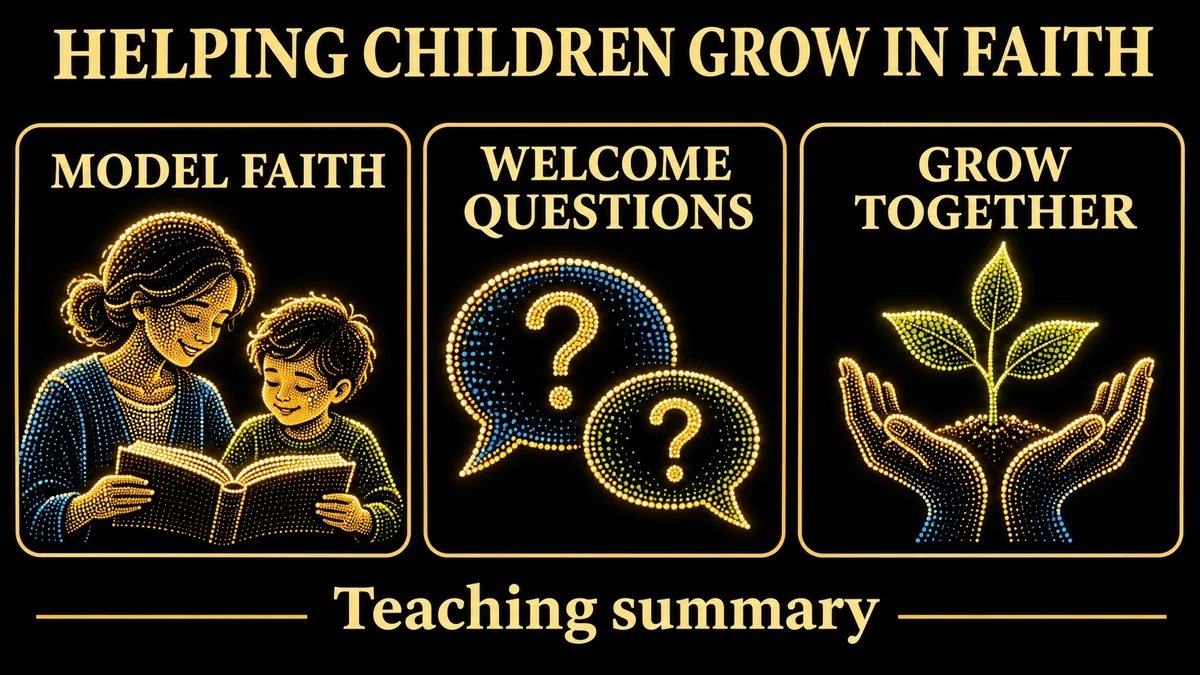
Helping Children Grow in Faith: model faith; welcome questions; grow together. Teaching summary, not a quotation of Scripture or a guaranteed outcome.
A Worked Example: Start With One Sustainable Week
Consider this illustrative situation, not a reported case: a parent wants to restart family Bible reading with a younger child and a teenager. Previous attempts became long lectures, and everyone began avoiding them.
The parent first acknowledges that problem and proposes ten minutes after two evening meals. They read Mark 10:13–16. The younger child identifies whom Jesus welcomes; the teenager asks why some churches make children feel unwelcome. The parent listens rather than defending every church experience.
Together they choose one practical response: include someone who is often left out. The parent models a brief prayer and allows each child to contribute, listen, or pass. When the second evening falls apart because everyone is exhausted, they reschedule without treating the interruption as spiritual defeat.
At the weekend, the parent asks what helped and what felt forced. They shorten the next reading and follow up privately on the teenager’s concern. The practice becomes repeatable because it allows honest feedback.
The point is faithful attention over time. Parents can keep learning, repairing, and inviting while entrusting their children to God. A small practice carried with love can serve that calling without becoming another measure of family success.
Frequently Asked Questions About Raising Children in Faith
Does Proverbs 22:6 Guarantee That a Child Will Remain Christian?
Proverbs 22:6 commends the lasting importance of early training. Read within biblical wisdom literature, it should not become a mechanical guarantee of every child’s future choices or a verdict that struggling parents failed. Teaching matters, but parents cannot manufacture faith. Seek honest reflection and support without accepting blame for everything an adult child believes.
Should Children Be Baptized Before They Can Explain Their Faith?
Christians differ. The Catholic Catechism teaches infant baptism and continuing growth in baptismal grace. The Baptist Faith and Message describes baptism as a believer’s act of obedience expressing faith in Christ. Our guide to baptism and Christian differences explores the disagreement further. Discuss your church’s teaching and practice with its leaders. Neither approach removes the responsibility for sustained Christian nurture, and children should not be pressured into statements they do not understand or believe.
What if My Child Does Not Want to Pray Aloud?
Offer alternatives: listening, silent prayer, a written prayer, or a simple shared response. Ask privately whether embarrassment, uncertainty, language difficulties, or another concern is involved. Public fluency is not a reliable measure of faith. You can model prayer and invite participation without demanding a performance.
What if We Have Neglected This for Years?
Begin with the relationship and one realistic practice. Acknowledge any hurt without expecting a fresh routine to erase it. Invite older children into the conversation instead of imposing an ambitious program. Seek trustworthy pastoral support, and qualified help where harm has occurred. Christian growth leaves room for repentance, patient repair, and a new beginning.
Sources and translation note: Biblical teaching is chiefly paraphrased, with linked World English Bible passages for reading in context. The cited church documents describe their own baptismal teaching. Church of England safeguarding guidance supplies practical examples, while reporting responsibilities and protective services depend on the reader’s location.