

A wedding invitation can bring genuine happiness for a friend and a private ache about your own future. Another Christian may feel settled in an unmarried life, yet face repeated questions about when they will finally settle down. Both can struggle to hear what Scripture actually says beneath the expectations surrounding them.
The Bible teaches that singleness can be a faithful, fruitful way of following Christ. Marriage is good, but it is neither a requirement for Christian maturity nor a promise made to every believer. Jesus and Paul give singleness a dignity the church must honor, while Scripture calls God’s people to offer real companionship, practical care, and room for honest longing.
GUIDED ARTICLE EXPERIENCE
What Does the Bible Teach About Singleness?
Read along as the narration moves through the article.
Browser narration · No stored audio or site tracking
CONTINUE GUIDED TOUR
Continue where you left off.
GUIDED TOUR COMPLETE
You have reached the end of this study.
Study record saved on this device.
GUIDED TOUR
What Does the Bible Teach About Singleness?
Narrator: Paranoid Prophet Recommended Voice Native device narration
Prepare to follow the article as it is narrated.
VOICE & TOUR OPTIONS
Voice & Listening
NARRATOR
Finding a narrator…
Checking the best narrator available on this device.
Restores the site recommendations available in this browser.
Our listening picks lead when available; other voices are ranked for narration. Known novelty voices are hidden. Browser-provided voices may use an online voice service.
Screen-awake support will be checked when narration starts.
Optional: improve your device voices
Listening works with the voices already available here. Your device may offer additional free voices through its own settings.
iPhone or iPad: Settings → Accessibility → Read & Speak (or Spoken Content) → Voices → English. Look for Premium or Enhanced choices, then return here.
If offered, preview Ava or Zoe for U.S. English, or Serena or Jamie for British English. An explicit Premium or Enhanced version can improve on its compact version.
Mac: System Settings → Accessibility → Read & Speak → System voice. Open the voice list to preview or download additional choices.
Windows: Settings → Accessibility → Narrator → Add natural voices. Browser availability varies; a Narrator voice may not appear on websites. Edge may also expose online Natural voices without a model download.
Android: Open Accessibility → Text-to-speech output (the location varies by device). In the preferred engine settings, look for voice data and English choices.
Download sizes vary; some enhanced voices exceed 100 MB. This website cannot install system voices, and an installed voice appears here only if your browser exposes it.
Apple voice guide · Windows voice guide · Android voice guide
CHOOSE A NARRATOR
Recommended on this device
Our listening picks: Aaron, Martha, then Daniel, when available here. Otherwise, automatic uses the highest-ranked suitable voice. Preview alternatives or save your own choice.
Preparing the guided article experience…
RESUME GUIDED TOUR?
Continue where you left off.
GUIDED TOUR COMPLETE
You have reached the end of this study.
Article Guide10 sections
Your Dignity Does Not Depend on Marriage
Human worth begins with being created in God’s image, not with being chosen by a spouse. Genesis 1:26–28 grounds human dignity in God’s creative purpose. Marriage does not confer that dignity, and remaining unmarried does not diminish it. Our guide to being made in the image of God develops this foundation.
Genesis also celebrates marriage. In Genesis 2:18–25, God answers the man’s solitude by creating the woman, and the passage explains their one-flesh union. We should receive that affirmation without turning it into a prediction that every individual will marry.
Jesus lived an unmarried earthly life. Christian teaching confesses Him as fully human and perfectly faithful to the Father. His life rules out the idea that marriage is necessary for complete humanity or mature obedience. He also lived among friends, disciples, and households. His singleness was not a model of emotional isolation.
Paul likewise writes as an unmarried man in 1 Corinthians 7:7–8. Whether he had previously been married is uncertain. His present example is clear enough: an unmarried Christian can lead, teach, love deeply, and serve faithfully without waiting for a different marital status.
Jesus Recognizes Singleness for the Kingdom
Read Matthew 19:10–12 within Jesus’ discussion of marriage and divorce. The disciples respond to the seriousness of marriage by suggesting that it might be better not to marry. Jesus explains that not everyone can receive the saying, then describes different reasons people do not enter marriage.
His language includes people born as eunuchs, people made eunuchs by others, and those who renounce marriage for the kingdom of heaven. In that final expression, Jesus describes voluntary renunciation of marriage. He is not instructing anyone to injure their body. The passage must never become advice for bodily harm or a means of pressuring someone into celibacy.
Jesus honors a way of life devoted to God’s kingdom while recognizing that it is not given to everyone in the same way. This teaching appears alongside His affirmation of marriage, so neither vocation requires despising the other.
There is an older biblical note of hope here too. Isaiah 56:3–5 promises faithful eunuchs a lasting place and name in God’s house. Their future with God is not closed by the absence of biological descendants. Family lineage does not exhaust the ways a life can belong to God’s purposes.
Read Paul’s Counsel in Its Full Context
First Corinthians 7 addresses married believers, unmarried people, widows, and particular questions from the Corinthian church. Paul commends remaining unmarried, acknowledges different gifts from God, and repeatedly permits marriage. In verse 28 he explicitly says that marrying is not a sin.
His counsel also reflects what verse 26 calls the present distress. The precise circumstances are debated; we should not confidently identify a particular famine or persecution from this verse alone. His awareness that the present world is passing away also shapes verses 29–31. These circumstances matter when reading his preference for remaining as one is.
Paul sees a practical opportunity in singleness: freedom from the particular obligations of marriage can allow concentrated attention to the Lord. Married people must also attend to their spouses, which is a real responsibility rather than a spiritual defect. In verse 35, Paul’s stated purpose is their benefit and undivided devotion, not imposing a restraint.
The gift language in verse 7 needs equal care. Christians differ over whether its emphasis falls on a particular capacity for celibate life or God’s provision within different circumstances. Either way, the passage does not define a gift as never feeling attraction, loneliness, or a wish to marry.
Being unmarried today also does not prove a lifelong calling to celibacy. Some freely embrace that vocation; others hope to marry and have not found a suitable spouse. A Christian can practice faithfulness now without claiming certainty about the rest of life. Paul’s permission to marry in verses 8–9 should relieve pressure, not become a command to rush into an unsuitable relationship.
Make Room for Desire, Grief, and Chastity
Chosen singleness and unwanted singleness can feel very different. A person may enjoy meaningful work and friendships while grieving the absence of marriage, sexual intimacy, or children. A widow may miss a particular person rather than simply want a new relationship. Single parents may carry responsibilities that outsiders never notice.
Those experiences deserve attentive listening. Saying that singleness is good does not make every experience within it easy. Faithfulness permits lament, and gratitude can coexist with sorrow. Christian contentment should never be presented as a bargain in which God supplies a spouse once someone stops wanting one.
Historic Christian sexual teaching reserves sexual intimacy for marriage and calls unmarried believers to abstinence. It also calls married believers to fidelity and everyone to respect others’ bodies and boundaries. First Thessalonians 4:1–8 connects holiness with sexual conduct and warns against wronging another person. Chastity concerns faithful love and self-control, not contempt for the body.
People experience desire differently. Neither strong desire nor little desire establishes someone’s spiritual worth. Pastoral care should offer truthful teaching without humiliation, invasive questioning, or assumptions about a person’s sexuality.
Bring actual hopes to God. Ask for companionship, wisdom, and strength for today’s responsibilities. Our guide to how Christians should pray encourages prayer rooted in trust rather than techniques for securing a desired outcome.
Resurrection Hope Reorders Our Expectations
In Matthew 22:23–33, the Sadducees challenge Jesus with a question about a woman who has had seven husbands. Their scenario assumes that resurrection would simply continue the present arrangements of marriage.
Jesus corrects that assumption. Those raised do not marry or enter marriage as people do in this age. His comparison with angels concerns that condition; He does not say that human beings become angels. The passage affirms God’s power and the reality of resurrection.
Marriage therefore belongs to this present life rather than defining the final fulfillment of every person. Christians need not experience every earthly good to share fully in God’s promised future. That hope honors marriage without making it ultimate.
This should produce patience, not a dismissal of present pain. Resurrection hope gives grief a horizon. It does not authorize telling a lonely person that friendship, tenderness, or practical support no longer matter.
Christian Traditions Have Honored Celibacy Differently
Voluntary celibacy has a long place in Christian life, including consecrated virginity and monastic communities. Yet a celibate religious vocation, a requirement for a particular ministry, and someone’s current unmarried circumstances are distinct matters.
Catholic teaching honors both marriage and virginity for the kingdom, as the Catechism’s discussion of these callings explains. The Latin Catholic Church normally requires priestly celibacy, with exceptions. Eastern Catholic churches have a different discipline that permits ordaining married men as priests. The Catechism, paragraphs 1579–1580, explicitly distinguishes those practices.
Eastern Orthodoxy highly values monastic life while also having married parish priests. Marriage ordinarily precedes ordination, and bishops are celibate. The Orthodox Church in America’s explanation of clergy outlines these distinctions. Honoring monasticism does not mean that every Orthodox Christian must become a monastic.
Many Protestant reformers rejected compulsory clerical celibacy and defended ministers’ freedom to marry. The Lutheran Augsburg Confession, article 23, is one influential example. Protestant churches vary in how explicitly they recognize celibate vocations, and their approaches should not be treated as identical.
These differences involve theology, church discipline, and history. Explaining them fairly is more helpful than claiming that one tradition universally despises marriage or another has no place for singleness.

Church Family Must Become Practical Care
When Jesus identifies those who do God’s will as His brother, sister, and mother in Mark 3:31–35, He gives disciples a family relationship that extends beyond biological kinship. The church should make that belonging visible. What Is the Church? explains this shared life in Christ.
Invite unmarried people into ordinary meals and holidays, not only singles events. Ask about work, friendships, concerns, and interests instead of making every conversation about dating. Include people across ages and marital situations in decisions and relationships. Singleness is not a measure of spiritual immaturity or an automatic qualification for extra volunteer shifts.
Practical care matters too. Someone living alone may need a ride after a medical appointment, help during illness, or a trusted person to call in an emergency. A single parent may need reliable childcare or help with household tasks. Ask what would help rather than deciding from a distance.
Friendship must be mutual. Unmarried Christians have gifts to share and needs others should welcome. They should be able to decline service without having to prove their time matters. Our guide to Christian friendship explores the patient habits that help relationships deepen.
Romans 12:9–16 joins sincere love with hospitality, practical generosity, and sharing both joy and sorrow. A church’s teaching about singleness becomes credible when those practices reach the people in its pews.
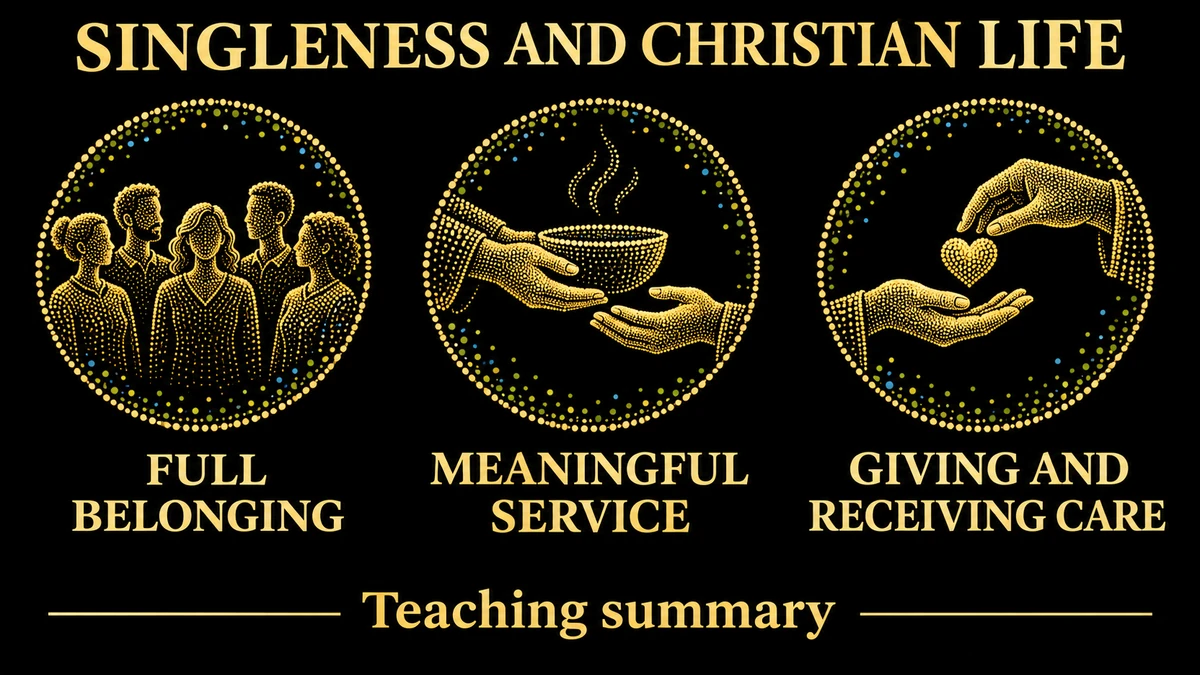
Singleness and Christian life: full belonging; meaningful service; giving and receiving care. Teaching summary, not a quotation of Scripture.
A Practical Case: Belonging Beyond Sunday
Consider an illustrative case, not a reported event. Daniel is thirty-eight, lives alone, and hopes to marry. He enjoys his church, but most invitations he receives involve covering a volunteer shortage. When he mentions difficult weekends, a friend tells him that God will send someone once he is content.
A better response begins by withdrawing that unsupported promise and listening. Daniel says he would value regular company more than another dating suggestion. Two friends arrange a fortnightly dinner with him. One is married and one is single; their friendship does not depend on matching life stages.
When Daniel has a minor procedure, a friend provides the ride he needs and another brings a meal. Daniel contributes to their lives too, but their care is not payment for his usefulness. His ministry leader asks about his actual capacity before requesting another shift and accepts his answer.
Daniel continues to pray about marriage and may pursue a relationship wisely. He does not need to announce a permanent celibate calling to receive support now. Nor do his friends need to solve his future before they can share his present life.
The loneliness has not vanished, and the story has no promised wedding. What changes is the congregation’s response: an unmarried member is known, welcomed, and cared for as a person whose life already matters.
Common Questions About Singleness
Does the Bible promise that every Christian will marry?
No. Scripture celebrates marriage and permits believers to desire it, but it gives no universal promise of a spouse. Advice that guarantees marriage after enough prayer, healing, or contentment goes beyond what the Bible says.
Does wanting marriage mean I lack the gift of singleness?
Desire alone cannot settle that question. First Corinthians 7 does not define the gift as an absence of longing. You can seek wise counsel, remain open to marriage, and live faithfully while unmarried without declaring your present circumstances permanent.
Is singleness more spiritual than marriage?
Paul commends its opportunities for devotion, and traditions differ in how they describe consecrated celibacy. Neither marital status automatically makes someone holy. Both married and unmarried Christians need grace, obedience, humility, and love. A wedding is no certificate of maturity.
How should a church support someone who is lonely?
Listen before advising. Offer consistent friendship, shared meals, practical help, and inclusion in ordinary life. Respect boundaries and avoid treating every friendship as a matchmaking opportunity. If loneliness becomes persistent or overwhelming, support seeking appropriate pastoral and professional help rather than blaming weak faith.
Follow Christ in the Life You Have Today
You do not have to predict your future to take the next faithful step. Cultivate a friendship, tell someone what support you need, bring your hopes honestly to God, and attend to the responsibilities already before you. A fulfilled Christian life includes receiving love as well as giving it.
Churches can begin just as concretely: listen, make room at the table, and honor unmarried believers without conditions. The Bible’s teaching on singleness calls us toward Christ and toward one another. Your place among His people does not wait for a wedding day.