
GUIDED ARTICLE EXPERIENCE
Resurrection vs Reincarnation: What Happens After Death?
Read along as the narration moves through the article.
Private device narration · No hosted audio or tracking
CONTINUE GUIDED TOUR
Continue where you left off.
GUIDED TOUR COMPLETE
You have reached the end of this study.
Study record saved on this device.
GUIDED TOUR
Resurrection vs Reincarnation: What Happens After Death?
Narrator: Paranoid Prophet Recommended Voice Native device narration
Prepare to follow the article as it is narrated.
VOICE & TOUR OPTIONS
Voice & Listening
NARRATOR
Finding a narrator…
Checking the best narrator available on this device.
Restores the best curated narrator available on this device.
Narrator choices are curated for clear, long-form listening on this device.
Screen-awake support will be checked when narration starts.
CHOOSE A NARRATOR
Curated for this device
Choose a verified narrator for this browser, or use System Narrator. Automatic mode uses the best reliable route exposed by this device; your chosen narrator is preserved even if this device needs a temporary fallback.
Preparing the guided article experience…
RESUME GUIDED TOUR?
Continue where you left off.
GUIDED TOUR COMPLETE
You have reached the end of this study.
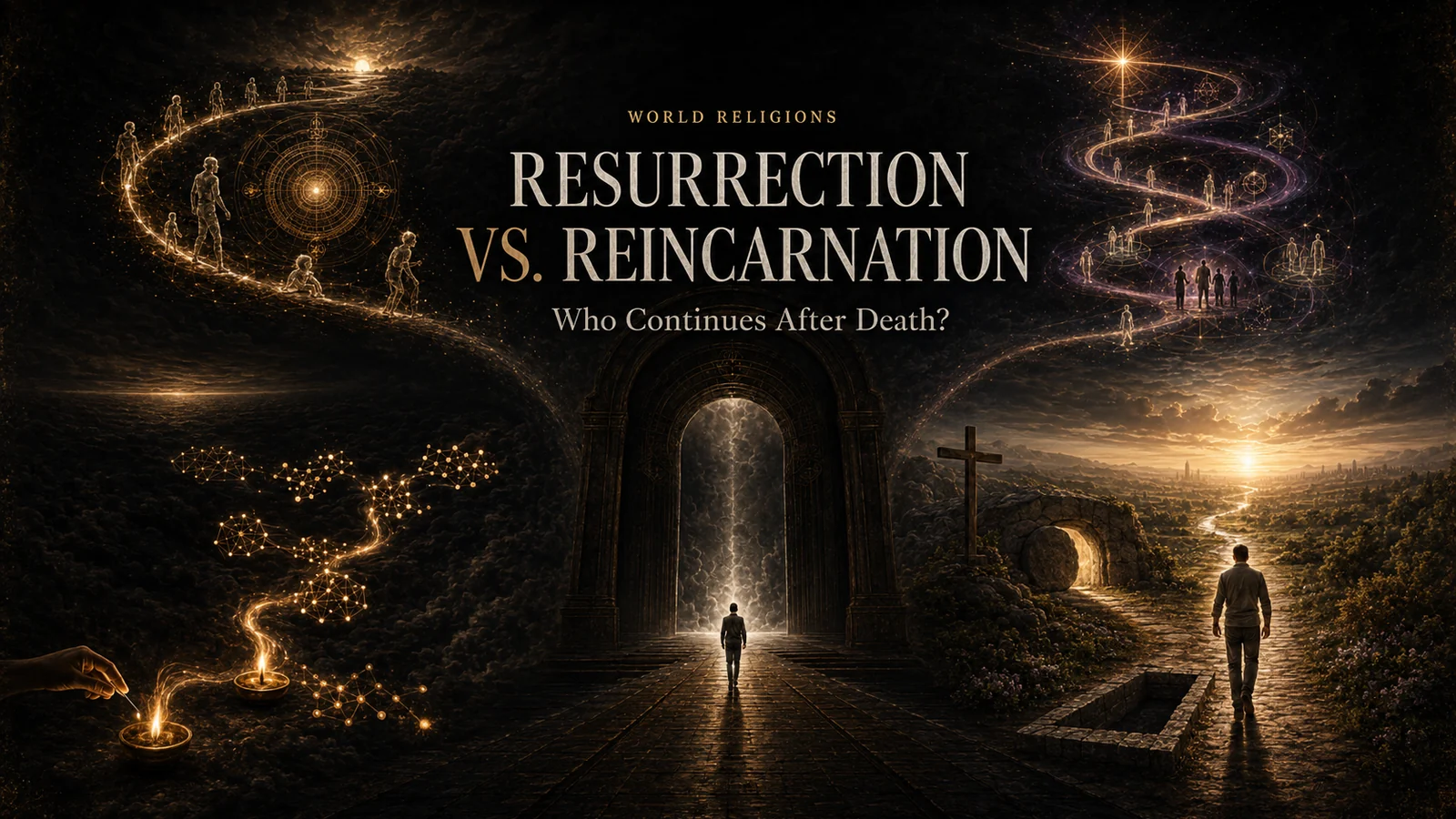
Death is not the only question. The deeper question is what kind of future, if any, follows it. Does an enduring self take another body? Does a karmically conditioned process continue without an eternal soul? Does a higher self choose new lives for growth? Or does the personal God raise and transform the person who died?
Those are not interchangeable versions of a vague belief in “life after death.” They are rival accounts of identity, justice, embodiment, liberation, and hope. Comparing them fairly requires more than matching familiar words. It requires hearing each tradition in its own categories, allowing for internal diversity, separating sacred texts from later interpretation, and distinguishing empirical reports from philosophy and theology. That is the approach explained in our guide to comparing religions fairly.
A serious resurrection vs reincarnation comparison must ask more than whether something survives death. This article therefore begins with description before evaluation. It will distinguish Hindu reincarnation from Buddhist rebirth, modern New Age past-life spirituality from both, and Christian resurrection from them all. Then it will test the questions that press on every view: Who continues? What grounds responsibility? What evidence is available? What finally happens to death?
Article Guide17 sections
Short Answer: Resurrection and Reincarnation Are Not the Same
Reincarnation usually describes an enduring subject entering another embodiment after death. Many Hindu traditions affirm such continuity through samsara, the recurring course of birth and death, while disagreeing about the self, God, and the meaning of liberation.
Buddhist rebirth is different. Buddhism generally denies that an eternal, unchanging soul migrates from body to body. It teaches conditioned continuity: intentional action, craving, ignorance, and their effects contribute to renewed existence. The later being is causally related to the earlier one without being an immortal self carried intact between bodies.
New Age past-life spirituality often speaks of a soul or higher self choosing lives, learning lessons, healing wounds, or advancing through spiritual evolution. That modern Western synthesis may borrow Asian vocabulary, but it should not be projected backward as the consensus of ancient Hindu or Buddhist traditions.
Christian resurrection is neither another earthly life nor the escape of an immortal essence from embodiment. Christianity teaches one mortal life, death, judgment, and God’s bodily raising of the person who died. Jesus Christ is the firstfruits: the same crucified Jesus rose transformed, and those who belong to Him will be raised into renewed creation.
So the central contrast is not cycle versus cycle. It is repeated embodiment or conditioned rebirth versus a personal act of God that judges, saves, raises, and finally defeats death.
Why “Life After Death” Is Too Broad a Category
Two people may agree that death is not the end and still disagree about almost everything that matters. “Life after death” does not tell us whether the individual survives, whether a soul exists, whether another body is earthly or transformed, whether memory continues, whether the goal is another life or release from becoming, or whether salvation comes through moral causation, insight, devotion, grace, or divine judgment.
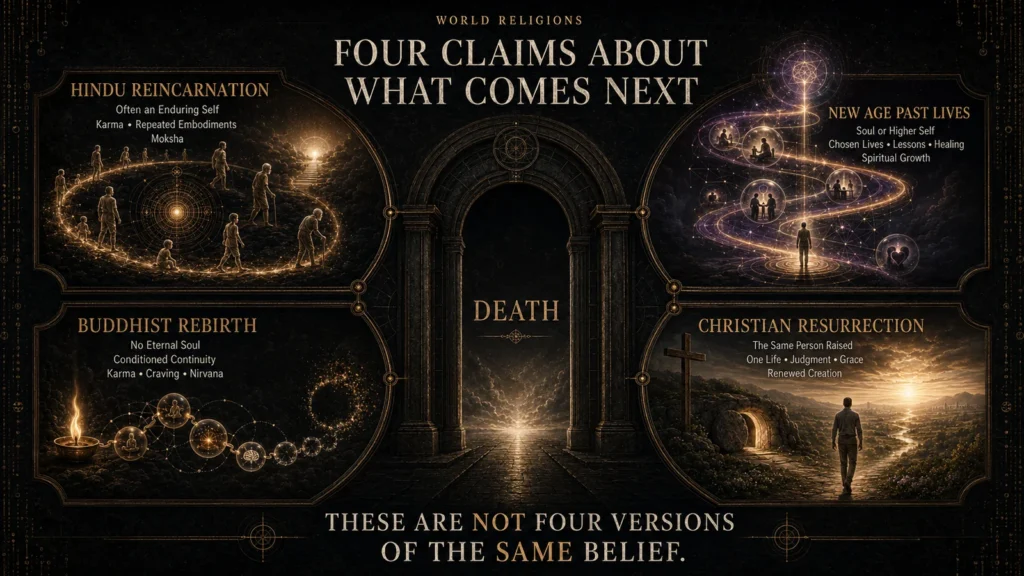
Four Claims About What Comes Next
- Hindu reincarnation: Many traditions teach that an enduring self passes through successive embodiments under karma until liberation, though the identity of that self and the nature of liberation differ by school.
- Buddhist rebirth: Karmically conditioned existence continues without an eternal soul. The goal is awakening and the ending of ignorance, craving, suffering, and renewed becoming.
- New Age past lives: A soul or higher self often returns for lessons, healing, chosen experiences, or spiritual development.
- Christian resurrection: God raises the person who died, transforms embodied life, judges personally, and brings those united to Christ into a renewed creation.
Even their destinations differ. Moksha is a Hindu term for liberation whose meaning depends on the school. Nirvana is the Buddhist liberation from the causes of suffering and renewed existence. Neither term simply means Christian heaven. Christianity’s final hope is not endless disembodied residence elsewhere but resurrection life with God in a creation set free from corruption.
What Hindu Traditions Mean by Reincarnation
There is no single Hindu creed that settles every question about reincarnation. Hindu traditions commonly affirm karma, samsara, repeated embodiment, and liberation, but they disagree sharply about the self, ultimate reality, the personal God, individuality, devotion, knowledge, action, and grace. A fair account begins with shared texts and then names the schools that read them differently.
The enduring self and changing bodies
In Swami Gambhirananda’s English translation, as presented by the IIT Kanpur Gita Supersite, Bhagavad Gita 2:13 compares the embodied person’s movement through childhood, youth, and old age with passing to another body. In Gita 2:22, the embodied one leaves worn garments and takes new ones, as it leaves worn bodies and enters others. Gita 2:20 describes the self as unborn and not killed when the body is killed.
These passages support real continuity through bodily change. Terms such as atman can denote self, while jiva commonly denotes the living, embodied individual. Yet naming continuity does not settle its deepest nature. The Upanishadic and Vedanta traditions disagree over how the individual self relates to Brahman, the ultimate reality.
Karma, desire, and samsara
Karma literally concerns action and, in these contexts, the morally significant consequences of action. It is not best reduced to a god handing out punishments. In Patrick Olivelle’s The Early Upanisads: Annotated Text and Translation, the Brihadaranyaka Upanishad 4.4 links a person’s becoming with desire, intention, and action; the Chandogya Upanishad 5.10 presents differing postmortem paths and renewed birth. The Gita ties attachment and desire to action while teaching ways of action, knowledge, and devotion that do not bind in the ordinary way.
Samsara is therefore not merely an optimistic opportunity to sample more lives. It is bondage to recurring birth and death. A favorable rebirth may be better than an unfavorable one, but it remains within the condition from which liberation is sought. Contemporary language about “coming back to learn another lesson” can miss this classical urgency.
Moksha and the end of rebirth
Moksha means liberation, but what liberation preserves depends on the tradition. In Advaita Vedanta, associated especially with Shankara, the deepest self is Brahman. Liberating knowledge removes the ignorance by which one identifies with a separate empirical individuality. Karma and rebirth lose their hold when nondual reality is known.
Ramanuja’s Vishishtadvaita defends the reality of individual selves while teaching their complete dependence on the personal God. Liberation does not erase the soul into an undifferentiated identity; devotion, surrender, and communion matter. Madhva’s Dvaita goes further in affirming an enduring distinction between God and souls. Vishnu’s grace is indispensable to liberation. Samkhya, which is not Vedanta, teaches many distinct conscious selves, or purushas, and seeks their disentanglement from material nature.
These are not cosmetic variations. One view understands the deepest identity as nondual Brahman; another preserves dependent individuality in loving relation to God; another maintains eternal difference; another analyzes reality through a plurality of conscious selves and material nature. Bhakti traditions can give devotion and divine grace a substantial role, so it would be false to describe every Hindu path as self-salvation by an impersonal moral machine.
Why Hindu traditions disagree
The same scriptural inheritance is interpreted through different metaphysical and devotional frameworks. Shankara, Ramanuja, and Madhva all engage the Upanishads, Bhagavad Gita, and Brahma Sutras, yet reach competing conclusions about what those texts finally teach. Hindu reincarnation is therefore a family of claims, not one mechanism with one destination.
Still, a broad contrast is possible. In many Hindu systems, a real enduring subject stands behind successive embodiments, even when empirical individuality is ultimately reinterpreted. Karma connects lives, and liberation ends the bondage of samsara. That is close enough to ordinary “reincarnation” language to be recognizable, but accurate description must keep the school-specific qualifications in view.
What Buddhism Means by Rebirth
Buddhism affirms samsara, karma, renewed birth, and liberation while generally rejecting an eternal self. That combination can sound contradictory if “rebirth” is assumed to require a soul that travels. Buddhist thought instead analyzes a person as a conditioned process and asks how suffering continues when its causes continue.
No eternal soul
In Samyutta Nikaya 22.59, the Buddha examines form, feeling, perception, volitional formations, and consciousness, the five aggregates by which a person is ordinarily analyzed. Each is impermanent, vulnerable to affliction, and “not-self” (anatta). Even consciousness is not identified as an eternal owner behind experience.
This does not mean human beings are imaginary or that nothing exists. Nor does the Mahayana teaching of emptiness mean sheer nothingness. It denies independent, inherent self-existence and emphasizes dependent arising. At the conventional level, people act, suffer, remember, promise, practice, and bear consequences. The denial concerns an unchanging essence, not ordinary moral life.
Rebirth through dependent origination
Samyutta Nikaya 12.2 sets out dependent origination: ignorance conditions volitional formations, which condition consciousness and the further links that culminate in birth, aging, and death. When ignorance and craving cease, the chain leading to renewed suffering is brought to an end.
Majjhima Nikaya 38 is especially important because a monk named Sati claims that the very same consciousness roams and transmigrates. The Buddha rebukes that view and explains consciousness as arising dependent on conditions, as a fire is named according to its fuel. Rebirth is affirmed, but an unchanged packet of consciousness is not.
Karma without an eternal self
Buddhist karma centers on intentional action. Intentions shape dispositions, experience, and future conditions. The later stream is dependent on the earlier stream, so it is not arbitrary or wholly unrelated. Yet there is no permanent substance sitting beneath the series as its owner.
Neither the Same nor Unrelated
A later Buddhist dialogue, the Milindapañha, uses analogies such as one flame lighting another and milk becoming curds to explain causal continuity without an eternal traveler. Buddhist continuity is neither strict identity nor complete difference. One moment conditions the next; one life conditions renewed existence. The later being is not an eternal soul carried over unchanged, but neither is it causally disconnected from the intentions and craving that preceded it. The analogies explain a relation; they do not turn the process into a hidden atman.
This approach answers the insider question “Who receives the karma?” by challenging the assumption that responsibility requires an immutable substance. Causal dependence can ground concern and consequence. A Christian or other critic may still ask whether that relation is enough for moral desert, but the criticism should engage this actual Buddhist answer rather than insert a soul Buddhism denies.
Nirvana and the end of renewed existence
The Four Noble Truths diagnose suffering, trace its origin to craving, announce its cessation, and prescribe the Noble Eightfold Path. Nirvana names liberation from ignorance, craving, suffering, and renewed becoming. It is not simply a more pleasant rebirth. Classical Buddhist practice seeks freedom from the cycle itself.
Theravada, Madhyamaka, Yogacara, Tibetan, and Pure Land qualifications
Theravada emphasizes conditioned continuity through karma and craving within the early discourses and later analysis. Madhyamaka presses the emptiness of all things, including any inherently existing person, while retaining conventional causal and moral continuity. Yogacara develops a model of alayavijnana, often translated “storehouse consciousness,” in which karmic seeds are carried and mature. This storehouse is conditioned and transformable; it must not be relabeled an eternal soul.
Tibetan traditions may speak of a subtle continuity of consciousness and recognize tulkus, rebirth lineages connected with teachers and compassionate service. Even here, the tradition does not simply adopt a Hindu-style atman. Tibetan explanations can distinguish a continuation in the same mind-stream from emanation, karmic connection, or appointed succession.
Pure Land traditions seek birth in the Buddha-field of Amitabha or Amida through his vow and practices of entrusting and remembrance. The Pure Land is favorable for awakening and liberation from samsaric bondage. It is not Christian heaven, Amitabha is not the biblical Creator, and “other-power” should not be equated with the gospel of Christ merely because both use language of dependence.
What New Age Spirituality Means by Past Lives
“New Age” names a diverse modern spiritual milieu rather than a single church or canon. Its past-life teachings often combine Western esotericism, Theosophy, spiritualism, therapeutic culture, ideas drawn from Asian religions, and confidence in personal experience. Because authority is decentralized, two practitioners may offer very different accounts.
Courtney Bender’s study of contemporary American past-life practice traces how such beliefs are adapted within modern spiritual life.
Soul growth and chosen experience
A common model presents a soul or higher self that survives death and chooses repeated lives in order to learn, evolve, balance energies, heal relationships, or experience many perspectives. Suffering may be framed as part of a curriculum chosen before birth. Relationships can be interpreted through “soul groups,” and recurring conflicts through unfinished past-life business.
This can feel morally and emotionally attractive. It gives pain a purpose, preserves loved connections, and portrays the universe as a school rather than a courtroom. Some adherents also emphasize compassion and freedom rather than punishment. Fairness requires acknowledging that appeal before asking whether the claims are true.
Soul contracts and regression
Some teachers speak of soul contracts, life-between-lives planning, or memories recovered through guided imagery and hypnosis. Such narratives can be meaningful to the person who experiences them. Emotional vividness, however, is not the same as historical memory. Suggestion, imagination, role expectation, cryptomnesia, and confabulation can produce detailed stories without deceit.
Why this differs from classical Asian traditions
The modern emphasis on self-development through chosen lives differs from classical traditions that often see renewed birth as bondage. Hindu moksha and Buddhist nirvana are not simply graduation after enough self-selected adventures. Buddhism also denies the durable higher self assumed in much New Age practice. Hindu traditions may preserve an enduring self, but they do not all teach pre-birth contracts or a therapeutic program of soul evolution.
What Christianity Means by Bodily Resurrection
Christian hope begins not with a naturally recurring cycle but with the personal God who creates, judges, redeems, and raises. Resurrection is what God does for the dead. It is bodily, personal, transformative, and final.
One life, death, and judgment
The Bible’s pattern is linear: creation, fall, redemption, judgment, resurrection, and renewed creation. Hebrews 9:27 says that people die once and then face judgment, but the doctrine does not rest on that sentence alone. Daniel 12:2 anticipates the awakening of the dead. John 5:28-29 speaks of those in the tombs coming out. Acts 17:30-31 joins judgment to the risen Jesus. Revelation 20-22 moves from judgment to the new heaven and new earth.
Christianity does not teach that every person receives identical circumstances. It teaches that every person is fully known by the perfectly just God. One life does not limit God’s knowledge of motives, wounds, opportunities, secrets, or responsibility.
Jesus as firstfruits
Christian resurrection is anchored in Jesus, not first in a theory about human survival. In 1 Corinthians 15, Paul proclaims that Christ died for sins, was buried, was raised, and appeared. He calls Christ “the firstfruits” of those who have fallen asleep. His resurrection begins the harvest that will include His people.
That is why the cross cannot be detached from the future hope. Jesus willingly bears sin and gives Himself for sinners; God raises Him in victory. For a fuller account of the atonement, see why Jesus died. Resurrection is not a reward earned by cycling through enough lives. Those united to Christ receive forgiveness and life by grace.
The same person, transformed body
Luke 24:36-43 depicts the risen Jesus as tangible and able to eat, yet His life is no return to ordinary mortality. Philippians 3:20-21 says Christ will transform the believer’s lowly body to be like His glorious body. Romans 8:18-25 places human resurrection within the liberation of creation from corruption.
The person raised is the person who died. Continuity makes recognition, redemption, and judgment intelligible. Transformation means the risen life is imperishable and glorious. Christian thinkers disagree about the metaphysical mechanism of personal identity, but the doctrine does not require God to retrieve every atom a body ever contained. Human bodies exchange matter throughout life. God’s faithfulness is to the embodied person and history, not to a museum inventory of particles.
Resurrection rather than resuscitation
Resuscitation restores someone to ordinary mortal life, as when a person is revived and will later die. Resurrection raises into a new order of embodied life beyond death’s dominion. Jesus is not merely a corpse restarted for a few more years. He rises never to die again.
Paul’s phrase “spiritual body” in 1 Corinthians 15 does not mean an immaterial ghost. The contrast is between a body animated by ordinary mortal life and a transformed body empowered by God’s Spirit. The adjective describes the source and quality of life, not the absence of a body.
New creation rather than escape
The Christian destination is communion with God in a healed creation. Revelation 21-22 pictures God dwelling with humanity, death abolished, tears wiped away, and the nations healed. Christianity includes questions about the intermediate state, but its final hope is resurrection, not permanent escape from embodiment.
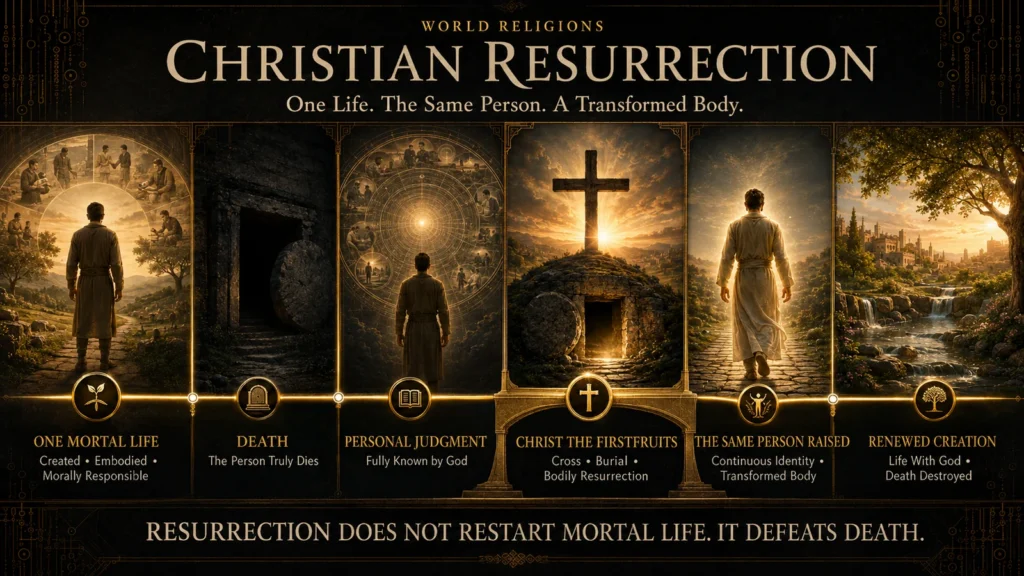
Christian Resurrection in 60 Seconds
- Human beings receive one mortal life.
- Death is followed by God’s personal judgment.
- God raises the person who died.
- The body is continuous yet radically transformed.
- Grace comes through Christ’s cross, not accumulated lives.
- The risen Christ is the firstfruits and foundation of Christian hope.
- Those who belong to Him will live in renewed creation.
- Death, the last enemy, will be destroyed.
Who, Exactly, Continues After Death?
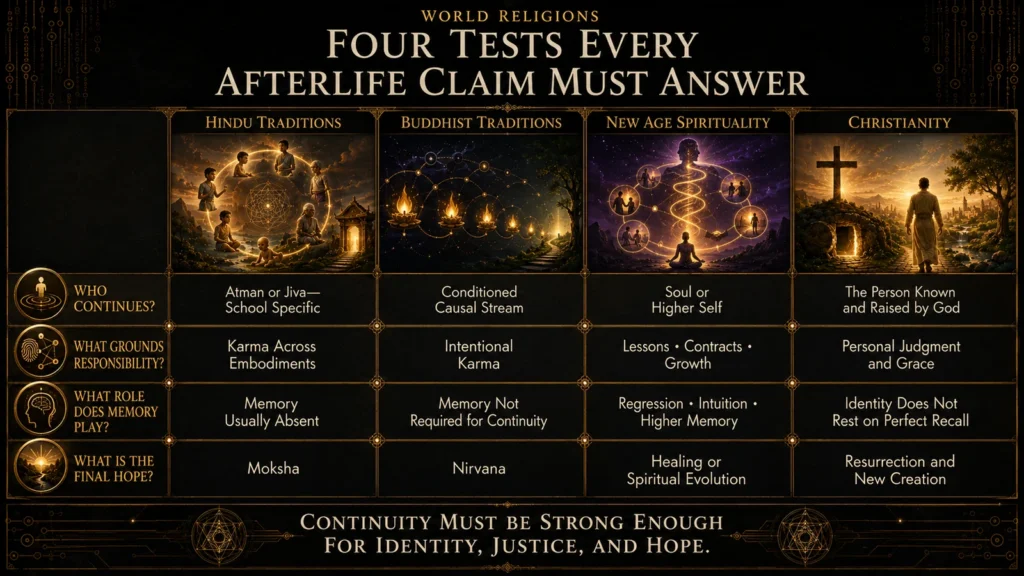
Every account must connect a present person with a future outcome. Without enough continuity, “my” future belongs to someone else. With too rigid a theory, ordinary bodily and psychological change can seem to destroy identity even during this life.
Hindu enduring-self models
Many Hindu accounts answer with an enduring atman or jiva. The self remains through changing bodies while subtle mind, dispositions, desires, and karmic effects help explain the conditions of embodiment. Complete autobiographical memory is not required, just as an adult remains the person who was once an infant despite recalling little of infancy.
The comparison becomes more complex at liberation. Advaita distinguishes the empirical individual from the deepest self identical with Brahman. Vishishtadvaita preserves real dependent souls in relation to God. Dvaita insists on enduring difference. Asking “Does Hinduism preserve the individual?” therefore receives school-specific answers.
Buddhist causal continuity
Buddhism rejects the demand for an unchanging bearer. A stream of conditioned aggregates continues because earlier causes produce later effects. The relation is strong enough for karma and compassion while empty of permanent essence. From within that framework, insisting on a soul begs the question.
A philosophical challenge remains: Is causal descent alone enough for the later sufferer to deserve consequences of an action he or she cannot remember? Buddhist thinkers can reply that responsibility never required an immutable substance; even within one life, the angry child and repentant adult differ profoundly while remaining causally connected. The debate is not solved by calling rebirth incoherent. It turns on what kind of continuity moral responsibility needs.
New Age higher-self models
New Age models often preserve a higher self that contains or coordinates multiple incarnations. The everyday personality may forget, while a deeper level remembers the whole curriculum. This offers a direct subject of growth, but it raises another question: If the conscious personality has almost no access to prior choices, in what sense is the current life an informed lesson rather than a story supplied afterward?
The person known and raised by God
Christian identity rests finally in God’s knowledge, creative authority, covenant faithfulness, the person’s embodied history, moral agency, and relation to Christ. God does not manufacture a replacement with copied memories. He raises the dead. The risen person can be transformed without becoming someone else, just as Jesus is gloriously changed yet still bears the history of the crucified Lord.
Memory, identity, and responsibility
No view should make perfect recall the sole test of identity. Injury, dementia, sleep, and ordinary forgetting do not erase personhood. Yet memory still matters as evidence and as a means of moral formation. Rebirth may be defended as moral causation without conscious memory. It is harder to describe it as education when the student ordinarily does not remember the lesson, the offense, or the prior classroom.
Christian resurrection does not promise omniscient self-recall as the basis of salvation. It promises that the God who forgets nothing will restore and judge the actual person, heal what sin has damaged, and preserve personal history within transformed embodied life.
Karma or Judgment: What Makes Justice Possible?
Karmic traditions and Christianity agree on a morally serious point: actions matter. Human choices are not swallowed by an indifferent universe. But they explain consequence, guilt, forgiveness, and final restoration in different ways.
Why karma can appear morally compelling
Karma offers a connection between conduct and consequence wider than one visible lifetime. It can explain why good action matters even when wrongdoers seem to prosper and victims receive no earthly repair. It may also encourage patience, discipline, non-harm, generosity, and responsibility.
Its exact meaning varies. Buddhist karma is intentional action within dependent causation, not a decree from a creator God. Some Hindu systems likewise describe an ordered moral causality, while theistic schools include divine governance, devotion, and grace. It would be unfair to reduce all karma to automatic punishment or to claim that every adherent sees every tragedy as deserved.
Why memory and identity matter
Justice normally asks who acted, with what knowledge and intent, and who receives the consequence. An enduring Hindu self supplies a direct bearer, though missing memory complicates the educational value. Buddhist continuity supplies causal inheritance without immutable identity. New Age models often appeal to the higher self’s choice or memory.
Each answer has a cost. Too little continuity threatens desert; too much appeal to hidden decisions makes the theory difficult to test. A doctrine of justice should not merely fit any outcome after the fact.
The danger of hidden-desert explanations
When suffering is explained by unknown wrongdoing in another life, the claim can become unfalsifiable and pastorally cruel. A poor, abused, disabled, or grieving person can be told that present pain was earned or chosen, even when no evidence identifies the supposed act or contract. Classical traditions contain resources for compassion, and many adherents reject such blunt conclusions. Still, any system that invokes hidden desert must guard against turning mystery into blame.
Christianity also fails when believers casually treat every hardship as God’s direct punishment. Jesus rejects the disciples’ attempt to assign the man born blind a simple causal guilt in John 9. The book of Job condemns confident explanations from observers who do not know God’s purposes. A Christian doctrine of judgment is not permission to diagnose another person’s suffering.
God’s personal judgment
Biblical judgment is personal because God knows the agent, deed, motive, opportunity, and harm. Romans 2 speaks of impartial judgment; Acts 17 connects the appointed Judge with Jesus’ resurrection; 2 Corinthians 5:10 places every person before Christ. Christianity does not claim identical circumstances. It claims that every person is known completely and judged by the perfectly just God. Repeated lives are not required for God to judge rightly.
Grace, forgiveness, and transformation
Karma can describe consequence, but Christianity places forgiveness at the center. Guilt is not ignored or transferred by moral fiction. At the cross, the Son willingly offers Himself; God is both just and the justifier of the one who trusts Jesus. Repentance is not denial of responsibility. It is turning from sin to receive mercy and a changed life.
Grace does not make conduct irrelevant. It reconciles the guilty, gives the Spirit, and produces obedient fruit. Nor does forgiveness by itself undo every temporal injury. Christian hope includes judgment, resurrection, and God’s final setting right of creation. Its distinctive claim is that justice and mercy meet in a person: the crucified and risen Christ.
Are Past-Life Memories Evidence for Reincarnation?
The strongest empirical claims do not come from adults under hypnosis. They concern young children who spontaneously speak about an apparent previous life, often between ages two and five. Reports can include another name, family, place, occupation, manner of death, unusual fear, preference, recognition, or birthmark. Some statements are later matched with a deceased person.
Why some childhood cases deserve attention
The University of Virginia Division of Perceptual Studies has collected and investigated such reports for decades. A 2022 scoping review identified 78 observational studies; most involved children, and case reports were the predominant design. The recurring features across cultures justify careful study rather than ridicule.
Serious attention is not the same as endorsement. Case investigation can preserve testimony, test details, and compare explanations. It cannot bypass problems of selection, retrospective memory, cultural expectation, or causal inference merely because a story is striking.
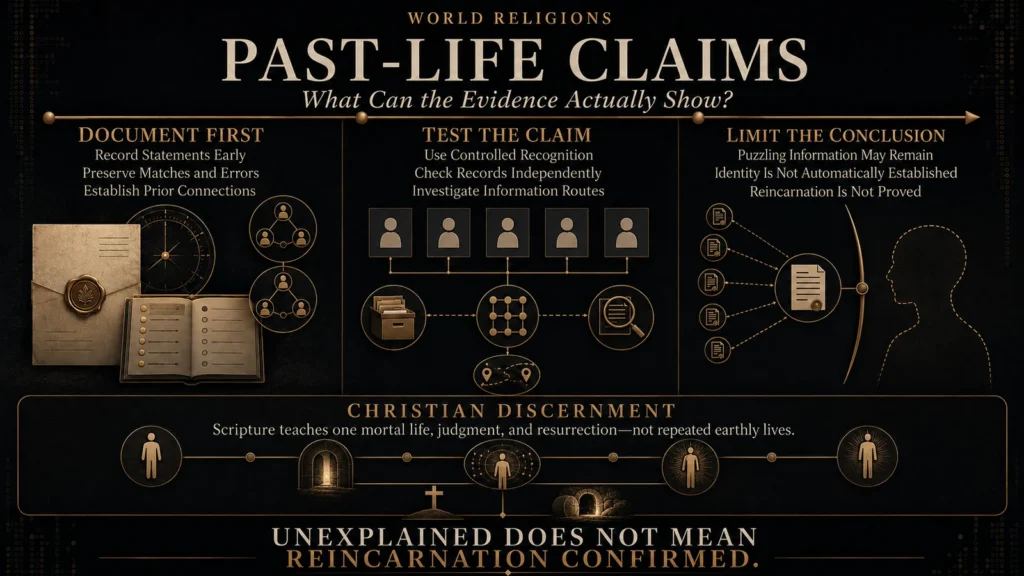
What makes a case strong
A stronger case records the child’s statements before a candidate deceased person is identified. Investigators arrive early. The families have no known contact. Statements are specific rather than flexible, and errors are preserved alongside matches. Recognition tests include controls. Birthmark or medical claims rely on independent records. Researchers actively look for ordinary channels by which information could have traveled.
A weaker case begins after families meet, depends on recollection years later, counts only successes, uses broad details, permits repeated prompting, or never defines the candidate pool. If dozens of possible deceased people could fit, an impressive match may be a selection effect rather than evidence of personal survival.
Information leakage, memory, culture, and matching
Children absorb more than adults realize. Family conversation, local stories, media, visits, and leading questions can supply information without fraud. Once a candidate is proposed, both families may reconstruct earlier statements in light of the match. Cultural belief can shape which comments receive attention and how they are interpreted.
Chance matters too. A large collection of vague statements will produce coincidences. Fraud is possible in some cases, but it is not fair to declare every family dishonest. Psychological identification, fantasy, cryptomnesia, and ordinary memory error may explain some reports. A strong investigation tests these options rather than selecting one in advance.
What anomalous information would prove
Suppose a prospectively documented child reports several specific facts that were inaccessible by normal means. That would be anomalous and important. It would not, by itself, prove that the child is numerically the same person as the deceased. Information could be related without identity.
Alternatives sometimes proposed include telepathy, clairvoyance, communication from surviving consciousness, spiritual influence, or an unknown memory mechanism. Naming alternatives does not establish them. It shows that the data underdetermine the worldview. Even a genuinely anomalous case would not prove universal reincarnation, karma, samsara, Hindu metaphysics, Buddhist dependent rebirth, New Age soul contracts, or any particular path of liberation.
UVA’s 2025 research initiative appropriately shifts toward cognitive, neurophysiological, environmental, memory, and trauma pathways. That is what an open question requires: better methods and competing hypotheses, not a victory announcement.
Why hypnotic regression is weaker
Hypnosis increases suggestibility and can increase confidence without guaranteeing accuracy. Guided prompts can invite a subject to construct scenes, roles, and emotional narratives. Cryptomnesia can make forgotten information feel newly discovered. A story may be therapeutic or symbolically meaningful without being a recovered historical event.
Past-life regression also reverses the evidential advantage of spontaneous child reports. The adult is asked to produce a past-life narrative within a setting that expects one. A published ethics review warns of false-memory risk and the lack of evidence-based support. The responsible verdict is narrow: hypnotic past-life regression may produce emotionally meaningful narratives, but it is not a reliable method for recovering verifiable historical memories.
Evidence Quality Checklist
- Was the statement recorded before a match was proposed?
- Were the two families previously connected?
- Were errors counted as carefully as correct details?
- Was recognition tested with credible controls?
- Was medical evidence documented independently?
- Were ordinary routes of information investigated?
- Was the case reviewed by an independent investigator?
- What worldview, if any, would the data actually establish?
Some cases may remain puzzling after this checklist. “Unexplained” is an honest category. It is not a synonym for “reincarnation proved.”
What Evidence Supports the Resurrection of Jesus?
The Christian claim concerns a named person in public history: Jesus of Nazareth was crucified under Pontius Pilate. The earliest Christian sources then report His burial and proclaim that He was raised and appeared to His followers. Historical inquiry can examine the sources, chronology, and explanatory options. It cannot rerun the event or compel a theological conclusion.
Crucifixion
Jesus’ execution by Roman crucifixion is among the most secure conclusions about His life. It appears across early Christian sources and fits Roman practice and the political setting. Our focused review presents the historical evidence that Jesus was crucified. A resurrection claim without a real death would be a different claim.
First-generation proclamation
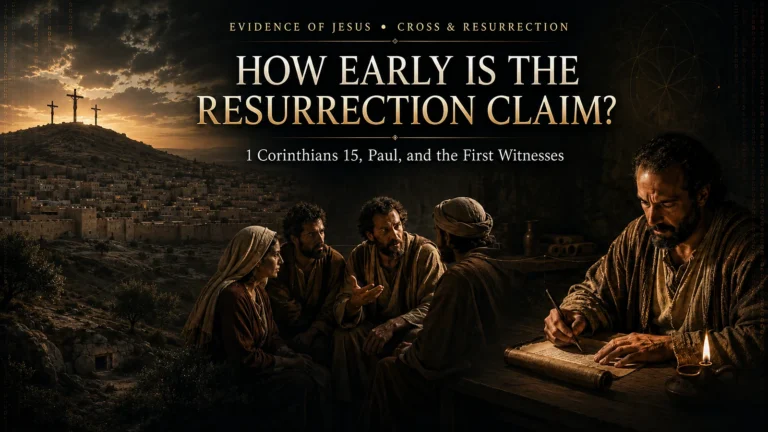
Paul’s letters place resurrection proclamation within the first Christian generation. In 1 Corinthians 15:3-8, Paul says he delivered what he had received: Christ died, was buried, was raised, and appeared to Cephas, the Twelve, more than five hundred, James, all the apostles, and Paul. The formula predates the letter. Galatians 1-2 reports Paul’s meetings with Cephas and James, connecting him with Jerusalem leaders named in the tradition.
This does not independently verify every appearance detail. It does show that resurrection was not a belief invented centuries later. See our analysis of how early the resurrection proclamation appeared.
Paul, Cephas, and James
The earliest sources present Cephas, James, and Paul as recipients of resurrection appearances. Paul directly attests his own experience, while the claims concerning Cephas and James are preserved through early received tradition. Assessments differ over the nature and cause of these claims.
The Gospels offer fuller narratives, including the empty tomb, women as first discoverers, and embodied encounters. Their precise literary relationships, burial details, harmonization, and the exact nature of appearances are debated. Readers can examine what the first witnesses claimed about the risen Jesus without treating every debated point as equally certain.
What History Can and Cannot Conclude
Evidence and limits:
- Historically strong: Jesus was crucified; resurrection proclamation arose in the first generation; Paul preserved earlier tradition; Paul directly reports his own experience; received tradition names Cephas and James as recipients.
- Substantially evidenced but debated: particular burial details, the empty tomb, how individual appearance accounts relate, and the evidential force of the five hundred.
- Christian apologetic conclusion: God raised Jesus bodily from the dead, vindicating Him as Lord.
History can establish early proclamation and context; the confession that God raised Jesus is a theological and apologetic conclusion.
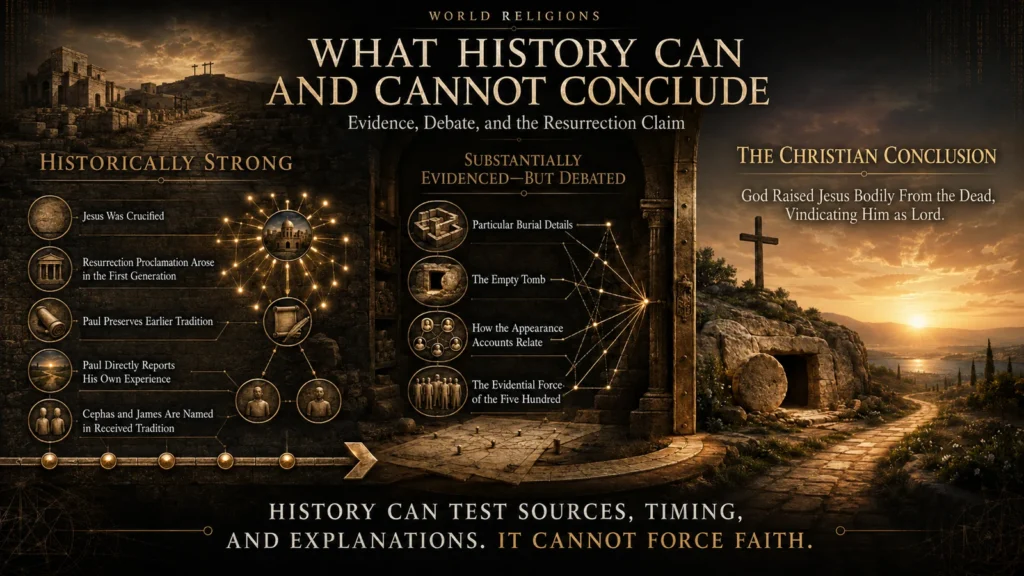
Historical evidence does not force belief in a miracle. Worldview assumptions affect what explanations a person considers possible. The Christian argues that actual resurrection best explains the converging data and fits Jesus’ identity and mission. That inference should be made openly, not disguised as a neutral historical theorem.
Does the Bible Teach Reincarnation?
Several biblical passages are said to preserve reincarnation beneath later Christian interpretation. Read in context, they do not teach a soul returning through another earthly birth.
John the Baptist and Elijah
Jesus connects John the Baptist with the promised Elijah in Matthew 11:14 and 17:10-13. Luke 1:17 explains the connection: John goes before the Lord “in the spirit and power of Elijah.” John 1:21 records John denying that he is Elijah personally. At the transfiguration in Matthew 17:1-8, Elijah appears alongside Moses while John has already died. The texts distinguish the men while identifying John’s prophetic role.
John therefore fulfills the Elijah expectation typologically and prophetically. The passage does not say Elijah’s soul entered John’s body.
The man born blind
In John 9:1-3, the disciples ask whether the man or his parents sinned so that he was born blind. The question records their proposed explanation; it does not reveal a doctrine. Jesus rejects both alternatives as the explanation for the blindness and redirects attention to God’s work. The text neither describes a prior life nor endorses prenatal karmic guilt.
Born again or born from above
In John 3:1-8, Jesus tells Nicodemus that one must be born anothen, a Greek word that can carry the sense “again” or “from above.” Nicodemus misunderstands in physical terms. Jesus explains birth by the Spirit. The passage concerns spiritual renewal from above, not a soul entering another earthly body after death.
One death, judgment, and resurrection
Hebrews 9:27 fits a much wider biblical pattern. Human beings die and face judgment. Jesus speaks of the dead coming from tombs in John 5. Paul expects transformation at Christ’s coming in 1 Corinthians 15 and 1 Thessalonians 4. Revelation moves toward final judgment and new creation. None of these texts presents a sequence of forgotten earthly lives.
The Bible does contain restoration, regeneration, and resurrection. Those words must not be made to say reincarnation. Its hope is the redemption of the person and creation through Christ, not repeated mortal embodiment.
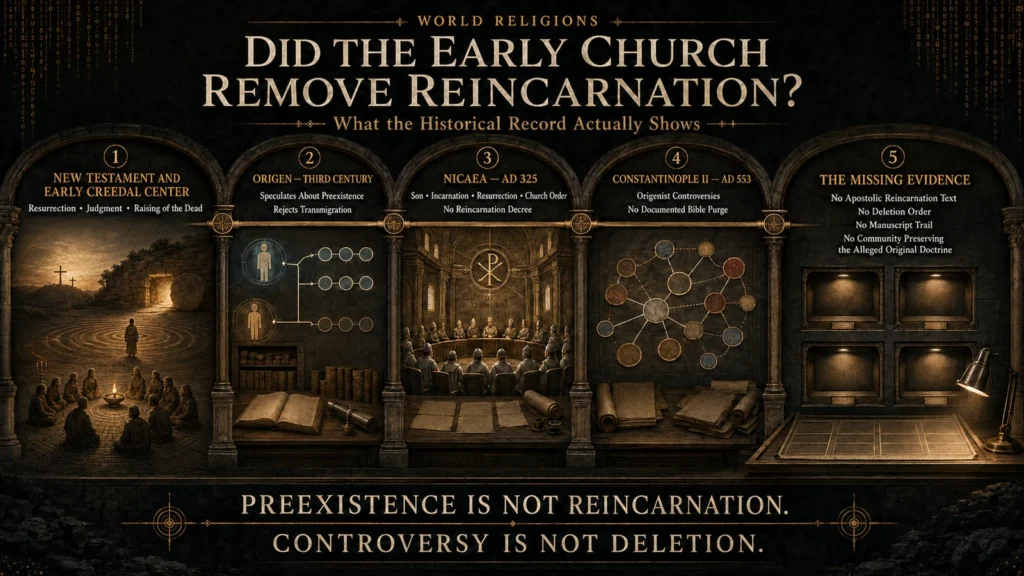
Did the Early Church Remove Reincarnation?
A popular suppression theory claims that early Christians taught reincarnation until church authorities removed it, often at Nicaea in 325 or Constantinople in 553. The surviving texts do not support that account.
Origen’s preexistence speculation
Origen of Alexandria was a brilliant and controversial third-century Christian thinker. He speculated about the preexistence of rational souls and explored difficult questions about creation, freedom, judgment, restoration, and embodiment. His transmission is complicated because some works survive in translations affected by later controversy.
Preexistence, however, is not the same as reincarnation. A soul existing before its present body does not by itself imply a series of human lives, karmic rebirth, or soul migration into new organisms.
Origen’s rejection of transmigration
In his Commentary on Matthew, Book 13, Origen directly considers whether John was Elijah through transmigration. He rejects that reading, distinguishes soul from spirit, and explains John’s relation to Elijah through prophetic spirit and power. Elsewhere he treats the migration of souls through bodies as alien to the church’s teaching.
Origen’s speculative preexistence makes him relevant to later debates, but it does not provide evidence that apostolic Christianity taught modern reincarnation.
What Nicaea decided
The surviving creed and twenty canons of Nicaea address the relation of the Son to the Father, the incarnation, suffering, resurrection, church order, clergy, discipline, and the date of Easter. They contain no decree abolishing reincarnation, no order editing biblical manuscripts, and no list of past-life verses to delete.
Nicaea confesses that Christ became human, suffered, rose on the third day, ascended, and will return to judge the living and the dead. Its documented subject matter is public. The claim that it secretly replaced reincarnation lacks the primary evidence a historical claim requires.
Constantinople and disputed anathemas
The Second Council of Constantinople in 553 centered on the Three Chapters controversy involving Theodore of Mopsuestia, writings of Theodoret, and the letter attributed to Ibas. Anti-Origenist condemnations circulated in the sixth-century controversies, and scholars debate the attribution and conciliar status of particular anathemas. Those disputes involved preexistence, restoration, and other Origenist ideas. They do not document church leaders deleting reincarnation from Scripture.
Why the suppression theory fails
A credible suppression theory would need apostolic texts teaching reincarnation, broad early reception, a formal decision to remove the doctrine, evidence of manuscript alteration, protests from communities that retained it, and textual traces predating the alleged purge. Instead, the New Testament and early creedal center repeatedly emphasize Christ’s bodily resurrection, judgment, and the future raising of the dead.
The historical correction is not that every early Christian agreed on every detail of the soul or afterlife. They did not. It is that diversity does not supply the missing evidence for a once-apostolic reincarnation doctrine.
Resurrection and Reincarnation Compared at a Glance
Hindu reincarnation
- Lives: repeated embodiments within samsara.
- Continuity: commonly an enduring self, interpreted differently by school.
- Moral order: karma links action and consequence; theistic traditions may include devotion and grace.
- Memory: normally absent at the conscious level; subtle impressions may continue.
- Goal: moksha, understood as liberation according to the school.
Buddhist rebirth
- Lives: renewed existence while ignorance and craving continue.
- Continuity: conditioned causal process without an eternal soul.
- Moral order: intentional karma bears fruit through dependent continuity.
- Memory: not an enduring essence; remembered previous lives are possible in Buddhist texts but not required for ordinary continuity.
- Goal: nirvana, ending the causes of suffering and renewed becoming.
New Age past lives
- Lives: often chosen or coordinated incarnations.
- Continuity: soul, higher self, or spiritual identity.
- Moral order: lessons, balance, healing, contracts, or evolution.
- Memory: sometimes sought through intuition, dreams, readings, or regression.
- Goal: growth, integration, healing, or higher consciousness.
Christian bodily resurrection
- Lives: one mortal life, followed by judgment and resurrection.
- Continuity: the person who died is raised by God.
- Moral order: personal judgment; guilt can be forgiven through Christ.
- Memory: identity rests in God’s knowledge and faithfulness, not flawless recall.
- Goal: transformed embodied life with God in renewed creation.
The contrast is not “spiritual East” against “literal West.” Every family contains philosophical sophistication and internal debate. The decisive differences concern selfhood, the source of salvation, the meaning of embodiment, and whether death is escaped through release from recurrence or conquered through resurrection.
Which Hope Best Preserves the Person?
The following is a Christian apologetic synthesis. It evaluates the preceding views from explicitly Christian convictions while relying on the fair descriptions already given.
Identity
Hindu enduring-self models provide a substantial subject across lives, though Advaita ultimately reinterprets separate individuality. Buddhist rebirth gives a careful account of causal continuity but intentionally refuses an enduring self. New Age belief usually preserves a higher self, although its relation to the everyday personality can be unclear.
Resurrection most directly preserves the person because its claim is not that a successor inherits effects or that a deeper self discards personalities. God raises the embodied agent who lived and died. Transformation fulfills rather than cancels identity.
Justice
Karma takes action seriously and can answer the apparent imbalance of one lifetime. Yet unremembered transgressions and hidden life histories make moral education and public verification difficult. Buddhist causal accounts face the further question of whether neither-identical-nor-unrelated continuity is sufficient for desert.
Christian judgment is personal. The Judge knows what finite observers cannot: each act, motive, wound, opportunity, and withheld truth. No invented prior life is needed to explain His knowledge, and no sufferer may be casually labeled deserving by an outsider.
Grace
Some Hindu devotional traditions have robust accounts of divine grace, and Pure Land Buddhism challenges self-reliance through Amitabha’s vow. These should not be erased. Christianity’s distinctive confession is more specific: the holy God reconciles guilty people through the willing death of the incarnate Son. Grace forgives, transforms, and joins believers to Christ’s resurrection life. Readers can examine the broader case for Jesus as the Son of God.
Embodiment
Reincarnation values embodiment enough to return to it but often treats recurring bodily life as a condition from which liberation is needed. Christianity agrees that mortal embodiment is corrupted and painful, yet refuses to call created bodily life the final problem. The body is redeemed and transformed. Human particularity, relationship, work, and creation matter eternally because God renews rather than abandons His creation.
Final victory over death
Repeated embodiment extends the cycle; liberation exits it. Resurrection defeats death. The Christian hope does not ask the mourner to accept that a loved one has become another personality without recognition. It promises that the last enemy will be destroyed and that those in Christ will be raised.
The resurrection case is historically anchored to Jesus’ crucifixion and first-generation proclamation, while the conclusion that God raised Him remains an apologetic and theological judgment. Everything depends on Jesus.
Frequently Asked Questions
Is resurrection reincarnation?
No. Reincarnation or rebirth involves renewed earthly or samsaric existence after death. Christian resurrection means God raises and transforms the person who died. Jesus did not begin another mortal biography in another body.
Do Hindus all agree about reincarnation?
No. Many Hindu traditions affirm karma, samsara, an enduring self, and liberation, but Advaita, Vishishtadvaita, Dvaita, Samkhya, and bhakti traditions differ about the self, Brahman, God, individuality, practice, grace, and the final state.
Do Buddhists believe in a soul?
Buddhism generally denies an eternal, unchanging soul or self. Traditions use different models of continuity, but it is misleading to describe Buddhist rebirth as an immortal soul migrating between bodies.
What is reborn in Buddhism?
Buddhist answers speak of conditioned continuity: karmic intentions, craving, ignorance, consciousness, and aggregates arise dependently. The later being is causally related to the earlier one without being a permanent substance carried over unchanged.
Are past-life memories proof of reincarnation?
No. Some spontaneous childhood reports merit careful investigation, especially when statements were recorded before matching and ordinary information routes were tested. Even anomalous information would not by itself establish numerical identity, universal rebirth, karma, or a complete religious worldview.
Does the Bible teach reincarnation?
No. John fulfills Elijah’s prophetic role; John 9 records and rejects a proposed guilt explanation; John 3 teaches birth from above by the Spirit. The Bible’s wider pattern is one life, death, judgment, resurrection, and final destiny.
Did Origen teach reincarnation?
Origen speculated about preexistent souls, but preexistence is not repeated incarnation. In discussing John and Elijah, he explicitly rejects transmigration as the correct Christian reading.
Did Nicaea remove reincarnation?
No. Nicaea’s surviving creed and canons concern the Son’s relation to the Father, incarnation, resurrection, church order, discipline, and Easter. They contain no decree removing reincarnation and no action editing the Bible.
What is a spiritual body?
In 1 Corinthians 15, a spiritual body is embodied life transformed and empowered by God’s Spirit. “Spiritual” contrasts its source and imperishable quality with ordinary mortal life; it does not mean nonphysical ghost.
Is the resurrection body the same body?
It is the body of the same person, continuous with mortal embodied history and radically transformed. Christian doctrine does not require the collection of every atom that ever belonged to the body. God raises the person, not a mere material duplicate.
Sources and Further Reading
Primary texts govern the doctrinal descriptions; academic and insider sources clarify school-specific interpretation; empirical reports remain separate from theology; and historical evidence remains distinct from Christian apologetic inference.
- Hindu texts and interpretation: Bhagavad Gita 2:13, 2:20, 2:22, 8:15-16, and 15:8 in Swami Gambhirananda’s English translation on the IIT Kanpur Gita Supersite; Patrick Olivelle, The Early Upanisads: Annotated Text and Translation (Oxford University Press, 1998), including Brihadaranyaka Upanishad 4.4, Chandogya Upanishad 5.10, and the Katha Upanishad; Internet Encyclopedia of Philosophy entries on Ramanuja, Madhva, and Hindu philosophy; Stanford Encyclopedia of Philosophy on Shankara.
- Buddhist texts and interpretation: SN 22.59; MN 38; SN 12.2; MN 135; SN 56.11; Milindapanha 3.2.1; SuttaCentral; Stanford Encyclopedia entries on Madhyamaka, Yogacara, and Japanese Pure Land philosophy.
- New Age context: Courtney Bender, “American Reincarnations: What the Many Lives of Past Lives Tell Us about Contemporary Spiritual Practice”; George D. Chryssides, “The New Age,” in The Cambridge Companion to New Religious Movements.
- Past-life and memory research: UVA Division of Perceptual Studies; Moraes and colleagues, “Academic Studies on Claimed Past-Life Memories: A Scoping Review”; Andrade, “Is Past Life Regression Therapy Ethical?”; psychological literature on suggestion and false autobiographical memory.
- Christian history and resurrection: Origen’s Commentary on Matthew; the surviving documents of Nicaea and Constantinople II; 1 Corinthians 15; Galatians 1-2; N. T. Wright, The Resurrection of the Son of God; Dale C. Allison Jr., The Resurrection of Jesus; Larry Hurtado, Lord Jesus Christ; the Internet Encyclopedia of Philosophy entry on resurrection.
For related studies, visit the World Religions library and our guide to the Bible’s resurrection hope.
Jesus Did Not Return as Someone Else
Every view in this comparison recognizes that death exposes the limits of ordinary life. Hindu traditions seek liberation from samsara. Buddhism seeks the ending of the ignorance and craving that sustain renewed suffering. New Age spirituality seeks growth and healing across lives. Christianity names death an enemy and points to an event: Jesus Christ was crucified and raised.
The gospel does not say that Jesus’ soul migrated into another child, that His disciples discovered His higher self in a new personality, or that He resumed the cycle in a different body. The tomb belonged to Jesus. The wounds belonged to Jesus. The risen Lord who called Mary by name, met His disciples, confronted Thomas, and appeared to Paul was Jesus.
That claim brings judgment and mercy together. We do not receive endless lives in which to erase guilt by accumulated progress. We are called now to repent and trust the Son who gave Himself for sinners. At His cross, grace is not indifference to evil; God deals with sin at terrible cost. In His resurrection, forgiveness is not escape into abstraction; God begins the renewal of embodied creation.
Read Luke 24, John 20, and 1 Corinthians 15. Examine the crucifixion and the early proclamation. Ask not only whether something survives death, but whether Jesus is alive and Lord. If He is, the final hope is neither another turn of the wheel nor the dissolution of the person. It is Christ’s promise: because He lives, His people will live, their bodies transformed and death finally destroyed.
Jesus did not enter another body. The crucified Lord rose, and He promises to raise those who belong to Him.