
Some Christians can explain the Gospel clearly and still wonder whether its promises apply to them. They remember a serious failure, struggle with the same temptation, or hear a warning passage and begin questioning everything. Others feel certain because they once prayed a prayer, grew up in church, or have never seriously examined what they believe.
Scripture speaks to both situations. It gives substantial reasons for confidence in Jesus Christ, and it exposes confidence built on the wrong things. A careful answer must take the promises and the warnings seriously.
First John 5:13 states the purpose plainly: believers may know that they have eternal life. The question is how that confidence grows, what supports it, and how it differs from presumption.
GUIDED ARTICLE EXPERIENCE
Can a Christian Be Sure of Salvation?
Read along as the narration moves through the article.
Browser narration · No stored audio or site tracking
CONTINUE GUIDED TOUR
Continue where you left off.
GUIDED TOUR COMPLETE
You have reached the end of this study.
Study record saved on this device.
GUIDED TOUR
Can a Christian Be Sure of Salvation?
Narrator: Paranoid Prophet Recommended Voice Native device narration
Prepare to follow the article as it is narrated.
VOICE & TOUR OPTIONS
Voice & Listening
NARRATOR
Finding a narrator…
Checking the best narrator available on this device.
Restores the site recommendations available in this browser.
Our listening picks lead when available; other voices are ranked for narration. Known novelty voices are hidden. Browser-provided voices may use an online voice service.
Screen-awake support will be checked when narration starts.
Optional: improve your device voices
Listening works with the voices already available here. Your device may offer additional free voices through its own settings.
iPhone or iPad: Settings → Accessibility → Read & Speak (or Spoken Content) → Voices → English. Look for Premium or Enhanced choices, then return here.
If offered, preview Ava or Zoe for U.S. English, or Serena or Jamie for British English. An explicit Premium or Enhanced version can improve on its compact version.
Mac: System Settings → Accessibility → Read & Speak → System voice. Open the voice list to preview or download additional choices.
Windows: Settings → Accessibility → Narrator → Add natural voices. Browser availability varies; a Narrator voice may not appear on websites. Edge may also expose online Natural voices without a model download.
Android: Open Accessibility → Text-to-speech output (the location varies by device). In the preferred engine settings, look for voice data and English choices.
Download sizes vary; some enhanced voices exceed 100 MB. This website cannot install system voices, and an installed voice appears here only if your browser exposes it.
Apple voice guide · Windows voice guide · Android voice guide
CHOOSE A NARRATOR
Recommended on this device
Our listening picks: Aaron, Martha, then Daniel, when available here. Otherwise, automatic uses the highest-ranked suitable voice. Preview alternatives or save your own choice.
Preparing the guided article experience…
RESUME GUIDED TOUR?
Continue where you left off.
GUIDED TOUR COMPLETE
You have reached the end of this study.
Article Guide12 sections
Can a Christian Know They Are Saved?
Yes. The New Testament gives believers real grounds for confidence in their salvation through Jesus Christ. That confidence rests on God’s promise, Christ’s saving work, and the Holy Spirit’s testimony. Scripture also connects life in Christ with repentance, love, and obedience.
Here, assurance means warranted confidence in Christ and His promises. Christians disagree about whether that includes infallible certainty of one’s present justification or final perseverance, whether a genuinely regenerate believer can finally fall away, and how the church’s sacraments relate to assurance. Those disagreements affect how this question is answered.
Three questions help keep the discussion clear:
- Assurance: What grounds do I have for trusting that I belong to Christ?
- The experience of assurance: Why do I sometimes feel confident and sometimes afraid?
- Perseverance and final salvation: How do God’s keeping power and the warnings against falling away fit together?
These questions overlap, but they are not interchangeable. A person can feel confident for poor reasons. A Christian can also struggle to feel the confidence that God’s promises warrant.
If the basic message of Christianity is unfamiliar, begin with What Is the Gospel?. Assurance depends on understanding who saves us and what He has done.
Start where you need help: Read about recurring doubts, practical steps toward assurance, continuing sin and obedience, frightening warning passages, or differences among Christian traditions.
What Is the Biblical Foundation of Assurance?
God Gives Life Through His Son
First John 5:11–13 locates eternal life in God’s Son. John writes to people who believe in the Son’s name so that they may know they have eternal life. He directs their attention to God’s testimony about Jesus.
That is a better starting point than asking whether today’s emotions are strong enough. The Gospel concerns the crucified and risen Christ, not a feeling we must sustain through concentration. Read 1 John 5:11–13.
Ephesians 2:8–10 places salvation in God’s grace, received through faith, and then describes the good works for which believers are created. Titus 3:4–7 likewise traces salvation to God’s mercy and the renewing work of the Spirit. Neither passage presents moral achievement as the purchase price of reconciliation.
This matters when assurance begins to feel like a second salvation project. We can start treating sufficiently intense faith, sufficiently deep remorse, or sufficiently visible improvement as the thing that makes Christ willing to receive us. Scripture directs us to His mercy. Our study of Salvation by Grace explains that foundation more fully.
Jesus Promises to Keep His People
In John 10:27–30, Jesus describes His sheep as those who hear His voice and follow Him. He gives them eternal life and promises that no one will snatch them from His hand or His Father’s hand.
The strength of the promise lies in the Shepherd’s authority and care. It is spoken about people who belong to Him. We should neither weaken the promise into a vague possibility nor detach it from the relationship Jesus describes.
Romans 8:31–39 gives another substantial reason for confidence. Christ died, rose, and intercedes for His people. Suffering, persecution, death, and hostile powers cannot separate them from God’s love in Christ. Painful circumstances are therefore no reliable measure of whether God has abandoned a believer. Read John 10:27–30 and Romans 8:31–39.
The Holy Spirit Bears Witness to Our Adoption
Romans 8:14–17 describes the Spirit’s witness that believers are God’s children. They approach God as Father and share in the inheritance of Christ, including the path through suffering toward glory.
The passage does not prescribe one emotional sensation that every Christian must identify. Its wider context includes dependence on God, resistance to sin, hope amid suffering, and help in weakness. Later in the chapter, the Spirit helps people who do not know how to pray as they should.
A troubled prayer life does not place someone beyond His help. Christian confidence includes dependence on the Spirit precisely where our strength and understanding are limited. Read Romans 8.

Does Doubt Mean Someone Is Not Saved?
Doubt by itself does not establish a person’s spiritual condition. It matters what the doubt concerns and how the person is responding.
Someone may be struggling with a historical question about the resurrection. Another may misunderstand a difficult passage. Someone else may be hiding conduct they know is wrong. Another may experience relentless fear despite sincerely wanting to trust and obey Christ. Those situations call for different kinds of care.
It is unhelpful to tell every worried person that worry proves salvation. It is equally unhelpful to say that any doubt proves unbelief. Neither conclusion follows simply from the presence of fear.
The father in Mark 9:24 brings his mixed faith and unbelief to Jesus. The scene is not a formula for diagnosing salvation, but it shows that a plea for help can be honest about weakness. The Gospel does not require someone to conceal that weakness before approaching Christ.
Likewise, a person does not need a dramatic conversion story to trust the Savior. Some can name a decisive moment. Others came to understand and embrace the faith over time. The more useful question is whom they are trusting now.
If fear becomes repetitive and intrusive, or repeatedly checking whether you are saved disrupts sleep, work, or ordinary life, seek support from a trustworthy pastor and a qualified mental health professional who respects your faith. You do not have to decide alone whether the difficulty is theological, emotional, or both. Receiving help is not a spiritual failure.
How Can a Christian Grow in Assurance?
Return to the Gospel in Context
Read a passage such as John 10, Romans 8, or 1 John with attention to the surrounding argument. Ask what it says about Christ before asking how strongly you feel it. Avoid building your understanding around isolated sentences from alarming clips or arguments online.
Respond Honestly to Known Sin
Confess specific wrongs without trying to manufacture a particular degree of emotion. Seek forgiveness, take practical steps toward change, and repair harm where possible and appropriate. If another person is being harmed, their safety matters more than preserving your reputation or restoring your sense of comfort.
Stay Connected to a Faithful Church
Hebrews 10 places mutual encouragement beside its call to hold fast. Christian life ordinarily includes hearing Scripture, praying, worshiping, receiving pastoral care, and sharing the life of the church. Discuss baptism and the Lord’s Supper with your pastor, recognizing that Christian traditions explain their role differently.
Let Reflection Lead Back to Trust and Obedience
Self-examination has a place (2 Corinthians 13:5), but it should serve a purpose. Bring a concrete concern to God and to someone trustworthy. Receive correction where needed, receive encouragement where warranted, and take the next faithful step. Continually restarting the examination may leave the real question untouched.
Why Does First John Also Talk About Obedience and Love?
The letter that speaks so clearly about knowing we have eternal life also warns against empty professions of faith. John connects knowing God with keeping His commands, loving fellow believers, and confessing the truth about Jesus Christ (1 John 2:3–6; 3:14–18; 4:1–3; 5:1–5).
We should read those passages alongside the opening chapters. John says that claiming to have no sin is self-deception. He calls believers to confession and points them to Jesus Christ when they sin. His concern for holiness does not require pretending that Christians never fail. Read 1 John 1:5–2:6.
There is a meaningful difference between struggling against sin and defending it as something Christ has no right to address. Repentance can include painful setbacks, practical help, confession, and the work of repairing harm. It does not make peace with wrongdoing simply because forgiveness is available.
John’s teaching about love is equally concrete. First John 3:16–18 describes care for people in need. A profession of faith cannot excuse cruelty, exploitation, or indifference to another person’s suffering.
These passages deserve honest reflection. They should not become a private scoring system in which every impatient thought cancels every reason for hope. The question is whether our confession of Christ has any meaningful relationship to how we receive His word and treat other people.
Even that reflection benefits from perspective. People differ in maturity, circumstances, and their ability to recognize growth. A trusted pastor or mature Christian may see evidence of grace that a frightened person discounts. Someone protecting harmful conduct may need the same community to confront what they refuse to see.
For the underlying concepts, read What Is Sin? and Repentance and Faith.
Assurance and Presumption Are Different
Presumption claims a favorable standing with God while ignoring what He says. It can take several forms:
- Treating church attendance, religious knowledge, or a past decision as permission to reject Christ’s teaching now.
- Assuming that impressive ministry, spiritual experiences, or public influence establish God’s approval.
- Expecting forgiveness while refusing to acknowledge or address harm done to others.
- Trusting personal decency as though it removes the need for mercy.
Matthew 7:21–23 is especially sobering. The people Jesus rejects appeal to remarkable religious activities. Jesus says He never knew them. Their achievements do not settle the question of whether they belong to Him.
The passage also warns us against treating success as spiritual proof. A large audience or a dramatic testimony cannot excuse lawlessness. Neither can someone use assurance to pressure another person to remain silent about abuse.
Healthy assurance supports humility, repentance, gratitude, and love. It gives a sinner reason to come into the light. Presumption tries to keep the benefits of Christianity while refusing its Lord.
Yet fear is not automatically humility, and anxiety is not proof of repentance. A frightened person needs careful listening rather than an assumption that greater distress will produce stronger faith.
What About the Bible’s Warnings Against Falling Away?
An article on assurance would be incomplete if it quoted only comforting passages. Hebrews warns its readers against an unbelieving heart, spiritual hardening, and turning away from the living God. John 15 calls disciples to remain in Christ. Other passages urge believers to continue in faith and take heed rather than become proud (Hebrews 3:12–14; John 15:1–6; Colossians 1:21–23; Romans 11:20–22).
Christians differ over how these warnings relate to regeneration and God’s promises to preserve His people. Their practical seriousness should not depend on pretending that those differences do not exist.
Hebrews 6:4–6 Describes a Grave Rejection
Hebrews 6 speaks of people who have been enlightened, tasted the heavenly gift, shared in the Holy Spirit, and then fallen away. Its language about the impossibility of renewing them to repentance is severe.
Some interpreters understand these people to have genuinely participated in saving life and then rejected Christ. Others understand them as people who experienced profound blessings within the Christian community without the enduring faith associated with salvation. Still others emphasize the warning’s role in keeping the community faithful. Those approaches involve real interpretive arguments, including how the passage describes participation in the Spirit and how verses 7–12 distinguish fruitful from unfruitful responses.
The immediate continuation matters. In Hebrews 6:9–12, the writer expresses confidence about better things concerning the readers and urges diligence, hope, faith, and patience. The chapter then points to God’s trustworthy promise and the hope anchored in Jesus.
This is not a passage about an unwanted thought, an unresolved question, or every failure in the struggle against temptation. Nor should its severity be explained away. Its subject is a grave falling away associated with repudiating the Son of God. Read Hebrews 6 in context.
Hebrews 10:26–31 Must Be Read Through Verse 29
The warning about willful sin in Hebrews 10 can terrify someone who remembers choosing to do something wrong after becoming a Christian. Verse 29 describes the offense in fuller terms: contempt for the Son of God, His covenant blood, and the Spirit of grace.
The warning concerns repudiating the saving provision found in Christ. Rejecting His sacrifice leaves no alternative sacrifice to rely on. It cannot reasonably mean that every knowingly committed sin makes forgiveness permanently unavailable, because the New Testament also calls sinning Christians to confession, repentance, and restoration.
That does not make deliberate sin harmless. Sin can harden a person. The response is to turn toward Christ and seek help, rather than use either assurance or despair as a reason to continue.
The same chapter urges readers to draw near to God, hold fast their hope, and encourage one another. The warnings belong within that appeal to persevere together (Hebrews 10:19–25, 32–39). Read the warning in Hebrews 10:26–31.
Promises and Warnings Address the Same Christian Life
Scripture calls believers to trust God’s faithfulness and to continue following Christ. It does not invite us to choose whichever set of passages best fits our temperament.
A careless person needs to hear that faith is serious and that Christ cannot be treated with contempt. A repentant, frightened person needs to hear that Jesus receives those who come to Him (John 6:37). Pastoral wisdom takes the person’s actual situation into account while remaining accountable to the whole biblical witness.
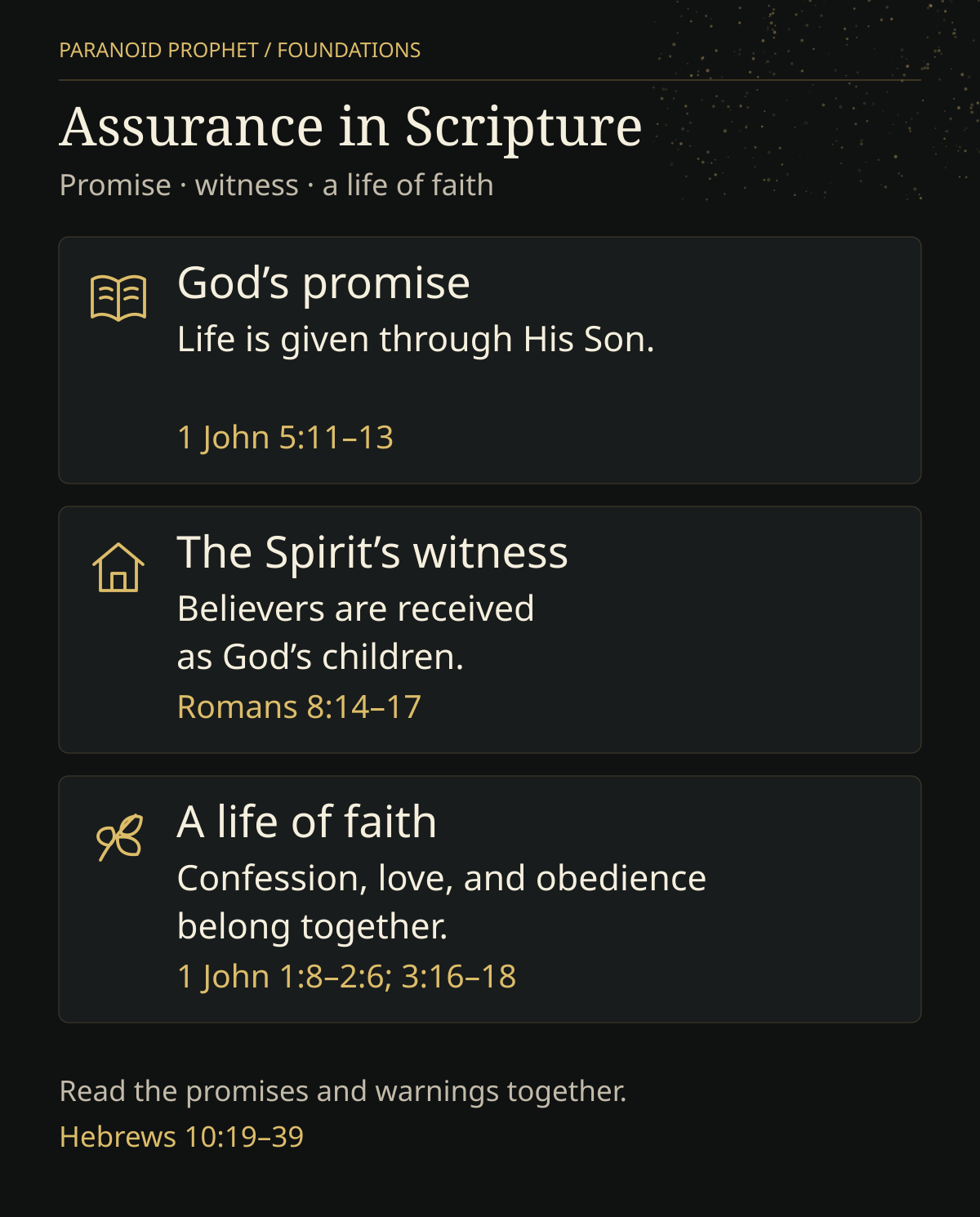
Assurance in Scripture (image text)
Promise · witness · a life of faith
- God’s promise
Life is given through His Son.
1 John 5:11–13 - The Spirit’s witness
Believers are received as God’s children.
Romans 8:14–17 - A life of faith
Confession, love, and obedience belong together.
1 John 1:8–2:6; 3:16–18
Read the promises and warnings together.
Hebrews 10:19–39
PARANOID PROPHET / FOUNDATIONS
Why Do Christian Traditions Explain Assurance Differently?
The disagreement is more precise than saying that some Christians believe in grace and others believe they must save themselves. Historic Christian traditions affirm the necessity of God’s grace while disagreeing about its operation, the possibility of falling away, and the language of certainty.
Reformed Christianity
Reformed theology teaches that those truly regenerated and united to Christ will finally persevere because God preserves them. It distinguishes that security from the believer’s experience of assurance, which may be weak or interrupted. The Westminster Confession, chapters 17–18, also recognizes serious failures and rejects complacency. Its account of assurance includes God’s promises, the Spirit’s witness, and evidence of grace in a believer’s life. Westminster Confession, chapters 17–18.
Wesleyan and Many Arminian Traditions
These traditions affirm present assurance through faith and the Spirit’s witness while holding that a believer can turn away from grace. Continuing faith remains necessary, and perseverance depends on grace rather than independent human achievement. United Methodist doctrinal materials explicitly affirm assurance of present salvation and the possibility of departure and renewal. Wesleyan teaching on assurance and the Confession of Faith, Article IX.
Lutheran Christianity
Lutheran teaching also affirms that believers can have assurance through Christ while warning that faith can be abandoned. It particularly directs a troubled conscience toward God’s promise in the Gospel rather than repeated measurement of the strength of one’s own faith. Word and sacrament have a central role in its account of how God gives and sustains faith. Formula of Concord, Solid Declaration XI, a Lutheran explanation of perseverance, and the LCMS statement of beliefs.
Roman Catholic Christianity
Catholic teaching stresses confident hope in Christ’s promises and reliance on grace to persevere. It rejects both despair and the presumption that expects forgiveness without repentance. Its Catechism also cautions against concluding that one is justified merely from feelings or works. This account should not be confused with either Reformed certainty of final perseverance or the claim that Catholics have no reason to trust God’s mercy. Catechism 1817–1821, 2005, and 2090–2092.
Catholic teaching distinguishes firm hope in God’s mercy from infallible certainty about one’s own state of grace or final perseverance. The Council of Trent rejects such certainty as an ordinary possession of believers, while urging firm reliance on God’s help; it allows for special revelation concerning perseverance. See Trent, Session VI, chapters IX and XII–XIII and canon XVI (conciliar text hosted by a third-party archive).
Eastern Orthodox Christianity
Orthodox teaching commonly approaches salvation as life and healing in union with Christ, received now and awaiting its fullness. It emphasizes repentance, perseverance, worship, and participation in the church’s sacramental life. Metropolitan Tikhon’s explanation presents salvation as God’s gift already shared in the present and still to be fully received. That emphasis resists reducing salvation to a past profession detached from continuing life in Christ. Orthodox Church in America: Metropolitan Tikhon on salvation.
These summaries do not erase disagreements or represent every variation within each tradition. Evangelical Christians who affirm eternal security also differ among themselves about the relationship between assurance, obedience, and perseverance. A responsible discussion should ask what a particular teacher means rather than assume a slogan settles the matter.
Frequently Asked Questions
Does Continuing to Sin Prove Someone Was Never Saved?
The New Testament recognizes that believers sin and need confession and forgiveness. It also warns against defending sin and refusing repentance. First John 1:8–2:6 holds those truths together. No simple count of failures can replace attention to faith, repentance, conduct, and the person’s circumstances.
Does “Once Saved, Always Saved” Mean Behavior No Longer Matters?
It should not be used that way. Reformed perseverance and other evangelical accounts of eternal security have important differences, but a slogan cannot cancel biblical commands or excuse harm. Anyone explaining eternal security should also explain the passages about obedience, discipline, repentance, and perseverance.
What If I Fear That Jesus Will Reject Me When I Come to Him?
John 6:37 records His promise to receive the person who comes to Him. Bring the fear to Him rather than trying to make yourself worthy of an invitation He already gives. If a particular passage or past action troubles you, work through it with a careful pastor instead of reaching a final verdict alone.
Where Christian Confidence Finally Rests
The New Testament gives substantial grounds for assurance. God has acted in Jesus Christ, the Son gives eternal life, and the Spirit bears witness to adoption. The same Scriptures call people to repentance, love, obedience, and perseverance.
A sound account of assurance makes room for all of that. It encourages the struggling believer without protecting presumption, and it takes sin seriously without presenting Christ as reluctant to show mercy.
Come to the crucified and risen Jesus. Trust His promise, receive His correction, and continue with His people. Christian hope has a Savior to rest in.
Continue Studying Christian Foundations
Scripture and Further Reading
Scripture is the governing source for this study. Read the passages in context, especially John 6 and 10; Romans 8; Ephesians 2:1–10; Hebrews 3, 6, and 10; and the whole letter of 1 John. Biblical teaching is chiefly paraphrased. Links above use the public-domain World English Bible for convenient reading.
The confessions, catechism, and denominational explanations linked in the comparison section document how those traditions describe their own positions. They are included to support fair representation, not to imply that every interpretation is equally persuasive or that a church document outranks Scripture.
Continue studying: Read about the Holy Spirit’s identity and work and the new life that begins when you become a Christian.