
If salvation is God’s gift, why does the New Testament insist that Christians obey Him? If faith receives salvation, why does James warn that faith without action is dead? And when Paul excludes works from justification, is he contradicting James?
These questions touch both our understanding of the gospel and the way we live. A person can spend years trying to make God accept them through achievement. Another can use religious language to avoid responsibility for obvious harm. The New Testament challenges both responses. It directs our trust toward Jesus Christ and calls the people He saves into a changed life.
GUIDED ARTICLE EXPERIENCE
What Does Salvation by Grace Mean? Faith and Works Explained
Read along as the narration moves through the article.
Browser narration · No stored audio or site tracking
CONTINUE GUIDED TOUR
Continue where you left off.
GUIDED TOUR COMPLETE
You have reached the end of this study.
Study record saved on this device.
GUIDED TOUR
What Does Salvation by Grace Mean? Faith and Works Explained
Narrator: Paranoid Prophet Recommended Voice Native device narration
Prepare to follow the article as it is narrated.
VOICE & TOUR OPTIONS
Voice & Listening
NARRATOR
Finding a narrator…
Checking the best narrator available on this device.
Restores the site recommendations available in this browser.
Our listening picks lead when available; other voices are ranked for narration. Known novelty voices are hidden. Browser-provided voices may use an online voice service.
Screen-awake support will be checked when narration starts.
Optional: improve your device voices
Listening works with the voices already available here. Your device may offer additional free voices through its own settings.
iPhone or iPad: Settings → Accessibility → Read & Speak (or Spoken Content) → Voices → English. Look for Premium or Enhanced choices, then return here.
If offered, preview Ava or Zoe for U.S. English, or Serena or Jamie for British English. An explicit Premium or Enhanced version can improve on its compact version.
Mac: System Settings → Accessibility → Read & Speak → System voice. Open the voice list to preview or download additional choices.
Windows: Settings → Accessibility → Narrator → Add natural voices. Browser availability varies; a Narrator voice may not appear on websites. Edge may also expose online Natural voices without a model download.
Android: Open Accessibility → Text-to-speech output (the location varies by device). In the preferred engine settings, look for voice data and English choices.
Download sizes vary; some enhanced voices exceed 100 MB. This website cannot install system voices, and an installed voice appears here only if your browser exposes it.
Apple voice guide · Windows voice guide · Android voice guide
CHOOSE A NARRATOR
Recommended on this device
Our listening picks: Aaron, Martha, then Daniel, when available here. Otherwise, automatic uses the highest-ranked suitable voice. Preview alternatives or save your own choice.
Preparing the guided article experience…
RESUME GUIDED TOUR?
Continue where you left off.
GUIDED TOUR COMPLETE
You have reached the end of this study.
Article Guide14 sections
The Short Answer: Grace, Faith, and Good Works
Salvation by grace means God rescues sinners because of His undeserved mercy, through Jesus Christ, rather than because they have earned His favor. Faith receives Christ and His promise. Good works belong to the life His grace creates. In the Protestant reading defended here, works do not provide the basis of our justification, but living faith bears fruit in love and obedience.
Ephesians 2:1–10 places the gift and its purpose together. James 2:14–26 challenges a profession of faith that leaves conduct unchanged. Both passages deserve to be heard in context.
A note about perspective: This study argues for a Protestant understanding of justification while explaining significant disagreements fairly. Catholic, Orthodox, and Protestant Christians all speak about grace, faith, and a transformed life, but they do not define every term or relate them in the same way. Scripture remains the final authority for this site’s conclusions.
Find your question: Start with why obedience matters, compare Paul and James, or read help for the worry “Am I doing enough?”.
Read All of Ephesians 2:8–10
Ephesians 2:8–9 excludes human boasting about salvation. Verse 10 immediately describes the good life God intends for His people. Stopping before that final verse can leave the impression that obedience is irrelevant. Starting with obedience while ignoring the preceding gift can turn Christian living into an anxious attempt to earn acceptance.
The passage gives us a clear relationship:
- God acts graciously. Salvation begins in His mercy and love.
- Faith receives the gift. We depend on Christ rather than presenting our achievements as a claim against God.
- God makes His people new. The result includes a life shaped for good actions.
Our rescue and our renewal have their source in God. The believer has no ground for boasting and no excuse for treating obedience as meaningless. Ephesians 2:1–10.
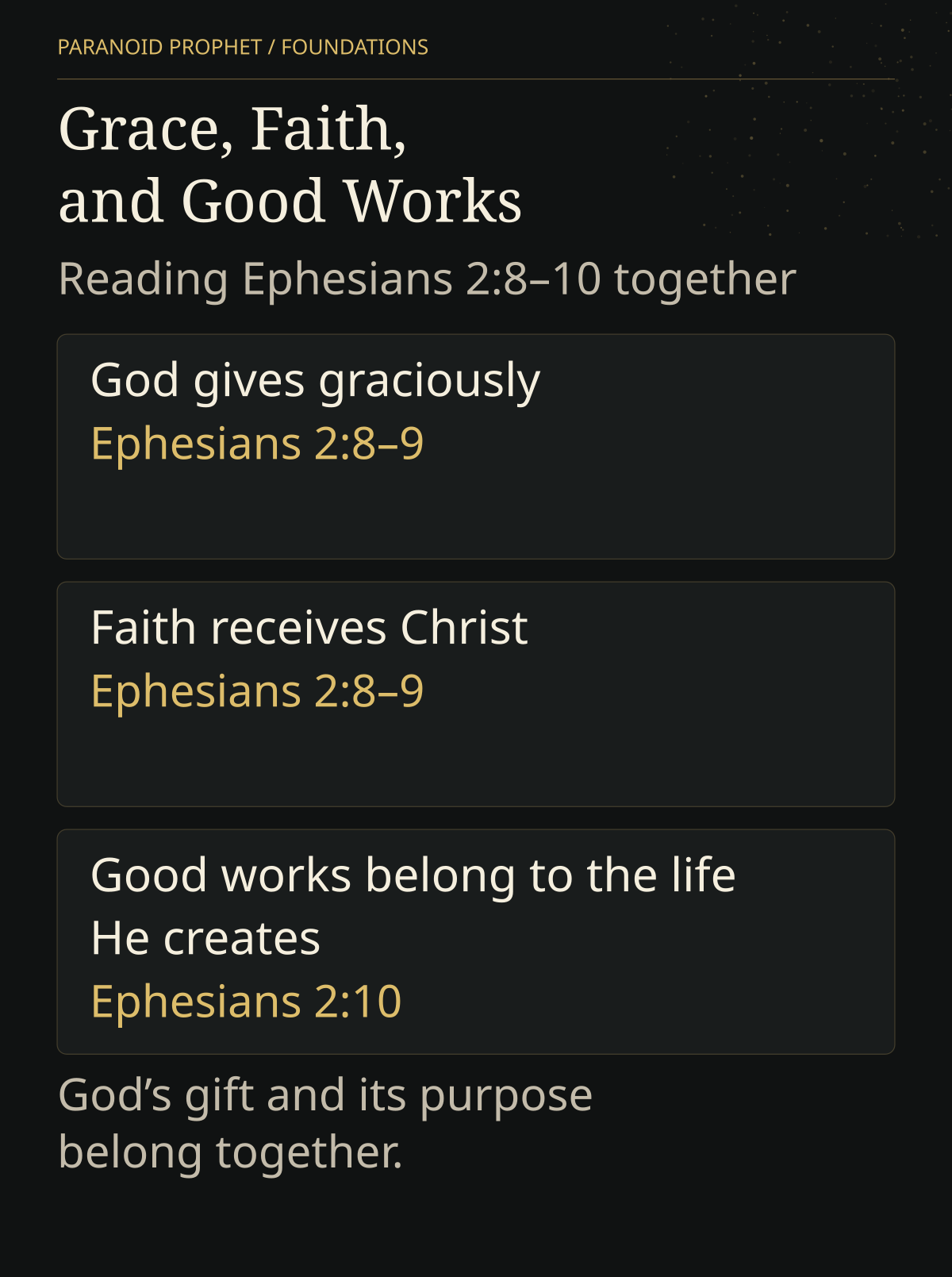
Grace, Faith, and Good Works (image text)
Reading Ephesians 2:8–10 together
- God gives graciously
Ephesians 2:8–9 - Faith receives Christ
Ephesians 2:8–9 - Good works belong to the life
He creates
Ephesians 2:10
God’s gift and its purpose belong together.
PARANOID PROPHET / FOUNDATIONS
If Works Do Not Earn Salvation, Why Do Them?
Because God commands love, our neighbors need it, and His grace directs us toward a life that reflects Christ.
Feeding someone matters to the person who is hungry. Telling the truth matters to the person who was deceived. Keeping a promise matters to the person who depended on it. Good works are not merely evidence we collect to reassure ourselves about our spiritual status. They are acts of love with real consequences for other people.

Paul tells the Philippians to take their life of obedience seriously while grounding it in God’s work within them. Divine action and human responsibility appear together. Philippians 2:12–13.
Grace therefore changes the reason for obedience. We can serve out of gratitude and dependence rather than using people as opportunities to improve our standing with God. When we fail, we confess and seek repair. When we grow, we give thanks rather than assume superiority.
What Does Grace Mean in Salvation?
Grace begins with God’s generosity toward people who cannot establish a claim on His favor. In Ephesians 2, the movement toward salvation begins with God’s mercy and love. The people described need to be made alive with Christ. Their rescue is not presented as a reward for overcoming sin through superior effort.
Titus makes a similar point. God saves because of His mercy, renews His people through the Holy Spirit, and gives them hope of eternal life. The passage then calls believers to devote themselves to doing good. Grace produces a new way of living without turning that life into the payment that caused God to save. Titus 3:3–8.
Calling salvation a gift does not mean sin is insignificant. God’s mercy comes through the costly saving work of Christ. In Romans 3, grace and redemption belong together with Jesus’ sacrificial death. The full account includes God’s justice as well as His generosity. Romans 3:21–31.
For that larger theological picture, read Why Did Jesus Die?. This article concentrates on how grace, faith, and obedience fit together rather than repeating the entire account of the cross.
What Are Justification and Sanctification?
Christian teaching uses several terms because salvation concerns more than one aspect of our need.
In the Protestant framework used here, justification concerns God’s gracious verdict: He pardons sinners and accepts them as righteous because of Christ, received through faith. Sanctification concerns God’s work of setting His people apart and renewing their lives in holiness. These belong together, but they should not be confused.
The distinction helps answer an anxious question: does every uneven day of Christian growth require us to rebuild the foundation of acceptance with God? Protestant teaching directs that foundation toward Christ’s work, while treating actual growth and repentance as serious consequences of belonging to Him.
The Westminster Confession, chapters 11 and 13, is one representative Reformed statement of this distinction. The Lutheran Augsburg Confession, Article IV and Article VI, likewise links free justification through faith with the necessity of good fruit, without making that fruit its meritorious cause. These are identifiable Protestant formulations, not a claim that every Christian tradition uses the words identically.
The New Testament also describes salvation through reconciliation, adoption, freedom, renewal, and the hope of resurrection. We should not make one term carry every part of that larger promise.
For how these changes affect ordinary life, read What Happens When You Become a Christian?.
What Does Paul Mean by Justification Apart From Works?
Romans 3 addresses humanity’s sin and God’s righteousness in Christ. Paul excludes boasting and argues that both Jews and Gentiles approach the same God through faith. He is not explaining why one ethnic or religious group is morally superior to another.
His reference to works required by the law belongs within that argument about God’s law, human sin, and the inclusion of the nations. Circumcision and covenant membership matter to the context. Paul’s reasoning should not be flattened into the accusation that Jewish people have always believed salvation can be bought by accumulating good deeds.
Romans 4 then turns to Abraham. Paul distinguishes wages owed for work from a gift received through trust. Abraham’s righteousness is credited in connection with believing God’s promise, and Paul emphasizes that this occurred before circumcision. His argument undermines both boasting in achievement and the idea that circumcision is the necessary basis of belonging to Abraham’s family. Romans 4:1–12.
The Protestant conclusion is that our acceptance with God rests on Christ rather than our performance. Faith does not become a superior achievement that earns what other works could not. It is dependence on the One who justifies sinners.
Paul’s concern does not end with acceptance. Later in Romans, he rejects the suggestion that abundant grace makes continued allegiance to sin acceptable. Belonging to Christ involves a new life. Romans 6:1–4.
What Does James Mean by Faith Without Works?
James begins his argument with someone who claims to have faith while failing to act. His example is immediate and material: a fellow believer lacks adequate clothing and food, and another person offers pleasant words without providing needed help.
This is not an abstract puzzle about how many religious activities someone must complete. It exposes the emptiness of a profession that remains unmoved by a neighbor’s need. James also observes that correct belief about God’s oneness is not, by itself, the same as faithful trust. Even hostile spiritual beings acknowledge that truth.
James presses the reader beyond a label. Faith must enter a person’s choices, relationships, and costly responses to God. His concern includes salvation, not merely a respectable public reputation. James 2:14–26.
This makes the passage uncomfortable in a useful way. A person can defend orthodox doctrine and still ignore the hungry neighbor directly in front of them. James refuses to let doctrinal accuracy become cover for lovelessness.
Why Do Paul and James Both Appeal to Abraham?
Both writers draw from Abraham’s story, including Genesis 15:6, but their arguments emphasize different concerns and moments in that story.
Genesis 15: God’s Promise and Abraham’s Trust
In Genesis 15, Abraham receives God’s promise concerning his descendants and believes Him. Paul uses this passage to show that righteousness is credited through faith rather than earned as wages. Read Genesis 15:1–6 beside Romans 4.
We should not use this observation to claim that Genesis 15 must record the first moment Abraham ever trusted God. Genesis has already described his response to God’s call. Paul’s explicit argument in Romans 4 concerns faith, crediting righteousness, and its priority to circumcision.
Genesis 22: Trust Expressed in Costly Obedience
James appeals to the later account in which Abraham obeys God’s command concerning Isaac. Genesis describes this as a test, and the narrative ends with Isaac spared and a ram provided. James uses the event to explain how Abraham’s trust and obedience worked together and how the earlier Scripture reached fulfillment in his life. Genesis 22:1–18; James 2:21–23.
The later obedience did not precede the promise in Genesis 15. It brought Abraham’s existing trust into costly expression. This chronology supports the Protestant reading, while not settling every theological question by itself.
Genesis 22 is a particular biblical narrative, not permission for anyone to harm another person because they believe they have received a private divine command.
So Do Paul and James Contradict Each Other?
This article’s conclusion is that their teachings can be read coherently without weakening either one.
Paul opposes making human works the basis of justification and boasting. James opposes calling an inactive profession saving faith. Paul directs sinners away from self-reliance to God’s promise; James insists that trust in God must become active in life.
James 2:24 still needs to be faced directly. It joins being considered righteous with action and rejects faith that stands alone. A Protestant explanation cannot simply delete that verse or claim the wording says something entirely different.
Many Protestants understand James here to describe the vindication and maturation of genuine faith: Abraham’s obedience demonstrates that his trust is living and brings it to its intended expression. That interpretation draws on the passage’s contrast between claimed faith and lived faith, its examples, and the order of Abraham’s story. It is an argument from context, not a claim that one English definition of justify automatically resolves the matter.
Nor should the explanation reduce James to how a person looks in front of other people. His opening question concerns whether the claimed faith can save. The problem is real spiritual emptiness, not merely poor public relations.
Paul himself connects faith with love in Galatians 5:6. Titus 3 places unearned salvation and devotion to good deeds in the same paragraph. These passages provide strong reasons to resist a reading that makes Paul indifferent to conduct. Galatians 5:1–6; Titus 3:3–8.
How Do Christian Traditions Differ?
The dispute is more substantial than different slogans, but it should be described accurately.
Protestant Approaches
Historic Lutheran and Reformed formulations teach justification through faith apart from the merit of our works, while affirming that faith should produce obedience. They distinguish the basis of acceptance from the good life that follows. Protestant communities also disagree among themselves about assurance, perseverance, and how best to describe the relationship between faith and discipleship. Augsburg Confession, Articles IV and VI; Westminster Confession, chapters 11 and 16.
Catholic Teaching
The Catholic Catechism includes forgiveness and interior renewal within justification and connects it with baptism. It teaches that God’s grace comes first and that no one can earn the initial grace of conversion and justification. It also gives a real role to grace-enabled cooperation and speaks of merit within the life of charity. That differs from the Protestant framework above, but it is not accurately summarized as buying salvation through unaided effort. Catechism, paragraphs 1987–1993 and 2007–2011.
For Catholic teaching, grace-enabled works are more than evidence of renewal: the Catechism connects their merit with growth in grace and the attainment of eternal life. It attributes this entirely dependent merit to Christ’s grace, rather than to an independent claim against God. See Catechism 2007–2011, especially 2010.
Orthodox Teaching
Writing for the Orthodox Church in America, Fr. John Breck describes salvation as Christ’s gracious work leading people into communion with God, while emphasizing an ongoing, grace-enabled response often called synergy. Another OCA pastoral explanation rejects a numerical quota of works and insists that faith become visible in mercy. These are representative Orthodox explanations, not comprehensive statements on behalf of every Orthodox writer. Salvation Is Indeed By Grace; Grace and Salvation.
The OCA explanation also treats active mercy as integral to the path of salvation, rather than simply outward evidence that a past profession was genuine. This is part of its account of a continuing life in Christ.
A fair comparison recognizes both disagreement and shared concerns. These traditions reject the idea that indifference to God and cruelty toward others constitute a healthy Christian life. They differ about how justification, renewal, sacraments, cooperation, and final salvation relate. This article finds the Protestant distinction between justification through faith and the renewed life that follows especially compelling when Romans, Ephesians, Titus, and James are read together.
How Much Fruit Is Enough?
Scripture does not provide a numerical quota by which readers can calculate salvation. The warning against empty profession should awaken honesty, not create an endless spiritual performance audit.
A beginner’s growth may be uneven. A person dealing with serious illness, disability, exhaustion, or restricted opportunity may have little public activity to display. Visibility and volume are poor measures of love. Quiet faithfulness matters, and outsiders cannot see everything God is doing in a person’s life.
At the same time, a sustained refusal to acknowledge wrongdoing should not be excused by appealing to grace. James addresses the danger of words that never reach action. John directs believers away from denying sin and toward confession and Christ’s advocacy. 1 John 1:8–2:2.
If this question troubles you, begin with Christ and His promise, then talk honestly with mature Christians who know you. Ask what obedience is actually before you. It may be a specific confession, a neglected responsibility, an act of mercy, or receiving help you have resisted. No article can make an infallible judgment about an individual’s heart.
For a fuller discussion of promises, warning passages, and recurring doubts, read Can a Christian Be Sure of Salvation?.
Receive Grace and Walk in Its Purpose
The gospel frees us from presenting our best week as the reason God should receive us. It also confronts the use of faith as a shelter for indifference or harm.
Look to Jesus Christ, who died for sinners and rose again. Trust His mercy. Turn from the sin you have been defending. Attend to the neighbor whose need you can address. Ask for the Spirit’s help and learn to follow Christ with His people.
Grace gives both a secure object for faith and a new direction for life. Paul protects our dependence on Christ. James presses that dependence into action. Read them together, and let neither self-righteousness nor empty profession take the place of living faith.
Frequently Asked Questions
Does James 2:24 disprove justification by faith alone?
Christians disagree about how to interpret its relationship to Paul. This article argues that James rejects a claimed faith without living obedience, while Paul rejects works as the basis of justification. James’ language about action must remain part of the explanation rather than being ignored.
Is faith itself a work that earns salvation?
Paul contrasts receiving through trust with earning wages in Romans 4. Faith relies on God’s promise and Christ’s saving work. Treating the act of believing as a meritorious accomplishment would undermine that contrast.
Do Catholics teach that people can earn salvation without grace?
No. The Catholic Catechism says no one can merit the initial grace of conversion and justification. Catholic teaching still differs from Protestant teaching in its account of justification, baptism, grace-enabled cooperation, and merit. Those differences should be discussed without misrepresenting either position.
Sources and Further Study
The linked biblical passages are the primary sources. They open in the New International Version; the article uses paraphrase and commentary rather than extended Scripture quotations.
- Grace and the purpose of salvation: Ephesians 2:1–10; Titus 3:3–8; Romans 3:21–31.
- Paul, James, and Abraham: Romans 4:1–12; James 2:14–26; Genesis 15:1–6; Genesis 22:1–18.
- Grace and Christian living: Romans 6:1–4; Galatians 5:1–6; Philippians 2:12–13; 1 John 1:8–2:2.
- Lutheran primary statements: Augsburg Confession, Article IV: Justification; Article VI: New Obedience.
- Reformed primary statement: Westminster Confession, especially chapters 11, 13, and 16.
- Catholic primary statement: Catechism on justification and merit.
- Representative Orthodox explanations: Fr. John Breck: Salvation Is Indeed By Grace; Orthodox Church in America: Grace and Salvation.
- Continue within this site: Why Did Jesus Die?; Christian Foundations; Sources and Verification.
Continue studying: Explore what Jesus saves us from and for, the biblical meaning of sin and reconciliation, and the response of repentance and faith.