
A friend asks why you believe in Jesus. A relative says Christians have made faith look dishonest. Someone at lunch wonders whether there is any reason to hope beyond death. You care about the person, but you can already feel yourself searching for the perfect answer.
You do not need a polished performance to speak honestly about Christ. You do need to know what you are saying, listen to the person in front of you, and remember that love does not disappear when a conversation becomes difficult. Scripture joins a clear message to a manner of life that makes room for patience, courage, and gentleness.
GUIDED ARTICLE EXPERIENCE
How Can Christians Share Their Faith? Speaking About Jesus with Truth and Grace
Read along as the narration moves through the article.
Browser narration · No stored audio or site tracking
CONTINUE GUIDED TOUR
Continue where you left off.
GUIDED TOUR COMPLETE
You have reached the end of this study.
Study record saved on this device.
GUIDED TOUR
How Can Christians Share Their Faith? Speaking About Jesus with Truth and Grace
Narrator: Paranoid Prophet Recommended Voice Native device narration
Prepare to follow the article as it is narrated.
VOICE & TOUR OPTIONS
Voice & Listening
NARRATOR
Finding a narrator…
Checking the best narrator available on this device.
Restores the site recommendations available in this browser.
Our listening picks lead when available; other voices are ranked for narration. Known novelty voices are hidden. Browser-provided voices may use an online voice service.
Screen-awake support will be checked when narration starts.
Optional: improve your device voices
Listening works with the voices already available here. Your device may offer additional free voices through its own settings.
iPhone or iPad: Settings → Accessibility → Read & Speak (or Spoken Content) → Voices → English. Look for Premium or Enhanced choices, then return here.
If offered, preview Ava or Zoe for U.S. English, or Serena or Jamie for British English. An explicit Premium or Enhanced version can improve on its compact version.
Mac: System Settings → Accessibility → Read & Speak → System voice. Open the voice list to preview or download additional choices.
Windows: Settings → Accessibility → Narrator → Add natural voices. Browser availability varies; a Narrator voice may not appear on websites. Edge may also expose online Natural voices without a model download.
Android: Open Accessibility → Text-to-speech output (the location varies by device). In the preferred engine settings, look for voice data and English choices.
Download sizes vary; some enhanced voices exceed 100 MB. This website cannot install system voices, and an installed voice appears here only if your browser exposes it.
Apple voice guide · Windows voice guide · Android voice guide
CHOOSE A NARRATOR
Recommended on this device
Our listening picks: Aaron, Martha, then Daniel, when available here. Otherwise, automatic uses the highest-ranked suitable voice. Preview alternatives or save your own choice.
Preparing the guided article experience…
RESUME GUIDED TOUR?
Continue where you left off.
GUIDED TOUR COMPLETE
You have reached the end of this study.
Article Guide13 sections
The Short Answer
Christians share their faith by explaining the good news about Jesus, giving honest reasons for their hope, and inviting people to respond without manipulation or coercion. Prayer, patient listening, truthful speech, practical love, and life in a Christian community belong together. No conversational method can guarantee another person’s faith.
If you want help getting started, go to a simple conversation example. If you are unsure what to say about Jesus, begin with the message itself. If someone has been hurt by Christians, read how to respond to hurt.
Why Share Your Faith at All?
In Matthew 28:18–20, the risen Jesus commissions His disciples to make disciples, baptize, and teach obedience to His commands. The passage points beyond collecting favorable reactions. It concerns people becoming learners and followers of Christ.
The New Testament also shows the message spreading beyond the apostles. Acts 8:1–4 describes scattered believers speaking the word in new places. Christians have different gifts and responsibilities, but ordinary believers are not spectators while a small professional class does all the speaking.
There is a serious claim behind Christian witness: Jesus matters for reconciliation with God, forgiveness, judgment, and life. If that is true, sharing it can be an act of love. Love also shapes how we share it. Another person is a neighbor to be treated with dignity, including when that person disagrees.
An anxious Christian may hear all this as a demand to turn every encounter into a presentation. That is a poor foundation for genuine relationships. There are moments to explain, moments to ask, moments to help, and moments to stop talking. Wisdom involves recognizing which moment you are in.
A Conversation Can Be Simple and Honest
Imagine a friend asking, “Why does Christianity matter to you?” A plain answer might sound like this:
“Because I believe Jesus really died and rose again, and that through Him we can be forgiven and reconciled to God. Following Him has changed how I understand my failures, my responsibilities, and my hope. I still have questions and a lot to learn. What has your experience with Christianity been like?”
This is an illustrative answer, not a testimony anyone should borrow as their own. Use only claims you actually believe and experiences you can truthfully describe.
From there, listen. Perhaps your friend wants historical reasons. Perhaps the question comes from bereavement, a difficult church experience, or confusion about what Christians teach. A prepared speech about something else may miss the real question completely.
A useful next sentence is often, “Can you tell me more about that?” Another is, “Would you like to hear why I see it differently?” Asking does not weaken your conviction. It helps make the conversation mutual rather than a speech delivered at someone.
If the person declines, honor the answer. Keep the friendship honest. Do not turn future kindness into a way to reopen a conversation they have clearly asked to leave alone.
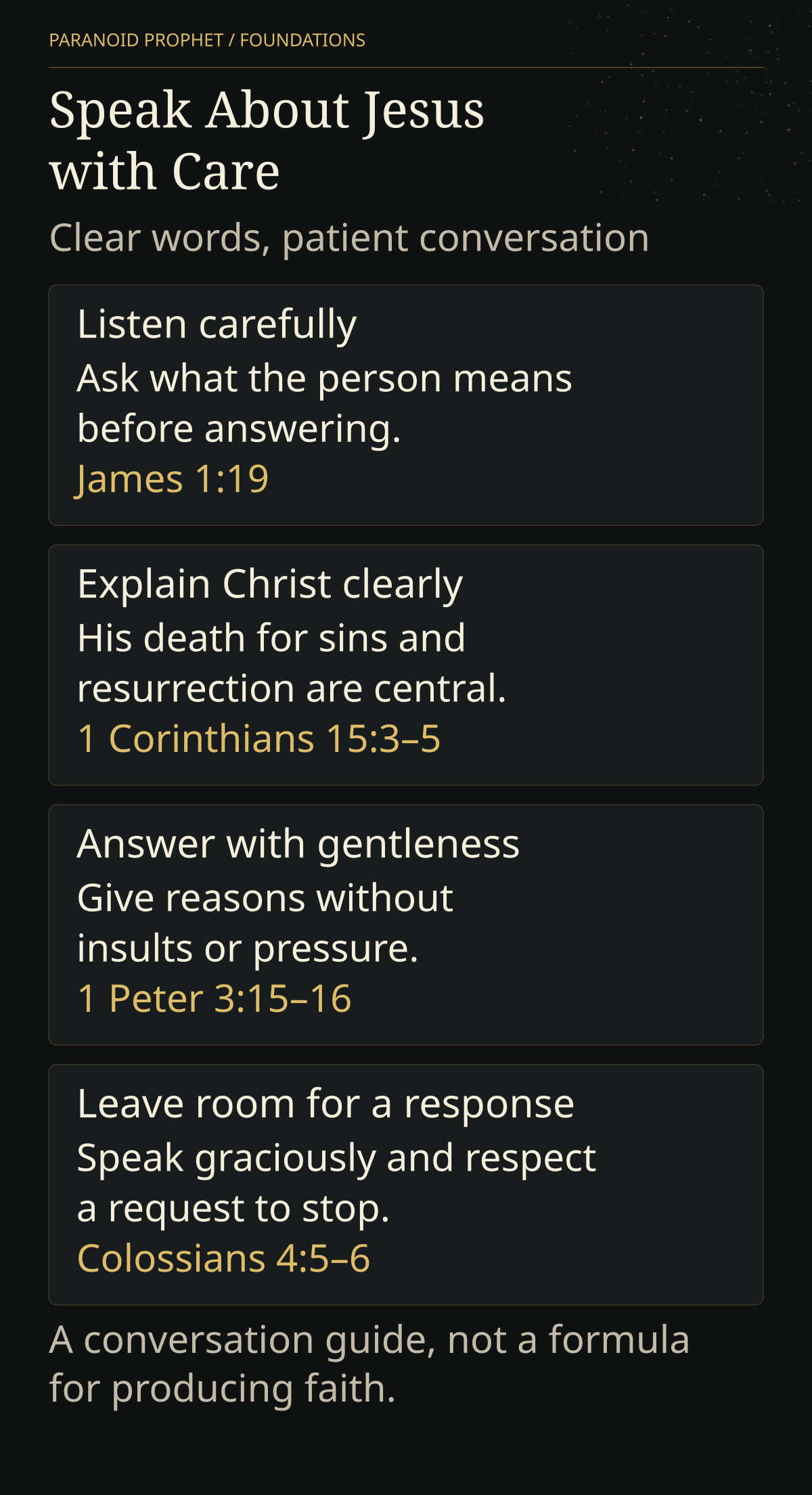
Speak About Jesus with Care (image text)
Clear words, patient conversation
- Listen carefully
Ask what the person means
before answering.
James 1:19 - Explain Christ clearly
His death for sins and
resurrection are central.
1 Corinthians 15:3–5 - Answer with gentleness
Give reasons without
insults or pressure.
1 Peter 3:15–16 - Leave room for a response
Speak graciously and respect
a request to stop.
Colossians 4:5–6
A conversation guide, not a formula for producing faith.
PARANOID PROPHET / FOUNDATIONS
Keep Jesus and the Gospel Central
People can hear a great deal about Christian politics, moral controversies, or church culture without hearing the Gospel clearly. Be ready to explain what Christianity actually announces.
In 1 Corinthians 15:1–8, Paul reminds the Corinthians of the message they received: Christ died for sins, was buried, was raised, and appeared to witnesses. Paul presents these events as central to the Gospel, not as optional illustrations of a general moral principle.
A simple explanation can include these connected truths:
- God made us, and we are accountable to Him.
- Sin damages our relationship with God and our life with one another.
- Jesus Christ died for sins and rose from the dead.
- God calls us to turn toward Him and trust Christ.
- Salvation is God’s gracious gift, leading into a life of discipleship rather than a purchase earned through good behavior.
This is a starting summary, not a substitute for the whole biblical story. Explain unfamiliar words. “Sin” includes more than notorious crimes. “Repentance” involves turning toward God, rather than merely feeling embarrassed. “Faith” means trusting Christ, rather than making yourself feel certain about every question.
Our guides to the Gospel, repentance and faith, and salvation by grace explore those questions more fully. In conversation, a clear sentence with room for questions often serves someone better than a crowded list of terms.
Listen Before You Decide What Someone Needs
James 1:19–27 connects listening, restraint in speech and anger, and actually doing God’s word. It is not a technical manual for evangelism. Its instruction still challenges the habit of composing a rebuttal before another person has finished speaking.
Ask questions you genuinely want answered. “When you say faith, what do you mean?” may reveal that the two of you are using the same word in different ways. “What do you find hardest to believe?” may uncover a serious objection you would otherwise overlook.
Do not assume that an atheist has never thought deeply, that a member of another religion secretly believes what you do, or that a churchgoer understands the Gospel. Learn what this particular person believes. You can disagree firmly without describing a position more crudely than its own thoughtful adherents would recognize.
Listening also means recognizing when someone needs company rather than an argument. A grieving friend does not owe you a philosophical debate. You can offer practical help, acknowledge the pain, and ask whether prayer would be welcome. Our guide to suffering and Christian hope gives that situation more room.
Give Reasons Without Pretending to Know Everything
1 Peter 3:13–18 addresses believers facing hostility and suffering. Its call to explain their hope belongs with gentleness, respect, a good conscience, and conduct shaped by Christ. It does not authorize contempt toward people who question Christianity.
Evidence matters. If someone asks whether Jesus existed or why Christians believe the resurrection occurred, you can discuss sources and arguments. You should also distinguish what a source says, what historians broadly accept, and what conclusion you think the evidence supports.
For example, Paul’s report of appearances in 1 Corinthians 15 is a source to examine. It does not give us hundreds of separately preserved interviews with each person he mentions. Responsible witness does not need to exaggerate the record to make it impressive.
Use the site’s historical evidence for Jesus and guide to evaluating religious truth claims as starting points for investigation. The Evidence Web can help someone follow connected questions. Choose one relevant resource, explain why it may help, and leave space to examine it.
“I don’t know” is an honest answer. You can add, “I can look into that and tell you what I find.” If you make that offer, follow through, including when the evidence is less decisive than you expected. Do not repeat a dramatic quotation, archaeological claim, or conversion story merely because it favors your position.
Share Your Story Without Making It Everyone’s Story
A personal testimony can explain why your faith matters and what following Christ has meant in your life. Keep it truthful, proportionate, and centered on Christ rather than on making yourself sound extraordinary.
You do not need a dramatic past. Nor should you embellish suffering, manufacture a miraculous detail, or turn another person’s private experience into material for your story. Ask before sharing identifiable details about someone else.
An account of improved relationships or changed habits can be meaningful. It does not prove that every Christian will experience the same outcome. Some faithful people continue living with illness, grief, difficult circumstances, or unanswered questions. Avoid promising that conversion will reliably fix someone’s marriage, finances, anxiety, or health.
Your experience is one part of the conversation. The Gospel concerns what Christians believe God has done in Christ, including for people whose lives look different from yours.
Read a Passage Together
Acts 8:26–40 describes Philip meeting an Ethiopian official who is reading Isaiah. Philip asks about understanding, receives an invitation to join him, and begins with the passage to explain Jesus. This is a particular narrative of God’s guidance, not a guarantee that every encounter will unfold the same way.
It nevertheless offers a helpful picture of attention to a person’s actual question and to Scripture itself. You might ask, “Would you like to read a short passage about Jesus together?” If the answer is yes, choose something manageable, such as Mark 2:1–12, Luke 15:11–32, or a section of the resurrection narratives.
Read the surrounding passage rather than extracting a line to settle an argument. Ask what the text says, what seems confusing, and what it reveals about Jesus. Allow the other person to notice things before supplying every answer. Avoid using the questions as a disguised test with only your preferred phrasing accepted.
The Bible in Context guide provides a worked example of careful reading. If a passage raises a hard question, that can become the next conversation rather than an embarrassment to rush past.

Respect Boundaries and Differences in Power
Christian witness should be open about its purpose. Do not disguise a religious invitation as an unrelated social event or make essential help depend on someone listening to your message.
A person should be able to decline without losing friendship, fair treatment, employment opportunities, practical assistance, or access to care. This matters especially when you supervise, teach, counsel, or provide services to someone. Follow applicable policies and safeguarding requirements. A position of responsibility must never become leverage for religious agreement.
In ordinary conversation, stop when someone asks you to stop. Do not continue through repeated messages, new accounts, or pressure from a group. If there is genuine interest later, the person can reopen the subject. Respect for a boundary does not require pretending you no longer believe the Gospel.
Online, address the actual claim rather than trying to humiliate its author. Do not direct followers to swarm someone, share private messages without permission, or treat ridicule as courage. Colossians 4:2–6 joins prayer for clear proclamation with wise conduct and gracious speech. The medium changes; the responsibility for your words remains.
When Christians Have Caused Harm
If someone tells you a church leader exploited them, listen without immediately defending the institution or questioning whether the harm was serious enough. You are not required to know every fact to acknowledge that abuse and deception are wrong.
Do not use “Christians aren’t perfect” to minimize wrongdoing. If you caused harm, accept responsibility and take appropriate steps to repair it. If someone faces danger, practical safety and qualified help take priority over preserving a religious organization’s reputation.
You can explain why you believe Jesus deserves to be considered without demanding that a harmed person trust you, return to an unsafe congregation, or discuss religion before they are ready. Our guides to forgiveness and reconciliation and the church distinguish faithfulness from tolerating harmful leadership.
Invite a Response Without Trying to Control It
Christianity makes claims that call for a response. In Acts 17:22–34, Paul engages an Athenian audience and speaks about God, repentance, judgment, and resurrection. The account records different reactions: mockery, further interest, and belief. A serious invitation does not produce one uniform outcome.
If someone wants to follow Jesus, keep helping. Read Scripture together, discuss repentance and faith, and help them connect with a trustworthy local congregation. Baptism and continuing instruction belong to the disciple-making commission. Christians differ on some details of initiation and baptism; be honest about your church’s teaching rather than presenting a particular method as the only Christian practice.
A prayer can express repentance and trust, but repeating your words is not a technique that lets you certify another person’s spiritual condition. Do not pressure someone into a declaration so you can count a result. Give room for questions and sustained learning. What happens when you become a Christian? explains useful next steps.
In 1 Corinthians 3:5–9, Paul challenges factions built around Christian leaders. He describes himself and Apollos as servants while crediting God with growth. The immediate concern is division in the church, but it also corrects a boastful view of ministry success. Faithful service matters; control of another person’s response is not ours.
A Practical Starting Point This Week
Pray for someone you already know, asking for love and wisdom rather than planning how to corner them. Refresh your understanding of the Gospel. When a natural opportunity comes, ask a real question, listen fully, and speak honestly about Jesus if the conversation is welcome.
If you have been harsh, apologize. If you promised to investigate a question, do it. If someone is interested, offer a relevant passage or resource and ask whether they would like to continue. If they decline, continue treating them well.
The aim is a faithful witness to Christ expressed through truthful words and a life of love. You can take that responsibility seriously without turning another human being into a project.
Sources and Translation Note
Biblical teaching in this guide is paraphrased rather than presented as an extended quotation. Scripture links open the NIV for readers; the surrounding passages were also checked in the public-domain World English Bible. Practical conversation examples are illustrative applications, not biblical quotations or promises of a particular outcome. For the broader approach, see our sources and verification standard.