
The gospel is the good news that God has acted through Jesus Christ to save sinners and bring them into His life and kingdom. Jesus, the eternal Son made human, died for our sins, was buried, rose bodily from the dead, and reigns as Lord. Through Him, God offers forgiveness, reconciliation, and new life to those who turn to Him in repentance and faith. Christian hope reaches beyond death to resurrection and life with God in His renewed creation.
That is the center of Christianity. Understanding it requires asking both sides of the question: What does Jesus save us from, and what does He save us for?
GUIDED ARTICLE EXPERIENCE
What Is the Gospel? What Jesus Saves Us From and For
Read along as the narration moves through the article.
Browser narration · No stored audio or site tracking
CONTINUE GUIDED TOUR
Continue where you left off.
GUIDED TOUR COMPLETE
You have reached the end of this study.
Study record saved on this device.
GUIDED TOUR
What Is the Gospel? What Jesus Saves Us From and For
Narrator: Paranoid Prophet Recommended Voice Native device narration
Prepare to follow the article as it is narrated.
VOICE & TOUR OPTIONS
Voice & Listening
NARRATOR
Finding a narrator…
Checking the best narrator available on this device.
Restores the site recommendations available in this browser.
Our listening picks lead when available; other voices are ranked for narration. Known novelty voices are hidden. Browser-provided voices may use an online voice service.
Screen-awake support will be checked when narration starts.
Optional: improve your device voices
Listening works with the voices already available here. Your device may offer additional free voices through its own settings.
iPhone or iPad: Settings → Accessibility → Read & Speak (or Spoken Content) → Voices → English. Look for Premium or Enhanced choices, then return here.
If offered, preview Ava or Zoe for U.S. English, or Serena or Jamie for British English. An explicit Premium or Enhanced version can improve on its compact version.
Mac: System Settings → Accessibility → Read & Speak → System voice. Open the voice list to preview or download additional choices.
Windows: Settings → Accessibility → Narrator → Add natural voices. Browser availability varies; a Narrator voice may not appear on websites. Edge may also expose online Natural voices without a model download.
Android: Open Accessibility → Text-to-speech output (the location varies by device). In the preferred engine settings, look for voice data and English choices.
Download sizes vary; some enhanced voices exceed 100 MB. This website cannot install system voices, and an installed voice appears here only if your browser exposes it.
Apple voice guide · Windows voice guide · Android voice guide
CHOOSE A NARRATOR
Recommended on this device
Our listening picks: Aaron, Martha, then Daniel, when available here. Otherwise, automatic uses the highest-ranked suitable voice. Preview alternatives or save your own choice.
Preparing the guided article experience…
RESUME GUIDED TOUR?
Continue where you left off.
GUIDED TOUR COMPLETE
You have reached the end of this study.
Article Guide10 sections
What Does “Gospel” Mean?
“Gospel” means good news. In the New Testament, the news concerns Jesus Christ and what God has accomplished through Him.
Paul gives a concentrated summary in 1 Corinthians 15:1–11: Christ died for sins, was buried, was raised on the third day, and appeared to witnesses. Paul presents these events as the fulfillment of Scripture and the message the apostles proclaimed.
Jesus’ announcement in Mark 1:14–15 brings another part of the picture into view: God’s kingdom has drawn near, and people are called to repent and believe. These belong together. The crucified and risen Savior is the King whose reign brings forgiveness, defeats evil, and will finally overcome death.
The gospel therefore announces something God has done before it describes anything we must do. Its claims can be received or rejected, but they cannot be replaced by a general commitment to kindness, a spiritual feeling, or a promise of personal success. The message has a particular center: Jesus Christ.
The word also appears in the titles of the four Gospels: Matthew, Mark, Luke, and John. Those books tell the story of Jesus’ life, teaching, death, and resurrection. The gospel message is the good news they bear witness to.
What Has God Done Through Jesus?
He Has Kept His Promises
The Bible begins with God creating a good world and human beings made in His image. Our lives have a purpose before sin enters the story: to know God, reflect His goodness, and care faithfully for His creation (Genesis 1:26–31).
Human rebellion brings estrangement, violence, and death. Yet God’s purpose for His creation continues. He calls Abraham and promises blessing for the nations; Israel’s Scriptures tell of His faithfulness, human failure, judgment, mercy, and the hope of restoration (Genesis 12:1–3).
Jesus comes within that history. Paul introduces the gospel as God’s promised message concerning His Son, descended from David in His human life (Romans 1:1–7). After the resurrection, Jesus explains His suffering, rising, and the proclamation of forgiveness in relation to Israel’s Scriptures (Luke 24:44–49).
The Christian claim is that Israel’s promised Messiah has come, and His saving reign concerns the nations. “Christ” is a title meaning Messiah or Anointed One, not Jesus’ surname.
The Son Has Entered Our Humanity
The identity of the Savior matters. According to John 1:1–18, the eternal Word who was with God and was God became flesh. Jesus is truly human without ceasing to be divine.
His earthly life includes faithful obedience, compassion, teaching, temptation, suffering, and prayer. He enters the life we actually live. Hebrews presents Him as a sinless high priest who understands human weakness and welcomes those who need mercy (Hebrews 4:14–16).
Christian salvation is the work of the one God: the Father sends the Son, the Son gives Himself, and the Holy Spirit brings renewal. These are distinct persons acting in a united saving purpose. For that foundation, see What Is the Trinity?.
He Has Died for Sins and Risen From the Dead
The New Testament gives Jesus’ death a saving meaning. He bears sins, reconciles people to God, and gives His life for others. God’s love initiates this rescue while we are still sinners; Jesus does not persuade an otherwise loveless Father to become merciful (Romans 5:6–11; 1 Peter 2:24).
God’s mercy also takes evil seriously. In Romans 3:21–26, Christ’s atoning death reveals God’s righteousness as He justifies those who trust Jesus. Scripture explains this saving work through several connected images, including sacrifice, redemption, reconciliation, and victory. Our study Why Did Jesus Die? examines those in detail.
The same Jesus who died is alive. Luke describes the risen Jesus showing His hands and feet and eating with His disciples, identifying Himself as more than a ghost (Luke 24:36–43). Paul describes resurrection life as transformed and imperishable, rather than a temporary return to ordinary mortal existence (1 Corinthians 15:42–54).
The resurrection is essential to the gospel. Paul says that without it, Christian faith would be futile and sin would remain unresolved. The risen Christ is the beginning of His people’s future resurrection, and He reigns until death itself is defeated (1 Corinthians 15:17–26).
What Does Jesus Save Us From?
From Sin’s Guilt and God’s Judgment
Sin includes what we do, what we refuse to do, and the desires that direct our lives away from God. Deceit, cruelty, pride, exploitation, and indifference to our neighbor are failures of love with real consequences. Scripture treats them as offenses against the holy God who made us.
Paul’s argument in Romans 3 is that everyone needs mercy. Religious knowledge and comparison with worse offenders cannot establish our innocence before God. Our dignity as His creatures does not erase our guilt, and admitting our guilt does not erase our dignity.
Jesus saves from the condemnation that sin deserves. Romans 5:9 speaks of rescue from God’s wrath, while Romans 8:1 announces freedom from condemnation for those who are in Christ. God’s wrath is His righteous opposition to evil, not a passing fit of temper.
Forgiveness therefore means more than feeling better about ourselves. God deals with real guilt and grants peace with Himself. We can confess honestly because mercy does not require us to pretend that our wrongdoing was harmless.
From Sin’s Rule and Alienation From God
Sin also enslaves. We can recognize a destructive pattern and still return to it. Scripture describes a condition that reaches beneath isolated choices to the loyalties and desires governing us.
In Romans 6:1–23, belonging to Christ means a change of master and a new life. Sin is no longer entitled to rule His people. Freedom grows into obedience to God, whose service leads toward holiness and life.
This does not mean every temptation disappears at conversion. It means the struggle can now be faced with a new belonging, new resources, and a different future. The Holy Spirit works in those who belong to Christ, enabling them to resist sin and learn faithful love (Romans 8:9–14).
Christ also restores the relationship sin has broken. Reconciliation means that former enemies are brought into peace with God (Romans 5:10–11). The person who trusts Him is invited to approach God rather than build a life around hiding from Him.
From Death’s Final Dominion
Christians still grieve, become ill, and die. Scripture does not conceal that reality. It places it within the promise that death will not have the final word.
Because Jesus rose, those who belong to Him await resurrection. Their hope includes the redemption of their bodies and creation’s liberation from decay (Romans 8:18–25). Salvation reaches the whole person and the world God made.
This also guards against a cruel misuse of the gospel: an illness, disability, or bereavement is not evidence that someone has failed to believe strongly enough. In John 9:1–3, Jesus rejects His disciples’ attempt to explain one man’s blindness by assigning blame to him or his parents. People who suffer need compassion and care.
What Does Jesus Save Us For?
For Life With God as His Children
The greatest gift of salvation is God Himself. Forgiveness opens into restored fellowship, prayer, worship, and the privilege of belonging to Him.
Romans 8:14–17 describes this belonging as adoption. Through the Spirit, believers approach God as Father and become heirs with Christ. Adoption is a family word: those welcomed by God have a place in His household.
The New Testament also describes believers as being in Christ. This means more than admiring Jesus from a distance. Their life, standing, and hope are bound to the living Savior. The benefits of salvation come with belonging to Him.
Explore how forgiveness, adoption, and new birth shape everyday life in What Happens When You Become a Christian?.
For a Holy Life Among His People
God’s grace creates a new way of living. Ephesians 2:8–10 places two truths together: salvation is God’s gift rather than our achievement, and those made new in Christ are created for good works.
That purpose becomes concrete in truthfulness, generosity, patience, sexual faithfulness, care for the vulnerable, and a willingness to seek reconciliation. The Spirit forms love and self-control in people who once served destructive desires (Galatians 5:13–26).
Salvation also brings us into a people. Ephesians 2:11–22 describes Jews and Gentiles being reconciled to God in one body and welcomed into His household. The church is called to make this shared belonging visible through worship, teaching, prayer, generosity, and mutual care.
A Christian website can help someone learn. It cannot replace the ordinary life of a congregation where people know, serve, and bear with one another.
Our guide to the Holy Spirit’s work explains how His presence, fruit, and gifts shape this shared life.

For Resurrection and a Renewed Creation
The Bible’s final hope is life with God in a renewed creation. Revelation 21:1–8 describes God dwelling with His people and the end of death, mourning, and pain. It also speaks soberly of judgment. Evil does not receive the last word or an indefinite right to continue.
Christians disagree about aspects of the sequence of end-time events. The central promise here is clear: Jesus will complete His saving work, His people will be raised, and God will dwell with them.
This future gives weight to present faithfulness. Caring for bodies, keeping promises, resisting injustice, and loving a difficult neighbor matter within a creation God intends to renew.
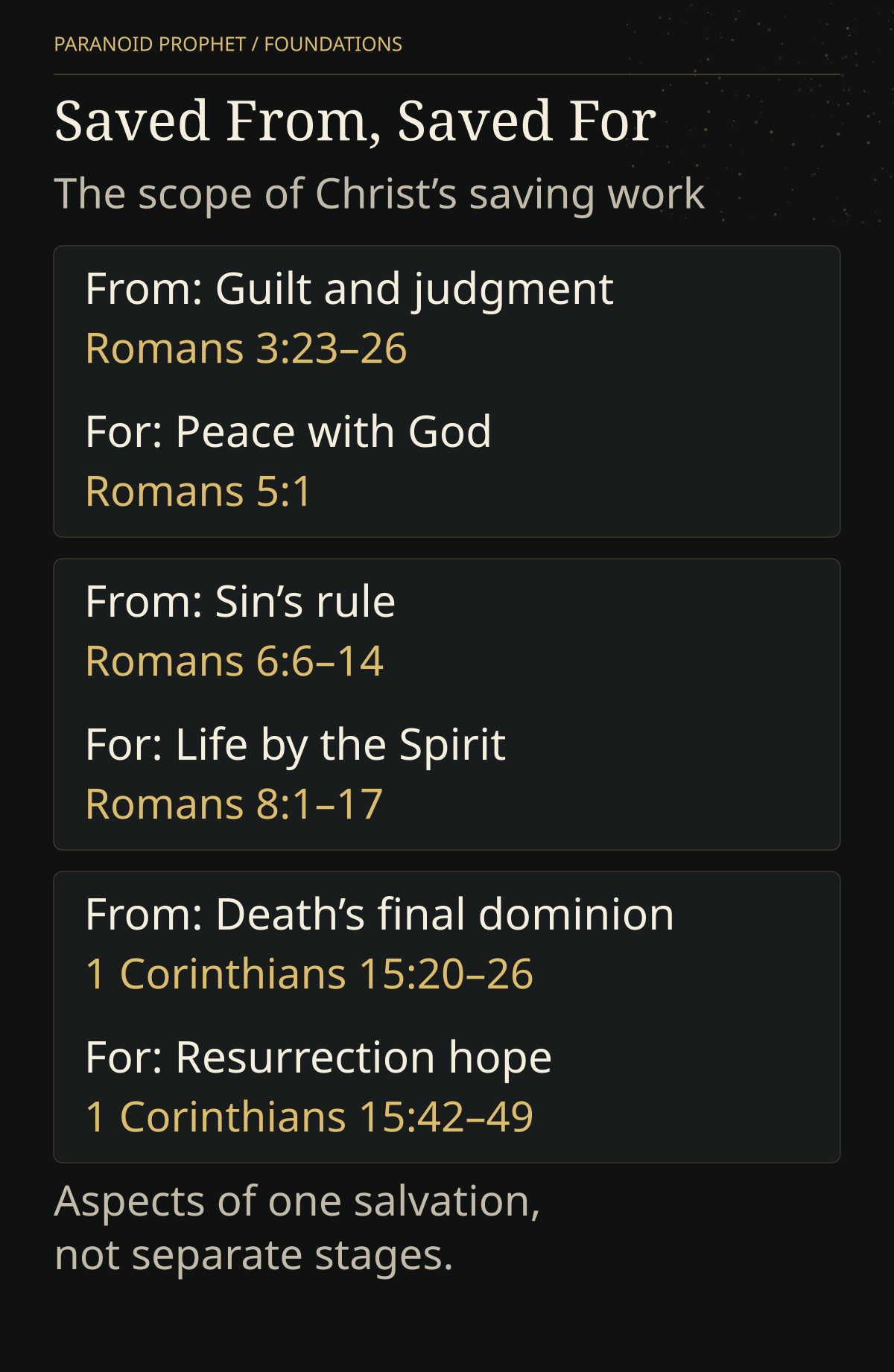
Saved From, Saved For (image text)
The scope of Christ’s saving work
- From: Guilt and judgment
Romans 3:23–26
For: Peace with God
Romans 5:1 - From: Sin’s rule
Romans 6:6–14
For: Life by the Spirit
Romans 8:1–17 - From: Death’s final dominion
1 Corinthians 15:20–26
For: Resurrection hope
1 Corinthians 15:42–49
Aspects of one salvation, not separate stages.
PARANOID PROPHET / FOUNDATIONS
How Are We Saved by Grace Through Faith?
Grace is God’s undeserved favor and generous action toward people who need His mercy. Ephesians 2:1–10 describes God giving life to people who could not create it for themselves; Titus 3:3–7 likewise locates salvation in His mercy and the Spirit’s renewal.
Faith means trusting Jesus Christ for mercy and receiving Him as Lord. Its saving significance rests in the Savior we trust. In the Protestant understanding reflected here, God’s gracious acceptance is received through faith rather than earned by moral achievement, and it leads into a changed life.
You do not have to repair your entire life before approaching Christ, and grace gives no permission to refuse His transforming work. For the relationship between justification, obedience, and Christian disagreements about these terms, read Salvation by Grace: Faith, Works, Paul and James.
How Does Scripture Call Us to Respond?
Repent and Trust Christ
Jesus calls people to repentance and faith (Mark 1:15). Repentance is turning toward God, acknowledging sin, and abandoning the claim that we have the right to rule our lives apart from Him. It includes a changed direction that bears fruit in conduct.
You can begin honestly. Name the wrong you know rather than hiding behind a vague admission that nobody is perfect. Ask for mercy and help. Where you have harmed another person, repentance includes stopping the harm and seeking appropriate accountability and repair. It does not entitle you to immediate restored trust.
Faith turns toward the Savior. Romans 10:9–13 joins believing in Jesus’ resurrection, confessing His lordship, and calling on Him for salvation. The invitation is open across the divisions of people and background.
Prayer can express this response. You can confess your sin, ask Jesus to save you, and tell Him you want to follow Him. Scripture gives no required script that works by precise wording. Confidence belongs in Christ and His promise.
Be Baptized and Learn to Follow Him
Baptism belongs within the New Testament’s account of becoming a disciple. Jesus commands His followers to make disciples, baptize them, and teach them to obey Him (Matthew 28:18–20). In Acts 2:36–42, those receiving the apostolic message are baptized and begin sharing the church’s life.
Christians differ over baptism’s subjects, timing, and relationship to regeneration. Our guide to becoming a Christian explains representative views. Speak with a trustworthy pastor about the biblical teaching and your own circumstances, including any previous baptism.
Look for a congregation that teaches Scripture in context, confesses the historic Christian faith, welcomes honest questions, and takes accountability seriously. Learning to follow Jesus ordinarily happens with others who can encourage, challenge, and care for you.
What If I Still Struggle After Believing?
The New Testament expects Christians to need ongoing confession, help, and growth. First John 1:5–2:2 warns against claiming sinlessness while directing those who sin to Jesus as their advocate. Confess rather than conceal, seek practical help where a pattern harms you or others, and keep following Christ through the unfinished parts of life. For realistic expectations about new life and suffering, read What Happens When You Become a Christian?; for recurring fears about belonging to Him, read Can a Christian Be Sure of Salvation?.
Frequently Asked Questions
Is the Gospel the Same as Being a Good Person?
The gospel announces what God has done through Jesus to rescue sinners. It calls forth a good life, but moral improvement cannot substitute for forgiveness and reconciliation with God. Ephesians 2:8–10 presents salvation as a gift that produces good works.
Is the Gospel of the Kingdom Different From the Gospel of Salvation?
They are connected aspects of the biblical message. Jesus announces God’s kingdom, and the apostles proclaim His death, resurrection, and lordship. The King saves people from sin and brings them under His gracious reign, which will culminate in the defeat of death (Mark 1:14–15; 1 Corinthians 15:20–28).
Do I Have to Understand Every Doctrine Before Coming to Jesus?
You need to understand whom you are trusting and the central message about Him. You do not need exhaustive theological knowledge. Bring honest questions, read the Gospel accounts, and seek patient instruction. Discipleship includes continuing to learn what you have begun to believe (Matthew 28:19–20).
Can the Gospel’s Historical Claims Be Examined?
Yes. The texts, their dates, the testimony they preserve, and competing explanations can be examined. Historical investigation and theological interpretation should be distinguished. Paul’s report that Jesus appeared to more than five hundred people is one surviving report about that appearance, not five hundred independent surviving testimonies. Begin with How Early Is the Resurrection Claim?.
Begin With Jesus
If you are new to Christianity, start by reading Mark’s Gospel. As you read, ask: Who does Jesus claim to be? What does He say people need? Why does He go to the cross? What do the witnesses say happened afterward?
Then read 1 Corinthians 15:1–11, Ephesians 2:1–10, and Romans 8:1–25. Together they show the gospel’s center, the grace by which it saves, and the life and hope it opens.
The invitation is personal: turn toward the crucified and risen Christ. He saves people from guilt, alienation, sin’s rule, and death’s final dominion. He saves them for fellowship with God, life among His people, faithful love, and resurrection.
Keep reading through Christian Foundations, and bring what you are learning to a trustworthy Christian congregation. The good news leads us to a living Savior and a life of following Him.
Sources and Further Reading
Primary biblical passages: The linked passages use the NIV, consistent with this site’s normal practice. Explanations in this article are paraphrases rather than extended quotations.
- 1 Corinthians 15: the apostolic gospel, Christ’s resurrection, His reign, and believers’ future resurrection.
- Mark 1:14–15 and Romans 1:1–7: God’s kingdom and His promised gospel concerning the Son.
- John 1:1–18 and Luke 24:36–49: incarnation, bodily resurrection, and scriptural fulfillment.
- Romans 3:9–31, Romans 5:1–11, and Titus 3:3–7: sin, grace, justification, reconciliation, and renewal.
- Romans 6, Romans 8:1–25, and Ephesians 2: freedom, adoption, grace, good works, and the people of God.
- Romans 10:9–13, Acts 2:36–47, and Matthew 28:18–20: the response of faith, baptism, and discipleship.
- Galatians 5:13–26, 1 John 1:5–2:2, and Revelation 21:1–8: present holiness, ongoing confession, and future hope.
Historic Christian context: The Nicene Creed summarizes the historic Christian confession of the Son’s incarnation, crucifixion, resurrection, reign, and return. It is a witness to Christian belief, not an additional biblical book or independent first-century evidence for the events it confesses.
On differences between traditions: Compare the representative Reformed formulation in Westminster Confession, chapter 11, the Catholic account of grace in Catechism paragraphs 1996–2005, and the Orthodox Church in America’s account of redemption. These documents help identify the traditions’ own teaching; citing them does not imply agreement on every doctrine.
About our approach: Read What Paranoid Prophet Believes About the Bible and Sources and Verification for the distinction between Scripture, historical evidence, and theological interpretation.
Continue studying: Explore why humanity needs reconciliation with God, how repentance and faith respond to the gospel, and how grace, faith, and good works fit together.