


You begin trusting Jesus Christ, and then ordinary life continues. There are dishes in the sink, unfinished responsibilities, relationships to navigate, and habits that have not disappeared. You may feel relief, joy, uncertainty, or a mixture of all three.
So what has actually changed?
The New Testament answers by describing what God does for people who belong to Christ. He forgives sins, gives new life, welcomes believers into His family, and brings them into the life of His people. Following Jesus also begins a continuing transformation that reaches into how we think, love, work, and respond when we fail.
The foundation is the crucified and risen Jesus. If you are still exploring that foundation, begin with What Is the Gospel?. Here we will consider the next question: what does receiving that good news mean for your life?
GUIDED ARTICLE EXPERIENCE
What Happens When You Become a Christian?
Read along as the narration moves through the article.
Browser narration · No stored audio or site tracking
CONTINUE GUIDED TOUR
Continue where you left off.
GUIDED TOUR COMPLETE
You have reached the end of this study.
Study record saved on this device.
GUIDED TOUR
What Happens When You Become a Christian?
Narrator: Paranoid Prophet Recommended Voice Native device narration
Prepare to follow the article as it is narrated.
VOICE & TOUR OPTIONS
Voice & Listening
NARRATOR
Finding a narrator…
Checking the best narrator available on this device.
Restores the site recommendations available in this browser.
Our listening picks lead when available; other voices are ranked for narration. Known novelty voices are hidden. Browser-provided voices may use an online voice service.
Screen-awake support will be checked when narration starts.
Optional: improve your device voices
Listening works with the voices already available here. Your device may offer additional free voices through its own settings.
iPhone or iPad: Settings → Accessibility → Read & Speak (or Spoken Content) → Voices → English. Look for Premium or Enhanced choices, then return here.
If offered, preview Ava or Zoe for U.S. English, or Serena or Jamie for British English. An explicit Premium or Enhanced version can improve on its compact version.
Mac: System Settings → Accessibility → Read & Speak → System voice. Open the voice list to preview or download additional choices.
Windows: Settings → Accessibility → Narrator → Add natural voices. Browser availability varies; a Narrator voice may not appear on websites. Edge may also expose online Natural voices without a model download.
Android: Open Accessibility → Text-to-speech output (the location varies by device). In the preferred engine settings, look for voice data and English choices.
Download sizes vary; some enhanced voices exceed 100 MB. This website cannot install system voices, and an installed voice appears here only if your browser exposes it.
Apple voice guide · Windows voice guide · Android voice guide
CHOOSE A NARRATOR
Recommended on this device
Our listening picks: Aaron, Martha, then Daniel, when available here. Otherwise, automatic uses the highest-ranked suitable voice. Preview alternatives or save your own choice.
Preparing the guided article experience…
RESUME GUIDED TOUR?
Continue where you left off.
GUIDED TOUR COMPLETE
You have reached the end of this study.
Article Guide14 sections
What Happens When You Become a Christian? The Short Answer
Through Jesus Christ, God brings you into a new relationship with Himself. Scripture describes forgiveness and reconciliation, new birth, adoption into God’s family, the gift of the Holy Spirit, belonging to the church, and the hope of resurrection. You begin learning to live under Christ’s lordship, with His grace sustaining your growth.
These are connected dimensions of life in Christ. Christians differ over the precise relationship between faith, regeneration, baptism, and other aspects of Christian initiation. The sections below explain the biblical promises while identifying important disagreements where they affect the question.
Looking for a place to begin today? Jump to practical next steps, or read what it means if you do not feel different.
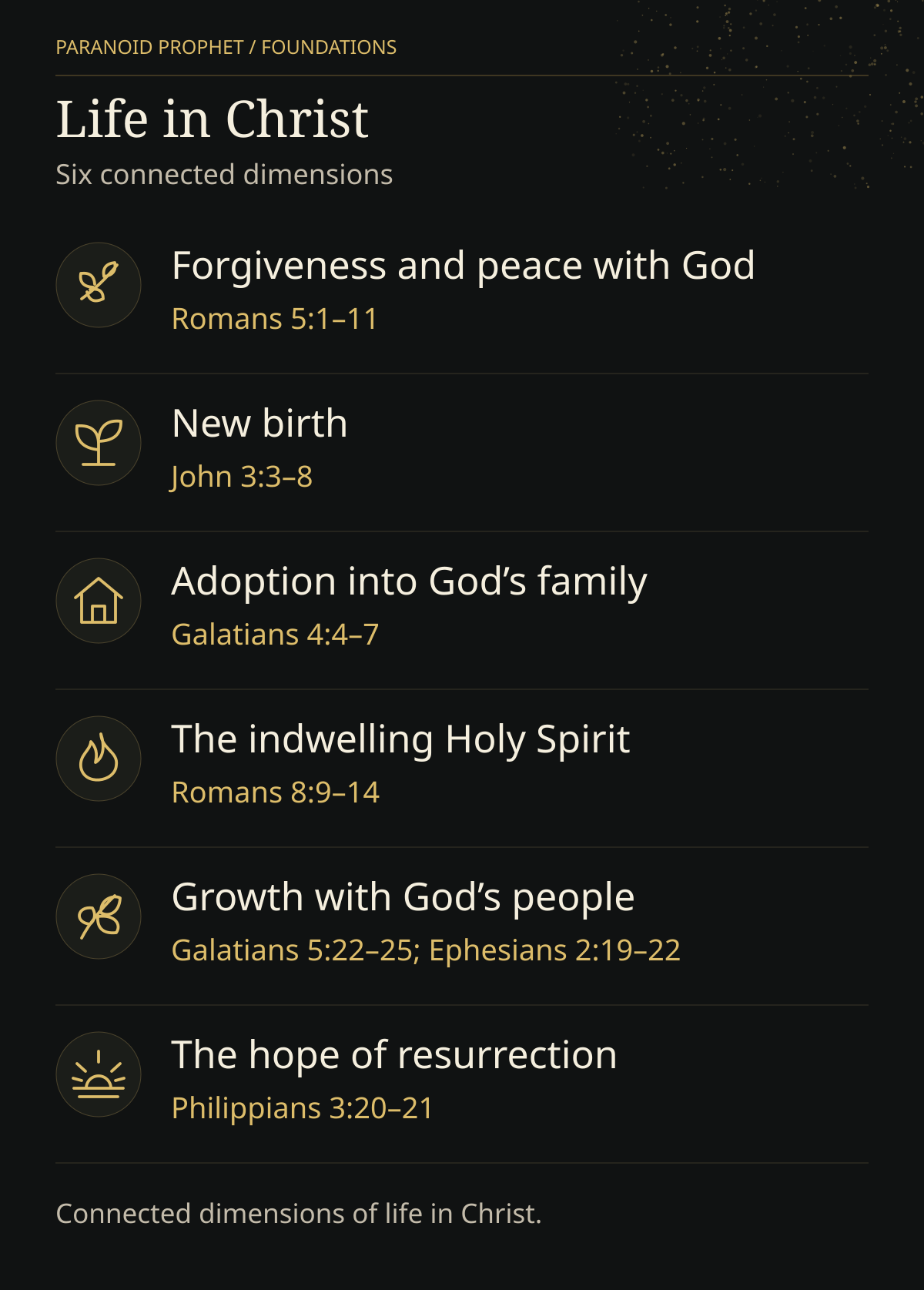
Life in Christ (image text)
Six connected dimensions
- Forgiveness and peace with God
Romans 5:1–11 - New birth
John 3:3–8 - Adoption into God’s family
Galatians 4:4–7 - The indwelling Holy Spirit
Romans 8:9–14 - Growth with God’s people
Galatians 5:22–25; Ephesians 2:19–22 - The hope of resurrection
Philippians 3:20–21
Connected dimensions of life in Christ.
PARANOID PROPHET / FOUNDATIONS
1. Your Life Becomes United With Christ
The New Testament repeatedly describes believers as being in Christ. That expression helps hold the other changes together.
In Ephesians 1:3–14, Paul locates God’s saving blessings in Jesus: adoption, redemption, forgiveness, an inheritance, and the promised Holy Spirit. Their source is the living Savior to whom believers belong.
Paul also connects Christian life with Jesus’ death and resurrection. Romans 6:3–11 speaks of baptism into Christ’s death and walking in newness of life. Becoming a Christian means that what Jesus accomplished begins to define your standing, loyalties, and future.
You remain a real person with a history, personality, and responsibilities. Yet Christ now has the rightful claim on your life. Your failures, achievements, background, and public reputation no longer provide a complete account of who you are.
That changes a practical question. Alongside asking what you want to do, you begin asking what faithfulness to Jesus looks like here.
2. You Receive Forgiveness and Peace With God
Sin creates real guilt before God. The good news is that Jesus has acted to reconcile sinners to Him.
Romans 5:1–11 connects justification by faith, God’s gracious acceptance of the believer, with peace with God through Jesus Christ. It grounds reconciliation in the death of God’s Son and hope in His risen life. Ephesians 1:7 likewise connects forgiveness with redemption through Christ’s blood.
This peace concerns your relationship with God. You can bring your sins into the light, confess them, and turn toward Him rather than keep trying to conceal what He already knows. An unsettled afternoon or a painful memory does not, by itself, tell you whether you have peace with God.
Forgiveness also calls for honesty with other people. A converted person may still need to apologize, repay what was stolen, accept consequences, or rebuild trust over time. Claiming God’s forgiveness never entitles someone to demand immediate access to a person they harmed.
For the fuller explanation of the human problem, read What Is Sin?. For how God’s grace relates to faith and obedience, continue with Salvation by Grace.
3. God Gives You New Birth
Jesus told Nicodemus that he needed to be born anew to see God’s kingdom. The conversation in John 3:1–21 concerns a work of God’s Spirit and directs attention to believing in the Son whom God sent.
Christians often call this regeneration, meaning new birth. Titus 3:3–7 connects it with God’s mercy, the Spirit’s renewal, and the hope of eternal life.
New birth is God’s work. A person cannot manufacture spiritual life through a sufficiently moving experience or a polished religious performance. The language of birth points to dependence on the God who gives life.
This renewal begins to affect what you love and how you respond to God. You may become more willing to hear Scripture, admit wrongdoing, receive correction, or ask for help. Those changes can develop unevenly. The New Testament also teaches believers how to grow, which assumes there is much they still need to learn.
John 3:5 speaks of birth involving water and the Spirit, and Titus 3:5 connects salvation with washing, new birth, and renewal. Christians disagree about precisely how these expressions relate to baptism and faith. That helps explain the baptism differences below; the passages locate new life in God’s saving mercy through Jesus and the Holy Spirit.
4. You Are Welcomed Into God’s Family
John 1:12–13 says that those who receive Christ and believe in His name are given the right to become God’s children. Paul describes this relationship as adoption.
In Galatians 4:4–7, God sends His Son to redeem, and sends the Spirit of His Son into believers’ hearts. They can address God as Father and belong to His household as heirs.
Adoption gives Christian prayer its personal character. You can speak to God about ordinary concerns, confess sin, ask for wisdom, and bring grief that you cannot yet put into tidy sentences. Through Christ, you are invited to approach Him.
For someone whose experience of a parent was painful, the word Father may be difficult. Scripture presents God’s character as the standard by which human fatherhood must be judged. Human cruelty does not define what God is like.
Being God’s child also means learning His ways. His care includes teaching and correction. Christian freedom grows within a relationship of love, trust, and obedience.

5. The Holy Spirit Is Present in Your Life
The Christian life depends on God’s presence and help. Romans 8:9–14 connects belonging to Christ with the indwelling Spirit and describes putting sinful deeds to death by the Spirit. Ephesians 1:13–14 calls the promised Spirit God’s seal and the pledge of the inheritance to come.
The Holy Spirit is personal and divine. He is not a spiritual energy that believers learn to control.
His work becomes visible in the kind of people Christians are being formed into. Galatians 5:22–25 names love, joy, peace, patience, kindness, goodness, faithfulness, gentleness, and self-control. That gives you a concrete way to think about spiritual growth: how are you learning to love and act faithfully?
Christians disagree about some spiritual gifts and about how particular experiences of the Spirit should be understood. An unusual experience should never be treated as permission to ignore Christ’s teaching or excuse destructive behavior. Paul places diverse gifts within the shared life and mutual care of Christ’s body in 1 Corinthians 12.
6. Your Relationship With Sin Begins to Change
Following Jesus brings an ongoing call to holiness. Christians commonly call this growth sanctification.
In Romans 6, Paul says that believers should offer themselves to God and refuse sin’s rule. In Galatians 5, he describes an active struggle between sinful desires and the Spirit’s work. Both passages belong in our expectations of Christian life.
You may now feel troubled by behavior you once defended. A dishonest habit, a cruel response, or a relationship built on manipulation may become harder to excuse. The appropriate response is to confess the wrong, seek God’s help, and take concrete steps toward obedience.
For example, repentance about gossip may include correcting a false claim and refusing to repeat it. Repentance about anger may involve admitting the harm, creating safeguards, and seeking wise help. Promising to try harder while protecting the same destructive pattern leaves necessary work undone.
Continuing struggle calls for dependence on Christ. 1 John 1:8–10 rejects claims to be without sin and directs believers toward confession. First John 2:1–6 points to Jesus’ advocacy and insists that knowing Him should shape how we live.
A failure deserves a truthful response. It does not justify abandoning prayer, hiding from everyone, or deciding that obedience no longer matters. Return to Christ, receive correction, and keep walking with His people. Repentance and Faith develops that response more fully.
7. You Become Part of a People
The New Testament describes salvation in deeply personal terms and also brings believers into a shared life.
Ephesians 2:11–22 explains how Christ brings formerly separated people near and makes them members of God’s household. 1 Corinthians 12:12–27 uses the picture of a body whose members need one another.
This belonging takes practical form in a local church: learning Scripture, worshiping, receiving care, serving, sharing the Lord’s Supper according to the church’s teaching, and helping carry one another’s burdens. In Acts 2:41–47, those who receive the apostolic message are baptized and enter a community shaped by teaching, fellowship, prayer, and generosity.
Look for a congregation that clearly teaches the biblical gospel, takes Scripture seriously, and demonstrates accountable, caring leadership. 1 Peter 5:1–4 instructs leaders to shepherd willingly and lead by example rather than dominate those entrusted to them.
No congregation will be flawless. Abuse, coercion, and pressure to conceal wrongdoing still require a serious response. Joining a church does not require surrendering your safety or treating a leader as beyond question.
8. You Receive a Hope That Reaches Beyond Death
Christian hope rests on Jesus’ resurrection. 1 Peter 1:3–9 connects new birth with a living hope and an enduring inheritance, while speaking honestly about trials that grieve believers now.
That combination matters. Becoming a Christian does not guarantee immediate healing, financial security, restored relationships, or an easy life. Jesus prepared His disciples for trouble and called them to courage because of His victory (John 16:33).
The promised future includes the resurrection and transformation of believers’ bodies (Philippians 3:20–21). Scripture also looks toward God dwelling with His people in a renewed creation, where death and mourning are finally overcome (Revelation 21:1–5).
Your body, ordinary responsibilities, and acts of love therefore matter. Christian hope gives a reason to endure and serve in the present, even when the completion of God’s work is still ahead.
Where Does Baptism Fit?
Jesus commands His followers to make disciples and baptize them in the name of the Father, Son, and Holy Spirit (Matthew 28:18–20). Acts 2 connects the response to the gospel with repentance, baptism, forgiveness, and the gift of the Spirit. Romans 6 connects baptism with Christ’s death and resurrection.
Those texts deserve careful attention. Christian traditions differ about exactly how baptism participates in the beginning of Christian life.
- Catholic teaching identifies baptism with forgiveness, new birth, incorporation into Christ, and entry into the church. See the Catechism, paragraphs 1262–1270.
- Eastern Orthodox teaching describes baptism as participation in Christ’s death and resurrection and new birth by water and the Spirit. See the Orthodox Church in America’s explanation of baptism.
- Baptist teaching, as represented by the Southern Baptist confession, describes believers’ baptism as an act of obedience symbolizing faith in the crucified and risen Savior and new life in Him. See Baptist Faith and Message, article VII.
Lutheran teaching also treats baptism as a means through which God offers grace. Reformed teaching describes it as a sign and seal of God’s covenant promises, while distinguishing its outward administration from the timing of regeneration. Protestant views therefore extend beyond the Baptist example. See Augsburg Confession IX and Westminster Confession XXVIII, especially sections 1, 5–6. These examples do not exhaust Christian teaching on baptism.
For someone beginning to follow Jesus, baptism belongs in the conversation from the start. Speak with a trustworthy pastor about the biblical passages, your background, and the church’s teaching. If you were baptized earlier in life, explain that history as well. Churches differ over which earlier baptisms they recognize and whether baptism should be repeated.
What If You Do Not Feel Different?
People describe coming to faith in different ways. Some remember a clear turning point. Others, especially those raised within Christian communities, describe a growing understanding and trust that is harder to place on a calendar.
Scripture gives no universal emotional script that everyone must reproduce. Joy and sorrow can accompany faith. So can unanswered questions and the slow work of understanding what you believe.
Pay attention to Jesus, His promises, and the direction of your response to Him. Are you seeking to trust Him? Are you willing to bring sin into the light? Are you learning to love other people and receive instruction?
These questions help a conversation with a mature Christian. They should not become a demand to inspect your feelings every hour. In 1 John 5:11–13, the assurance offered to believers is anchored in God’s testimony about His Son and the life found in Him.
If doubts keep troubling you, speak with a trustworthy pastor who will listen and work through Scripture with you. An article cannot settle every question about an individual’s spiritual condition.
What Should a New Christian Do Next?
Begin with a few faithful practices that can become part of ordinary life.
- Read a Gospel slowly. Mark or John is a helpful starting point. Notice what Jesus says, what He does, and how people respond. Write down questions instead of pretending you understand every passage.
- Pray honestly. Thank God for His mercy, confess specific sins, ask for help, and bring Him the needs of others. You can begin with plain words.
- Connect with a trustworthy local church. Tell a pastor that you are beginning to follow Jesus and want help understanding the faith, baptism, and life in the congregation.
- Take the next clear step of obedience. Correct a lie, stop participating in a harmful practice, seek appropriate help, or make a needed apology. Where others have been harmed, respect their boundaries and the consequences of your actions.
- Learn alongside other Christians. Ask someone mature in the faith to read Scripture with you. Receive guidance with humility and examine teaching carefully in the light of Scripture (2 Timothy 3:14–17).
You do not need to understand every theological disagreement before beginning these practices. You do need patient instruction and a willingness to keep following Jesus.
Frequently Asked Questions
Do Christians stop sinning immediately?
Christians are called to turn from sin and grow in holiness. First John also teaches believers to confess their sins and look to Jesus as their advocate. Ongoing struggle should be met with repentance, practical help, and perseverance. Claiming faith while deliberately protecting harmful behavior calls for serious correction.
What if I still have questions about Christianity?
Bring them into the open. Read the relevant biblical passages and discuss them with Christians who welcome honest questions. Learning the faith takes time. Faithfulness includes being truthful about what you understand and what you still need to examine.
Begin With Christ and Keep Following Him
Becoming a Christian changes your relationship with God and gives your life a new center. Through Christ, sinners receive forgiveness, new life, a place in God’s family, and a hope death cannot finally defeat.
Those gifts shape what comes next: repentance when you fail, obedience where you need to change, love toward other people, and patient participation in the life of the church.
Return to the gospel. Read Scripture. Pray. Take the next faithful step. The Jesus who calls people to follow Him also promises to be with His disciples as they learn to obey Him (Matthew 28:20).
Continue Through Christian Foundations
- What Is the Gospel?
- What Is Sin?
- Repentance and Faith
- Salvation by Grace
- Explore Christian Foundations
Sources and Reading Notes
Scripture is the primary authority for this study. The linked biblical passages are presented in the public-domain World English Bible. The article summarizes their teaching rather than treating a single verse as a complete explanation of conversion.
The Catholic Catechism, Orthodox Church in America teaching, Baptist Faith and Message, Augsburg Confession, and Westminster Confession are linked as primary sources for the traditions’ own accounts of baptism. Their inclusion documents the differences described here and does not place those documents above Scripture or imply that the examples exhaust Christian views.
Continue studying: Learn more about who the Holy Spirit is and what He does, and explore whether a Christian can be sure of salvation.