


Sin is humanity’s failure and refusal to live in faithful love toward God and our neighbors. It includes what we do, what we knowingly leave undone, and the desires and loyalties from which our actions grow. Scripture also describes sin as a power that holds people in bondage. Its consequences reach beyond regret: guilt before God, damaged relationships, and death.
That is a serious diagnosis. Yet the Bible’s message does not end with humanity’s failure. God acts in Jesus Christ to forgive sinners, reconcile them to Himself, and give them new life. Understanding sin helps us understand why the gospel is good news.
GUIDED ARTICLE EXPERIENCE
What Is Sin? Why Humanity Needs Reconciliation with God
Read along as the narration moves through the article.
Browser narration · No stored audio or site tracking
CONTINUE GUIDED TOUR
Continue where you left off.
GUIDED TOUR COMPLETE
You have reached the end of this study.
Study record saved on this device.
GUIDED TOUR
What Is Sin? Why Humanity Needs Reconciliation with God
Narrator: Paranoid Prophet Recommended Voice Native device narration
Prepare to follow the article as it is narrated.
VOICE & TOUR OPTIONS
Voice & Listening
NARRATOR
Finding a narrator…
Checking the best narrator available on this device.
Restores the site recommendations available in this browser.
Our listening picks lead when available; other voices are ranked for narration. Known novelty voices are hidden. Browser-provided voices may use an online voice service.
Screen-awake support will be checked when narration starts.
Optional: improve your device voices
Listening works with the voices already available here. Your device may offer additional free voices through its own settings.
iPhone or iPad: Settings → Accessibility → Read & Speak (or Spoken Content) → Voices → English. Look for Premium or Enhanced choices, then return here.
If offered, preview Ava or Zoe for U.S. English, or Serena or Jamie for British English. An explicit Premium or Enhanced version can improve on its compact version.
Mac: System Settings → Accessibility → Read & Speak → System voice. Open the voice list to preview or download additional choices.
Windows: Settings → Accessibility → Narrator → Add natural voices. Browser availability varies; a Narrator voice may not appear on websites. Edge may also expose online Natural voices without a model download.
Android: Open Accessibility → Text-to-speech output (the location varies by device). In the preferred engine settings, look for voice data and English choices.
Download sizes vary; some enhanced voices exceed 100 MB. This website cannot install system voices, and an installed voice appears here only if your browser exposes it.
Apple voice guide · Windows voice guide · Android voice guide
CHOOSE A NARRATOR
Recommended on this device
Our listening picks: Aaron, Martha, then Daniel, when available here. Otherwise, automatic uses the highest-ranked suitable voice. Preview alternatives or save your own choice.
Preparing the guided article experience…
RESUME GUIDED TOUR?
Continue where you left off.
GUIDED TOUR COMPLETE
You have reached the end of this study.
Article Guide12 sections
What is sin according to the Bible?
When Scripture addresses the heart, it does not equate every unwanted thought or temptation with a chosen welcome of evil. Honest responsibility should be distinguished from anxious scrutiny of every passing impression.
Several biblical descriptions belong together:
- Lawlessness: Sin rejects God’s rightful authority. First John 3:4 states, “Sin is lawlessness.”
- Failure to love: Jesus identifies love for God and love for neighbor as the great commandments on which the Law and the Prophets depend.
- Wrongdoing within the heart: Jesus locates the source of deceit, greed, pride, and other evils within human hearts.
- Neglected good: James includes knowing the good we ought to do and failing to do it.
- Bondage: Jesus describes those who practice sin as enslaved to it and identifies Himself as the One who can set them free.
These descriptions come from 1 John 3:4–10, Matthew 22:34–40, Mark 7:14–23, James 4:13–17, and John 8:31–36. No single image exhausts the subject. Sin involves accountability, relationship, inward corruption, and the need for deliverance.
This is a theological study. Following our sources and verification standard, Scripture supplies the foundation. The aim is to read its claims in context, including the grace announced alongside its warnings.
Why does sin matter if God made people good?
The Bible begins with God’s good creation. In Genesis 1:26–31, human beings are made in God’s image, receive His blessing, and belong within a creation He calls very good. Being human, having a body, and depending on God are not defects.
Genesis 3 then describes a rupture within that good world. The serpent challenges God’s word and goodness. The man and woman take what God has forbidden. Their disobedience is followed by hiding, accusation, painful consequences, and exclusion from the garden. The story presents human beings attempting to obtain wisdom and life on terms contrary to God’s command. They discover estrangement instead. Read Genesis 3.
This helps explain why sin is more than breaking an arbitrary rule. The Creator gives life and establishes the terms of faithful life with Him. Distrust of His word becomes disobedience, and disobedience damages the relationships that depend on trust.
The consequences spread outward. Adam blames the woman and indirectly blames God. The woman points to the serpent. Wrongdoing is followed by evasion rather than honest responsibility. That pattern remains recognizable whenever we excuse our own cruelty because someone else disappointed us first.
Human dignity and human sinfulness therefore belong in the same account. We are creatures God made for good, who need rescue from a corruption we cannot simply dismiss. Calling a person sinful is never permission to treat that person as disposable.
Sin includes actions, motives, and neglected good
Some sins are easy to identify because the harm is visible: fraud, violence, exploitation, adultery, and deliberate falsehood. Scripture also examines motives that can hide beneath respectable behavior.
The heart matters
In Mark 7, a dispute over ritual washing leads Jesus to teach about what defiles a person. He names evils that come from within, including greed, deceit, envy, and pride. His point concerns moral defilement, not whether washing one’s hands is useful. External observance cannot make an inwardly corrupt life righteous. Read Mark 7:1–23.
A person may tell the truth in one situation to serve a neighbor and in another to humiliate someone. Public generosity can coexist with a desire to control its recipient. God’s concern reaches the purposes for which we use otherwise good things.
Temptation and sin must be distinguished. Hebrews presents Jesus as genuinely tempted yet without sin; James describes desire giving birth to sin. An unwanted thought is not automatically the same as embracing it. Read Hebrews 4:14–16 and James 1:13–15.
What we fail to do matters
James 4:17 includes failing to do the good one knows ought to be done. Its immediate setting is a warning against arrogant plans that ignore dependence on God. Knowing what is right creates responsibility to act on that knowledge. Read James 4:13–17.
This exposes the limits of saying, “I did not hurt anyone.” Neglecting a responsibility can cause real harm. So can withholding help to preserve comfort or refusing to correct a lie from which we benefit.
The command to love also has limits proper to being human: no individual can meet every need. Sinful neglect should not be confused with lacking the ability, knowledge, or resources to do everything. The relevant question is what faithful love requires within the responsibilities and opportunities actually before us.
For example, suppose someone knowingly repeats an unverified accusation to embarrass a coworker, then stays silent after learning it was false. The words, the desire to humiliate, and the refusal to correct the harm all matter. Repentance would include stopping the rumor, correcting it with those who heard it, and accepting accountability. The case is different from an unwanted thought or an honest mistake promptly corrected.
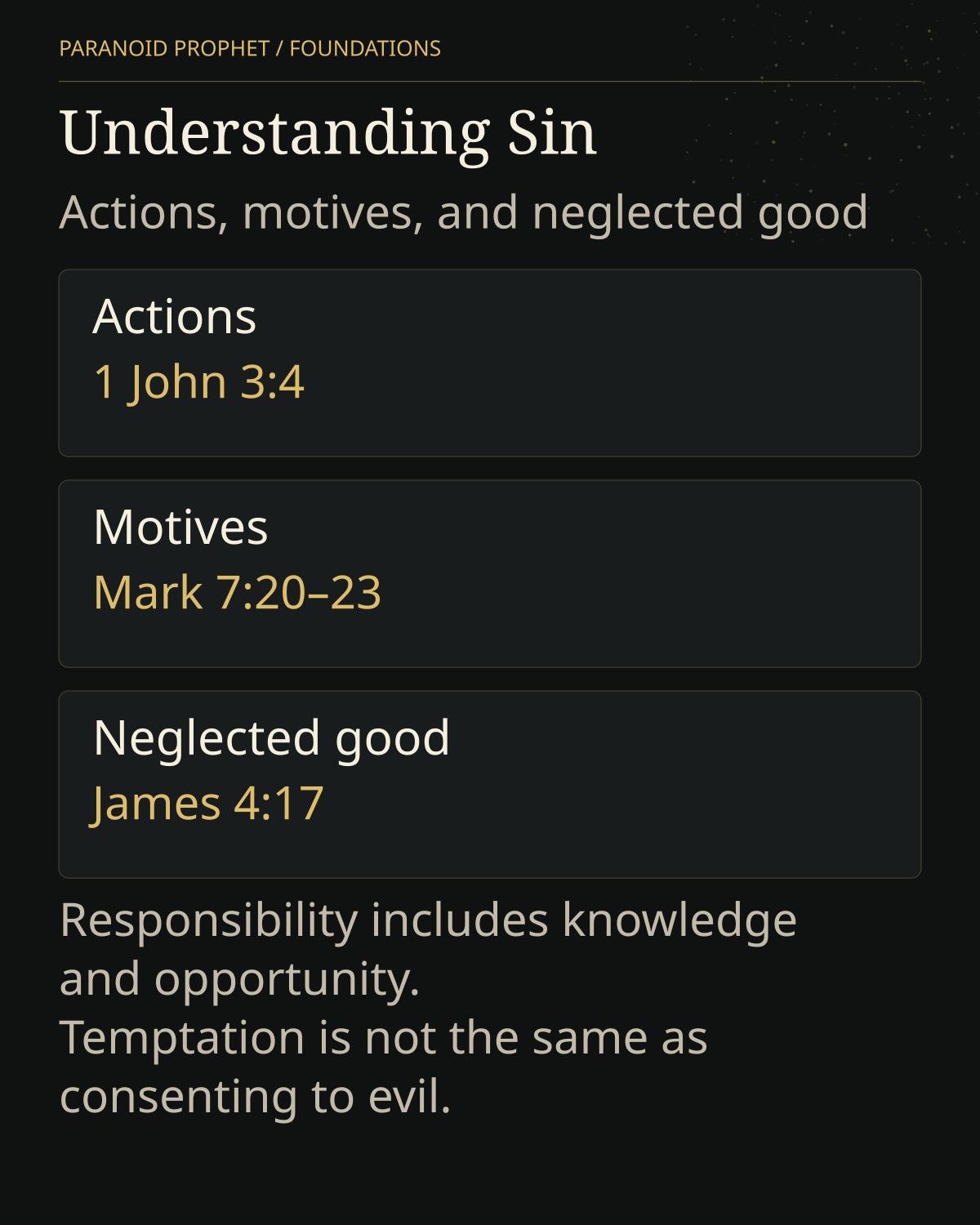
Understanding Sin (image text)
Actions, motives, and neglected good
- Actions
1 John 3:4 - Motives
Mark 7:20–23 - Neglected good
James 4:17
Responsibility includes knowledge and opportunity. Temptation is not the same as consenting to evil.
PARANOID PROPHET / FOUNDATIONS
Is sin something we do or a condition we share?
Scripture speaks of both.
We commit particular sins for which we are responsible. We also belong to a humanity already marked by sin and death. In Romans 5:12–21, Paul connects the entrance of sin and death to Adam and contrasts Adam’s disobedience with the obedience of Jesus Christ. The passage reaches beyond a list of isolated bad decisions. Humanity needs a new representative and a new life.
Christians often use original sin for this inherited human predicament. Christian traditions differ over how to describe inherited guilt, corruption, mortality, and human freedom. Those questions deserve more care than a slogan can provide. The central claim here is that sin is not merely an occasional problem affecting an otherwise self-sufficient humanity. Its reach is universal, and deliverance comes through Christ.
Ephesians 2 gives another perspective. It describes people as dead in transgressions while actively following disordered desires and the patterns of the world around them. The image of death concerns their need for God to make them alive; it does not mean they were literally inactive. The passage moves immediately toward God’s mercy and new creation. Read Ephesians 2:1–10.
Sinful actions express an inward problem, and repeated actions can deepen harmful habits. Social environments can also normalize injustice and reward it. These influences help explain our predicament without removing personal responsibility. We need forgiveness for what we have done and renewal of the lives from which those actions come.
Does everyone sin? What about genuinely good people?
Paul’s conclusion in Romans 3 is comprehensive: Jews and Gentiles alike are under sin. Possessing religious knowledge does not place anyone outside that verdict. The famous statement that all have sinned belongs to an argument that removes boasting and announces God’s grace through Jesus Christ. Read Romans 3:9–31.
This does not require pretending that courage, kindness, and generosity outside the church are fake. Romans 2 acknowledges Gentiles doing things required by the law and describes the witness of conscience. A Christian can recognize real good in a neighbor while also believing that neither of them can establish innocence before God by comparing themselves with someone worse. Read Romans 2:12–16.
Nor does universal sinfulness mean that everyone commits the same wrongs or causes the same harm. Jesus’ teaching about servants distinguishes accountability according to knowledge and responsibility. Scripture’s universal diagnosis does not flatten meaningful moral differences. Read Luke 12:41–48.
“Everyone sins” must never become an excuse to minimize abuse, conceal a crime, or demand that an injured person stop seeking justice. Shared need for mercy does not erase the responsibility of the person who caused the harm.
The Christian confession is therefore personal as well as universal. It should lead us to acknowledge our own wrongdoing, not merely assemble evidence against the people we dislike.
Why does sin require reconciliation with God?
Reconciliation means the restoration of a broken relationship. In the gospel, God reconciles sinners to Himself through Jesus Christ. That language addresses more than a troubled conscience.
Sin brings real guilt
Guilt is accountability for wrongdoing before God. Feeling guilty and being guilty are related, but they are not identical. Someone may feel little remorse after doing serious harm. Someone else may carry shame for something done to them that was never their fault.
God’s judgment is described as truthful and impartial in Romans 2:1–11. The measure is not the intensity of our feelings or the force of another person’s accusation. We need forgiveness for actual wrongdoing, and we need to distinguish that responsibility from blame that does not belong to us.
Sin damages fellowship with God
First John connects fellowship with God to walking in the light. Claiming fellowship while choosing darkness is self-deception. Yet the same passage promises cleansing through Jesus and forgiveness when sins are confessed. Holiness and mercy appear together. Read 1 John 1:5–10.
Alienation does not mean God has ceased to sustain the world or has become incapable of hearing a sinner’s cry. It means the relationship is morally disordered and requires restoration. We cannot make it whole merely by deciding that God ought not to mind.
Sin enslaves and leads to death
In Romans 6, Paul describes sin as a master and contrasts its outcome with God’s gift of eternal life in Christ. The chapter addresses people called to live under a different lordship because they belong to the risen Jesus. The warning about death belongs alongside the promise of freedom and life. Read Romans 6.
This connection between sin and death does not authorize diagnosing every illness or loss as punishment for a particular person’s wrongdoing. In John 9, Jesus rejects the disciples’ proposed explanation that a man’s congenital blindness resulted from his sin or his parents’ sin. A general account of a fallen world is not a license to assign blame to individual sufferers. Read John 9:1–7.
Why can’t good works repair the relationship?
Good works matter. Returning stolen property, telling the truth, and protecting vulnerable people can be necessary expressions of repentance. But later obedience does not make earlier wrongdoing disappear or supply the forgiveness and new life we need. Ephesians 2:8–10 presents salvation as grace received through faith and good works as part of the life God creates. For a fuller explanation, including Paul, James, and differences among Christian traditions, read Salvation by Grace.
How does Jesus reconcile sinners to God?
The initiative belongs to God. Romans 5:6–11 describes Christ dying for the ungodly and sinners being reconciled through His death. Second Corinthians 5:14–21 connects His death and resurrection with forgiveness, reconciliation, and new creation. God deals with evil through Christ rather than declaring it harmless.
Reconciliation also changes how people live together. Ephesians 2:11–22 describes Jews and Gentiles being reconciled to God in one body and joined in His household. For the full saving announcement, read What Is the Gospel?; for atonement, redemption, and Christ’s victory, read Why Did Jesus Die?.
What does a faithful response look like?
The fitting response is repentance and faith: turning from sin toward God and entrusting ourselves to Jesus Christ. Repentance includes honesty about wrongdoing and a willingness to change direction. Faith rests in Christ’s saving work rather than the strength of our moral record.
Romans 2:4 connects repentance with God’s kindness. First John 1:9 promises forgiveness and cleansing to those who confess their sins. These invitations give us reason to stop hiding. Read Romans 2:1–4 and 1 John 1:5–10.
A practical beginning may include:
- Name what is wrong truthfully. Avoid excuses, but do not invent guilt or accept blame for another person’s actions.
- Ask God for mercy through Jesus Christ. Forgiveness rests on His provision, not on finding a flawless formula of words.
- Turn toward concrete obedience. Stop the harmful behavior, seek appropriate accountability, and make restitution where possible.
- Learn to live with other believers. Seek a trustworthy church that teaches Scripture, welcomes honest questions, and takes both grace and responsibility seriously.
Where someone has been harmed, an offender’s claim to repentance does not entitle them to immediate trust or renewed access. Forgiveness, accountability, safety, and the rebuilding of human relationships require careful attention. Reconciliation with God must not be used to pressure someone into danger.
Believers also continue to need grace. First John rejects claims of sinlessness and presents Jesus as the righteous advocate for those who sin. Romans 8 joins freedom from condemnation in Christ with the Spirit’s work of putting sinful deeds to death. Growth in holiness matters, and ongoing dependence on Christ remains central. Read 1 John 1:8–10, 1 John 2:1–6, and Romans 8:1–17.
For ongoing growth, read how the Holy Spirit works in believers. If failure has become a recurring fear about salvation, continue with our guide to assurance and doubt.

Frequently asked questions about sin
Is sin just breaking religious rules?
Sin violates God’s will and character, including His commands to love God and neighbor. Some religious rules are human traditions rather than divine commands. Mark 7 shows Jesus challenging traditions that undermine obedience to God. Scripture, read in context, must govern the distinction.
Is temptation itself a sin?
Being tempted is not identical to consenting to evil. Hebrews 4:15 describes Jesus as tempted yet without sin. Scripture also takes disordered desires seriously. An unwanted thought or temptation should not automatically be treated as a deliberate choice to welcome or act on it.
Are all sins equally serious?
All sin matters before God, and everyone needs grace. Different sins nevertheless involve different harms, knowledge, and responsibilities. Luke 12:47–48 distinguishes degrees of accountability. Universal sinfulness cannot excuse serious wrongdoing or eliminate the need to protect people from harm.
Can God forgive someone who has sinned repeatedly?
Repeated failure is a reason to seek Christ’s mercy and meaningful change, rather than hide or conclude that grace is unavailable. First John 1:9 promises forgiveness and cleansing, while 1 John 2:1 calls believers away from sin and points them to Jesus as their advocate. Grace never makes harm unimportant.
Sin is serious, and reconciliation is offered
The biblical diagnosis leaves no room for boasting. We need more than favorable comparisons, better appearances, or stronger excuses. We need God’s forgiveness and the renewal only He can give.
The gospel also leaves no reason to make despair our final answer. God’s love has taken concrete form in the death and resurrection of Jesus Christ. He calls sinners to turn, trust Him, and receive a life shaped by grace.
If you are beginning to explore Christianity, start with the evidence and biblical claims concerning Jesus Christ. If you already believe, let the truth about sin lead to honest confession, greater compassion, and renewed dependence on the Savior.
Scripture for further study
- Genesis 1:26–31 and Genesis 3: creation, human dignity, disobedience, and estrangement.
- Mark 7:1–23: the heart and moral defilement.
- Romans 3:9–31: universal sin and justification by grace.
- Romans 5:1–21: peace with God, reconciliation, Adam, and Christ.
- Romans 6: freedom from sin’s dominion and a changed life.
- Ephesians 2: salvation by grace and belonging to God’s household.
- 2 Corinthians 5:14–21: new creation and the ministry of reconciliation.
- 1 John 1:5–10 and 2:1–6: confession, forgiveness, and obedience.
Scripture quotation: World English Bible. Passage links allow readers to examine the surrounding context.
Continue studying: Read what the gospel announces about Jesus’ saving work, what repentance and faith mean, and why salvation by grace produces a changed life.