
A hen can enthusiastically eat a bowl of scratch and still miss the nutrients she needs. Appetite is not a balanced-feed label.
When deciding what to feed laying hens, start with the birds’ life stage and the complete ration. Then consider calcium, grit, treats and access. That order makes feeding much less complicated than a shelf full of supplements.
GUIDED ARTICLE EXPERIENCE
What to Feed Laying Hens: Feed, Calcium, Grit & Healthy Nutrition
Read along as the narration moves through the article.
Private device narration · No hosted audio or tracking
CONTINUE GUIDED TOUR
Continue where you left off.
GUIDED TOUR COMPLETE
You have reached the end of this study.
Study record saved on this device.
GUIDED TOUR
What to Feed Laying Hens: Feed, Calcium, Grit & Healthy Nutrition
Narrator: Paranoid Prophet Recommended Voice Native device narration
Prepare to follow the article as it is narrated.
VOICE & TOUR OPTIONS
Voice & Listening
NARRATOR
Finding a narrator…
Checking the best narrator available on this device.
Restores the best curated narrator available on this device.
Narrator choices are curated for clear, long-form listening on this device.
Screen-awake support will be checked when narration starts.
CHOOSE A NARRATOR
Curated for this device
Choose a verified narrator for this browser, or use System Narrator. Automatic mode uses the best reliable route exposed by this device; your chosen narrator is preserved even if this device needs a temporary fallback.
Preparing the guided article experience…
RESUME GUIDED TOUR?
Continue where you left off.
GUIDED TOUR COMPLETE
You have reached the end of this study.
Article Guide14 sections
Quick Answer: Complete Feed Comes First
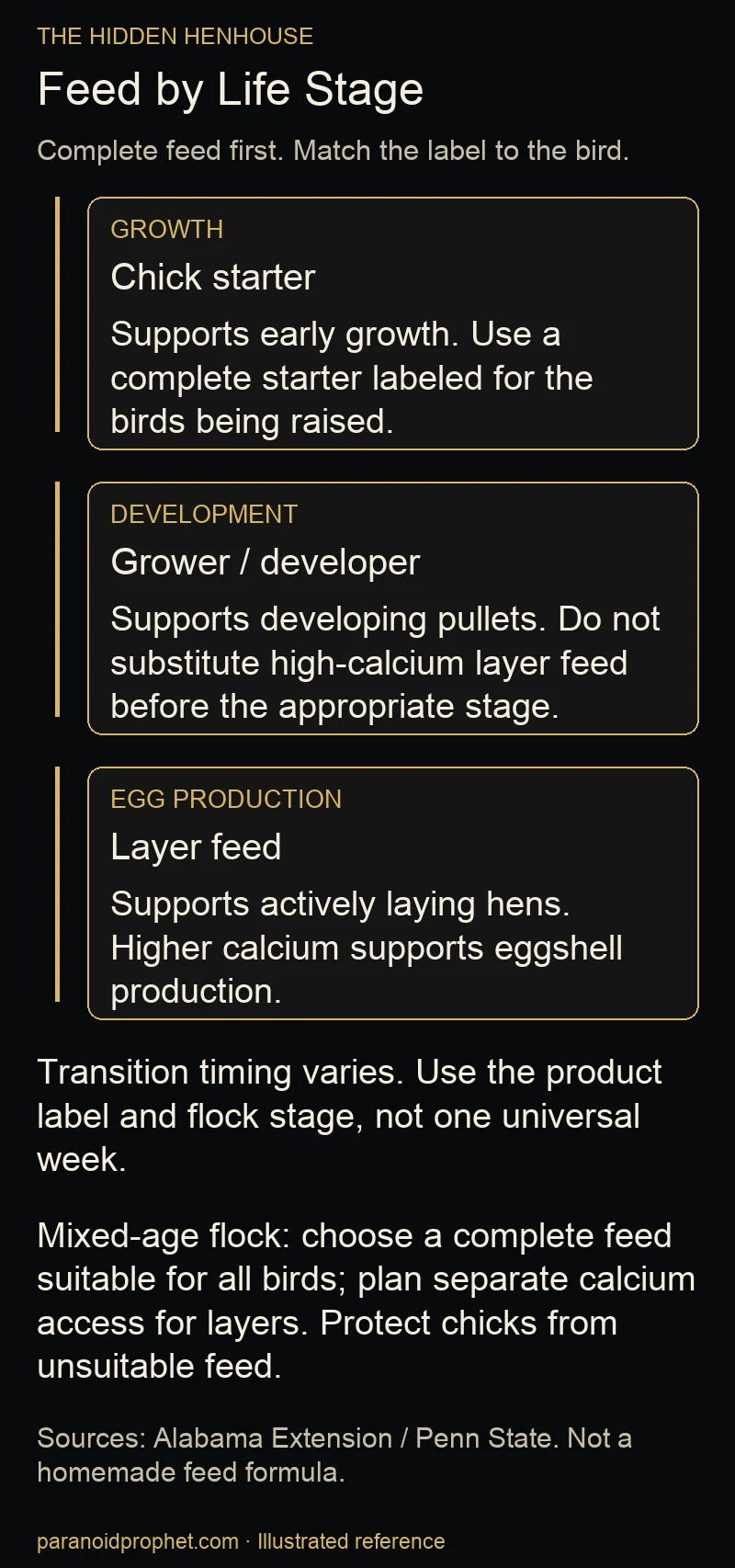
Actively laying adult hens need a complete feed formulated for their stage of production, available with clean drinking water. Follow the product’s feeding directions. Scratch, garden scraps and other treats cannot replace that ration. Do not give standard high-calcium layer feed to chicks or growing pullets.
For mixed-age flocks, select a complete diet labeled for the birds sharing it and plan calcium access separately for the layers, with poultry nutrition advice where needed. A feed name alone does not establish that it fits every bird. Alabama Extension’s nutrition guide explains why excessive calcium is dangerous for immature chickens.
Match the Ration to Life Stage
Chicks and growing pullets
Starter and grower/developer feeds support growth without the high calcium concentration used for shell production. Products differ: some combine starter and grower stages, while others specify separate transitions. Use the label for the actual product and bird type rather than a universal calendar copied from another feed bag.
Extension schedules are useful orientation, but not identical. Penn State describes starter followed by grower and layer stages; Alabama’s laying guide discusses first eggs commonly around 20–25 weeks, with breed, season and development affecting timing. An early or late pullet should not be fed by a countdown alone. The baby-chick guide covers brooder feeding without treating adult layer ration as a shortcut.
Adults producing eggs
A complete layer ration supplies protein, energy, vitamins and minerals for maintenance and production. It is more than grain with oyster shell added. Its higher calcium content addresses shell formation; that is precisely why it is not the default ration for growing birds.
Read the Label Before Comparing Prices
Look for a statement that the product is a complete feed for the intended birds, the guaranteed analysis, feeding directions and a manufacture or freshness date. Check crude protein, calcium information, and any medication or withdrawal directions where applicable. “Scratch,” “treat” and “supplement” are not interchangeable with “complete feed.”
Keep the tag when switching diets. It gives a veterinarian or nutrition adviser something concrete to review if appetite, body condition or shell quality changes. An attractive bag illustration cannot do that job.
Why protein recommendations differ
Penn State’s laying-flock guide gives 16–18% crude protein for layers. Alabama’s 2022 laying-hen publication recommends around 18% in its discussion, while its general table says 16% or more. These are broad feeding guides, not proof that one percentage is correct for every strain, feed intake or production level.
Protein percentage is only part of the formulation. Amino acids, energy and actual consumption also matter. Choose a properly formulated product for the birds and follow its instructions. Adding high-protein treats to a complete ration is not a reliable way to repair an unexplained laying decline.
Calcium and Phosphorus: Balance, Not More at Any Cost
Laying requires calcium for shells, with phosphorus and other nutrients contributing to normal mineral use. Alabama’s general layer-feed table lists approximately 3–4% calcium and 0.4–0.5% phosphorus. Those figures describe formulated layer diets; they are not a recipe for mixing mineral powders into feed yourself.
Weak shells have more than one possible cause. Review the complete diet and what the bird actually eats, but also consider age and health. An unwell hen producing abnormal eggs needs assessment. Do not keep increasing calcium while overlooking illness.
When oyster shell may help
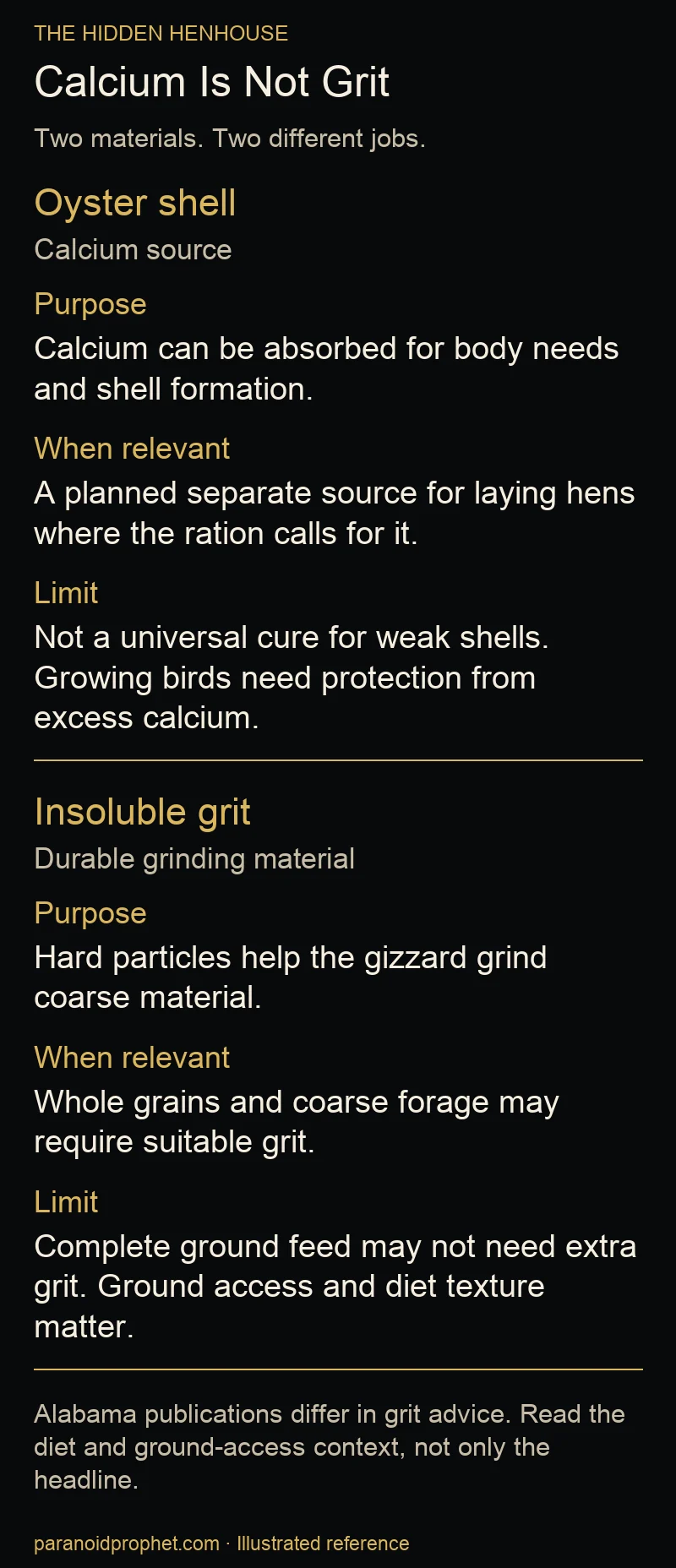
Oyster shell supplies calcium. A complete layer ration may already meet the flock’s needs; supplemental shell is not automatically necessary. Offering a suitable calcium supplement separately can be useful when layers share an appropriate lower-calcium complete ration with nonlayers, or when a nutrition adviser recommends it.
Use a poultry product suitable for adult layers, keep it dry and separate, and prevent young birds from treating it as their main feed. Do not indiscriminately mix extra calcium into everyone’s ration. The laying-pause guide explains why supplements cannot fix every cause of fewer eggs.
Oyster Shell Is Not Insoluble Grit
Hard insoluble grit helps the muscular gizzard grind coarse material. Oyster shell dissolves as a calcium source and does not provide the same durable grinding function. The two products belong in separate decisions, even if a feed store displays them together.
The Extension guidance needs context. Alabama’s Feeding the Laying Hen says additional grit is unnecessary when the ration is commercially ground. Its broader nutrition publication recommends grit for coarse material and grain feeding. These statements describe different things entering the gizzard.
Pellets and crumbles are formed from ground ingredients; a pellet is not an intact grain simply because it looks solid. Whole grains, seeds and coarse forage change the grinding question. Birds may find suitable small stones on some ground, but bare soil, enclosed housing or an unfamiliar substrate does not guarantee useful grit.
Our practical recommendation is to assess what the birds eat and what ground they can access. If they eat coarse extras or lack dependable natural grit, offer an age-appropriate poultry insoluble grit separately and follow its directions. Do not claim that every hen always needs it, or that a backyard hen never does.
How Much Feed Should You Plan For?
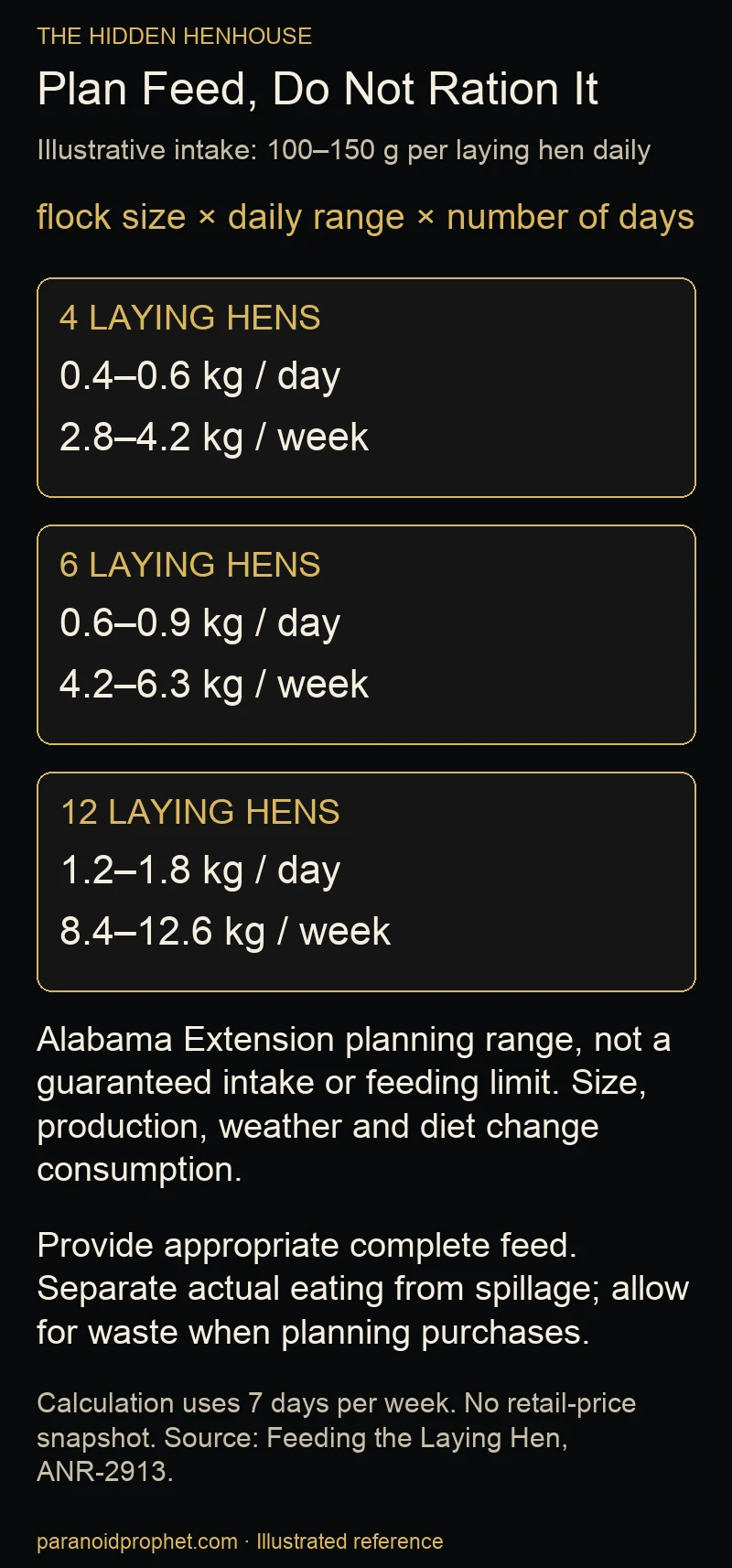
Alabama’s laying-hen guide gives 100–150 grams per adult laying hen per day as a planning range. That equals about 0.22–0.33 pounds, not a universal quarter-pound allowance. Size, strain, weather, laying, forage and waste can change actual use. Minnesota’s example of a six-pound hen eating roughly three pounds weekly also shows why one daily number cannot cover all birds.
| Adult layers | Daily planning range | Seven-day range |
|---|---|---|
| 4 | 0.4–0.6 kg | 2.8–4.2 kg |
| 6 | 0.6–0.9 kg | 4.2–6.3 kg |
| 12 | 1.2–1.8 kg | 8.4–12.6 kg |
These are multiplication examples using 100–150 grams, not restricted rations. Provide adequate complete feed and measure what your flock uses. A bird excluded from the feeder should not receive less simply because the group total looks normal.
Track feed added, feed remaining and obvious spills over a representative week. Keep waste separate from estimated intake when you can. The feed-cost and waste guide focuses on efficiency while preserving nutrition.
Pellets, Crumbles or Mash?
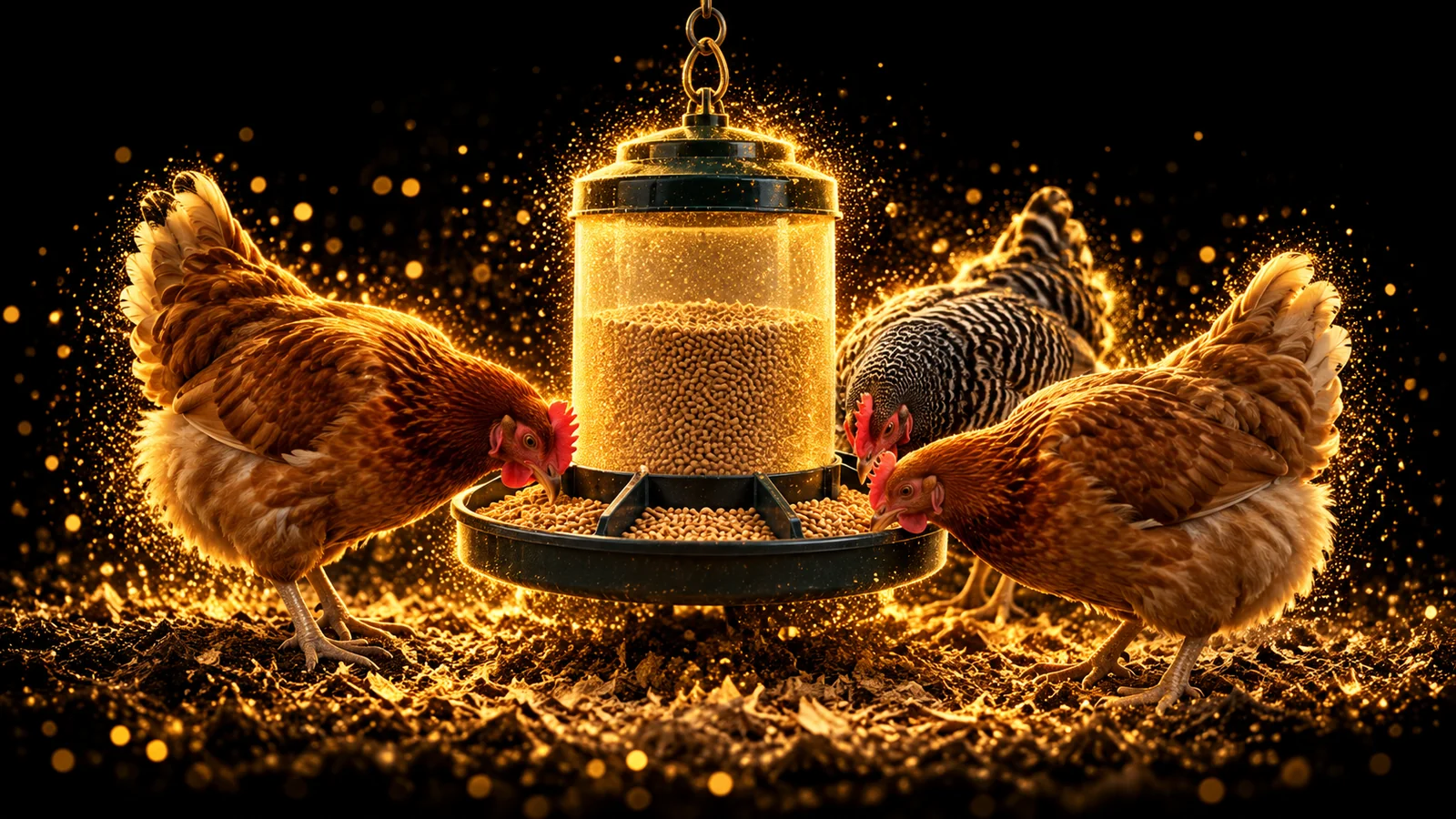
All three can be complete diets when formulated and labeled that way. Choose a texture the birds can eat comfortably and a feeder that handles it well. Pellets may reduce sorting and some waste; crumbles can suit smaller birds; mash requires attention to fine material and selective feeding. None is inherently a balanced ration just because of its shape.
Watch the tray rather than assuming the chosen format solved waste. Caked fines, damp corners and a heap on the ground deserve correction. The feeder-placement guide distinguishes feeder types and usable access.
Treats, Scratch and Foraging
The nutritional problem with many extras is displacement. If a hen fills up on incomplete foods, she may eat less of the formulated ration. More variety does not automatically mean a better nutrient balance.
Penn State’s small-flock guide takes a strict no-scratch approach. Alabama allows extras sparingly or not at all, while warning about dilution. Our editorial recommendation is to make the complete ration dependable and keep any appropriate extras small and occasional. You do not need treats to meet a hen’s basic nutritional needs.
Do not mix scratch into the complete feed to stretch the bag. Forage is enrichment and variable food, not a predictable substitute for a formulated ration. Use What Not to Feed Chickens for the separately sourced hazard distinctions, rather than treating every kitchen scrap as acceptable.
Mixed Ages, Roosters and Molting Hens
A flock may include actively laying hens, growing pullets and adults that are not laying. Giving everybody high-calcium layer feed is not an automatic solution. Nor is choosing any bag labeled “all flock” without checking which ages and species it actually supports.
For birds sharing feed, use a complete product labeled for all the members being fed, with a planned separate calcium source for layers. If young birds cannot be protected from unsuitable feed or supplements, separate feeding may be necessary. Ask a poultry nutrition adviser when the group cannot be accommodated safely by one product.
During natural molt or a long nonlaying period, needs change with production and body condition. Review the ration instead of adding protein indefinitely or withholding feed to force a molt. Seasonal egg loss and a single bird’s weight loss are different problems.
Season, Water and Safe Feed Storage
Heat can reduce feed intake while increasing the importance of reliable drinking access. Cold can change energy demand. Keep feed available and observe the birds rather than imposing the same measured portion year-round. The waterer guide covers equipment, usable access and seasonal reliability.
Store feed cool, dry and protected from rodents and insects. Keep the original identification and date, close containers, and rotate supplies. Do not repeatedly top up a feeder while old damp feed cakes underneath. Discard moldy, rancid or otherwise suspect feed; mixing it with fresh feed does not repair it.
Published storage suggestions differ: Penn State discusses a short four-week storage interval, while Alabama describes feed freshness over a longer period. Temperature, humidity and product directions matter. Buy quantities you can use promptly and follow the manufacturer’s storage guidance rather than treating the longest published interval as guaranteed shelf life.
Daily Feeding Check and Trouble Signs
- Confirm the correct ration is present and dry.
- Watch the smaller and timid birds actually eat.
- Check water flow and usable access.
- Remove stale or contaminated material and note unusual waste.
- Observe appetite, activity, body condition and shell changes.
Persistent poor appetite, weight loss, lethargy, abnormal droppings or lameness need assessment, not another supplement. Merck’s backyard-poultry manual notes that birds can hide early illness. Keep feed labels and observations for the veterinarian.
Frequently Asked Questions
Do free-ranging hens still need complete feed?
Yes. Forage varies and does not reliably supply a balanced diet. Keep appropriate formulated feed available.
Can oyster shell replace grit?
No. Calcium supplementation and durable grinding material have different roles.
Does every adult hen need layer feed forever?
No. Life stage, current production and the other birds sharing feed matter. Review the complete ration for nonlaying or mixed-age groups.
Will fermented feed reliably produce more eggs?
No such guarantee is supported here. Wet feed also brings spoilage and cleaning obligations. A sound complete-feed routine is a better starting point.
Dependable Care Is Often Ordinary
Feeding well is usually less dramatic than buying a new tonic. Read the bag, protect the feed, watch each bird reach it and notice changes. Christian stewardship includes those repeated, ordinary duties, even when the flock’s egg basket is quieter than expected.
Sources and Nutrition Scope
Sources checked October 8, 2026. Percentages are source context, not homemade formulation instructions. Individual diet problems require qualified advice.
- Alabama Extension: Feeding the Laying Hen, 2022; complete feed, consumption and ground-feed grit context.
- Alabama Extension: Nutrition for Backyard Chicken Flocks, 2022; life stages, calcium risks and coarse-feed grit.
- Penn State: Management Requirements for Laying Flocks; production-oriented feeding guidance.
- Penn State: Successfully Raising a Small Flock, updated 2016; basic management, not a universal modern product label.
- Minnesota Extension: Raising Chickens for Eggs; consumption and seasonal variation.
- Merck: Common Management-Related Problems, updated April 2025; nutritional and illness context.