


You can know every word of a worship song and still wonder what you are supposed to be doing. You can also sit quietly through a service, distracted or exhausted, and wonder whether everyone else is experiencing something you have missed.
Christian worship reaches deeper than a musical preference or a powerful moment. It concerns who God is, what He has done through Jesus Christ, and how His people respond together and throughout the week. Singing matters. So do listening, prayer, gratitude, obedience, and the way we treat people when the service ends.
GUIDED ARTICLE EXPERIENCE
What Is Christian Worship? More Than Music
Read along as the narration moves through the article.
Browser narration · No stored audio or site tracking
CONTINUE GUIDED TOUR
Continue where you left off.
GUIDED TOUR COMPLETE
You have reached the end of this study.
Study record saved on this device.
GUIDED TOUR
What Is Christian Worship? More Than Music
Narrator: Paranoid Prophet Recommended Voice Native device narration
Prepare to follow the article as it is narrated.
VOICE & TOUR OPTIONS
Voice & Listening
NARRATOR
Finding a narrator…
Checking the best narrator available on this device.
Restores the site recommendations available in this browser.
Our listening picks lead when available; other voices are ranked for narration. Known novelty voices are hidden. Browser-provided voices may use an online voice service.
Screen-awake support will be checked when narration starts.
Optional: improve your device voices
Listening works with the voices already available here. Your device may offer additional free voices through its own settings.
iPhone or iPad: Settings → Accessibility → Read & Speak (or Spoken Content) → Voices → English. Look for Premium or Enhanced choices, then return here.
If offered, preview Ava or Zoe for U.S. English, or Serena or Jamie for British English. An explicit Premium or Enhanced version can improve on its compact version.
Mac: System Settings → Accessibility → Read & Speak → System voice. Open the voice list to preview or download additional choices.
Windows: Settings → Accessibility → Narrator → Add natural voices. Browser availability varies; a Narrator voice may not appear on websites. Edge may also expose online Natural voices without a model download.
Android: Open Accessibility → Text-to-speech output (the location varies by device). In the preferred engine settings, look for voice data and English choices.
Download sizes vary; some enhanced voices exceed 100 MB. This website cannot install system voices, and an installed voice appears here only if your browser exposes it.
Apple voice guide · Windows voice guide · Android voice guide
CHOOSE A NARRATOR
Recommended on this device
Our listening picks: Aaron, Martha, then Daniel, when available here. Otherwise, automatic uses the highest-ranked suitable voice. Preview alternatives or save your own choice.
Preparing the guided article experience…
RESUME GUIDED TOUR?
Continue where you left off.
GUIDED TOUR COMPLETE
You have reached the end of this study.
Article Guide12 sections
What Is Christian Worship?
Christian worship is the reverent response of God’s people to who He is and what He has done, expressed through trust, praise, thanksgiving, prayer, and a life offered to Him. Christians gather to worship, and that allegiance also shapes ordinary responsibilities beyond the gathering.
The Bible gives a wider picture than the modern habit of calling only the songs “worship.” Yet widening the definition should not make a congregation’s shared prayer, teaching, singing, and celebration of Christ’s gifts seem unnecessary.
This guide approaches worship from a Scripture-centered Christian perspective. It identifies important agreements while acknowledging that Christians differ about the proper ordering of a service, sacraments, ministry, images, and music.
Choose a starting point: If you are new to church, begin with participating in a service. If worship feels emotionally empty, read worship when you feel little. For life outside church, go to everyday worship.
How Can You Participate in Worship?
Start by paying attention to what the congregation is actually saying and doing. You do not have to manufacture an experience or imitate somebody else’s expression.
- Listen to the Scripture reading. Follow the passage and ask what it reveals about God and His work. When teaching draws a conclusion, notice whether the passage supports it.
- Make the prayers your own where you can honestly do so. Bring real gratitude, needs, and confession before God. If a phrase confuses you, ask about it afterward.
- Attend to the words being sung. Singing can help a congregation remember and confess truth together. If you cannot sing, you can listen and reflect without treating that limitation as a spiritual failure.
- Receive instruction with both humility and discernment. Learning requires openness. It does not require switching off your judgment or accepting every claim made from a platform.
- Notice the people beside you. A newcomer, someone grieving, or someone who needs help getting home is part of the congregation’s life, not an interruption to it.
If you are visiting a church, ask how it understands participation in Communion rather than assuming every congregation has the same practice. Some parts of a service may be unfamiliar. Honest questions are a better beginning than pretending to understand.
For a fuller introduction to belonging and healthy participation, see What Is the Church?.
Who Is Christian Worship Directed Toward?
Christian worship is directed toward the living God revealed in Scripture. Within historic Trinitarian Christianity, the Father, Son, and Holy Spirit are not competing recipients of religious attention. Christians confess one God and approach Him through the saving work of Christ, with the help of the Spirit.
Ephesians 2:18 describes access to the Father through Christ in one Spirit. Its setting is reconciliation: people formerly divided are brought near and made members of God’s household. Worship belongs within that gracious welcome, not a competition to prove who deserves to approach.
The Gospel therefore gives worship its foundation. We respond to God’s mercy. We do not offer a convincing performance to purchase it.
This also gives discernment a clear center. A church can have excellent musicians, eloquent leaders, or beautiful architecture. Those gifts should help people attend to God. When a leader’s personality becomes beyond question, or loyalty to an organization displaces loyalty to Christ, something has gone wrong. See the Trinity guide for the theological background.
What Does Worship in Spirit and Truth Mean?
In John 4:19–26, Jesus speaks with a Samaritan woman about worship. Her question concerns the rival claims of a mountain and Jerusalem. Jesus announces a coming hour, already arriving through Him, in which true worshipers worship the Father in spirit and truth.
The conversation is about more than choosing a preferred atmosphere. Jesus identifies Himself as the Messiah and directs attention to the Father’s true worshipers. Sincerity matters, but sincerity alone cannot make every account of God equally true.
Christians discuss the precise relationship between human spirit and the Holy Spirit in this phrase. The passage should not be reduced to a contest between emotional worship and intellectual worship. Nor does it say that meeting with other believers has become pointless. Its focus is the worship made possible in the arrival of Jesus, beyond the location dispute before Him.
What Happens When Christians Worship Together?
Acts 2:42–47 describes the early believers continuing in the apostles’ teaching, fellowship, breaking bread, and prayer. Their common life included praise and practical sharing. Luke gives a portrait of a community shaped by the Gospel, not a minute-by-minute service template for every century.
The letters add instruction about the gathered church. Scripture is read and taught; believers pray, sing, encourage one another, and receive what their churches understand as Christ’s sacraments or ordinances. These activities involve the congregation, even when particular people lead them.
In Colossians 3:12–17, singing appears alongside compassion, forgiveness, love, peace, and the message of Christ. The songs carry teaching and mutual encouragement as well as gratitude to God. Their words deserve attention.
A song can be memorable and still make an unclear claim. It is reasonable to ask: Who is being addressed? What is being said about God? Can the congregation understand and affirm it? A familiar tune does not settle those questions, and an unfamiliar tune does not make a song suspect.
1 Corinthians 14:15–26 emphasizes understanding and building up the church. Christian traditions differ over the gifts discussed in this chapter, but a gathering that nobody can understand is not the goal Paul gives them.
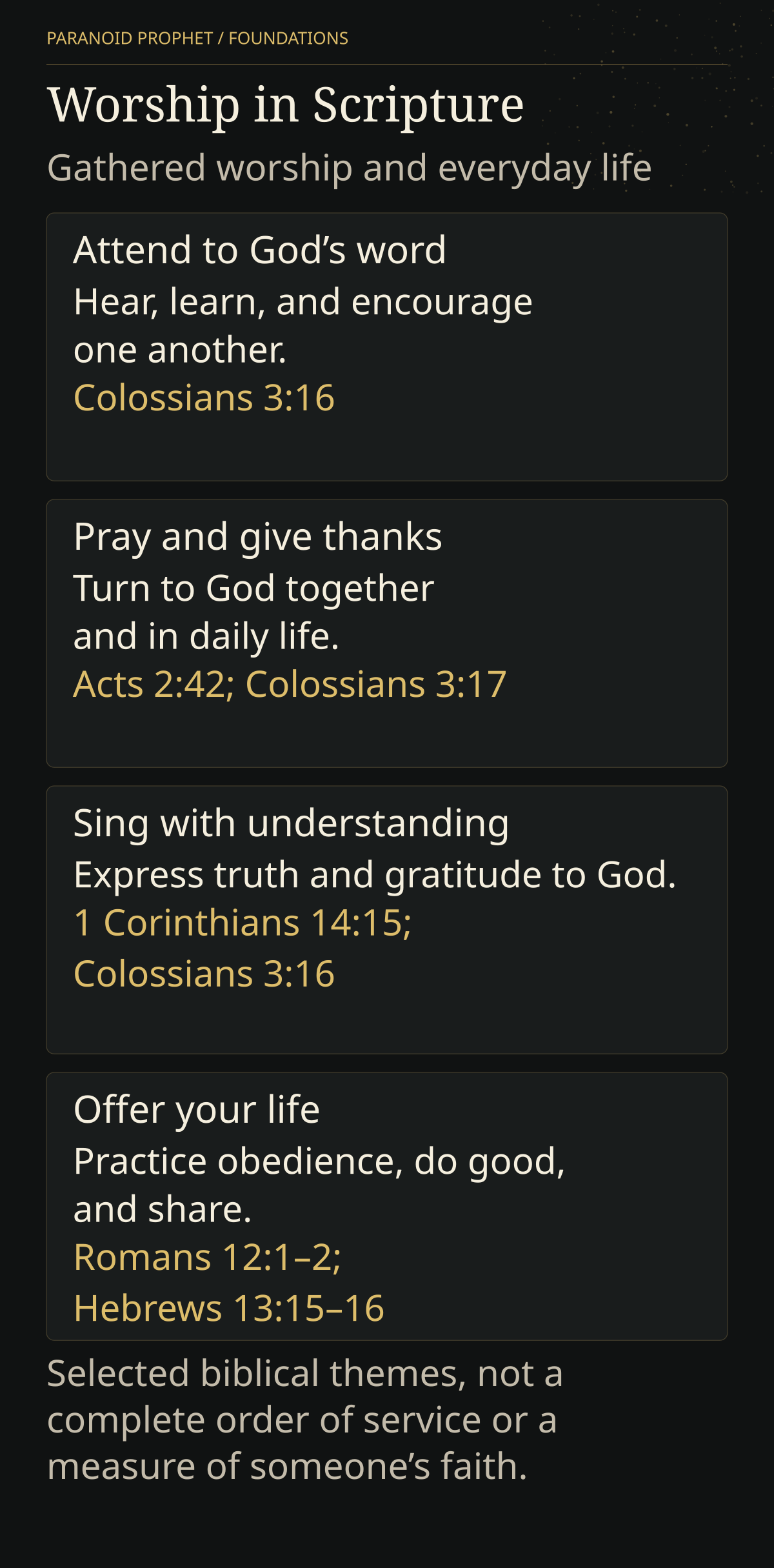
Worship in Scripture (image text)
Gathered worship and everyday life
- Attend to God’s word
Hear, learn, and encourage
one another.
Colossians 3:16 - Pray and give thanks
Turn to God together
and in daily life.
Acts 2:42; Colossians 3:17 - Sing with understanding
Express truth and gratitude to God.
1 Corinthians 14:15;
Colossians 3:16 - Offer your life
Practice obedience, do good,
and share.
Romans 12:1–2;
Hebrews 13:15–16
Selected biblical themes, not a complete order of service or a measure of someone’s faith.
PARANOID PROPHET / FOUNDATIONS
How Can Everyday Life Be Worship?
Romans 12:1–8 begins with God’s mercy and calls believers to offer their bodies to Him. Paul then describes renewed thinking, humility, membership in one body, and the use of different gifts. Worship involves actual people offering their actual lives.
That includes what we do with our attention, abilities, relationships, and resources. Telling the truth when a lie would help us, caring for a dependent, doing honest work, and serving without applause can express this allegiance. These examples apply Paul’s teaching; they are not a new list of religious achievements to earn acceptance.
Consider a person who leaves church and discovers that a neighbor needs a meal. Preparing food can be an act of service offered to God, even if nobody plays music or calls it a ministry. The neighbor’s hunger matters in its own right. We should not turn someone’s need into scenery for our spiritual image.
Hebrews 13:15–16 places praise, doing good, and sharing side by side as offerings pleasing to God through Jesus. The connection is direct: devotion has something to say about our words and our generosity.
Everyday worship does not mean that anything becomes good merely because we attach God’s name to it. Dishonesty, exploitation, and neglect remain wrong. Nor does it mean that every moment must feel deliberately religious. Ordinary faithfulness may be quiet, tiring, and largely unnoticed.
For the wider account of growth, see What Is Sanctification?. Growth can be real without being dramatic.

What If You Feel Little During Worship?
Joy, awe, tears, gratitude, and grief can all be genuine responses to God. Scripture makes room for human emotion. It also gives people words for days when they feel abandoned or cannot easily rejoice.
Psalm 13 moves through anguish and petition toward trust and praise. It does not tell the worshiper to pretend that sorrow was never there. Other psalms linger in darkness. Their presence in Scripture should make us cautious about treating cheerful expression as proof of spiritual health.
A powerful feeling does not by itself establish that a message is true. A flat or distracted feeling does not by itself establish that God has rejected you. Fatigue, grief, depression, sensory overload, unfamiliarity, and many other circumstances can affect attention and emotion.
Try a modest response: listen to one passage, pray honestly about what is difficult, or ask a trusted person to sit with you. If a pattern of distress persists, appropriate pastoral or professional help can be valuable. Receiving care is compatible with faith.
Worship leaders should not have to extract a particular reaction from everyone. Pressure to raise a hand, disclose something personal, give money, or demonstrate a spiritual experience can obscure the freedom to respond truthfully. For a fuller treatment of grief and faith, see Suffering and Christian Hope.
Why Do Christian Services Look Different?
Some churches follow a written liturgy. Others use a less formal order. Services may differ in music, posture, silence, preaching, sacraments, and expectations about spiritual gifts. Those differences can express serious convictions, cultural habits, or both.
A repeated prayer can be thoughtful and sincere. An unscripted prayer can be familiar and unexamined. The form alone does not reveal a person’s heart.
Christian traditions also disagree about which practices God authorizes in gathered worship. A few examples make that disagreement clearer:
- Catholic teaching presents liturgy as participation in Christ’s work and relates worship to proclamation and active charity. Its account of worship is not limited to music. See the Catechism, paragraphs 1066–1075.
- Orthodox teaching describes the Divine Liturgy as the church’s common action, involving prayer, Scripture, thanksgiving, and communion with Christ. Its Eucharistic understanding is central, rather than an optional addition to a concert. See the OCA explanation.
- Lutheran teaching in the Augsburg Confession recognizes ceremonies useful for good order while rejecting the idea that human traditions earn grace or must everywhere be identical. See Article XV and Article VII.
- Reformed teaching in the Westminster Confession emphasizes worship according to God’s revealed will and identifies practices including Scripture, prayer, singing, and sacraments. See chapter XXI.
These examples do not describe every congregation or resolve every disagreement. They do show why “traditional versus contemporary” is an inadequate account of the subject. If you are evaluating a church, ask what it believes its practices mean and why it follows them.
The separate Holy Spirit and Communion guides address some of the doctrinal questions behind those differences. Comparing sources carefully is more useful than dismissing an entire tradition by its appearance.
How Do We Discern Healthy Worship?
Begin with substance rather than production quality. Is God described faithfully? Is Scripture interpreted in context? Is Christ central? Are people encouraged to understand, repent, pray, give thanks, and love their neighbors?
Then examine how authority is exercised. Can a concern be raised without humiliation? Is an alleged revelation open to testing? Are vulnerable people protected? Are money and leadership handled responsibly? Attractive music and a moving atmosphere do not answer those questions.
Amos 5:21–24 confronts a people whose religious observance coexists with injustice. The passage condemns that contradiction; it is not a blanket condemnation of festivals or instruments. Its warning remains searching: religious activity does not excuse the mistreatment of people.
Avoid turning discernment into a demand for flawless people or your favorite style. Churches contain sinners learning to follow Christ. The concern is whether error and harm are faced honestly or protected by religious language. Forgiveness does not require remaining under abusive control. See Christian Forgiveness and Reconciliation for that distinction.
A Simple Way to Begin This Week
Read Colossians 3:12–17 slowly. Notice how the passage holds compassion, forgiveness, love, Christ’s message, singing, and gratitude together. Choose one response that fits a real responsibility in your life.
When you next gather with a church, listen carefully to a reading, prayer, or song. Afterward, talk with someone rather than evaluating the service only as an experience you consumed. During the week, make room for prayer and an ordinary act of service.
This is a starting point, not a spiritual scorecard. If you miss a day or struggle to concentrate, begin again. The point is to turn toward the God who has shown mercy, with the people He is teaching to love. Our prayer guide can help you take that next step.
Questions About Christian Worship
Can I worship at home?
Yes. Prayer, Scripture, praise, and faithful service belong in the home as well as the congregation. Christians who are ill, disabled, isolated, or caring for someone should not be treated as though inability to attend proves indifference. Where participation is possible, private devotion should enrich rather than replace the shared life described in Hebrews 10:24–25.
Is music necessary to worship God?
Many acts of worship involve no music. At the same time, Scripture repeatedly gives singing a place in the life of God’s people. Musical skill is not a requirement for approaching God, and inability to sing does not exclude someone from worship.
Does repetition make a prayer empty?
Repetition and empty speech are different questions. In Matthew 6:7–8, Jesus rejects a view of prayer that relies on many words to secure a hearing. A familiar prayer may be attentive and sincere; an original prayer may be distracted. Consider the words and your response rather than judging by novelty alone.
Sources and Translation Note
This article chiefly paraphrases Scripture; its Bible links open the New International Version for reading in context. The denominational summaries refer to each tradition’s own teaching and are selective comparisons, not claims that every Christian agrees about the order of worship.
Read the surrounding passages and ask what their authors are teaching before applying an isolated phrase. For a worked example of that approach, see How to Read the Bible in Context.