
The bread reaches your row, and a question you have never said aloud suddenly feels urgent. What am I receiving? Should I take it? Does the person beside me understand this meal the same way I do? Familiar church practices can carry unfamiliar questions, especially when you visit a different congregation.
Communion, also called the Lord’s Supper or Eucharist, is the church’s shared meal of bread and the cup, instituted by Jesus and centered on His self-giving death. Christians celebrate it in remembrance of Him, proclaim His death, and look toward His return. They disagree about how Christ is present, what receiving accomplishes, and who should participate. Those differences deserve honest explanation rather than a quick label that makes another church sound foolish.
GUIDED ARTICLE EXPERIENCE
What Is Communion? The Lord’s Supper and Why Christians Differ
Read along as the narration moves through the article.
Browser narration · No stored audio or site tracking
CONTINUE GUIDED TOUR
Continue where you left off.
GUIDED TOUR COMPLETE
You have reached the end of this study.
Study record saved on this device.
GUIDED TOUR
What Is Communion? The Lord’s Supper and Why Christians Differ
Narrator: Paranoid Prophet Recommended Voice Native device narration
Prepare to follow the article as it is narrated.
VOICE & TOUR OPTIONS
Voice & Listening
NARRATOR
Finding a narrator…
Checking the best narrator available on this device.
Restores the site recommendations available in this browser.
Our listening picks lead when available; other voices are ranked for narration. Known novelty voices are hidden. Browser-provided voices may use an online voice service.
Screen-awake support will be checked when narration starts.
Optional: improve your device voices
Listening works with the voices already available here. Your device may offer additional free voices through its own settings.
iPhone or iPad: Settings → Accessibility → Read & Speak (or Spoken Content) → Voices → English. Look for Premium or Enhanced choices, then return here.
If offered, preview Ava or Zoe for U.S. English, or Serena or Jamie for British English. An explicit Premium or Enhanced version can improve on its compact version.
Mac: System Settings → Accessibility → Read & Speak → System voice. Open the voice list to preview or download additional choices.
Windows: Settings → Accessibility → Narrator → Add natural voices. Browser availability varies; a Narrator voice may not appear on websites. Edge may also expose online Natural voices without a model download.
Android: Open Accessibility → Text-to-speech output (the location varies by device). In the preferred engine settings, look for voice data and English choices.
Download sizes vary; some enhanced voices exceed 100 MB. This website cannot install system voices, and an installed voice appears here only if your browser exposes it.
Apple voice guide · Windows voice guide · Android voice guide
CHOOSE A NARRATOR
Recommended on this device
Our listening picks: Aaron, Martha, then Daniel, when available here. Otherwise, automatic uses the highest-ranked suitable voice. Preview alternatives or save your own choice.
Preparing the guided article experience…
RESUME GUIDED TOUR?
Continue where you left off.
GUIDED TOUR COMPLETE
You have reached the end of this study.
If you are attending a service soon, start with practical guidance for receiving. If Paul’s warning troubles you, go to self-examination and an unworthy manner. For the main differences between churches, see five Christian understandings.
Article Guide10 sections
What Should I Do When Communion Is Offered?
Before receiving in an unfamiliar congregation, ask a pastor or minister who is invited and how the church understands the meal. A brief conversation beforehand is usually easier than trying to work it out while everyone is moving toward the front.
Some churches invite baptized Christians who trust Christ and are seeking to follow Him. Others require membership, a shared confession, or preparation within that church. Catholics, Orthodox Christians, and many confessional Protestants have specific admission practices. Even churches using the same denominational label may differ in how they communicate or administer them.
You do not need to pretend agreement or participate because someone might notice you remaining seated. Listen, observe respectfully, and ask questions. A church’s boundaries at the table should be explained truthfully and without contempt for visitors.
If you have a food allergy, celiac disease, a concern about alcohol, or difficulty swallowing, speak privately with the minister beforehand. Available accommodations and what a church considers permissible vary. Do not put your health at risk or assume that an unfamiliar substitute is safe. These practical questions deserve care rather than embarrassment.
If you have not been baptized, ask how the congregation connects baptism and Communion. Our guide to baptism explains why that connection matters and why churches differ. The table also belongs within the continuing life of a congregation, explored in What Is the Church?.
Why Did Jesus Give His Disciples This Meal?
Luke 22:14–20 places the meal in the setting of Passover and Jesus’ approaching suffering. He gives bread and the cup to His disciples and connects them with His body, His blood, and the new covenant. He directs them to remember Him.
That setting gives the meal a particular center. Jesus speaks about what He is giving for His people. The meaning does not begin with the skill of the minister, the beauty of the building, or the strength of the worshipper’s emotions.
The new covenant language also places His death within God’s work of restoring a people to Himself. Communion therefore sends us back to the substance of the gospel. If we detach the meal from the crucified and risen Jesus, we lose the very person who gave it meaning.
The names highlight different aspects. The Lord’s Supper identifies whose meal it is. Communion emphasizes participation and fellowship. Eucharist comes from the language of thanksgiving. These names overlap; they do not, by themselves, tell you everything a particular church believes.
What Does Communion Mean in Scripture?
Remembering the Lord who gave Himself
Christian remembrance directs attention to Jesus and His saving work. It calls a congregation to receive His instruction and respond with gratitude and allegiance as a shared practice rather than treating the cross as a distant fact.
The word remembrance does not settle the whole dispute about Christ’s presence. Catholic, Orthodox, Lutheran, Reformed, and Baptist Christians all speak of remembering Jesus, while understanding the action differently. We should examine the rest of their teaching before assuming that a shared word means a shared doctrine.
Proclaiming His death and expecting His return
Paul connects the repeated meal with announcing the Lord’s death and awaiting His coming in 1 Corinthians 11:23–26. The bread and cup give the congregation a recurring way to confess where its hope rests.
The movement toward Christ’s return matters. Communion remembers suffering while looking beyond it. Christian hope includes a future with the Lord, not an endless cycle of fear about whether this week’s performance was adequate.
Sharing in Christ and belonging to one another
In 1 Corinthians 10:14–22, Paul describes participation in Christ’s body and blood and connects the shared loaf with the unity of His people. His immediate concern is also allegiance: Christians cannot treat the Lord’s table and participation in idolatrous worship as interchangeable.
This passage resists an entirely private understanding of Communion. The people beside us matter. A person cannot plausibly celebrate belonging to Christ’s people while considering their hunger, humiliation, or loneliness beneath notice. Unity asks something of us after the service ends.
The nature of participation remains one of the central questions in Christian interpretation. Calling it spiritual does not automatically mean imaginary, and calling it real does not tell us which account of Christ’s presence is intended.

What Does It Mean to Take Communion in an Unworthy Manner?
Paul’s warning is serious. It also has a setting that we must not skip. Read 1 Corinthians 11:17–34 from the beginning of the argument rather than starting with its most frightening sentence.
At Corinth, the gathering displayed divisions. Some were well supplied while others went hungry, and people with little were humiliated. The church’s conduct contradicted the meal it claimed to celebrate. Paul recalls Jesus’ self-giving and then calls the participants to examine themselves.
The problem therefore includes how the church treats its members. A private moment of solemnity cannot excuse public indifference to people being mistreated. A wealthy donor does not receive a more important place at Christ’s table than someone who needs help paying for groceries.
Paul’s language concerns receiving in an unworthy manner. He is not commanding people to establish that they have become sinless before approaching. Yet the warning is not reduced to good table manners either. Churches understand discerning the body in relation to Christ’s sacramental body, the congregation as His body, or both. The immediate context keeps reverence toward Christ and responsibility toward His people together.
Paul also describes judgment experienced in Corinth, then distinguishes the Lord’s discipline from condemnation with the world. This does not authorize us to diagnose another person’s illness as punishment for receiving Communion. We do not possess Paul’s knowledge of every person’s circumstances, and such accusations can inflict real harm.
A useful preparation is concrete: acknowledge known wrongdoing, seek help where needed, and consider whether you are refusing to treat someone with honesty or mercy. If you have harmed another person, repentance may involve restitution and accepting consequences. It does not entitle you to renewed contact with someone who needs distance. Our Repentance and Faith guide explores that responsibility more fully.
If self-examination becomes hours of compulsive checking, repeated reassurance seeking, or fear that an unwanted thought makes you unfit, ask a trusted pastor for help and consider support from a qualified mental-health professional. This article cannot pronounce your individual eligibility. It can remind you that an anxious feeling and a deliberate refusal to repent are different matters. See also assurance and doubt.
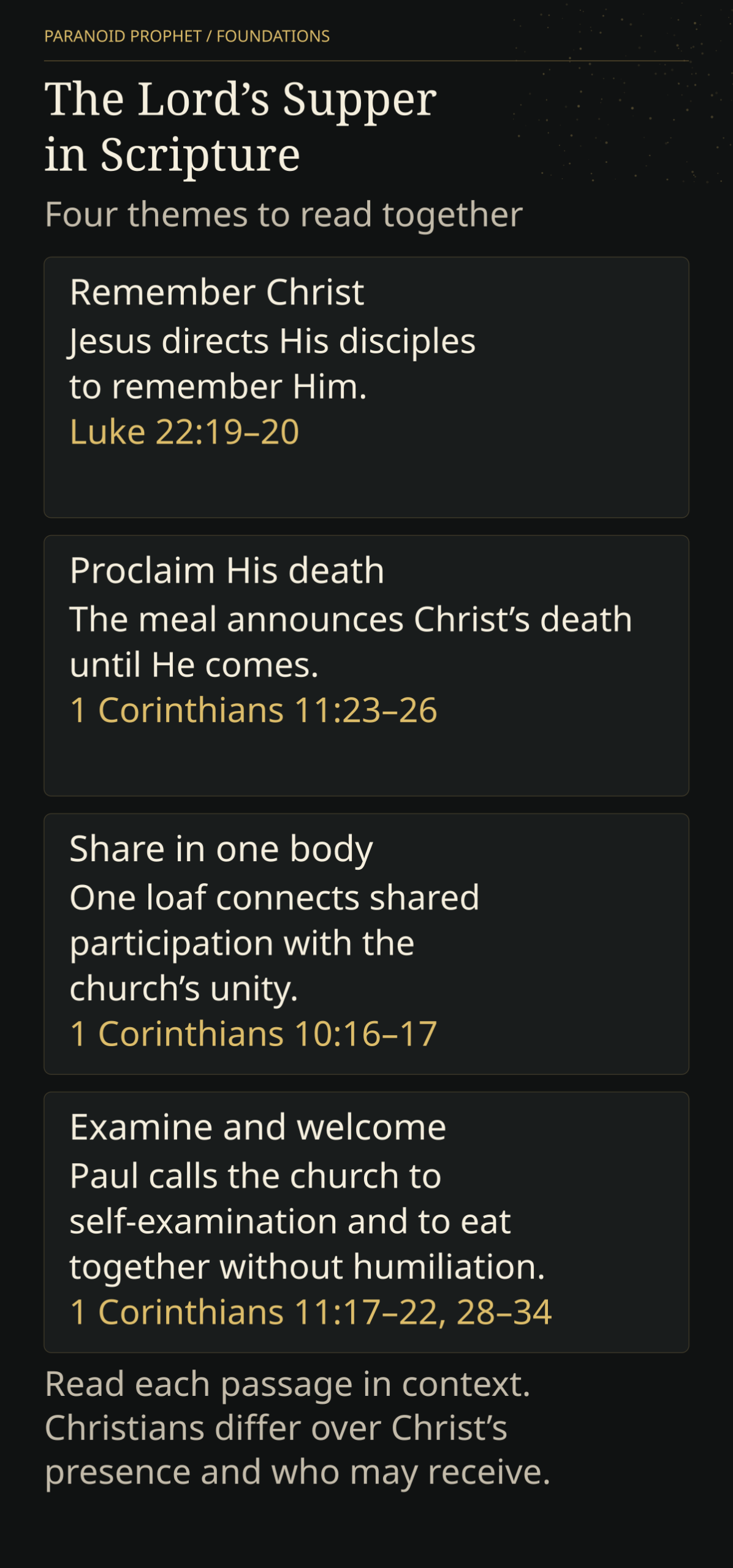
The Lord’s Supper in Scripture (image text)
Four themes to read together
- Remember Christ
Jesus directs His disciples
to remember Him.
Luke 22:19–20 - Proclaim His death
The meal announces Christ’s death
until He comes.
1 Corinthians 11:23–26 - Share in one body
One loaf connects shared
participation with the
church’s unity.
1 Corinthians 10:16–17 - Examine and welcome
Paul calls the church to
self-examination and to eat
together without humiliation.
1 Corinthians 11:17–22, 28–34
Read each passage in context. Christians differ over Christ’s presence and who may receive.
PARANOID PROPHET / FOUNDATIONS
How Do Christian Traditions Understand Christ’s Presence?
The following summaries introduce significant positions. They are not an exhaustive map of Christianity, and some congregations within a broad tradition express their teaching differently. This guide follows Paranoid Prophet’s Scripture-first approach while allowing each tradition to describe its own claims.
Catholic: Christ substantially present in the Eucharist
Catholic teaching holds that the whole substance of bread and wine is changed into Christ’s body and blood, while the appearances of bread and wine remain. It calls this change transubstantiation. The Eucharist is understood as Christ truly present and as the sacramental making-present of His one sacrifice, not another crucifixion added to an insufficient cross. Protestants may reject that explanation while still describing it accurately. See the Catechism, paragraphs 1362–1367 and 1374–1377.
Catholic preparation also includes specific teaching about confession when conscious of grave sin. The Catechism’s account of the Paschal banquet explains this within its sacramental understanding.
Orthodox: genuine communion with Christ in the holy mystery
The Orthodox Church in America describes the Eucharist as Christ’s true body and blood, consecrated through the Holy Spirit, and central to the church’s life. It rejects reducing the meal to an intellectual reminder. Its use of words such as mystery and symbol does not mean that Christ’s presence is unreal. The OCA account also explains that baptized and chrismated infants receive Communion. Read its teaching on the Holy Eucharist.
A visitor to an Orthodox service should ask the priest about preparation and reception rather than assuming that attendance at the liturgy makes every visitor eligible.
Lutheran: Christ’s body and blood truly given with the meal
The Augsburg Confession, Article X affirms Christ’s body and blood as truly present and distributed to those who receive the Supper. Luther’s Small Catechism connects the gift with Christ’s promise of forgiveness and stresses trusting His words. This is a sacramental Protestant position; it should not be grouped under a purely memorial account simply because it is Protestant.
A short label such as consubstantiation can obscure more than it explains. Reading the Lutheran confessions’ own language is a better starting point.
Reformed: real spiritual nourishment through faith
The Westminster Confession, chapter 29 teaches that the outward elements remain bread and wine, while believers truly receive and feed on Christ spiritually through faith. It rejects both transubstantiation and the Supper as an offering of Christ for the forgiveness of sins. Its account includes remembrance, assurance of Christ’s benefits, spiritual nourishment, and communion among believers.
That is more than a claim that worshippers merely think about an absent person. The disagreement concerns the mode of participation and the relation between the outward signs and what believers receive.
Baptist: obedient remembrance and expectation
The Baptist Faith and Message, Article VII describes the Lord’s Supper as a symbolic act of obedience that remembers the Redeemer’s death and anticipates His return. It connects participation with the church and places baptism before the Supper. This represents Southern Baptist confessional teaching, not every Baptist congregation’s exact admission practice.
A memorial emphasis need not make Communion casual or optional. A church can understand the elements symbolically while treating obedience, repentance, gratitude, and care for the congregation as serious responsibilities.
These positions cannot be made identical by saying that everyone believes the same thing in different words. They disagree about the elements, Christ’s presence, sacramental efficacy, and church authority. Patient comparison should identify those differences without inventing motives or accusing another believer of a position they reject.
Does John 6 Settle the Communion Debate?
In John 6, Jesus speaks of Himself as the bread of life, of coming to Him and believing, and of eating His flesh and drinking His blood. Readers should hold that discourse together rather than isolating one phrase from its repeated concern with life through Him.
Catholic and Orthodox interpretations commonly connect this language closely with the Eucharist. Many Protestants emphasize receiving Christ through faith; some also see sacramental significance, while others distinguish the discourse from the later institution of the Supper. The OCA teaching linked above explicitly draws on this chapter.
John 6 contributes to the discussion, but repeating a line without explaining its context does not resolve why Christians interpret it differently. Compare the discourse with the institution accounts and Paul’s instructions, and ask what each interpretation does with all the passages.
Does Communion Repeat Jesus’ Sacrifice?
Hebrews 10:1–18 stresses the sufficiency of Christ’s offering in contrast with repeatedly offered sacrifices. Our hope cannot rest on a chain of new crucifixions or a payment we make to complete His work.
The disagreement is more precise than that caricature. Catholic teaching describes the Eucharist as the sacramental making-present of the same sacrifice. Reformed teaching rejects offering Christ in the Supper and understands it as commemoration and spiritual reception. These are substantive differences, even though both appeal to the unique saving work of Jesus.
If the deeper question is whether a religious action earns God’s acceptance, begin with Salvation by Grace. A comparison of sacramental accounts should never become advice to purchase forgiveness or ignore Christ while trusting a ritual record.
Common Practical Questions
How often should a church celebrate Communion?
Acts 2:42–47 places breaking bread within the church’s shared life. Acts 20:7 describes a first-day gathering to break bread. Paul assumes repeated observance but does not supply a universal numerical interval in 1 Corinthians 11. Churches differ in how they apply these passages and their received practices. Ask why your congregation follows its pattern rather than assuming frequency alone proves seriousness.
Why do some churches use wine and others grape juice?
Churches make different judgments about fidelity to the institution, received tradition, pastoral care, and alcohol. The expression fruit of the vine appears in the institution narratives; it does not by itself settle every later argument about permitted elements. A full treatment also requires historical and confessional evidence. If alcohol is a concern, ask privately what the congregation provides before receiving.
Can I take Communion by myself at home?
The New Testament presents the Supper as a shared church practice. Traditions differ about home administration, online services, and who may preside. Being homebound does not mean being forgotten by the church. Ask a pastor about a visit or another practice consistent with the congregation’s teaching instead of assuming you must improvise alone.
What if I do not feel anything special?
A strong emotional response is not a reliable measure of whether you understood or received faithfully. Attend to Christ’s promise, the congregation’s teaching, and your own honest response. Bring persistent confusion to a patient minister. Communion should lead into a life of gratitude, faith, and love for others, including the ordinary hours when nothing feels dramatic.
Remember Christ and Care for His People
At the table, Christians are directed toward Jesus’ self-giving and the hope of His return. That remembrance belongs alongside truthful teaching, repentance, and concern for the people sharing the congregation’s life.
Keep reading the passages, ask your church to explain its practice, and resist the temptation to turn disagreement into contempt. The person who needs patience may be the newcomer beside you. The person who needs practical help may leave quietly before anyone notices. Learning what Communion means should deepen our attention to Christ and to them.
Sources and Translation Note
Scripture summaries here are paraphrases; reader links open the NIV. The discussion of 1 Corinthians 11 was also checked against the public-domain World English Bible. Denominational summaries link to the relevant confessional or teaching texts rather than assuming that every Christian uses the same terms in the same way. For the broader standard behind these studies, see Sources and Verification.